
The biggest myth IMGs believe about the H‑1B is that once you’re sponsored, you’re stuck. You’re not. You can switch employers on H‑1B as a physician — but only if you follow some very specific rules, and you can absolutely wreck your status if you get casual about them.
Here’s the answer you’re looking for: changing employers on H‑1B is possible, common, and legally allowed. But timing, paperwork, and your training timeline matter more than you think.
The Core Rule: H‑1B Is Employer‑Specific, Not Person‑Specific
An H‑1B is not a “general work visa” for you as a doctor. It’s permission to work:
- For one specific employer
- In one specific job
- At specific work locations
- For specific dates
If you change any of those in a meaningful way (especially the employer), you normally need a new H‑1B petition. This is often called H‑1B transfer, but that term is misleading.
There is no actual “transfer” of your H‑1B from Employer A to Employer B. What happens is:
- Employer B files a new H‑1B petition on your behalf (with its own LCA, fees, etc.)
- That petition asks USCIS to:
- Use the same H‑1B cap you were already counted under (so no lottery again if you were previously counted), and
- Extend or modify your status so you can work for Employer B
If it’s approved, you now have H‑1B authorization tied to Employer B. Your old approval for Employer A doesn’t magically go away, but once you stop working there, that relationship is over for practical purposes.
So can you switch employers? Yes. But only through a properly filed new H‑1B petition by the new employer.
The Safest Way to Switch: The “Transfer” Timeline That Works
Let’s walk the practical sequence, because this is where IMGs usually mess up.
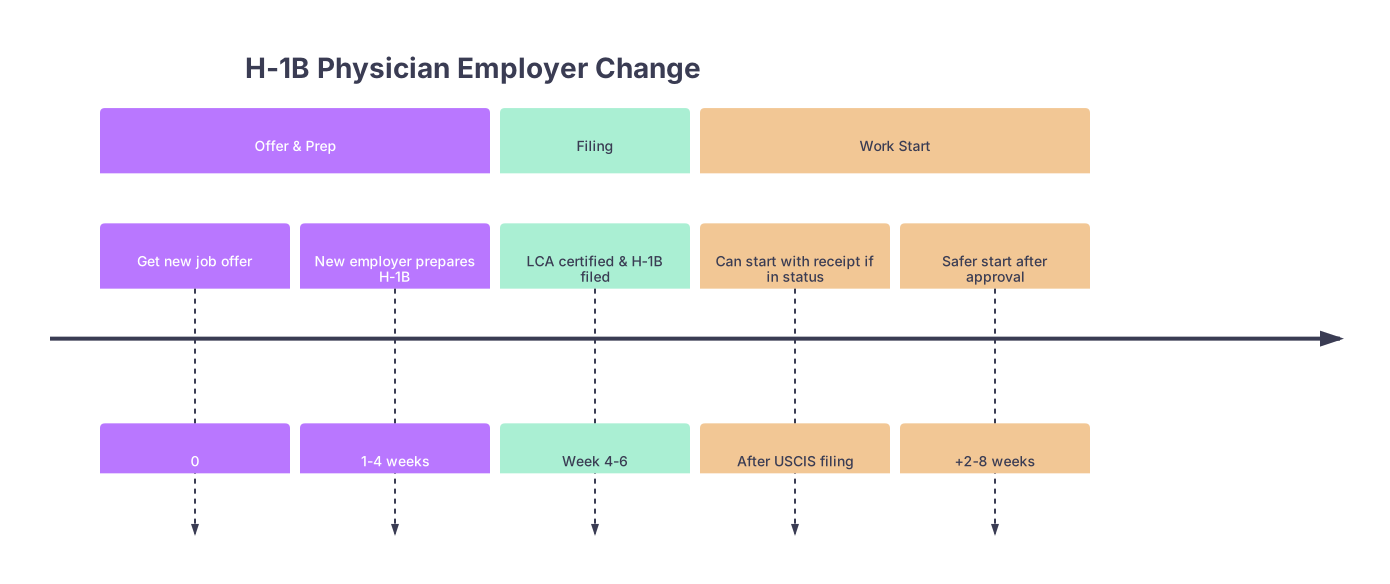
| Period | Event |
|---|---|
| Offer & Prep - Get new job offer | 0 |
| Offer & Prep - New employer prepares H-1B | 1-4 weeks |
| Filing - LCA certified & H-1B filed | Week 4-6 |
| Work Start - Can start with receipt if in status | After USCIS filing |
| Work Start - Safer start after approval | +2-8 weeks |
Basic rule set
If you’re already in H‑1B status in the U.S., you generally have two options:
Conservative approach (safest):
- New employer files H‑1B
- You keep working for current employer
- You move only after approval of the new petition with change of employer
Portability approach (more risk, but legal):
- New employer files H‑1B while you’re still in valid H‑1B status
- Once USCIS issues a receipt notice, you can start work for Employer B while the petition is pending (H‑1B portability)
- If USCIS later denies it, your authorization to work for B is gone immediately, and you may be out of status unless you still have a valid job/petition with Employer A
You’ll see people brag about “I switched on the receipt, no problem.” That doesn’t mean it was risk‑free. I’ve seen a denial of the new petition because of a weak job description, and the physician had already resigned from the first program. He had to scramble for a change to B‑1/B‑2 just to avoid accruing unlawful presence.
My blunt advice:
- If you can, wait for approval before you resign from your current H‑1B position.
- If timing forces portability, have a backup plan and a serious immigration lawyer.
Special Situations for Physicians: Training vs. Attending Jobs
H‑1B for physicians isn’t all the same. Where you are in the training pipeline changes the rules.
1. Switching employers during residency or fellowship
This is the worst time to “experiment” with H‑1B moves.
H‑1B residency/fellowship positions are usually:
- Cap‑exempt (university or nonprofit hospital connected to a university)
- Very specific to program, PGY level, and specialty
- Time‑limited to the exact training length
If you want to change training programs on H‑1B:
- The new program must be willing and able to sponsor H‑1B
- They must file a new H‑1B petition (cap‑exempt again if they qualify)
- The position must match your qualifications and training pathway
Common pitfalls:
- Mid‑year transfers are extremely messy
- GME offices move slowly and may refuse to take over an H‑1B mid‑cycle
- Any gap between one H‑1B and the next can drop you out of status
Realistically, if you’re still in training and thinking about changing hospitals, you need both GME offices and an immigration attorney on board before you move a muscle.
2. Moving from residency/fellowship to first attending job
This is where most IMG physicians switch employers on H‑1B.
Good news:
- If you were already counted against the cap at some point (for example, you had a cap‑subject H‑1B as a researcher/physician before residency), you can reuse that cap and go straight to a cap‑subject job without lottery.
- If you’ve only ever had cap‑exempt H‑1Bs (typical academic residency/fellowship), moving to a private practice or for‑profit hospital usually means you do need to go through the H‑1B cap lottery unless the position itself is cap‑exempt.
So you have two big questions:
- Was I ever counted in the H‑1B cap before?
- Is my new employer cap‑exempt or cap‑subject?

Here’s a quick comparison of typical scenarios.
| Scenario | Old Employer | New Employer | Cap Issue? |
|---|---|---|---|
| Residency → University Hospital Faculty | Cap-exempt | Cap-exempt | No new cap |
| Residency → Private Practice | Cap-exempt | Cap-subject | Need lottery (usually) |
| Research job (cap-subject) → Hospital Faculty | Cap-subject | Cap-exempt | No new cap, cap-exempt filing |
| Private Practice A → Private Practice B | Cap-subject | Cap-subject | No new lottery, but new petition |
If you’re in PGY‑2 or PGY‑3 and already thinking about your first attending job: you’re not paranoid. Planning the H‑1B strategy early is smart.
Critical Legal Requirements When You Change Employers
Let me walk you through the non‑negotiables.
1. Valid status at the time of filing
The new H‑1B petition should be filed while you’re still in valid H‑1B status with Employer A.
If:
- Your current H‑1B is expired, or
- You’ve already stopped working and your 60‑day grace period has passed
…then you have a problem. You may be looking at consular processing and leaving the U.S. for a visa stamp.
2. Proper LCA and job details
The new employer must:
- Get a certified Labor Condition Application (LCA)
- Offer at least the Required wage (prevailing or actual wage)
- Clearly define your job duties, locations, and schedule
If they cut corners on any of that, they’re not doing you a favor. They’re putting your status at risk.
3. Work only for who’s on the petition (with limited, structured exceptions)
You can’t moonlight or pick up shifts at Hospital B if your H‑1B is for Hospital A only, unless:
- You have a concurrent H‑1B filed by Employer B, or
- The work is explicitly covered as a secondary worksite on your existing petition
A lot of IMGs get casual about “just covering some shifts.” USCIS and DOL don’t find it cute. Unauthorized employment is a quick way to complicate every future benefit you’ll apply for.
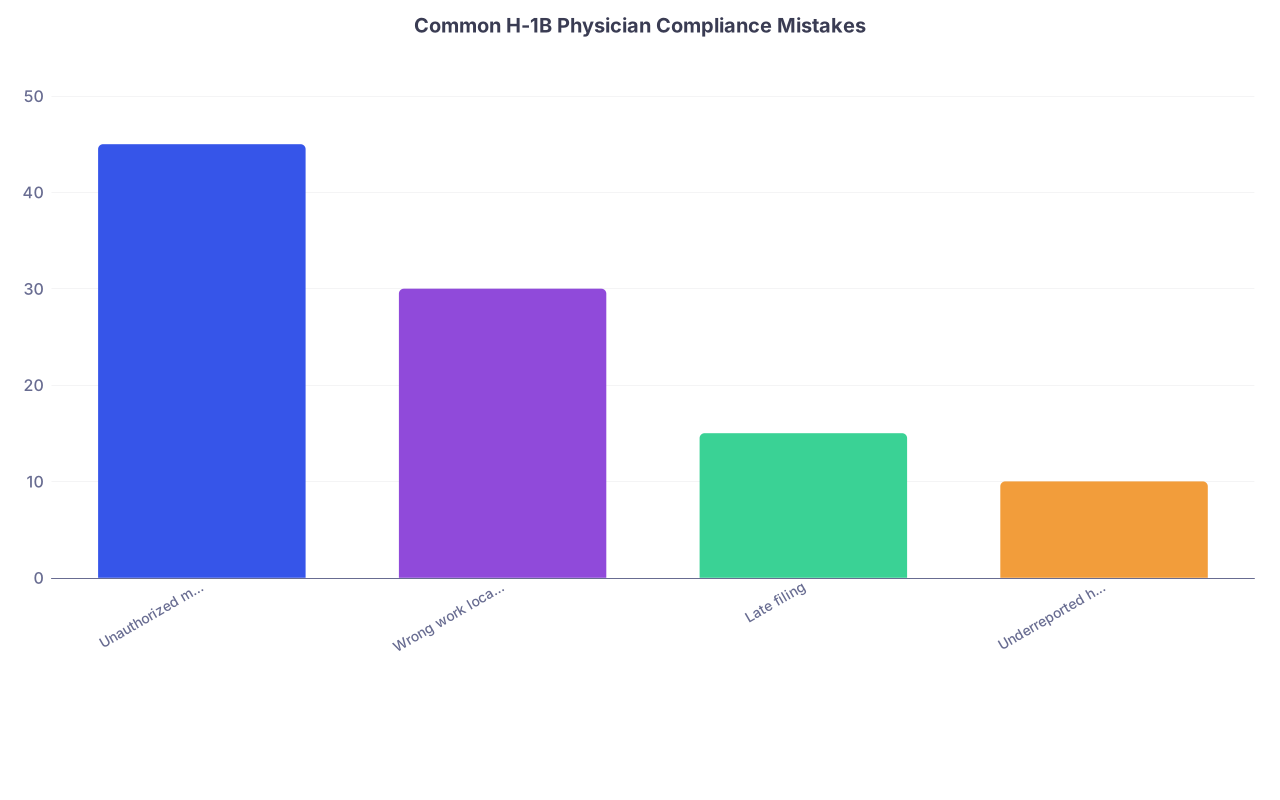
| Category | Value |
|---|---|
| Unauthorized moonlighting | 45 |
| Wrong work location | 30 |
| Late filing | 15 |
| Underreported hours | 10 |
How the 60‑Day Grace Period Actually Works
If you lose your H‑1B job (non‑renewal, program termination, group closure), in many cases you get up to 60 days grace period in the U.S., or until your I‑94 expiration, whichever comes first.
During that time, you can:
- Have a new employer file a new H‑1B petition
- File a change of status (e.g., to B‑1/B‑2 while you regroup)
- Prepare to leave the U.S.
This grace period isn’t a free extra work period. You cannot legally work unless and until:
- A new H‑1B petition is filed and you’re authorized under portability, or
- That petition is approved (if you’re waiting to start until then)
FAQ‑level point: if your I‑94 ends in 30 days, you don’t magically get 60 days. You get 30.
Common IMG Physician Scenarios (And What You Can Usually Do)
Let’s run through typical questions I hear from IMGs.
Scenario 1: “I matched on H‑1B at Hospital A. Can I switch to Hospital B for PGY‑2?”
Technically: yes, with a new cap‑exempt H‑1B from Hospital B.
Practically: often hard.
Problems:
- Hospital B must be willing to take an in‑transfer and file its own petition
- Timing must align with academic year
- You can’t have a gap in authorization between A and B
You need legal and GME coordination here. Do not resign from A until B’s H‑1B is approved.
Scenario 2: “I finished fellowship on H‑1B and have an offer with a private group in town. Can I just switch?”
Key questions:
- Were you ever counted in the cap before?
- Is this group cap‑subject? (Almost always yes.)
If you’ve only ever been on cap‑exempt H‑1Bs and the new job is cap‑subject, then you’re usually stuck waiting for an H‑1B lottery unless:
- The private employer structures a cap‑exempt relationship (e.g., joint appointment with a university/hospital that qualifies), or
- You move to a J‑1 waiver job on H‑1B with a cap‑exempt employer
This is where smart programming and contract structuring can save your career path.

Scenario 3: “I’m on H‑1B at a community hospital and got a better offer from another community group. Can I move easily?”
If both employers are cap‑subject, and you were already counted in the cap, then yes:
- New employer files change of employer H‑1B
- No new lottery
- You can use portability to start after receipt, or wait for approval
This is the most straightforward “H‑1B transfer” for physicians.
Documentation You Should Keep Before and After a Switch
If you’re going to change employers on H‑1B, you want your paperwork tight. Not just for immigration now, but for future green card filings.
At minimum, save:
- All I‑797 approval notices (old and new)
- Every I‑94 (print from CBP website if needed)
- All LCA postings and job offer letters
- Pay stubs showing continuous employment during your H‑1B periods
- Any moonlighting approvals and concurrent H‑1B documents
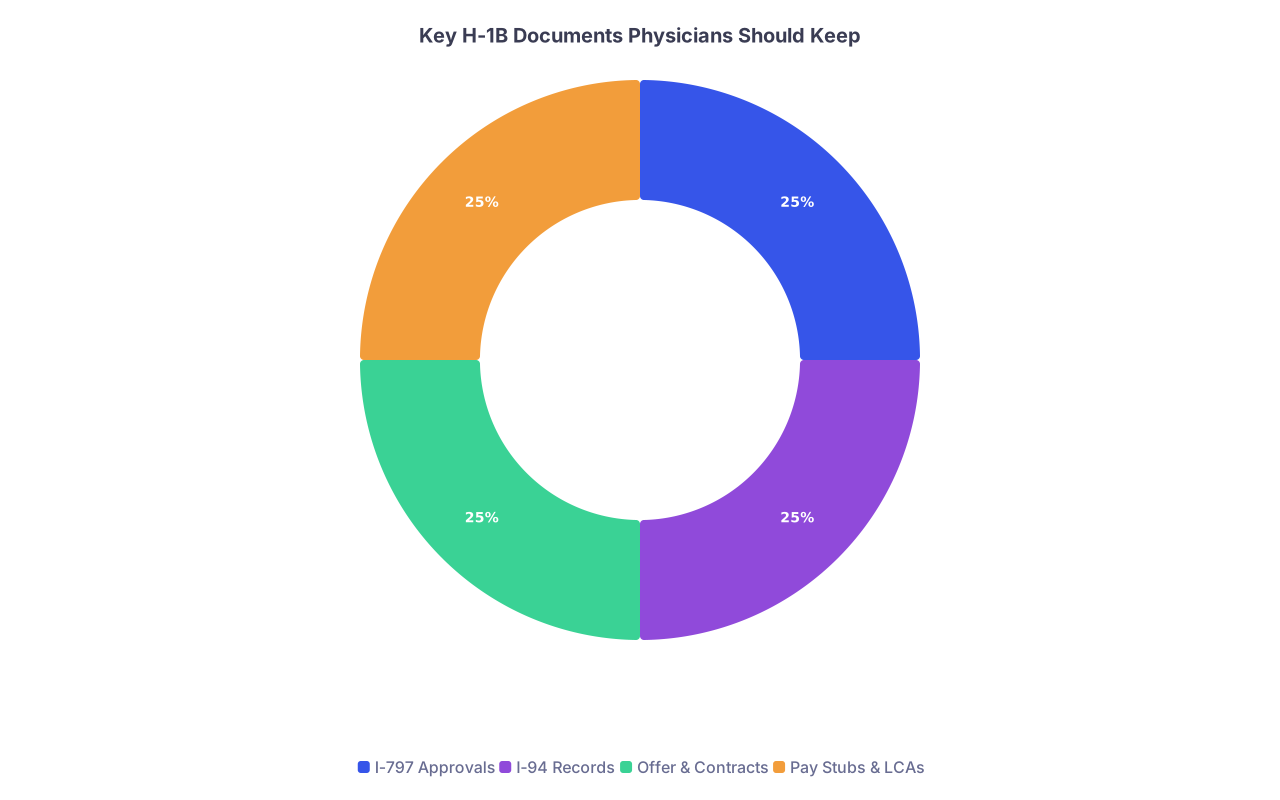
| Category | Value |
|---|---|
| I-797 Approvals | 25 |
| I-94 Records | 25 |
| Offer & Contracts | 25 |
| Pay Stubs & LCAs | 25 |
You’ll thank yourself when you’re filing I‑140 and I‑485 and USCIS suddenly wants proof of every job you’ve held in the U.S.
When You Must Talk to a Lawyer (Not Optional)
There are cases where “just following a blog post” is reckless. You need a real immigration attorney if:
- You have any prior status violations or periods of unemployment longer than 60 days
- You’re moving from a cap‑exempt to a cap‑subject job
- You’re on J‑1 now and planning a J‑1 waiver → H‑1B route
- You’re changing specialty mid‑training
- You’re timing this switch around a green card strategy (PERM vs NIW vs EB‑1)
And you should make sure the employer’s lawyer actually does physician immigration regularly. H‑1B for software engineers is not the same beast as H‑1B for IMGs with training timelines, waiver requirements, and academic titles.

Quick Decision Framework: Can You Switch H‑1B Employers?
Use this as a mental checklist:
- Am I currently in valid H‑1B status?
- If no → need lawyer, likely consular processing or change of status.
- Is my new employer cap‑exempt or cap‑subject?
- Cap‑subject + I was never counted → likely need lottery.
- Is there going to be any gap between old and new jobs?
- If yes → plan around 60‑day grace period and timing of filings.
- Do I need to moonlight or work at multiple sites?
- If yes → ask about concurrent H‑1B or multiple worksite coverage.
- Does this move align with my long‑term green card plan?
- If no idea → stop and get a consult. Switching randomly can delay your PR years.

| Step | Description |
|---|---|
| Step 1 | Current H-1B Job |
| Step 2 | Consult attorney, consider COS/consular |
| Step 3 | File cap-exempt H-1B, change employer |
| Step 4 | Need H-1B lottery or alternative status |
| Step 5 | File cap-subject H-1B, no new lottery |
| Step 6 | Start after receipt or approval |
| Step 7 | In valid status? |
| Step 8 | New employer cap-exempt? |
| Step 9 | Ever counted in cap? |
FAQ: Can I Switch Employers on H‑1B as a Physician?
1. Can I switch H‑1B employers while my new petition is still pending?
Yes, under H‑1B portability rules, if the new petition was filed while you were in valid H‑1B status. You can start with the new employer once USCIS issues a receipt. But if the petition is later denied, you lose work authorization with that employer immediately and may fall out of status. Starting after approval is safer if you can afford the wait.
2. Do I have to go through the H‑1B lottery again when I switch employers?
Usually not, if you were already counted against the cap before and are just moving between cap‑subject employers. But if you’re going from a purely cap‑exempt H‑1B (e.g., university hospital) to a cap‑subject employer (e.g., private practice) and you’ve never had a cap‑subject H‑1B, then yes — you likely need to win the lottery or structure a cap‑exempt position.
3. Can I work for two hospitals at the same time on H‑1B?
Yes, but only if each has its own H‑1B petition (concurrent H‑1Bs) or if the additional worksite is clearly included in a single employer’s petition. You cannot just “pick up extra shifts” at a second hospital that isn’t on your H‑1B. That’s unauthorized employment.
4. What happens to my H‑1B if I’m fired or my contract is not renewed?
In many cases you get up to a 60‑day grace period (or until your I‑94 expires, whichever is earlier). During this time you cannot work unless a new H‑1B is filed for you, but you can stay in the U.S. legally while arranging a new job, changing status, or preparing to leave. If no new petition or change of status is filed within that window, you start accruing unlawful presence.
5. I’m on H‑1B in residency and thinking of switching to another specialty/program. Is that allowed?
It can be, but it’s complex. The new program must sponsor its own H‑1B, and the change must still make sense given your education and training history. Mid‑residency specialty changes are immigration‑sensitive and can raise red flags if they look like you’re bouncing without a coherent training path. This is one of those situations where you should involve both GME and a qualified immigration lawyer early.
Key takeaways: You can switch employers on H‑1B as a physician, but you never do it “informally” — every move needs a new petition. Your cap history and whether the old and new jobs are cap‑exempt or cap‑subject will decide how easy this is. And if you care about your long‑term green card plan, you plan your H‑1B switches strategically, not impulsively.