

The biggest reason strong IMGs get silently screened out is not their scores. It is the way they write about visas in their personal statement.
If you are an IMG, you cannot afford to get this wrong.
Program directors are not just reading your story. They are scanning for risk. Visa risk. Sponsorship risk. Delay risk. “Will this applicant become a paperwork nightmare in March?” If your personal statement triggers that anxiety, you are done before anyone gets to your strengths.
Let me walk you through the visa-related personal statement mistakes that repeatedly scare off program directors – and how to avoid looking like a problem before you ever walk in the door.
1. Treating Your Personal Statement Like a Visa Request Letter
This is the worst one. I see it every cycle.
IMG writes:
“I am seeking a J‑1 visa for internal medicine residency. I hope your program can sponsor me and my family…”
Or:
“Because I need H‑1B sponsorship, I am especially interested in programs that can provide this visa…”
This is where many programs stop reading.
Why this is a red flag:
- It makes you look visa-first, training-second.
- It suggests you do not understand the primary purpose of the personal statement.
- It signals future difficulty: if you center your needs now, what will it be like working with you on call schedules, weekends, rotations?
Your personal statement is not:
- A visa inquiry
- An immigration negotiation
- A place to list J‑1 vs H‑1B preferences
Your personal statement is:
- A professional narrative
- An explanation of your path, interests, and fit for the specialty
- Evidence that you understand U.S. clinical training
Visa details belong in:
- ERAS application fields
- Program filters (they already know if they sponsor or not)
- Possibly a brief, factual clarification line in one very specific situation (more on that later)
The safe rule:
If your statement reads like it could be forwarded to an immigration attorney, you have gone off the rails.
2. Sounding Desperate or Entitled About Sponsorship
You might not realize how your wording sounds to a program director who has seen hundreds of applications.
Problem phrases that program directors hate:
- “I expect your program to sponsor an H‑1B…”
- “I must obtain an H‑1B visa…”
- “I will only be able to join a program that supports my visa and family situation…”
- “I trust that your prestigious program will value my contributions enough to sponsor…”
This language creates emotional pressure and administrative fear. Programs do not want a resident who:
- Tries to dictate terms from the start
- Sounds likely to argue with GME, HR, or legal
- Frames sponsorship as something they are owed
Even if this is not what you mean, that is how it lands.
How to avoid this:
- Do not state demands or conditions about visa type in the personal statement.
- Do not emotionally frame sponsorship as your only hope, your dream, or your rescue.
- Do not mention your “rights” to any particular visa in this context. That belongs in a legal discussion, not a personal statement.
If you must communicate a preference or constraint (for example, you are not J‑1 eligible due to prior J‑1), do it:
- Briefly
- Factually
- Without drama or emotional language
- Preferably in another part of the application, not the statement
3. Over‑Explaining Your Visa History and Triggering Risk
Many IMGs panic and think: “If I do not explain every visa detail, they will be suspicious.” So they do the opposite and overshare.
Common oversharing patterns:
- Long paragraphs about F‑1, OPT, STEM OPT, SEVIS, or previous denials
- Mentioning a visa overstay or status gap in emotional detail
- Describing consulate issues, administrative processing, or being refused at the border
To the program director, this reads as: “Complex file. Potential delays. Potential Match Day disaster.”
You are not writing to an immigration officer. You are writing to a training program that has:
- Limited GME legal bandwidth
- Tight onboarding deadlines
- Zero tolerance for start‑date uncertainty
When your statement becomes a visa case explanation, several bad things happen:
- Clinical content disappears.
- You look high‑maintenance.
- You introduce legal complexity that they do not have time to parse.
The safer approach:
- Do not explain full visa history in the personal statement.
- Do not bring up past refusals, issues, or overstay here.
- If there is a serious red flag that must be addressed, ask an immigration attorney and a trusted advisor how to handle it strategically (often in an addendum or during later communication, not in the core statement).
If a program director’s first thought is “I should forward this to legal,” you have already lost.

4. Using the Personal Statement to Argue for H‑1B Over J‑1
This one is becoming more common and it is killing good applications.
I have seen lines like:
- “J‑1 is not appropriate for my long‑term career goals…”
- “I strongly prefer H‑1B as it will allow me to stay and serve American communities…”
- “Because of the 2‑year home residency requirement, J‑1 would be extremely detrimental…”
Here is what a program director reads:
- “This applicant might refuse a J‑1 if that is what we offer.”
- “This person has strong demands before even being accepted.”
- “If our institution only sponsors J‑1, this could get messy.”
You are not negotiating a contract. You are trying to get an interview.
Reality check:
- Many programs have no control over H‑1B vs J‑1. It is purely institution/GME policy.
- If they only do J‑1, your H‑1B argument is wasted, and harmful.
- If they do both, they still do not want an inflexible or argumentative applicant.
Visa preference strategy should be:
- Handled via program selection (apply more heavily to places that sponsor what you need)
- Clarified via email or website research, not via personal statement demands
- Discussed later in the process if and when you have leverage (interview, offer)
Be very careful not to let your personal statement become a manifesto about U.S. immigration policy. Programs are not impressed. They are alarmed.
5. Making Visa Status the Emotional Center of Your Story
Some IMGs build their entire narrative around struggle with immigration. Emotional, detailed, dramatic.
Example pattern:
- “Growing up in [country], visas were always a barrier…”
- “My family’s years‑long struggle with visas has defined my life…”
- “When my visa was denied, my dream was shattered…”
- Entire paragraphs of personal suffering linked to visa issues
I understand why people do this. It feels powerful and vulnerable. But residency program directors do not want a personal statement that reads like:
- A visa trauma memoir
- A political or ideological essay
- A story that centers victimhood instead of resilience and clinical growth
The question they ask, consciously or not:
“Will this person bring drama into our program whenever bureaucracy does not go their way?”
You can mention hardship. You can show resilience. But do not frame your entire identity around being a visa struggler.
Stronger focus areas:
- Clinical experiences
- Patient encounters
- Educational gaps you have closed
- Evidence that you understand the U.S. system
- Professional maturity
You want program directors thinking: “Solid, stable, focused applicant who happens to need a visa,” not “visa story with some clinical content attached.”
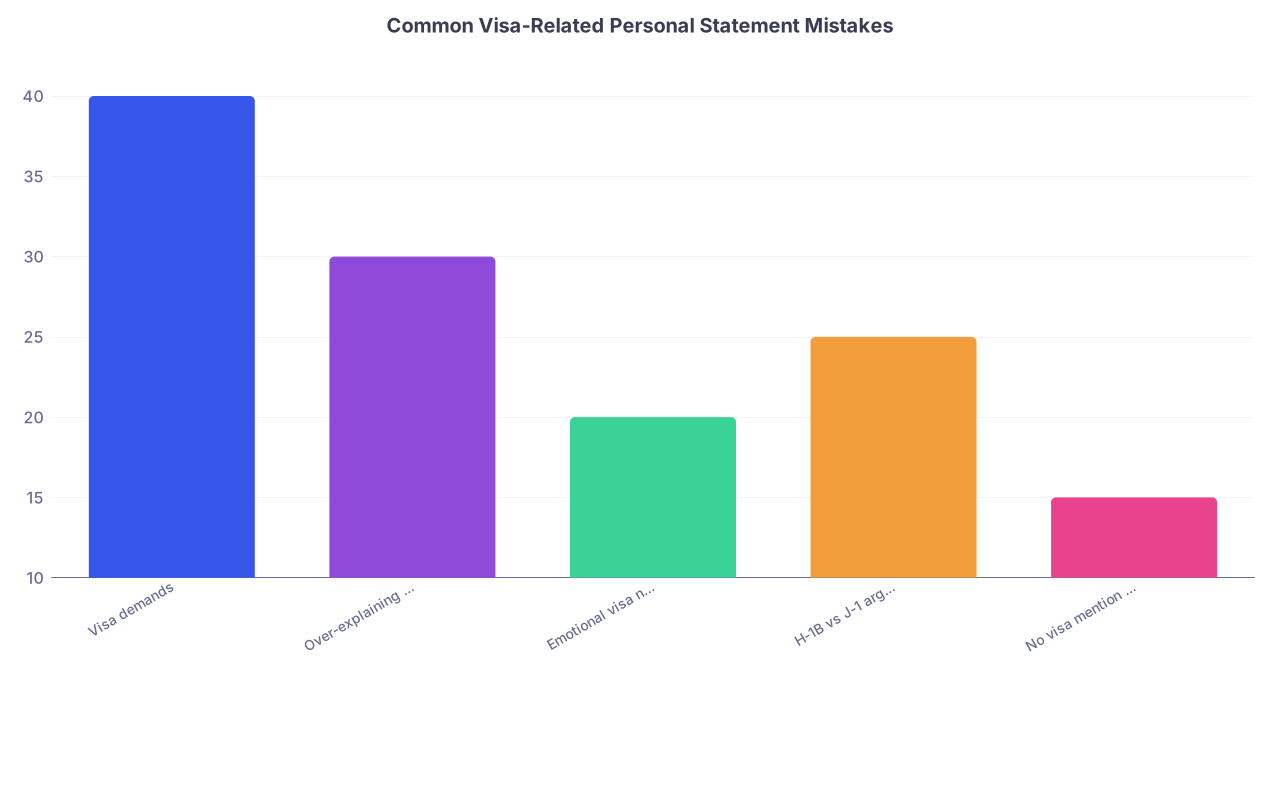
| Category | Value |
|---|---|
| Visa demands | 40 |
| Over-explaining history | 30 |
| Emotional visa narrative | 20 |
| H-1B vs J-1 arguments | 25 |
| No visa mention at all | 15 |
6. Hiding Visa Status Completely and Hoping They Do Not Notice
Now the opposite mistake.
Some IMGs are so scared of visa issues that they try to hide them. They:
- Avoid all mention of being an IMG or foreign graduate
- Use the statement to look as “domestic” as possible
- Hope ERAS filters, CV, and MSPE will somehow make the visa question disappear
Program directors are not stupid. They see:
- Your medical school country
- Gaps in U.S. experience
- ECFMG status
- ERAS visa fields (if completed correctly)
When you pretend your visa situation does not exist, it raises a different suspicion:
- “Is this applicant naive about what residency requires?”
- “Will they be unprepared for the paperwork and deadlines?”
- “Are they going to spring surprises on us in March?”
You do not need to write paragraphs on visas. But erasing all context of being an IMG or international graduate is also a mistake.
The balanced approach:
- Acknowledge your international background confidently.
- Show you understand the U.S. environment (through clinical narratives and insight).
- Use the application, not the statement, to clearly state your actual visa need.
You are not tricking anyone by pretending to be something you are not. What you are doing is looking unprepared.
7. Using Sloppy, Inconsistent, or Wrong Visa Terminology
Program directors use your language about visas as a proxy for how much trouble you will be administratively.
When your personal statement includes:
- Wrong visa names (“HB‑1”, “J1 waiver visa”, “working green card visa”)
- Confused status labels (“I am currently on an F‑1 green card…”)
- Inconsistent statements (“I do not need sponsorship” + clearly do)
- Legal half‑truths that sound like you googled them last night
You instantly look:
- Careless
- Poorly advised
- High‑risk for paperwork mistakes and missed deadlines
They do not have time to clean up your mess.
Minimum standard:
- If you mention status at all, it must be accurate.
- Spell the visa correctly (J‑1, H‑1B, F‑1, O‑1).
- Do not invent terms like “J‑1 transfer to H‑1B without sponsorship.”
- Do not claim “no sponsorship required” unless that is 100% legally true (e.g., you already have a green card or are a U.S. citizen).
If you are not sure of your exact status:
Talk to an immigration attorney or your current school’s DSO / international office. Do not guess in your personal statement.

8. Ignoring Genuine Red Flags That Need Minimal, Careful Context
There are rare situations where silence can be as harmful as oversharing. Typically:
- Long unexplained gaps related to immigration status
- Training interrupted by a forced return to home country
- Sudden change from one pathway to another (e.g., research fellow to IMG applicant) clearly linked to visa issues
If a program director sees:
- 2 missing years
- A sudden departure from the U.S.
- Or other obvious timeline disruptions
…with zero mention or context anywhere, they may assume:
- Academic trouble
- Disciplinary issues
- Professional misconduct
Sometimes a brief, controlled line in the personal statement is safer than complete silence.
For example:
- “A required return to my home country for immigration reasons led to a one‑year gap in U.S. clinical activity. During that year, I…”
- “When my prior research‑based visa ended, I returned home and focused on clinical work in [country] while preparing for USMLE and ECFMG certification.”
Key points:
- Keep it short.
- Do not emotionally unpack the entire immigration saga.
- Immediately pivot back to clinical development, maturity, or what you learned.
This is where most IMGs overcorrect. You do not need three paragraphs. Two clear sentences and a smart pivot are usually enough.
9. Forgetting That Visa Concerns Intensify Specialty Competition
Some specialties are already paranoid about visas. Add the wrong language in your personal statement and you are finished.
High‑risk specialties for visa‑sensitive screening:
- Dermatology
- Orthopedics
- Plastic surgery
- Neurosurgery
- Ophthalmology
- ENT
Moderately cautious, but still open:
- Radiology
- Anesthesiology
- Emergency medicine (depending on state/institution)
More historically IMG‑friendly (but not immune):
- Internal medicine
- Family medicine
- Pediatrics
- Psychiatry
If you are aiming at a visa‑cautious specialty and your personal statement screams “visa complexity,” you will not clear the first sort.
You must be more careful, not less:
- No visa preference speeches.
- No emotional narratives about U.S. immigration.
- No long explanations of past issues.
Your job in those specialties:
Look like the lowest administrative risk among the qualified IMGs.
| Situation | Recommended Visa Mention in PS |
|---|---|
| Standard IMG, needs J‑1 or H‑1B | 0–1 short factual line, or none |
| Previous visa denials, complex history | Avoid in PS; handle via advisor/legal |
| Gap clearly linked to immigration | 1–2 brief sentences with pivot |
| U.S. citizen / green card IMG | No visa content; highlight stability |
| Specialty highly cautious about visas | Minimal, factual, only if essential |

| Step | Description |
|---|---|
| Step 1 | IMG Applicant |
| Step 2 | No visa mention in PS |
| Step 3 | Maybe 1 short factual line or none |
| Step 4 | Handle via advisor, not PS |
| Step 5 | 1-2 sentence factual explanation + pivot |
| Step 6 | Clear visa need? |
| Step 7 | Any major gaps/complications? |
| Step 8 | Gap visible on CV? |
10. When (And How) It Is Safe to Mention Visa in the Personal Statement
You might have noticed a pattern: in most cases, the safest move is less, not more.
There are a few limited situations where a one‑line mention can help, if done carefully:
Situation A: You Do NOT Need Sponsorship, But Look Like You Might
Example: You are an IMG but a U.S. citizen / green card holder. Some programs auto‑assume “visa” when they see foreign medical school.
A single line near the end can prevent mistaken assumptions:
- “As a U.S. permanent resident who completed medical school abroad, I am eager to bring my international perspective back to serve patients here.”
Or:
- “Having grown up in the U.S. and completed medical school in [country], I am fully authorized to work without visa sponsorship and committed to building my career here.”
Notice:
- You do not use legal jargon.
- You do not turn it into a big point.
- You simply neutralize a potential misunderstanding.
Situation B: A Gap Is Clearly Linked to Immigration Logistics
As described earlier: brief, neutral, then move on.
Example:
- “A change in my immigration status required me to return briefly to [country], during which I worked as a junior physician in [setting] and strengthened my skills in [X]. Once eligible, I resumed my U.S. exam preparation and clinical exposure.”
That is enough.
Any more and you are writing for an immigration officer, not a program director.

11. The Simple Test: Does Your Statement Make You Look Like a Visa Problem?
Here is the blunt filter you should apply before submitting:
Print your personal statement. Highlight every sentence that mentions:
- Visa
- Sponsorship
- Status
- Immigration
- Country entry / exit
- Consulate / embassy
- Legal issues related to staying in the U.S.
Now ask:
- If a grumpy, overworked program director read only the highlighted sentences, what impression would they have of me?
- Do these sentences make me look:
- Complicated?
- Demanding?
- Risky?
- Dramatic?
- Hard to onboard?
If the answer to any of those is “yes,” those lines need to be cut, rewritten, or moved out of the personal statement entirely.
Your visa reality is what it is. The mistake is using the one document designed to show your clinical and personal strengths as a stage for your immigration frustrations.
Do not do that to yourself.
FAQ: Visa and Personal Statement Pitfalls for IMGs
1. Should I directly state “I require J‑1 (or H‑1B) visa sponsorship” in my personal statement?
Generally, no. Programs see your visa need through ERAS fields and filters. Putting that line in the personal statement adds no useful information and can make you look visa‑focused instead of training‑focused. The only exception is if your status is unusually confusing and you and an advisor decide a short clarification line will reduce misunderstanding, not increase it.
2. I had a prior U.S. visa denial. Do I need to disclose this in my personal statement?
Almost never. This is an immigration issue, not a personal statement topic. Over‑explaining denials scares programs. Get proper legal advice, make sure your current status and future eligibility are solid, and keep the personal statement focused on training, not consular history. If a program ever needs details, that will happen through official channels, not your essay.
3. My training was delayed because I had to return home for visa reasons. How do I explain that without hurting myself?
Use 1–2 neutral sentences, then pivot. Example: “Due to immigration requirements, I returned to [country] for one year, during which I worked in [clinical setting] and developed [skills]. I then resumed my path toward U.S. residency by [USMLE, observerships, etc.].” Do not unpack emotional pain, battles with the embassy, or blame. Calm, factual, growth‑oriented.
4. I am a U.S. citizen who studied abroad. Should I mention that I do not need sponsorship in my personal statement?
One short line can help prevent unnecessary screening out. Something like, “As a U.S. citizen trained in [country], I bring an international perspective paired with full work authorization here.” You do not need to list your passport status or use legal jargon. Just enough so a quick reader does not wrongly toss you in the “complex visa” pile.
5. Can a strong personal statement overcome a program’s reluctance to sponsor visas?
No. Institutional visa policy is not moved by your essay. If a program does not sponsor your required visa type, no amount of writing will fix that. Your strategy should be: (1) apply wisely to visa‑friendly programs, (2) avoid looking like a visa liability, and (3) use the personal statement to show maturity, reliability, and clinical value – so that among the programs that can sponsor you, you are an obvious “yes.”
Open your personal statement draft right now and search for the words “visa,” “sponsor,” and “immigration.” If those sentences make you look like a problem instead of a physician, cut or rewrite them today.


