

It is late October. You finally get a nibble: an interview email from a solid community internal medicine program in the Midwest. You open the message, scroll down—and it hits you. “Please confirm your current visa status and future visa needs.”
You quickly reply: “I’m flexible with visa, open to anything (J1 or H1B).”
You feel proud. You think you just showed you are “easy” to sponsor.
What you actually did: you walked straight into one of the most common IMG red-flag traps. Sloppy, vague, or copy-pasted visa answers. This is the stuff that gets your ERAS quietly pushed to the “no” pile before anyone reads a single word of your letters.
Let me walk you through the mistakes I see over and over again—and how to avoid getting labeled as “visa headache” before they even learn your name.
How Programs Actually Look At Your Visa Answers (And Why Sloppiness Kills You)
Residency coordinators are not immigration lawyers. They do not want to become immigration lawyers. Their lives are already complicated enough with schedules, ACGME paperwork, site visits, and angry attendings.
Here is what most programs want visa-wise:
- Predictability
- Compliance
- Minimal extra work or risk
They screen IMGs brutally fast. I have sat in rooms where they sort applicants in literal minutes, with comments like:
- “We do not do H-1B; toss all who ask for that.”
- “I’m not sure what this status means; skip.”
- “Did he just say O-1? Next.”
When your visa answers look confused, contradictory, or too “creative,” you send one loud message: “I will be time-consuming and risky to sponsor.”
You never want to be that person.
Red Flag #1: “Flexible With Visa, Open To Anything”
This is probably the single most common and damaging line IMGs write.
Variations include:
- “I’m flexible regarding visa type.”
- “Open to J-1, H-1B, or any other visa option.”
- “Any visa is fine; I just need sponsorship.”
Here is the problem. Flexibility sounds good in your head. But to a PD or coordinator, it sounds like:
- You do not understand the system.
- You have not done basic homework on what you actually qualify for.
- You will say yes now, then show up later panicking about waivers, 212(e), or green cards.
Programs want residents who know what they are asking for, not people who are outsourcing their immigration planning to GME.
How to avoid this mistake
You must know, clearly and precisely, what you are:
- Currently on (F-1 with CPT/OPT, B-1/B-2, no US status, etc.)
- Eligible for (J-1 only, J-1 and H-1B, only J-1 due to exams/ECFMG, etc.)
- Actually requesting.
A safe, professional answer looks like:
“I am currently on F-1 status in the U.S. and will be eligible for ECFMG-sponsored J-1 at the time of residency. I am specifically seeking programs that sponsor J-1 visas. If your institution also offers H-1B for eligible residents who have Step 3 completed, I would be happy to be considered for that as well.”
Notice the hierarchy:
- Clear current status
- Primary requested route (J-1)
- Conditional interest in H-1B only if the program already does it
You are not “open to anything.” You are realistic and aligned with actual program policies.
Red Flag #2: Mixing Up J-1, H-1B, Green Card, and OPT Like They Are Interchangeable
I have seen emails like this more times than I want to admit:
“I am on F1-OPT and would like a green card sponsorship through H1B or J1 depending on what your hospital provides.”
To an immigration attorney, this sentence is nonsense. To a program, it is a red flag that you do not understand basic categories.
Quick reality check:
- J-1 (ECFMG-sponsored) is not a green card route. It carries a 2-year home-country physical presence requirement (212(e)) unless you get a waiver.
- H-1B is a temporary work visa, dual intent, which can connect to a green card, but the residency program usually does NOT file your green card.
- F-1 OPT is just work authorization tacked onto your student status. It is not permanent, and it does not guarantee any particular next visa.
- Green card is permanent residence. Programs are almost never petitioning residents directly for that. Fellowships or employers sometimes do it later.
When you combine all of that into one confused sentence, it tells the program you will ask for things they do not offer and argue about “promised sponsorship” later. They remember every previous nightmare case. You do not get invited.
How to avoid this mistake
Learn your categories well enough that your wording is precise.
For example:
If on F-1 with OPT:
“I am currently on F-1 status with OPT authorization. For residency, I am seeking ECFMG-sponsored J-1 or, if your institution supports it and I meet the Step 3 and timing requirements, H-1B.”
If outside the U.S. with no current status:
“I am currently residing outside the U.S. and will require ECFMG-sponsored J-1 for residency training. I understand the associated 2-year home-country requirement and future need for a waiver.”
The key: do not tie J-1 directly to “green card” in your language. Do not treat H-1B as a magical residency-to-green-card bridge that programs are responsible for.
Red Flag #3: Ignoring Step 3 When You Mention H-1B
Programs that even consider H-1B are already the minority. Those that will sponsor an H-1B for a resident without Step 3 completed are microscopic.
Yet I constantly see:
- “I prefer H-1B sponsorship.” (With no Step 3)
- “I require H-1B only.”
- “Open to J-1 but strongly prefer H-1B for green card purposes.”
On an application that clearly shows:
USMLE Step 1: Pass, Step 2 CK: Pass, Step 3: not taken.
To the PD, this translates to:
- You demand a visa category you do not qualify for yet.
- You have a “requirements list” for them before they even meet you.
- You may decline a J-1 offer at the last second because “my lawyer advised me.”
You get moved out of the yes pile very fast.
How to avoid this mistake
Be brutally honest with yourself.
If you have not passed Step 3 before the H-1B filing season your program uses (typically spring before residency starts), then practically speaking, you are a J-1 candidate.
You can phrase it like:
“I have not yet taken Step 3, so at this time I am primarily seeking J-1 sponsorship. If I complete Step 3 in time and your institution offers H-1B for residents, I would be interested in that conversation.”
This shows:
- Self-awareness
- Realistic planning
- Deference to existing institutional policies
Programs like that. They will not hold it against you that you are J-1–bound. They will hold it against you if your application reads as “H-1B or nothing,” without the credentials to back it up.
Red Flag #4: Contradictions Between ERAS, CV, Emails, and Interviews
This is a silent killer.
Example pattern I have seen:
- ERAS Question: “Will you require visa sponsorship?”
You check: “No” (because you are on F-1 OPT and misunderstood the question). - Personal statement: “As an international medical graduate requiring visa sponsorship, I am particularly interested in J-1 programs.”
- CV: Lists “F-1 student visa” under personal details.
- Email to coordinator: “I will need H1B or green card sponsorship.”
That is three different answers to the same core question.
What the program sees:
- Inconsistency
- Possible dishonesty
- Risk of future “You lied on your application” immigration issues
Coordinators talk. When your documents do not line up, you become the applicant nobody trusts.
How to avoid this mistake
Before you submit anything:
List your current status and what you really need.
Go through every place you mention immigration:
- ERAS demographic and visa questions
- Personal statement
- CV/personal information section
- Emails to programs
- Interview answers
Make sure the core message is the same everywhere.
An easy standard:
“I currently hold [X status]. I will require [J-1 / H-1B] sponsorship to begin residency.”
Then keep that exact structure consistent across all materials, with minor expansions when needed.
Red Flag #5: Acting Like Visa Is Someone Else’s Problem
This one shows up as silence or vague optimism:
- You leave visa questions blank on ERAS where they allow free text.
- You never mention your status in any emails or PS even though you obviously need sponsorship.
- When directly asked in an interview, you say, “I am not sure, my lawyer will handle it.”
To you, you may think: “I do not want to make a big deal out of the visa. I will just get the offer first.”
To them, it screams:
- You expect the hospital to fix everything later.
- You may pop up with last-minute demands or complications in May/June.
- You are not taking ownership of your own immigration path.
Programs have been burned by “I thought I could change my status” stories. They have little patience left.
How to avoid this mistake
You do not need to be an immigration attorney. But you must show ownership.
When asked, your answer should sound like someone who has actually read the ECFMG J-1 page and maybe talked to an immigration lawyer once.
Example interview answer:
“I’m currently on F-1 with OPT that will end in June 2026, and I will require a new status for residency. I have read the ECFMG guidelines and understand that J-1 is the standard path for IMGs; that is what I am expecting to use. I also know your institution sometimes sponsors H-1B for residents who have Step 3. If offered a position, I would work with your GME and, if needed, my own immigration counsel to ensure everything is filed correctly and on time.”
Short version:
You know what you need. You know how the system works broadly. You are not trying to dump all responsibility on them.
Red Flag #6: Over-Explaining, Over-Sharing, and Writing Pseudo-Legal Essays
The opposite problem also exists: the IMG who writes a full mini-immigration brief in every message.
I have seen paragraphs like:
“Due to the complexities of INA §212(e) and the potential for a Conrad 30 waiver or hardship waiver based on my spouse’s future status as a potential permanent resident, I am seeking an institution willing to consider an H-1B sponsorship and/or future waiver sponsorship, understanding that my current B-2 status may change to F-1 pending the decision of USCIS…”
You just lost 95% of program staff after the words “INA §212(e).”
They do not want dense immigration explanations. It alarms them. It feels like a prelude to conflict, appeals, and “my lawyer will be in touch” emails.
How to avoid this mistake
Keep it simple in applications and interview answers:
- Current status
- Needed status for residency
- Optional brief note if you have a 212(e) issue and knowledge of it
Save the legal details for a private consultation with your immigration attorney or, if absolutely necessary, with the institution’s GME office after you match.
Good version:
“I previously held J-1 research status that is subject to the 2-year home requirement, so I am aware I will need a waiver or to fulfill that requirement before certain future visa options. For residency itself, I am expecting to use ECFMG-sponsored J-1.”
Bad version:
“I am subject to 212(e) but I believe I may qualify for a hardship waiver based on my future U.S. citizen children and am seeking a program that will sponsor me for H-1B and later an O-1 or EB-2 NIW petition…”
Do not drag programs into complicated “maybe in 7 years” scenarios.
Red Flag #7: Not Matching What The Program Actually Offers
Programs usually fall into three broad categories:
| Program Type | J-1 | H-1B | Comments |
|---|---|---|---|
| J-1 only | Yes | No | Majority of community programs |
| J-1 + limited H-1B | Yes | Yes | Often require Step 3 + high scores |
| No visa | No | No | Some community / smaller hospitals |
Now here is the mistake: you send the exact same message to all three types.
I routinely see IMGs email a known “J-1 only” program saying:
“I strongly prefer H-1B and would like to avoid the J-1 2-year requirement.”
The coordinator reads that and thinks: “So why are you applying here?”
You have just told them you will probably rank them low, complain about J-1, maybe not show up if you get a late H-1B offer somewhere else.
You become a risk, not an asset.
How to avoid this mistake
Do basic research:
- Check program website: Many explicitly say “J-1 only” or “J-1 and H-1B.”
- Look at past residents in Doximity/LinkedIn; often they list “J-1” or “H-1B” in profiles.
- Ask current residents (politely, briefly).
If a program is J-1 only:
“I understand your institution sponsors ECFMG J-1 visas for residents. That aligns with my plans, and I am seeking J-1 sponsorship.”
If a program offers both J-1 and H-1B:
“I am eligible for J-1 sponsorship and am comfortable training on J-1. I also understand your institution sometimes sponsors H-1B for residents who have completed Step 3; if I meet those criteria and it aligns with your policies, I would be interested in that option.”
Never sound like you are asking them to change their institutional practice just for you.
Red Flag #8: Being Vague About Timing and Expiry
Visa timing kills more matches than most people realize. Programs have seen applicants who:
- Cannot start on July 1 because their status expires June 15.
- Need to leave the U.S. and re-enter for consular processing at the worst possible time.
- Assume they can “fix status later” and show up without work authorization.
If your application looks like one of those cases, many places will quietly pass.
Patterns that worry them:
- No mention of OPT end date on F-1.
- Very short remaining status (e.g., B-1/B-2 expiring soon).
- Previous status violations or confusing travel history not explained at all.
How to avoid this mistake
You do not need to spill your full immigration biography, but you should show awareness of timing.
If on F-1 OPT:
“My current F-1 OPT is valid through August 2026, which covers the start of residency, but I understand I will require a change of status or new visa for GME. I am planning on transitioning to ECFMG-sponsored J-1 for residency.”
If you are currently abroad:
“I am currently living in [country] with no active U.S. status. I will require a J-1 visa issued at a U.S. consulate before the start of residency, and I am prepared for that consular process.”
Simple. Clear. You know there is a calendar problem and you are planning for it.
A Simple Process To Clean Up Your Visa Story
You want to avoid looking messy, needy, or confused. The way to do that is to build one coherent “visa story” and stick to it everywhere.
Here is a very basic structure you can scribble on a sheet of paper:
Current status
- What are you on right now? (F-1, B-1/B-2, abroad, etc.)
- When does it expire (roughly)?
Training visa plan
- For residency, I plan to use: J-1 / H-1B / J-1 primary with possible H-1B later.
Eligibility reality
- Do I have Step 3 yet? If no, cross out “H-1B primary” for PGY-1.
Program alignment
- For J-1-only programs: I will present myself as J-1-bound.
- For H-1B-friendly programs: I will present J-1 as acceptable, H-1B as bonus if criteria met.
One consistent sentence
Build your standard line and repeat it everywhere.
Then go clean your ERAS, personal statement, CV, and email templates with that unified story.
Visual: How Often Visa Confusion Sinks Otherwise Competitive IMGs
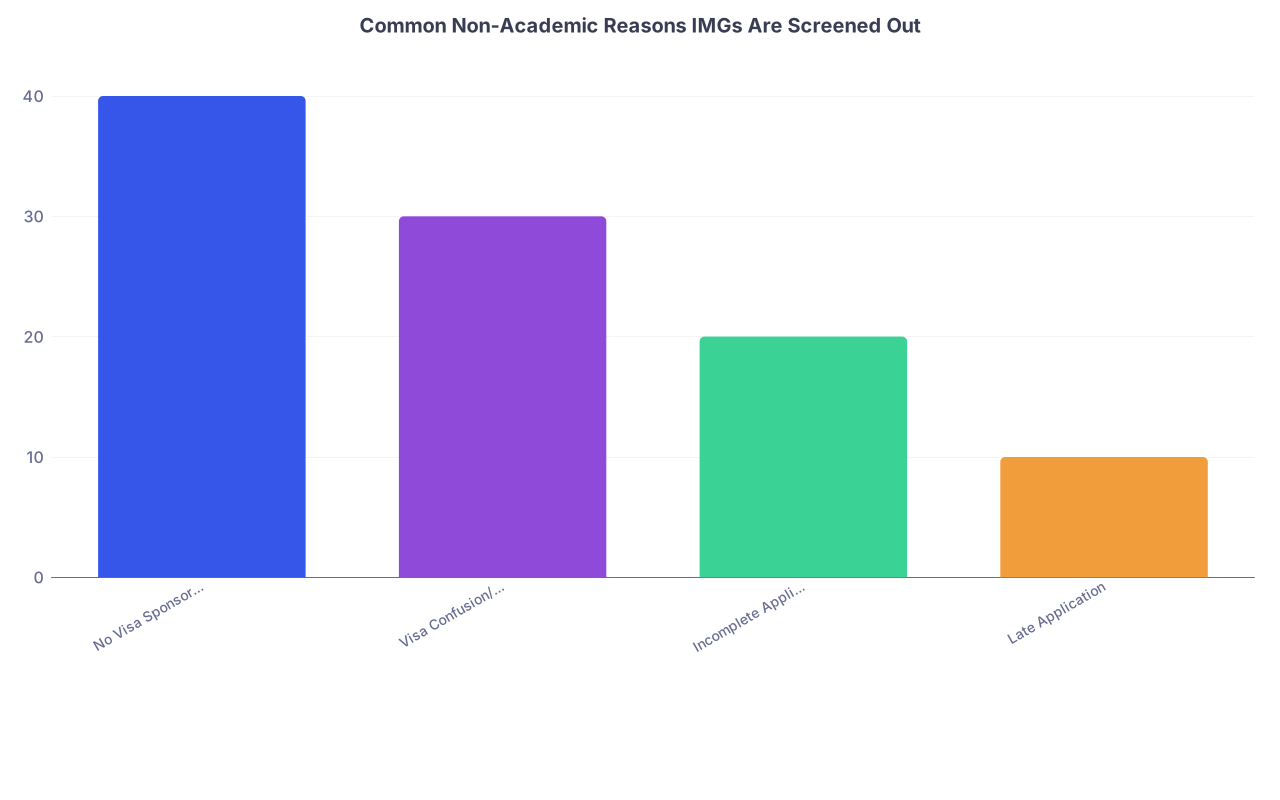
| Category | Value |
|---|---|
| No Visa Sponsorship | 40 |
| Visa Confusion/Red Flags | 30 |
| Incomplete Application | 20 |
| Late Application | 10 |
This kind of pattern is not theoretical. A substantial chunk of otherwise interviewable IMGs get filtered out not because of scores or grades—but because their visa answers look like trouble.
Bringing It All Together – Without Creating New Problems

| Step | Description |
|---|---|
| Step 1 | Know Current Status |
| Step 2 | Decide Realistic Visa Plan |
| Step 3 | Check Program Policies |
| Step 4 | Create One Consistent Visa Statement |
| Step 5 | Apply & Communicate Clearly |
| Step 6 | Clarify Details After Interview/Match |
You do not need perfection. You need clarity and consistency.
Do not:
- Advertise “any visa, any option, green card preferred” like a shopping list.
- Demand H-1B without Step 3 or against stated institutional policy.
- Spray different visa stories across ERAS, email, and interviews.
- Write legal essays using words you pulled from Google.
Do:
- Know your current status cold.
- Decide what you are actually eligible for in PGY-1.
- Match your ask to what each program historically does.
- Build one clean, realistic sentence and repeat it everywhere.
Key Takeaways
- Sloppy, vague visa answers are not harmless; they are a major red flag that can get you screened out before anyone reads your scores or letters.
- You must present one clear, consistent, and realistic visa plan that matches your current status, your Step 3 situation, and each program’s actual sponsorship patterns.
- Act like the person who owns their immigration path, not the one dumping it on the program—simple, accurate, and brief beats “flexible with anything” every single time.


