
The biggest mistake IMGs make in the Match is assuming “IMG-friendly” automatically means “visa-friendly.” It does not.
If you are already in the Match, you do not have time to be sloppy. You need a fast, targeted system to find programs that both:
- Sponsor your visa type, and
- Are realistically within your reach.
I am going to walk you through that system, step by step. No fluff. No false hope. Just what works when the clock is already ticking.
Step 1: Get Crystal Clear on Your Visa Reality
Before you touch ERAS again, you must know exactly what you are and are not eligible for. Vague ideas like “I think I can get H‑1B” are how people waste 30+ applications.
Know which visa types are actually on the table
For most IMGs in residency:
J‑1 (ECFMG sponsored):
- Most common visa for residency.
- Easier to obtain than H‑1B in most cases.
- Comes with a 2‑year home country requirement (unless waived later).
H‑1B (employer sponsored):
- Less common in residency.
- Requires Step 3 passed before visa filing in most states.
- Costs the program money and paperwork → many will not do it.
Green Card / EAD / Citizen:
- Best scenario.
- You count as “no visa issue” for almost all programs.
Other statuses (e.g., F‑1 with OPT, pending asylum, etc.):
- Highly variable.
- You must talk to an immigration attorney, not Reddit.
Now, you need to answer one hard question today:
“If a program asked me tomorrow, what exact visa status would I be starting residency on?”
If you cannot answer in one clear sentence, stop reading and fix that first.
Quick self-check by profile
| Profile | Most Realistic Visa Path |
|---|---|
| Fresh grad, passed Step 1 & 2, no 3 | J-1 |
| Older grad, Step 1, 2, *and* 3 passed | J-1 or H-1B (if programs open) |
| US citizen / GC holder IMG | No visa needed |
| On current US visa (F-1, H-4, etc.) | Often J-1 for residency |
| Asylum / pending status | Highly individualized |
If you are:
- J‑1 only: Your number of potential programs is large, but many “US-citizen only” institutions still cut you out.
- H‑1B possible: Your pool is much smaller. You cannot afford to be random.
Step 2: Build a List of Programs by Visa Type (Fast, Not Perfect)
You do not have time to manually open 300 program websites. You need structure.
Tool 1: FREIDA – good, but not enough
Use AMA FREIDA as your base filter. It is not perfect, but it is a strong starting point.
- Go to FREIDA.
- Filter by:
- Specialty (e.g., Internal Medicine)
- IMG % if available
- Use filters for:
- “Accepts international medical graduates”
- USMLE requirements
Then look at the Program Details:
- Many list “J‑1 only”
- Some list “J‑1 and H‑1B”
- Some say “No visa sponsorship”
Do not trust FREIDA blindly. I have seen programs listed as “J‑1 friendly” that stopped sponsorship 2 years ago. But it is a very good initial pass.
Tool 2: Program Websites – where truth usually lives
For each program from FREIDA that looks plausible, you quickly verify on their own site.
Look for pages labeled:
- “Residents → Current Residents”
- “Prospective Residents”
- “FAQ”
- “International Medical Graduates”
- “Visa and Eligibility”
You are hunting for language like:
- “We sponsor J‑1 visas only”
- “We sponsor J‑1 and H‑1B visas”
- “Applicants must have US citizenship or permanent residency”
- “We do not sponsor visas”
Create a simple spreadsheet (Google Sheets is fine) with:
- Program Name
- State
- Specialty
- Visa: J‑1 only / J‑1 + H‑1B / No Visa / Not Clear
- Source: FREIDA / Website / Email
- Last Verified: date
You do not need to be fancy. You need to be consistent.
Step 3: Use a Priority System, Not Hope
Once you have your list, you rank programs by visa compatibility + match likelihood.
Tier your programs by visa + competitiveness
Rough framework:
Tier 1: Perfect match
- Actively sponsor your visa type
- Historically take IMGs (look at current residents)
- Your scores and YOG are within their usual range
Tier 2: Plausible
- Sponsor your visa type on paper
- Maybe fewer IMGs, but some present
- Slightly above your stats level
Tier 3: Long shots
- Rarely sponsor your visa type
- Very competitive or mostly AMGs
- You are below average for their typical intake
You should not apply equally across tiers. That is financial suicide.
Here is how I tell IMGs to distribute applications when already in the Match and limited on time and money:
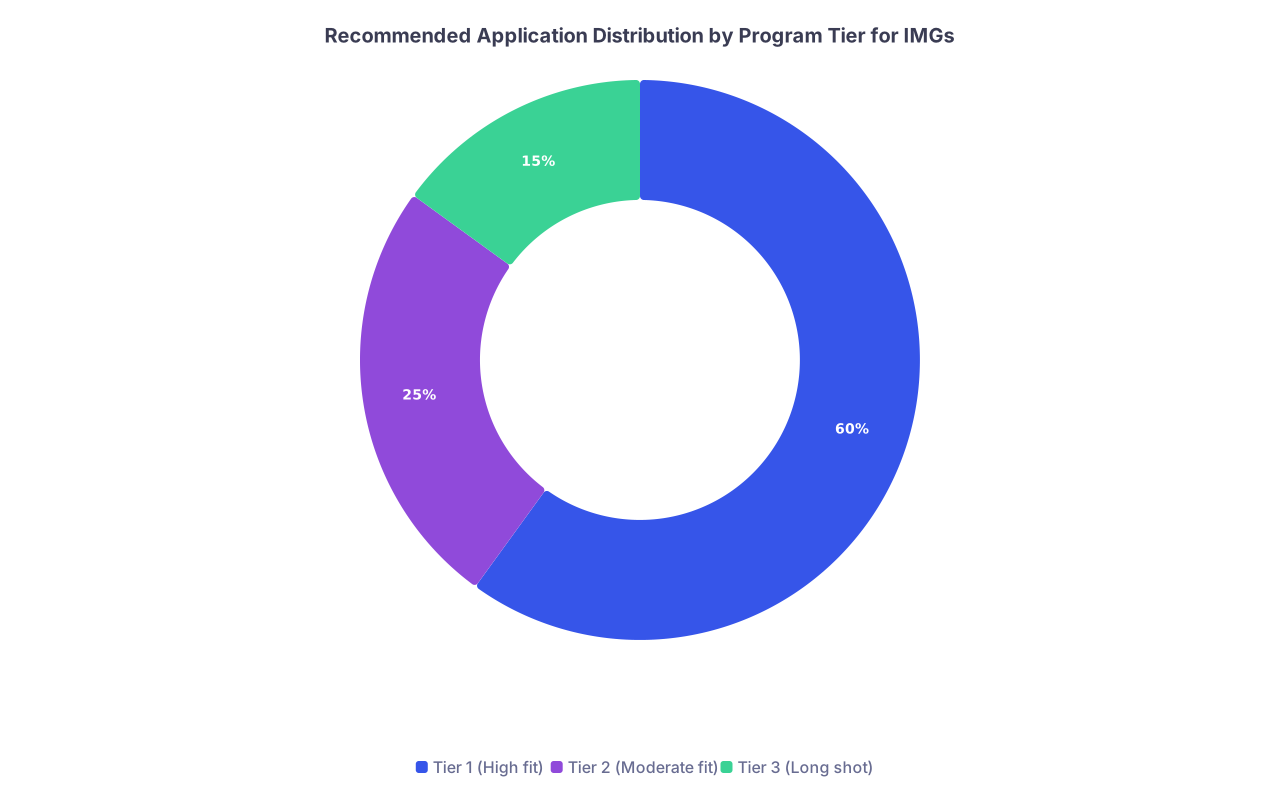
| Category | Value |
|---|---|
| Tier 1 (High fit) | 60 |
| Tier 2 (Moderate fit) | 25 |
| Tier 3 (Long shot) | 15 |
If you have already applied randomly, you can still salvage this.
You just use this system for:
- Signaling (if offered)
- Emails to PDs / PCs
- Future interview prioritization
Step 4: Verify Visa Sponsorship When Information Is Confusing
You will hit programs where info conflicts:
- FREIDA says “J‑1 and H‑1B”
- Website is silent
- Current residents show only J‑1s
You cannot guess. You ask.
How to email programs without looking desperate
You email the program coordinator, not the PD, for visa clarification. Keep it short. Precise. Non-needy.
Subject line options:
- “Quick question regarding visa sponsorship – [Your Name]”
- “Visa sponsorship clarification – [Program Name] IM Residency”
Body example:
Dear [Coordinator Name],
My name is [Name], and I have applied to your [Specialty] residency program for this Match cycle. I am an international medical graduate and will require [J‑1 / H‑1B] visa sponsorship to begin residency.
Could you please confirm whether your program sponsors [J‑1 only / both J‑1 and H‑1B visas] for incoming residents this cycle?
I appreciate your time and clarification.
Sincerely,
[Your Name], MD
AAMC ID: [#######]
You are not asking for an interview. You are verifying eligibility. That is entirely appropriate.
If you do not receive a response in 7–10 days, assume the least favorable interpretation unless their website clearly states otherwise.
Step 5: If You Need H‑1B, Play a Different Game
H‑1B for residency is a specialized game. If you try to play it like J‑1, you will not match.
Hard realities of H‑1B for residency
- Many programs have institutional policy: J‑1 only
- Some states have medical board rules requiring Step 3 before starting H‑1B
- H‑1B has costs and paperwork → programs need strong reason to use it
Typical patterns I have seen:
- High-demand specialties rarely bother with H‑1B for IMGs
- Some community IM or neuro programs will do H‑1B for exceptional candidates
- Big-name academic centers may do H‑1B, but usually for research-focused or very strong profiles
If you do not have Step 3 passed and need H‑1B → your realistic chances this cycle are low. Most places that do H‑1B for PGY‑1 expect Step 3 done before visa filing.
Minimum standard if you are truly aiming for H‑1B
You should:
- Have Step 3 passed
- Have strong scores on Step 1/2 (or at least not weak)
- Target programs where previous residents clearly had H‑1B (look at alumni LinkedIn or hospital staff pages)
You also target fewer but higher-yield programs. For example:
- 20–40 carefully chosen H‑1B-friendly programs
- You treat each like a job you truly want → tailored communication, research, and genuine interest
If you just spray 100 random applications and hope, H‑1B will almost always fail you.
Step 6: Already Applied? How to Retarget Mid-Cycle
Many IMGs are reading this after they have already submitted applications. Let me be blunt: you probably wasted some. That is done. The question is how to stop compounding the error.
Scenario A: You are still within the window to add more programs
Then you:
- Build your visa‑verified list as described above.
- Add Tier 1 and Tier 2 programs that match your visa but which you missed.
- Do not chase ultra-prestigious long shots unless:
- Your scores are high
- YOG is recent
- You have some US clinical experience
Scenario B: You cannot add more programs or your budget is maxed
Then the game shifts to maximizing impact where you already applied.
You:
Identify programs on your list that clearly:
- Sponsor your visa, and
- Have historically taken IMGs
Prioritize communication and signaling to those programs:
- If ERAS preference signaling is available → use them on visa-friendly, realistic programs.
- If not, you send targeted, concise interest emails to a subset (10–20) of those programs.
Do not spam every program with generic “I am very interested in your program” emails. Programs ignore that.
Step 7: Use Current Residents to Confirm Reality
Admissions pages sometimes lie by omission. Current residents rarely do.
How to read a current resident page for visa clues
On program websites, open the Current Residents page and scan for:
- Names clearly from your region (Patel, Ahmed, Zhang, etc.)
- Medical schools outside the US/Canada
- Occasional bios mentioning “ECFMG certified” or “from [country]”
If you see:
- Multiple IMGs in recent classes → good sign.
- One lonely IMG from 2013 → not great.
- Only US MD and DO grads → extremely unlikely they sponsor visas in reality.
You can even cross-check individuals on LinkedIn to see:
- Their visa history (sometimes listed)
- Whether they did J‑1 or H‑1B
- That the program is actually IMG-friendly, not just theoretically.
Reaching out to current residents
This must be done carefully. Many residents are overwhelmed and ignore cold emails. But if done well, it can help you:
Email example:
Subject: Quick question from IMG applicant – [Program Name]
Dear Dr. [Last Name],
I hope you are doing well. My name is [Name], an IMG who has applied to the [Program Name] [Specialty] residency this cycle. I noticed from your profile that you are also an international graduate, and I hoped you might be willing to answer a very brief question.
I will require [J‑1 / H‑1B] visa sponsorship for residency. Does your program currently sponsor this visa type for incoming residents?
I understand you are busy, so even a one-line reply would be very helpful.
Thank you for your time.
Sincerely,
[Your Name]
You are not asking for a recommendation. You are asking for factual clarification. That is reasonable.
Step 8: Stay Within Each Program’s Stated Eligibility
Here is where many IMGs sabotage themselves. They apply widely but ignore clearly stated cutoffs.
Common hard filters that override visa status
Even if a program sponsors your visa type, they may exclude you for:
- YOG too old
- Many programs prefer ≤ 5 or ≤ 7 years since graduation.
- Attempts on USMLE
- “No more than 1 attempt per Step” is common.
- Missing US clinical experience
- Some explicitly require US LORs.
- Incomplete USMLE steps
- Some require Step 2 CS equivalent documentation, Step 3 for H‑1B, etc.
You must respect these. Programs with strict cutoffs frequently auto‑filter in ERAS. Your visa status does not matter if you are screened out before a human sees your name.
Create a second column in your spreadsheet:
- “Meets posted criteria? Yes/No”
If “No,” then do not waste energy emailing them or hoping for a miracle.
Step 9: Prioritize Program Types That Actually Take IMGs
“IMG-friendly” is often code for a specific set of program profiles. Use that to your advantage.

Higher‑yield environments for IMG + visa sponsorship
Patterns I have seen repeatedly:
- Community-based university-affiliated IM programs
- Often rely more on IMGs
- Frequently sponsor J‑1
- Mid-tier academic centers in non-coastal states
- Need more applicants
- More open to J‑1, occasionally H‑1B
- Safety-net hospitals / county hospitals
- Serve underserved populations
- Historically more diverse residents
Versus:
- Ultra-competitive university hospitals in big cities
- Heavily US MD / DO
- Often “citizens/green card preferred” quietly, even if not explicit
- Prestige-heavy programs with big research names
- May take a few IMGs, but usually with outstanding metrics and research
You still include a few ambitious programs if your profile supports it. But your core strategy must be built around realistic visa‑friendly places.
Step 10: Watch for Silent Visa Barriers
Some programs will never state “no visas,” but they might effectively exclude you in other ways.
Common red flags:
Website says “We accept applications from LCME and AOA accredited schools only.”
- Translation: US MD and DO only.
Language: “Due to institutional policy, we are unable to sponsor visas at this time.”
- Self‑explanatory. Stop.
“We require applicants to be eligible to work in the United States without restriction.”
- Usually means citizen / green card, sometimes EAD.
If you see those phrases, move on. Your energy is finite.
Step 11: Time Management – How Many Hours To Spend On This
You are already in the Match. You cannot spend weeks re‑researching every program from scratch. So you chunk the work.
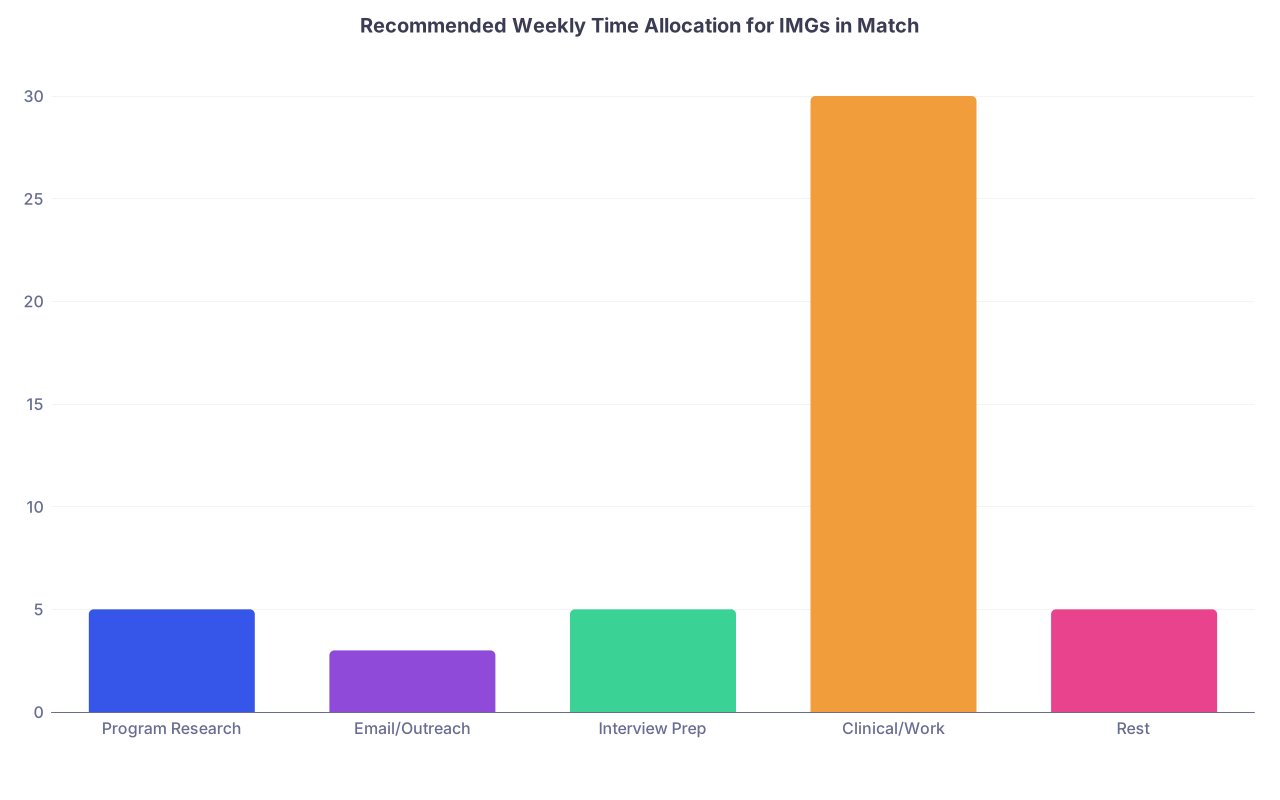
| Category | Value |
|---|---|
| Program Research | 5 |
| Email/Outreach | 3 |
| Interview Prep | 5 |
| Clinical/Work | 30 |
| Rest | 5 |
Aim for something like:
- 4–6 hours: visa‑focused program research and spreadsheet updating
- 2–3 hours: targeted emails / communication
- Remaining time: interview prep, clinical obligations, or work
The goal: within 1 week, you:
- Have a clean list of visa‑compatible, IMG‑friendly programs
- Know where you actually have a shot
- Stop worrying about programs that were never going to touch your file anyway
Step 12: If You Are Completely Stuck on Visa Strategy
Some situations are too messy for templates:
- Complicated immigration history
- Prior visa denials
- Pending asylum / TPS / DACA status
- Marriage petitions / employment-based green card in process
In those cases, I am going to be blunt: strangers on Telegram groups and Facebook are not qualified to advise you.
You need, at minimum:
- A 15–30 minute consult with a real immigration attorney who has dealt with physicians and J‑1/H‑1B issues.
Bring:
- Your full immigration history
- Your USMLE status
- Your realistic Match timeline
Your residency strategy must match your actual immigration constraints. Anything else is fantasy.
Practical Example: Two Different IMGs, Two Different Target Lists
Let me make this concrete.
Example 1: Dr. A – J‑1 only, average scores
- YOG: 2019
- Step 1: Pass
- Step 2 CK: 230
- No Step 3
- 2 US observerships
Strategy:
- Focus on J‑1‑sponsoring Internal Medicine community and university-affiliated programs.
- Avoid programs requiring Step 3 or no visas.
- Build a list of ~80–120 programs:
- 60–70 Tier 1 (clear J‑1, multiple IMGs, reasonable YOG window)
- 20–30 Tier 2 (a bit more competitive, but still IMG‑friendly)
- A handful of Tier 3 if there is personal connection or strong interest
Dr. A should not spend time chasing H‑1B talk. It is a distraction this cycle.
Example 2: Dr. B – H‑1B possible, strong profile
- YOG: 2021
- Step 1: 245 (or strong pass)
- Step 2 CK: 255
- Step 3: Passed
- 6 months US clinical electives, strong LORs
Strategy:
Build a curated list of ~40–60 programs that:
- Clearly sponsor both J‑1 and H‑1B
- Have previous residents on H‑1B
- Are not exclusively top‑10 academic giants
Apply with the intention:
- Flexible to J‑1 if needed
- But explicitly checking and confirming H‑1B possibilities wherever realistic
Dr. B can justify emails to PDs highlighting Step 3 completion and interest in H‑1B for specific programs known to offer it.
Visualizing the Process
Here is the actual workflow you should be following, not the “apply everywhere and pray” method.

| Step | Description |
|---|---|
| Step 1 | Define Exact Visa Status |
| Step 2 | Filter Programs in FREIDA by Specialty & IMG |
| Step 3 | Check Program Websites for Visa Policy |
| Step 4 | Discard Program |
| Step 5 | Check Eligibility: YOG, Scores, Attempts |
| Step 6 | Classify Tier 1/2/3 |
| Step 7 | Add to Spreadsheet |
| Step 8 | Verify Unclear Cases by Email |
| Step 9 | Prioritize for Signals & Outreach |
| Step 10 | Visa Compatible? |
| Step 11 | Meets Criteria? |
Do Not Confuse Activity With Strategy
You can send 300 applications and still not actually be “in the game” if:
- 150 programs do not sponsor your visa
- 80 have hard cutoffs you do not meet
- 40 rarely or never take IMGs
- 30 were realistic, but you barely engaged with them
I have seen too many applicants proudly say “I applied to 200 programs” when only 40 of those had any real chance of touching their application.
Your job now is simple:
- Identify those ~40–80 real opportunities
- Stop obsessing over the rest
- Put your time and effort where your visa status is not a deal‑breaker
Two Things to Remember
Visa compatibility is a hard filter, not a detail.
If the program cannot or will not sponsor what you need, it does not matter how strong your personal statement is.You still control your strategy, even mid‑cycle.
A focused, organized approach over the next 1–2 weeks can absolutely shift your odds—especially if you have been applying blindly so far.