

Last week, an IMG on WhatsApp sent me a voice note at 2:13 a.m. Her voice was shaking. She’d just gotten a J-1–sponsored residency offer, but her parents and siblings live in New Jersey as green card holders—and she was terrified she’d never be able to stay in the U.S. with them. “If I take this J-1, am I basically choosing to leave my family?” she asked.
You’re probably asking yourself the same thing. And you’re scared the “wrong” visa choice now will destroy your chances of ever getting a green card, even though you finally made it to the residency application stage.
Let’s go straight into the ugly what‑ifs you’re spiraling about.
The Core Fear: Does Saying Yes to J‑1 Mean Saying No to a Green Card?
Short answer: No, J‑1 doesn’t automatically kill your green card chances.
But. It can absolutely complicate them. Delay them. And if you’re careless or clueless about the rules, you can trap yourself.
Here’s the main nightmare everyone with family in the U.S. worries about:
“If I take a J‑1 for residency, I’ll be forced to leave the U.S. for two years and I’ll lose my chance to get a green card through my family.”
That’s rooted in something real: the two‑year home residence requirement (the famous 212(e) rule).
If you’re a J‑1 physician doing residency/fellowship through ECFMG sponsorship, you almost certainly become subject to 212(e). That means:
- After you finish training, you’re supposed to go back to your home country (the one on your passport, not “any country”)
- And live there for a total of 2 cumulative years
- Before you’re allowed to get:
- An H‑1B
- A green card
- Or change to most other long‑term statuses in the U.S.
That sounds brutal when your parents, siblings, spouse, or even kids are here in the U.S.
But here’s what most anxious IMGs don’t realize:
- There are waivers of that 2‑year rule
- Many, many J‑1 physicians never actually go back for those 2 years
- A lot of them still get green cards and stay in the U.S. long‑term
- Having family in the U.S. doesn’t stop you from getting a waiver
The problem is timing and strategy. Not that J‑1 = “no green card ever.”
J‑1 vs H‑1B If You Have Family in the U.S.
This is where you start doing mental gymnastics: “Should I only rank H‑1B programs? Should I refuse J‑1? Am I sabotaging my whole future if I accept ECFMG sponsorship?”
Let’s be blunt.
What J‑1 Does To Your Green Card Path
J‑1 for physicians:
- Almost always comes with 212(e)
- Means you typically need a J‑1 waiver job after training before you can move to green card
- That waiver job is usually in an underserved / rural area (Conrad 30, VA, HHS, etc.)
- Green card usually comes after:
- Residency/fellowship (on J‑1)
- Then 3 years of waiver service in a medically underserved area (on H‑1B)
- Then start the green card process
So yes, your life may look like:
3 years IM + 3 years Cards fellowship (J‑1) → 3 years waiver job (H‑1B) → then green card
If your parents are in New Jersey and your waiver job is in rural Kansas… yeah, that’s not the dream.
But it’s not “no green card.” It’s “green card after a detour.”
What H‑1B Does To Your Green Card Path
H‑1B for physicians:
- No 2‑year home requirement
- Dual intent is allowed (you can be in H‑1B and apply for a green card without breaking the rules)
- You can start PERM / I‑140 during residency or fellowship if your program or an employer backs you (not all will)
- It’s a cleaner, more direct line to a green card
This is why everyone online screams “ONLY DO H‑1B!!!”
But many key programs (and most community ones) only sponsor J‑1. Or prioritize it.
So now you’re stuck with:
- Either limit your ranking just to H‑1B places (and maybe not match)
- Or accept a J‑1 knowing it complicates things
If you’ve got family in the U.S., I get why this feels like choosing between your career and your people.
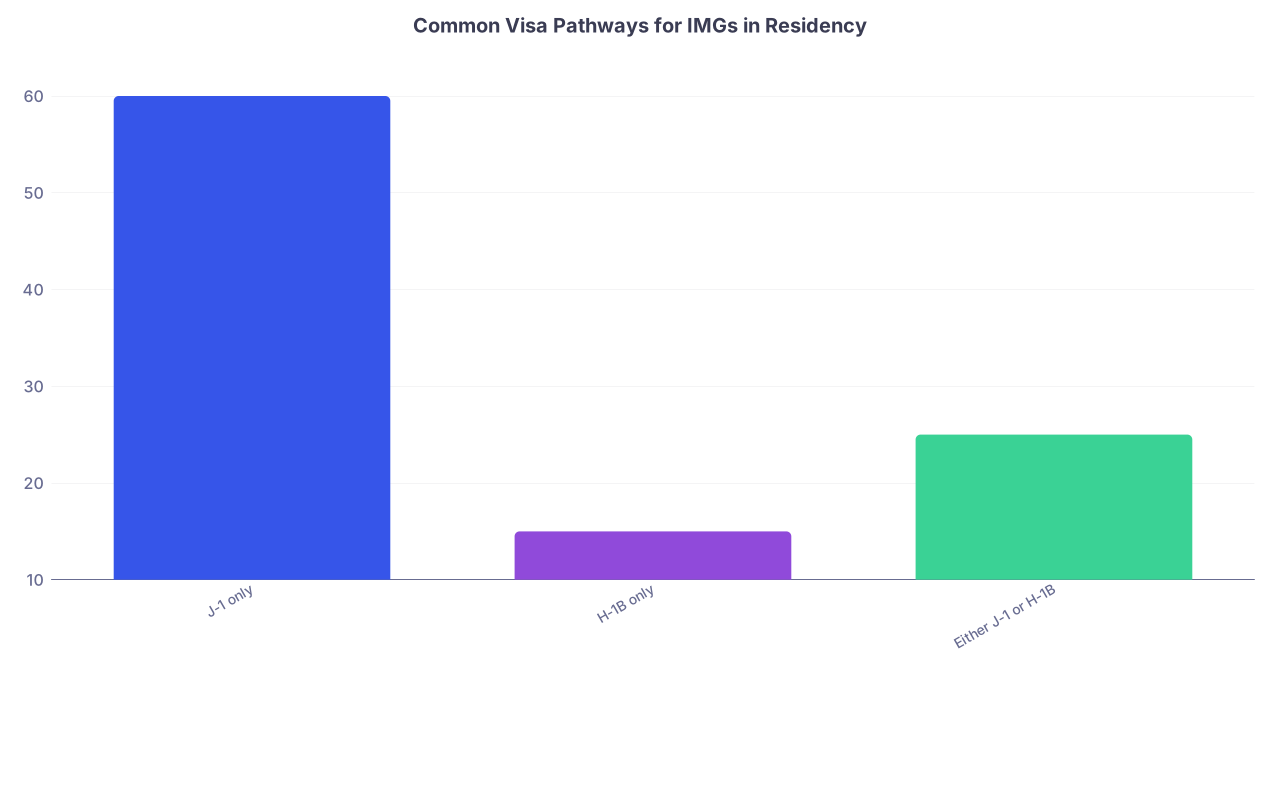
| Category | Value |
|---|---|
| J-1 only | 60 |
| H-1B only | 15 |
| Either J-1 or H-1B | 25 |
How J‑1 Interacts With Family‑Based Green Cards
This is the part everyone quietly freaks about, because it’s not obvious until you’re deep into immigration forums at 3 a.m.
Situation 1: Your Parents are Green Card Holders / Citizens
You’re thinking: “My parents will sponsor me—so I can just take J‑1 now and get a green card later, right?”
Reality:
- If you’re over 21, you’re not a 'child' anymore legally
- That puts you into slower categories:
- If they’re U.S. citizens: you’re in the F1 (unmarried son/daughter) or F3 (married) category
- If they’re green card holders: you’re F2B (unmarried son/daughter)
Those categories can have years of waiting, depending on your country. During those years, you still have to maintain some legal status (J‑1, H‑1B, etc.).
Now add 212(e):
- If you’re subject to the two‑year rule and you don’t get a waiver,
- You usually cannot adjust status in the U.S. to a green card through your parents
- Until you either:
- Complete the 2 years at home country, or
- Get a 212(e) waiver
So if you go J‑1, finish residency, and then your parents file for you, but you never deal with 212(e), you’re just… stuck. Approved petition or not.
Situation 2: Spouse or Fiancé(e) is a U.S. Citizen / Green Card Holder
This is messier emotionally.
- You marry during residency or fellowship
- Your spouse wants to apply for your green card
- But you’re still under J‑1 with 212(e)
You can still do a J‑1 waiver and then move onto H‑1B and then green card through spouse. That’s a very common path.
But if you:
- Ignore the waiver process,
- Let your J‑1 run out,
- And don’t have your 2 years at home done…
You can’t just flip a switch and become a permanent resident because you’re married to a citizen. 212(e) blocks that adjustment too.
Bottom line: Family in the U.S. doesn’t magically erase J‑1 obligations. But J‑1 obligations also don’t make a family‑based green card impossible. They just add steps.

J‑1 Waiver: The Bridge Between Training and Green Card
If you remember one phrase from this entire thing, let it be this:
“J‑1 waiver job.”
That’s your exit door from the 2‑year home requirement.
What Is a J‑1 Waiver Job?
For most IMGs, it’s a job in a medically underserved or rural area where:
- A state’s Conrad 30 program, a federal agency (like VA, HHS), or another route
- Requests that your 2‑year requirement be waived
- In exchange for you working there, typically:
- Full‑time
- 3 years
- Often on H‑1B status
Once your waiver is granted and you complete those service years, the 212(e) problem stops blocking green card options.
Then:
- Your employer sponsors you for EB‑2/EB‑3 green card
- Or you use family sponsorship, depending on what’s available
Is it glamorous? No. Some of those jobs are in the middle of nowhere.
Is it how a huge number of J‑1 IMGs eventually get green cards? Yes.

| Step | Description |
|---|---|
| Step 1 | Match on J-1 |
| Step 2 | Residency/Fellowship on J-1 |
| Step 3 | Seek J-1 Waiver Job |
| Step 4 | J-1 Waiver Approved |
| Step 5 | Work 3 Years in Underserved Area on H-1B |
| Step 6 | Employer or Family Files Green Card Petition |
| Step 7 | Green Card Approved |
So Should You Avoid J‑1 If You Have Family in the U.S.?
This is where the anxiety really spikes. Because there’s no perfect answer.
Here’s the honest breakdown.
When J‑1 Is Still Probably Worth It
- You don’t have any realistic H‑1B offers
- The J‑1 program is solid for your career (think University of Michigan IM, Mayo Clinic psych, etc.)
- You’re okay with the idea of:
- Doing a waiver job after training
- Potentially being away from your family’s city for a few years
- Your family is stable in the U.S. and staying long‑term, so a small delay is painful but not fatal
When You Should Push Hard for H‑1B
- You already have or will very likely have:
- U.S. citizen spouse
- Or a U.S. employer eager to sponsor you early
- You absolutely don’t want the geographic restriction of waiver jobs
- You’re aiming for extremely competitive fellowships or academic careers where location matters
- You’re the primary caregiver/emotional support for family in one specific area, and being sent to a rural, distant state for 3 years is not acceptable for you
But here’s the thing nobody likes to admit:
A lot of IMGs don’t get to choose. If your match list is J‑1 heavy, refusing J‑1 often means not matching at all.
No green card is worth much if you’re not practicing as a doctor.
So, tragic as it feels, sometimes the actual decision is:
“J‑1 and a real residency spot”
vs
“No match, no training, no U.S. path at all”
In that scenario, I’d take J‑1 and start planning the waiver + green card route early, not bury my head in the sand.
The Silent Killer: Intent and Timing
Here’s the part that messes with your head: J‑1 is a nonimmigrant visa. You’re supposed to have “nonimmigrant intent” when you get it.
So you panic: “If I ever admit I want a green card, they’ll deny my J‑1, right?”
Reality’s a bit less dramatic.
For J‑1:
- You’re expected to show you plan to return home or at least that you accept the 2‑year rule
- But tons of J‑1 physicians later get waivers and green cards. It’s not some secret scandal. The system is built that way.
Where you can really screw yourself is by:
- Lying on DS‑160s or at visa interviews
- Making inconsistent claims like:
- “I have no intention to stay in the U.S.” while also
- Having active immigrant petitions filed right now in a way that clearly contradicts what you’re saying
You can still have a long‑term hope of a green card and honestly say, “Right now, I’m coming for training under the J‑1 rules, including 212(e).”
The long‑term hope becomes real after you deal with the J‑1 obligations (through a waiver, usually).
Don’t overthink this into paralysis. Do respect that what you say in immigration paperwork is taken seriously.
| Factor | J-1 Physician | H-1B Physician |
|---|---|---|
| 2-year home requirement | Yes (almost always) | No |
| Dual intent allowed | No | Yes |
| Typical next step | J-1 waiver job → H-1B | Direct to green card sponsorship |
| Common for IMG residencies | Very common | Less common, program-dependent |
| Family-based green card | Needs waiver or 2 yrs at home | Can file and adjust in U.S. |
How to Protect Your Green Card Future If You Go J‑1
You can’t remove all risk. But you can avoid the dumb, preventable disasters.
Do this if you’re leaning J‑1:
- Talk to an actual immigration lawyer who works with J‑1 physicians. Not Reddit. Not that one friend of a friend. A real attorney. Ideally before you sign contracts.
- Ask programs, point‑blank: “Do you support J‑1 waiver job placement later? Have prior residents successfully done Conrad 30 and then green card?”
- Start thinking early about:
- Which states you might want a waiver job in
- Where your family could survive you being away for 3 years
- If you have U.S. family:
- Understand what category they’d file under
- Look at actual visa bulletin wait times for your country
- Don’t just vaguely assume “my parents will sponsor me and it’ll be fine”
And please, don’t rely on some magical future where “maybe they’ll change the law.” They might. They also might not. Your life can’t be built on that.
FAQs: J‑1, Family in the U.S., and Green Card Panic
1. If I take J‑1 for residency, does that mean I can never get a green card through my parents or spouse?
No. It means you probably have to either complete the 2 years in your home country or get a 212(e) waiver first. After that, family‑based options open up. Tons of J‑1 physicians end up doing exactly that—waiver job → H‑1B → green card via employer or family.
2. My parents are U.S. citizens and want to sponsor me. Should I skip J‑1 and stay home until the green card comes?
Depends on your age, country, and how long that category will take. If you’re already in the “unmarried son/daughter over 21” category with a 5–10+ year wait, you might stall your career for a very long time. Often it makes more sense to keep moving (even on J‑1), then later transition using a waiver + green card, rather than sitting in limbo.
3. Can I switch from J‑1 to H‑1B during residency to avoid the 2‑year rule?
Usually no. If you’re already subject to 212(e), you can’t just switch to H‑1B in the U.S. without either:
- Completing the 2 years in your home country, or
- Getting a J‑1 waiver first
Some people switch programs or pathways, but it’s complicated and needs a lawyer. Don’t bank on this as your Plan A.
4. If I marry a U.S. citizen during residency on J‑1, can’t I just adjust status and skip the home requirement?
Not if you’re subject to 212(e) and haven’t gotten a waiver or done the 2 years. Marriage to a citizen doesn’t magically cancel that rule. Most people in that situation still need to get a J‑1 waiver and move to H‑1B or another status before they can actually get the green card.
5. I’m scared a consular officer will deny my J‑1 if I admit I hope to stay long‑term. What do I say?
You don’t need to give a TED Talk about your 20‑year plan. You’re going for training under J‑1 rules, and you understand that includes a possible return home or waiver requirement. That’s honest and consistent with the law. Don’t volunteer extra drama, but don’t lie either.
6. If I have a J‑1 waiver job in a rural state, am I stuck there forever?
No. You’re generally committing to 3 years in that underserved area to fulfill the waiver obligation. After that, you can move to a different employer, different state, different job—especially once your green card is in process or approved. The waiver years are a chapter, not your whole book.
Key points to hold onto when your brain is spiraling:
- J‑1 doesn’t destroy your green card chances, but it does add extra required steps (waiver or 2 years at home).
- Having family in the U.S. doesn’t cancel 212(e), but it also doesn’t block you from getting a waiver and then a green card later.
- The real danger isn’t J‑1 itself—it’s going into it blindly, without a plan, and waking up at the end of residency realizing you never thought about the waiver or long‑term path.
You don’t need a perfect path. You need a realistic one that keeps both your career and your family in the picture.


