

It’s 2:17 a.m. You’re on night float. Between pages, you open your email… and there it is. A vague message from GME or HR about “re-evaluating H-1B sponsorship policy for future academic years.” Your stomach drops. You reread the same sentence ten times. You start doing math in your head: visa dates, training years left, Match rules, everything.
And the question won’t turn off:
What if they stop my H-1B support while I’m still in residency?
Let me say the scary part out loud: yes, programs can change policy. Yes, people have been blindsided. I’ve seen residents find out in April that from July on, their hospital “no longer sponsors H-1Bs for house staff.” So your anxiety here? Not crazy. Not overreacting.
But I’ve also seen people land on their feet. Sometimes with scars. Sometimes with a better setup than they started with.
Let’s walk through what actually happens, how bad it can get, and what your real options are if the worst-case scenario you’re playing in your head decides to show up in real life.
First: Can They Really Just Stop Sponsoring My H-1B?
Short answer: yes. They can change policy. But no, they cannot just snap their fingers and deport you tomorrow.
Here’s the split reality:
On the program side:
They can decide, “We’re not going to file new H-1Bs or extensions for trainees anymore.” Sometimes it’s because they hired a new lawyer. Sometimes it’s cost. Sometimes they suddenly remember “we’re really a J-1 institution.” Honestly, half the time it’s driven by someone in administration who doesn’t even understand what that means for you as a human being.
On the immigration side:
Your status depends on what’s already approved or pending with USCIS, not on a random policy email. If your current H-1B petition is approved through, say, June 30, 2027, that doesn’t evaporate because HR changed their handbook in 2025.
Where it hurts is here:
- You need extensions if your training goes beyond your current end date.
- You might need a new H-1B petition if you change programs.
- You’re only allowed to work while you’re in valid status and your petition is approved or properly extended.
So the big risk is less “they cancel your current H-1B overnight” and more “they refuse to extend it when you still have training left.”
That’s still bad. But it’s a different kind of bad than the panic scenario of “I’ll be illegal tomorrow.”
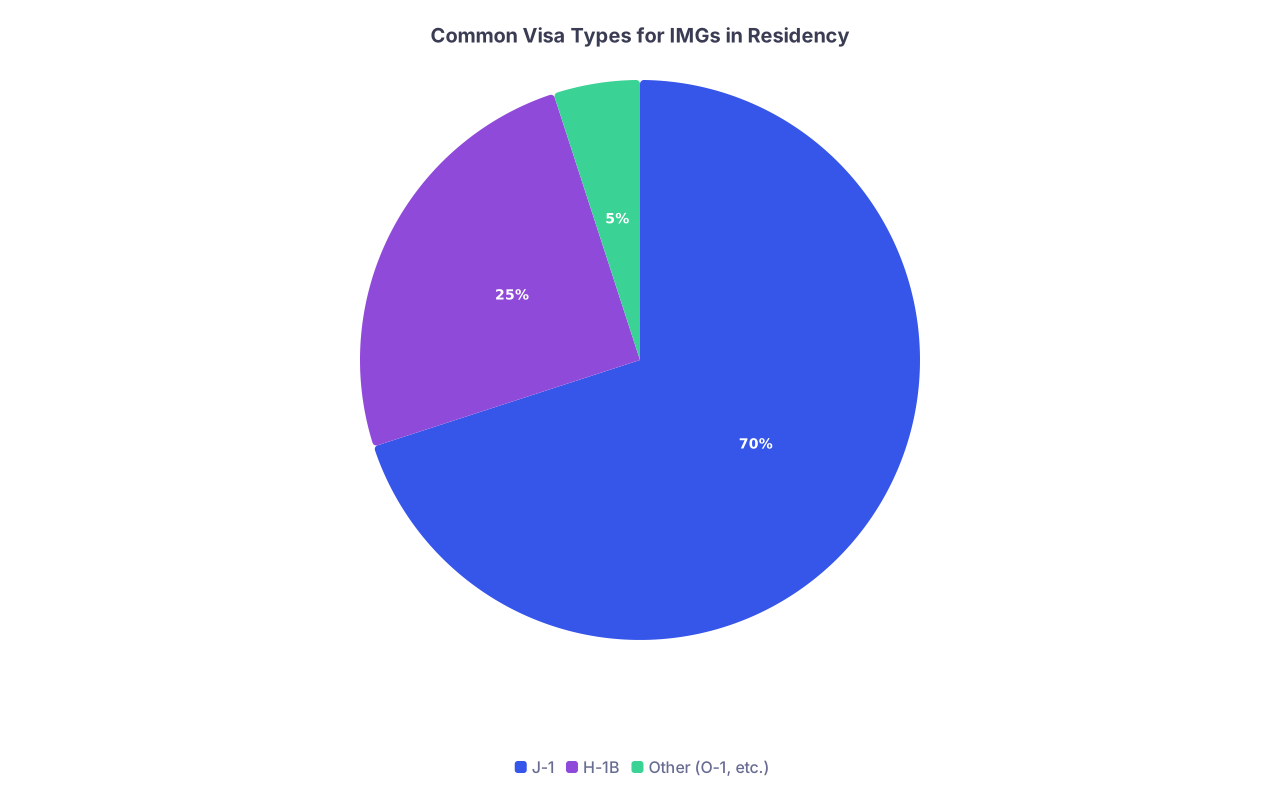
| Category | Value |
|---|---|
| J-1 | 70 |
| H-1B | 25 |
| Other (O-1, etc.) | 5 |
The Three Common Flavors of This Nightmare
There are a few patterns I see repeat over and over. None of them are fun, but some are survivable with less damage than others.
1. “We’re not filing H-1B for next year”
This is the more common one. You get told in PGY-1 or PGY-2:
“We’ll let your current H-1B run out but won’t extend for the rest of your training.”
Translation:
- They’ll honor what’s already approved.
- After that, you’re on your own.
If this happens and you still have multiple years of training ahead, it’s awful but you have time to strategize. You’re not out of status today. You are on a clock.
2. “We made a mistake and can’t extend your H-1B at all”
This one’s uglier. Sometimes:
- Their lawyer decides your previous setup was wrong.
- They realize you never took Step 3 when they filed (yes, this happens).
- They decide they can’t meet the wage requirements anymore.
Suddenly they say: “We can’t file your extension.” Or worse, “Our H-1B was denied.”
Now you’re not dealing with “policy shift for next year.” You’re dealing with a potential stop to work authorization around your current expiration date.
3. Full policy flip: “We’re going all J-1 for residents”
This one you’re probably dreading the most if you have home country issues or J-1 home return requirement problems. Program flips to exclusively J-1. You’re already on H-1B. They say they won’t extend your H-1B or file a new one.
They might offer to “switch you to J-1.” Depending on your personal situation, that’s either a reasonable pivot… or completely impossible.
None of these situations is hopeless. But none is trivial either.
What Actually Happens to Your Status If They Stop Support?
Let’s strip away the drama and talk mechanics.

Your life revolves around a few dates and documents:
- Your current H-1B approval notice (I-797)
- The end date on that notice
- Whether an extension is pending before that date
- The exact date your training contract ends each year
If your program says, “We’re not filing again,” what that typically means is:
- You can keep working lawfully until your current H-1B end date
- After that, unless some new petition (same or different employer) is filed and approved or at least timely filed, you lose work authorization
- There is no magic “grace year” for you to finish training
Yes, there is a 60-day grace period after H-1B employment ends in some contexts. But you cannot work during that time. It’s for wrapping up, transferring, changing status—not for showing up to continuity clinic and pretending everything’s fine.
So the cliff you’re afraid of? It’s real. It just has a date printed on it. That date is on your I-797.
Do I Have Any Options If They Drop Me Mid-Training?
You do. None are perfect. Some are messy and risky. But you’re not automatically done.
| Option | Main Use Case |
|---|---|
| Transfer H-1B | Move to another residency/fellowship that sponsors H-1B |
| Switch to J-1 | If home-country requirement is acceptable or waivable |
| O-1 Visa | Strong research / publications and institutional backing |
| Change to B-1/B-2 | Short-term bridge while planning next step |
1. H-1B Transfer to Another Program
If you can find another ACGME-accredited program willing to pick you up and file an H-1B petition, you can transfer.
Pros:
- You stay on H-1B status
- You may not count against the cap if you’re already cap-exempt through an academic institution
- You continue training
Cons:
- Programs have limited spots and political drama about mid-year transfers
- Not all are comfortable sponsoring H-1B at all, especially mid-cycle
- Timing is brutal—you need filing, approval (or at least receipt), and an actual offer quickly
Yes, people transfer between programs in PGY-2, PGY-3. It happens for non-visa reasons all the time (toxic environment, family relocation, etc.). But doing it under a tight H-1B deadline is like doing it with a gun to your head.
2. Switching to J-1
This sounds simple on paper. It’s not always.
You might be able to:
- Switch from H-1B to J-1 to finish training if ECFMG and the program support it
- Get DS-2019 issued through ECFMG
- Continue residency as a J-1, same program, new status
But then you’re facing:
- The 2-year home residency requirement after training, unless you later get a waiver
- Potential home country political/safety or career concerns
- Long-term trouble if your plan was a green card via H-1B and employer sponsorship
If you’re from a country where going back isn’t realistic (or safe), this can be a non-option.
3. O-1 “Extraordinary Ability” Route
This is the wild card. Everybody talks about it like some myth.
O-1 can be viable if:
- You have serious research: first-author papers, strong citations, national presentations
- You have letters from big-name people in your field
- You or your institution can hire a good O-1 lawyer and move fast
It’s not a casual backup plan for someone with a couple of posters and one case report. But if you’re an overachiever academic type, it’s worth exploring early before things are on fire.
4. Stopgap: B-1/B-2 or Other Status to Avoid Falling Out of Status
If the worst happens and you can’t keep working but don’t want to overstay:
Some people:
- Switch to a visitor status (B-1/B-2) temporarily to wrap up life, interview elsewhere, or prepare a different petition
- Use that window to file an O-1 or figure out next steps
You won’t be a resident during that time. You won’t be getting paid. This is survival mode, not ideal life planning. But it keeps your record cleaner than just silently overstaying.
Does the Program Have Any Obligation to Help Me?
Here’s the part that makes people angry.
Morally? Yes.
Legally? Mostly no, beyond basic contract and immigration compliance.
Most GME offices think in terms of:
“Can we legally employ this person?”
Not:
“What happens to this person’s entire life if we change our policy suddenly?”
A decent program will:
- Give clear written notice as early as possible
- Connect you to an immigration lawyer (theirs or one you hire)
- Help you explore J-1, transfer, or other options
- Write letters supporting a transfer or O-1 if you ask (and you should ask)
A bad program will:
- Bury the policy change in a generic “GME update” email
- Tell you “talk to HR” and wash their hands of it
- Tell you “we can’t give legal advice” as a shield for not doing basic human-level support
You can’t force them to sponsor you. But you can absolutely push for clarity, timelines, and written confirmation so you’re not playing guessing games with your future.
How to Respond Now If You See Red Flags
You’re probably already on edge because you’ve heard rumors. Or you saw one ominous line in a handbook.
Here’s a rough structure that helps you move from panic to action.

| Step | Description |
|---|---|
| Step 1 | Hear about H-1B policy change |
| Step 2 | Check I-797 end date |
| Step 3 | Ask GME for written clarification |
| Step 4 | Confirm timeline & lawyer |
| Step 5 | Consult immigration attorney |
| Step 6 | Explore H-1B transfer / J-1 / O-1 |
| Step 7 | Contact potential programs |
| Step 8 | Decide path & act before expiry |
| Step 9 | Still sponsoring your extension? |
Step 1: Pull out your I-797 and calendar
Write the end date where you’ll see it every day. That’s your real deadline. Not the gossip. Not the vibe.
Step 2: Get the program to say something clear in writing
“Can you please confirm in writing whether the institution will sponsor my H-1B extension through completion of my residency, assuming satisfactory performance?”
If they dodge, that’s its own answer.
Step 3: Talk to an actual immigration lawyer who understands physicians
Not your uncle’s friend who does real estate visas. Someone who does J-1 waivers, physician H-1Bs, O-1s. Get a paid consult if you can. Free advice is often worth what you paid.
Step 4: Quietly research backup programs
Look for:
- Same specialty, ACGME-accredited
- Track record of sponsoring H-1B for IMGs
- Any history of accepting transfers
You don’t need to tell your PD on day one that you’re looking. But don’t wait until your I-797 has three months left.

How Bad Is This For My Career Long-Term?
Let’s be blunt.
Worst-case:
- You can’t get an extension.
- You can’t find a transfer in time.
- You end up having to leave the U.S. without finishing residency.
That’s catastrophic in the moment. But it’s not game over for your life.
People do:
- Complete residency elsewhere (Canada, UK, home country), then later come back on different visas
- Re-enter on fellowships, research positions, O-1 setups
- Pivot to non-clinical roles that still value their medical background
Is that what you want? No. Of course not. You want the straight line: residency → fellowship → job → green card. The “Instagram version” of a physician immigrant story.
But the reality: there are more crooked paths than straight ones. And plenty of people still end up practicing and building decent lives here even after something like this derails their original route.
You’re not crazy for being terrified. Just don’t mistake “this is terrifying” for “this is definitely the end.”
Things You Can Do Before Anything Goes Wrong
Prevention isn’t perfect, but it helps.
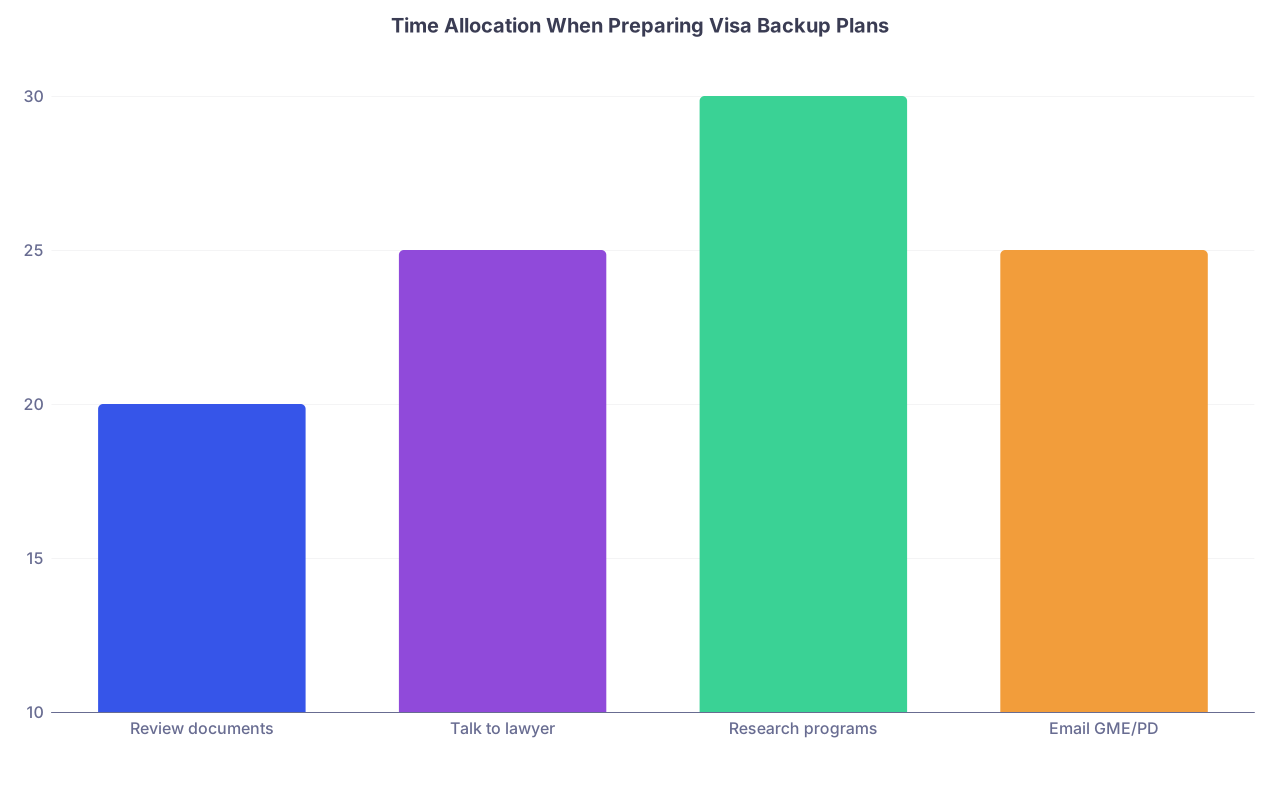
| Category | Value |
|---|---|
| Review documents | 20 |
| Talk to lawyer | 25 |
| Research programs | 30 |
| Email GME/PD | 25 |
If you’re still in the Match/application phase or early PGY-1:
- Be aggressive about asking programs exactly what they sponsor, for how long, and if there’s any plan to switch to J-1 only. If they’re vague, treat that as a red flag.
- Keep your Step 3 done as early as humanly possible. Lack of Step 3 has absolutely killed H-1B options for people who otherwise would’ve been fine.
- Start building a research/academic profile that could support an O-1 later if needed. Just in case.
- Keep copies of every visa document: I-797s, DS-2019s, I-94s, contracts. Don’t trust HR to have everything forever.
You can’t control hospital policies. You can control how boxed-in you are if they flip on you.
FAQ (Exactly 4 Questions)
1. Can my program cancel my current H-1B approval before it expires?
They can withdraw the petition with USCIS if they terminate your employment, but they usually don’t just randomly cancel a valid, in-use H-1B for a resident in good standing. If you’re still employed, working, and your contract is active, they typically let the current approval run its course. The real fight is over extensions, not mid-approval cancellations—unless there’s some performance or disciplinary issue.
2. If my H-1B extension is denied, do I have to stop working immediately?
Once a denial is issued, yes—there’s no continued work authorization based on that denied petition. You may have a grace period (up to 60 days or until your I-94 expires, whichever comes first) to remain in the U.S. and figure out your next move, but you cannot keep working as a resident during that time. That’s the hard edge most people underestimate.
3. Is switching from H-1B to J-1 mid-residency actually realistic?
Sometimes. I’ve seen residents switch H-1B → J-1 to finish training when the program refused H-1B extensions but was happy to sponsor J-1 through ECFMG. But it depends on ECFMG rules, your training timeline, your country’s situation, and the program’s willingness. And you’re trading away H-1B continuity for a J-1 that comes with the 2-year home requirement unless you later secure a waiver. It’s not a free fix.
4. Should I tell my program I’m looking for a transfer if they won’t extend my H-1B?
Eventually, yes. Initially, I’d quietly gather facts, talk to a lawyer, and maybe test the waters with other programs. Once you have an actual option or at least a plan, you should be transparent with your PD, especially if you’ll need letters or cooperation for a transfer. But you don’t owe them a panicked confession on day one of rumors. Get clarity and a strategy first; then loop them in.
Open your I-797 or approval email right now and write down your H-1B end date in big letters somewhere you can’t ignore it. That’s your anchor. From there, decide one next step: either email GME for written confirmation of sponsorship through graduation, or schedule a 30–60 minute consult with a real immigration lawyer who works with physicians. Don’t just sit with the anxiety in your head—turn it into a specific plan tied to actual dates.


