

What if your dream program’s website says nothing about visas… and you waste money applying to a place that will auto-reject you the second they see “IMG” and “needs visa” on your ERAS?
Because that’s what goes through your head, right?
“Silence” on a website starts to feel like “We don’t want you.”
Let’s talk about that silence.
What “No Visa Mention” Usually Actually Means (vs. What Our Brain Tells Us)
Your brain:
“They hate IMGs. They hate visas. They hate me personally. I’m about to pay $30+ per program for nothing.”
Reality, in a lot of cases:
Their website is just… bad. Or outdated. Or written by someone who hasn’t thought about IMGs for 10 seconds.
I’ve seen:
- Programs that literally sponsor multiple J-1s and H-1Bs every year whose websites still say nothing at all about visas.
- Sites that still list “Step 1 minimum 220” in 2024.
- Pages last updated in 2017 acting like nothing has changed in ECFMG or USMLE land.
Some programs are amazing clinicians and awful web admins. They assume that if you’re interested, you’ll email. Or they just don’t realize IMGs scrutinize every line like it’s a legal contract.
Here’s the honest breakdown of what “no visa info” might mean:
| Scenario | What It Often Means |
|---|---|
| No visa info anywhere | They haven't thought to add it / lazy site |
| Old last-updated date (years) | Outdated info, not policy |
| Has former IMGs in residents | Likely open to visas (at least J-1) |
| Affiliated with university | Often sponsor J-1 through GME office |
| Small community hospital, no IMGs | Higher chance they don't sponsor visas |
This is messy and inconsistent. That’s the truth. There’s no universal rule where “no visa mention = automatic no.”
But if you’re waiting for a crystal-clear line on every website that says “WE WILL 100% SPONSOR YOU” before you apply anywhere… you’ll probably undershoot and hurt yourself.
The Big, Ugly Fear: Am I Wasting Money Applying?
Let me say the thing you’re probably thinking:
“I barely have money for ERAS as it is. I can’t just ‘take a chance’ on 20 programs that might not even look at my application because of visas.”
Yeah. That fear is valid. Application fees hit harder when you’re paying in another currency, maybe not working full-time, maybe supporting family. It’s not theoretical.
So the question isn’t: “Should I apply everywhere just in case?”
It’s: “When is taking the risk reasonable, and when am I burning money?”
Here’s how I’d think about it.
1. Check how they treat IMGs in general
You can usually see current residents on the website or on social media.
If you see:
- Multiple international-sounding names
- Medical schools listed from outside the US/Canada
- Photos with ECFMG mentions or international graduation years
That’s a green-ish flag. Programs open to IMGs usually:
- Already know the visa process
- Already work with ECFMG
- Have sponsored J-1s at minimum
If their entire resident list is US MD/DO, all from nearby schools, and no one is obviously an IMG? Combine that with no visa mention… now I’d be more cautious.
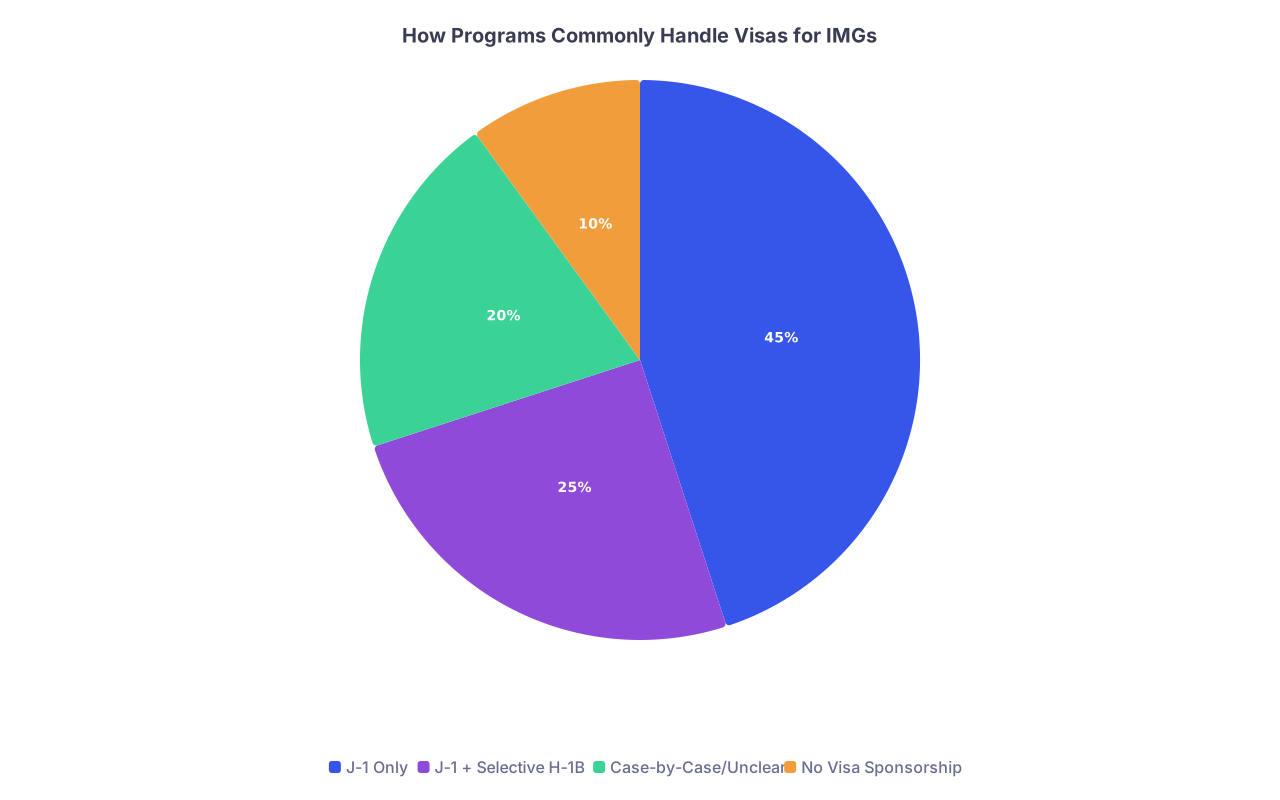
| Category | Value |
|---|---|
| J-1 Only | 45 |
| J-1 + Selective H-1B | 25 |
| Case-by-Case/Unclear | 20 |
| No Visa Sponsorship | 10 |
2. Look at program type and setting
I hate stereotypes, but patterns exist.
- Big university or large teaching hospital, especially in big cities (NYC, Chicago, Houston, Philly): much more likely to be familiar with visas, even if they don’t spell it out.
- Community programs with a history of IMGs: often J-1 friendly at least.
- Very small community programs in areas with few IMGs and no GME office listed: higher chance they just don’t sponsor.
None of this is guaranteed. But if you’re deciding where to risk money, patterns matter.
How to Investigate a Program with No Visa Info (Before You Panic or Pay)
Okay, here’s the part where you actually do something instead of spiraling at 1 a.m. in front of a glowing ERAS tab.
Step 1: Check FREIDA and other official listings
FREIDA isn’t perfect, but it’s better than nothing.
They often list:
- “Accepts IMGs?”
- “Sponsorship for J-1?”
- “Sponsorship for H-1B?”
If FREIDA says “J-1 sponsored” and the website is silent, I’d trust FREIDA + current resident lists more than the silence.
If FREIDA is blank and the website is blank and you see no IMGs… that’s a much bigger question mark.
Step 2: Stalk the resident list like your match depends on it (because it sort of does)
Try to find:
- Names that look international
- MD/MBBS from outside US/Canada
- LinkedIn profiles or old hospital introductions
If you can clearly see an IMG from, say, India, Pakistan, Nigeria, Egypt, etc., in PGY-1 or PGY-2 right now, then guess what? Someone was on a visa recently.
If you’re extra anxious (same), you can even:
- Google “Dr [Name] J-1 visa” or “Dr [Name] ECFMG”
- Look them up on LinkedIn: many IMGs will list “J-1 visa holder”
If they’ve taken an IMG recently, it’s extremely unlikely they suddenly decided, “We will never ever sponsor visas again,” and just didn’t tell anyone.

Step 3: Email them — but don’t make it weird
This is the part everyone overthinks.
You: “If I mention I need a visa, will they blacklist me?”
Reality: They already know you’re an IMG from your school. They will figure out the visa thing at some point.
Short, direct email. Something like:
Subject: Question about visa sponsorship for [Specialty] residency
Dear [Coordinator’s Name],
I’m an international medical graduate interested in applying to your [Year] [Specialty] residency program. I wasn’t able to find up-to-date information on your website regarding visa sponsorship.
Could you please let me know whether your program sponsors J-1 and/or H-1B visas for residents?
Thank you very much for your time.
Sincerely,
[Name], [Med School], ECFMG Certified / [Status]
That’s it. No life story. No begging. You’re not asking for an exception, you’re asking a factual question.
If their response is:
- “We only accept applicants who do not require visa sponsorship.” → Don’t apply. Save your money.
- “We sponsor J-1 visas through ECFMG.” → If you’re okay with J-1, that’s basically a green light.
- “We don’t sponsor H-1B visas.” → If you absolutely need H-1B only, then you decide. But at least it’s clear.
- Silence → annoying, but not uncommon. Then you’re back to reading between the lines with residents’ backgrounds and FREIDA.
When You Should Still Apply (Even with No Visa Mention)
Let me be blunt: if you only apply to programs with perfectly clear visa language, you’ll cut your list to a scary small number.
You should strongly consider applying if most of these are true:
- The program has visible current or recent IMGs in their resident list.
- FREIDA or other sources indicate J-1 sponsorship.
- The program is part of a larger university or health system that commonly sponsors visas.
- You get any confirmation via email that they sponsor at least J-1.
Even if the visa policy isn’t spelled out nicely on a FAQ page, if they’re clearly training IMGs right now, there’s a decent chance they’ll look at you.
Is it risk-free? No. But residency applications are never risk-free, especially for IMGs.
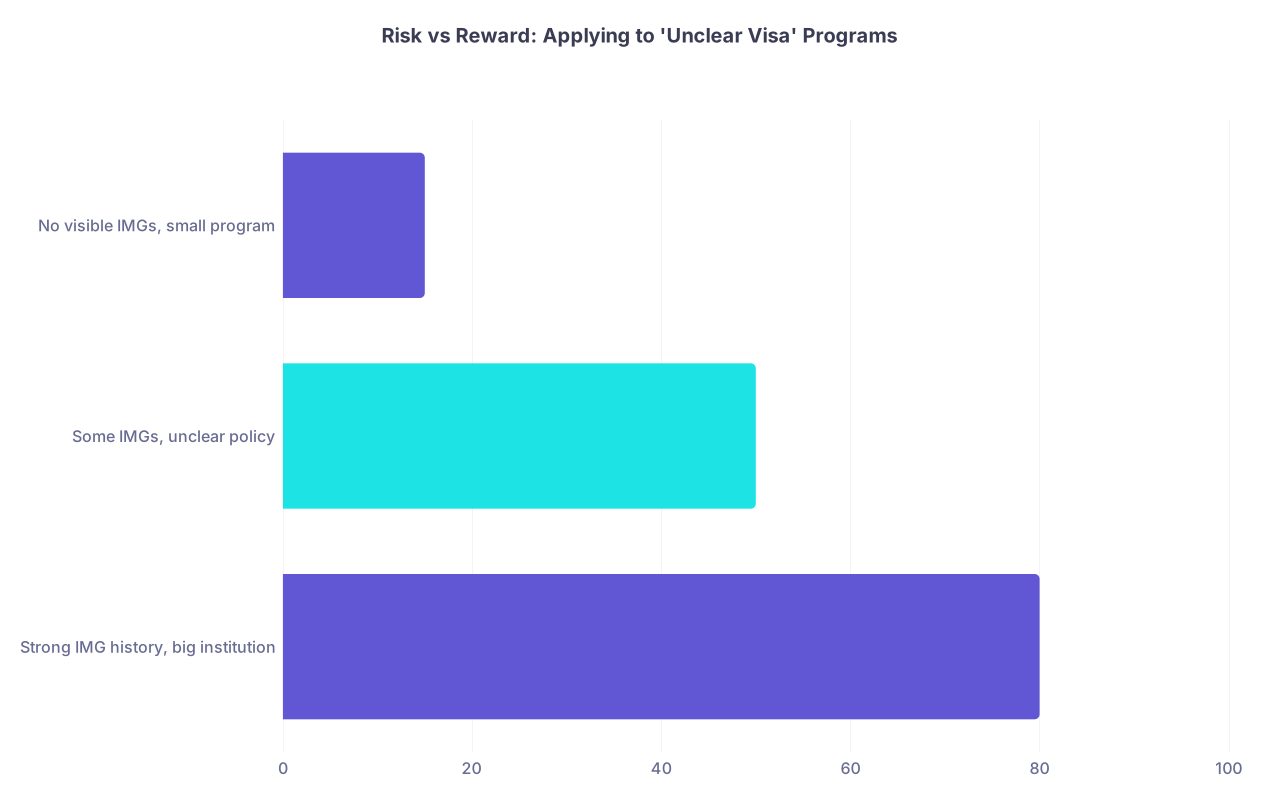
| Category | Value |
|---|---|
| Strong IMG history, big institution | 80 |
| Some IMGs, unclear policy | 50 |
| No visible IMGs, small program | 15 |
(Values represent rough “worth applying” likelihood as I’d personally see it, not exact statistics.)
When You’re Probably Wasting Your Money
There are situations where the silence is basically a soft “no” dressed up as nothing:
- Website:
“We only accept graduates from LCME-accredited medical schools.”
That’s usually code for US/Canada only. - Resident list: 100% US MD/DO, no obvious IMGs, in a place that doesn’t typically have many international residents.
- FREIDA: “Does not sponsor visas” or explicitly says “No IMGs” or “No visa sponsorship.”
- Email reply (if they even send one): “We do not sponsor visas and are unable to consider applicants who require sponsorship.”
In that situation, applying “just in case” is usually emotional, not strategic. You’re hoping for a miracle from people who already told you no.
You don’t need 5 different ways of being rejected by the same program.
The Emotional Side: It’s Not Just Policy, It’s Exhaustion
There’s a special kind of anxiety that IMGs get around visas.
It’s not just, “Will they like my application?”
It’s, “Even if they like me, can I legally work there?”
And, “Even if I match, will I be stuck because my visa type blocks me from some jobs later?”
You’re not just choosing programs. It feels like you’re choosing a whole future immigration path. From a website that sometimes hasn’t been updated since Obama’s first term.
Here’s the thing most people won’t say out loud:
You will not optimize this perfectly. No one does.
- You will apply to a few programs that won’t look at you.
- You will miss a few that might have liked you if you’d stretched your list.
- You will always wonder if you should have applied to “just a few more.”
But having an informed risk is different from blind panic or blind hope.

| Step | Description |
|---|---|
| Step 1 | No visa info on website |
| Step 2 | Check residents & FREIDA |
| Step 3 | Likely visa friendly |
| Step 4 | Higher risk |
| Step 5 | Email coordinator about J-1/H-1B |
| Step 6 | Reasonable to apply |
| Step 7 | Skip, save money |
| Step 8 | Decide based on IMG history & budget |
| Step 9 | Current/recent IMGs? |
| Step 10 | Response? |
Balancing Strategy and Sanity: How Many “Unclear” Programs to Include
You don’t want 80% of your list to be “maybe they’ll consider me.” But you also don’t want 0% risk and 100% ultra-safe options that barely interview IMGs.
A rough way I’d think about it (not rigid numbers, just vibe):
- Core list: programs with clear J-1 support and obvious IMG history.
- Stretch list: programs with “unclear” websites but visible IMGs + decent signs.
- Avoid-list: programs explicitly saying no visas or IMGs.
You might decide something like:
- 60–70% of your applications → clearly IMG + visa friendly
- 20–30% → “unclear but promising”
- 0–10% → extreme reaches, where even US grads struggle to match
That way, a few “no website info” programs can be part of your strategy, not your entire plan.
One More Ugly Truth: Policies Change, Websites Don’t
Programs change DIOs, GME policies, hospital contracts. Visa sponsorship can shift from year to year.
I’ve literally seen this:
- One year: “We sponsor H-1B and J-1.”
- Next year: Residents told, “No more H-1Bs because legal costs.”
- Website: Never updated. For years.
So even if last year they sponsored H-1B, that does not guarantee this year they will. That’s exactly why emailing now, this cycle, is so important.
If you’re really pressed on money, email becomes non-negotiable. You need that data point before paying.
What You Can Do Today (So You Don’t Just Sit and Worry)
You’re probably sitting there with a half-finished program list, 20 tabs open, and a calculator app haunting you.
Do this:
Right now, pick 5 programs on your list that:
- Have no clear visa info on their website,
- But look attractive to you in every other way.
For each of those 5:
- Check FREIDA and their current residents.
- If it’s still unclear, draft the short visa email I wrote earlier.
- Send all 5 emails today. Not tomorrow. Today.
You’re not deciding your entire future tonight. You’re just moving from “paralyzed and guessing” to “collecting real answers.”
Open your list, pick those 5 borderline programs, and send that one-sentence visa question email.
Don’t just sit there assuming the silence means “no” — force it to become either “yes,” “no,” or “not worth the risk.”


