

What happens if Match Day comes… and every program that liked you doesn’t sponsor the visa you actually need?
Because that’s the nightmare, right?
Not just “what if I don’t match” but “what if I match, technically, but can’t actually go because of the visa?”
Let’s pull this apart like an anxious person (because same), but in a way that actually gives you a plan instead of just more stomach pain.
First: Can This Actually Happen?
Yes. It can.
And I’ve seen variations of it play out:
- You ranked a bunch of H‑1B programs first… and only got an offer from a J‑1‑only place.
- You’re Canadian, need a TN or J‑1, and the one place that ranked you high doesn’t do either.
- You need J‑1 because your home country won’t issue the required statement-of-need in time for another visa category, but the only program that matched you is H‑1B only.
- You get a preliminary year at a visa-unfriendly program and then suddenly need another visa switch for PGY‑2.
The system cares about NRMP rules. It doesn’t care about whether USCIS or ECFMG will play nice with your specific situation.
So yes, worst case:
You could end up:
- Not matched at all
- Matched but unable to start because the program can’t/won’t sponsor the visa you qualify for
- Stuck between two bad visa options with tight deadlines and a lot of risk
Now the more useful part: what then?
The Visa Reality Check No One Spells Out

Let me be blunt: programs will NOT redesign their visa policy around you.
They may like you. They may say nice things. They won’t change their hospital’s legal/HR structure because you emailed a heartfelt paragraph about your dreams.
Here’s the oversimplified version of what you’re up against:
| Visa Type | Common For | Key Catch |
|---|---|---|
| J-1 | Most IMGs | 2-year home return requirement (unless waived) |
| H-1B | More competitive IMGs | Needs Step 3, higher cost, cap issues sometimes |
| O-1 | Rare, superstar CVs | Intense evidence burden, lawyer-heavy |
| TN | Canadian/Mexican citizens | Must qualify for specific category, not all specialties fit |
| F-1/OPT | Graduates of US med schools | Short work window, complex transitions |
The program usually has a default pattern like:
- “We only do J‑1”
- “We sponsor J‑1 and occasionally H‑1B if Step 3 done and HR approves”
- “We never sponsor visas; must already have your own independent work authorization (e.g., green card, EAD)”
So your fear is pretty rational: if your “preferred” or “required” visa doesn’t align with what they offer, you’re stuck.
But there’s a big difference between:
- “Preferred” visa (what you want – usually H‑1B)
- “Non‑starter” visa (what you cannot use – because of country, finances, long‑term goals, or legal restrictions)
You need to be crystal clear which one you’re actually talking about.
Scenario 1: You Don’t Match Anywhere At All
This is the cleanest, weirdly. Emotionally brutal, but logistically cleaner.
If you don’t match anywhere, visa type is a future problem. Right now it’s:
- SOAP?
- Gap year + reapply?
- Different country?
During SOAP
SOAP while being visa-limited is… ugly. You’re competing for a tiny pool of:
- Programs that are IMG‑friendly
- Programs that will sponsor anything
- Programs that will move fast with visa paperwork
Most SOAP spots are not set up to solve complicated visa puzzles on 48 hours’ notice.
So if you hit SOAP and need a specific visa type (say: must have H‑1B, or J‑1 is impossible), your realistic options shrink fast.
What I’d do in that scenario:
Talk to ECFMG / an immigration lawyer before SOAP opens.
Get very clear: what can you accept? What’s actually impossible vs just not ideal?Be brutally pragmatic in SOAP.
If J‑1 is not your ideal but is still possible, you have to decide: short‑term survival (getting into residency) vs long‑term visa strategy.Apply broadly in SOAP to any program whose visa policies don’t outright block you.
SOAP is not where you optimize. SOAP is where you avoid total collapse.
Scenario 2: You Match… But The Visa Doesn’t Work
This is the true horror story: you “succeed” and still can’t start.
Here’s the ugly-but-true checklist:
- The Match is binding from the training side, not the immigration side.
- If the program’s visa office/HR says no, they won’t risk their institution for you.
- They are not obligated to offer an alternative visa if their standard one doesn’t work.
But all is not automatically lost. Stuff I’ve seen happen:
- Someone thought they needed H‑1B, but J‑1 was actually still workable once they spoke to a proper lawyer.
- Step 3 was rushed and (barely) passed before visa deadlines so H‑1B became possible after initial doubt.
- Program initially said “we usually don’t do H‑1B” but changed to “we can with approval” once the applicant calmly made their case and showed they’d already passed Step 3 and had all documentation.
So if you matched and there's a mismatch:
Talk to the program coordinator and GME immediately.
Don’t spiral alone for three weeks. Ask directly:- “What visa types does your institution sponsor?”
- “What has been done for IMGs in the past few years?”
- “Is there any possibility of another category (e.g., H‑1B vs J‑1) if I meet all requirements?”
Get hard deadlines.
When do they need:- Forms submitted?
- Step 3 scores (if H‑1B possible)?
- DS‑2019 or H‑1B petition filed?
Loop in an actual immigration lawyer.
Not Reddit. Not your friend’s cousin. An actual doctor-visa-experienced lawyer.
Because sometimes the horror story is real:
They only do J‑1, you’re subject to something that makes J‑1 impossible, and they won’t touch H‑1B. In that case, you may end up in:
- Contract release / appointment cancelled
- Scramble for research / observerships
- Reapplying next year with a much stronger and more realistic visa strategy
It sucks. But pretending it’ll magically work out is how people lose months they could’ve used to regroup.
Scenario 3: You Can Technically Take J‑1… But You Wanted H‑1B
This is 90% of the worried messages I see.
You ranked H‑1B heavy programs high because:
- You’re terrified of the J‑1 2‑year home return requirement
- You want to stay in the US long term
- You’ve heard the phrase “J‑1 waiver hell” and now you can’t sleep
Then:
- You don’t match at H‑1B programs
- You only matched / got interest from J‑1‑only programs
- You’re asking yourself: “Should I refuse J‑1 and reapply next year for H‑1B?”
Here’s my honest, non-sugar-coated opinion:
Most people dramatically overestimate their ability to “do better next year” and underestimate how J‑1 + waiver can actually get them where they want long-term.
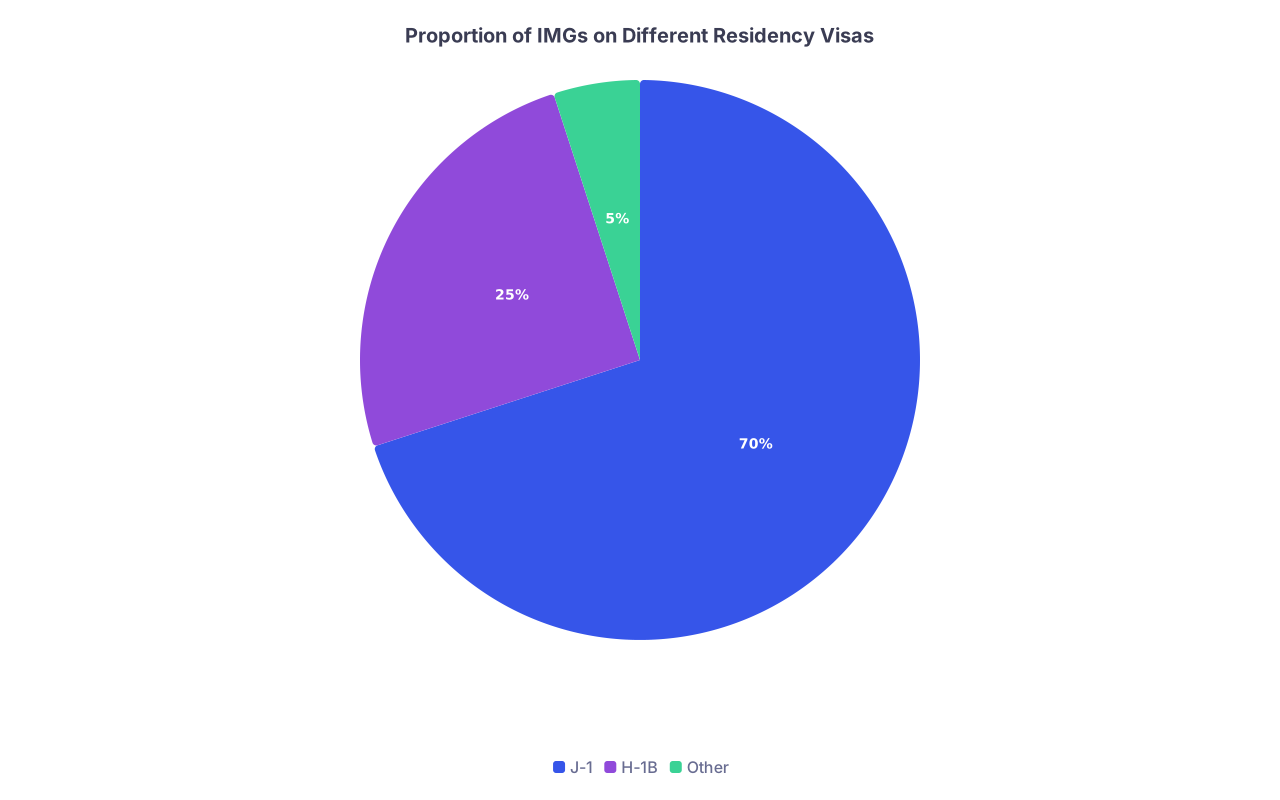
| Category | Value |
|---|---|
| J-1 | 70 |
| H-1B | 25 |
| Other | 5 |
J‑1 is not some fringe visa. It’s the default path for most IMGs in US residencies.
If you:
- Have no concrete, high‑yield way to massively improve your app within one year
- Don’t have a guaranteed pipeline to an H‑1B‑friendly program
- Are turning down a J‑1 spot based on vibes and fear, not actual legal advice
Then you’re probably gambling with your career.
Is H‑1B easier for long-term US life? Often, yes.
Is J‑1 an automatic life sentence back to your home country forever? No. Not if you plan.
If the only realistic offer you can get is at a J‑1‑only program, you have to choose:
- Career in US medicine with extra visa hoops later
vs - No career in US medicine at all (possibly ever)
Most people I’ve seen in hindsight say: they wish they’d taken the training and figured out the waiver later, rather than roll the dice on a theoretical H‑1B that never arrived.
What Can You Actually Do Now To Protect Yourself?

Let’s assume you’re pre‑Match or just matched and panicking.
Here’s the non-magical but real action list:
Clarify your true constraints.
Not “I prefer H‑1B.”
More like:- Am I legally barred from J‑1 (home country rules, prior J‑1 history, funding issues)?
- Is there any way I can satisfy the future 2‑year return requirement or get a waiver?
- Do I actually understand the consequences or am I just terrified of the unknown?
Before ranking (if you’re still pre‑Match):
- Call/email programs about visa types.
- Don’t rank places that categorically cannot sponsor any visa you can use.
- Put realistic visa sponsors higher, even if their “brand name” is lower. Name prestige doesn’t matter if you can’t legally show up.
If you already matched and the fit is messy:
- Get a lawyer consult immediately. 30–60 minutes can save you a year of chaos.
- Ask the program precisely what they’re willing to sponsor.
- See if step 3 (rushed but doable) could open H‑1B doors if they sometimes do it.
If it fully collapses (program refuses workable visa; you can’t start):
- Request written confirmation from the program/GME about visa impossibility.
- Ask if they’d consider you for a future cycle if your visa status changes.
- Start lining up: research positions, observerships, US experience that keeps you close to clinical medicine.
- Plan your reapplication with realistic visa targeting (prioritize programs that match your visa reality, not your fantasy).
Mental Side: This Feels Personal, But It’s Systemic
I know it feels like the universe singled you out. It didn’t.
The system is built with US grads in mind. IMGs with visa needs are an afterthought—valuable but administratively annoying. That’s the truth.
Visa denials, institutional policies, “we don’t do that category,” HR delays—none of that says anything about your worth as a physician. It just says everything about how rigid and risk‑averse big institutions are.
You’re not “less than” because your passport makes training harder. You’re just forced to play a harder game with more paperwork and less margin for error.
So if you’re sitting there thinking:
- “Did I waste my entire life?”
- “Did I ruin everything by not understanding visas sooner?”
- “Should I have gone to another country instead?”
You’re not alone. I’ve heard all of those out loud from very capable people who eventually did match, did train, and did figure out a visa path that worked.
Visualizing Your Next Steps (So It’s Less Paralyzing)
Here’s a quick mental flowchart of what usually happens after the “oh no, visa” moment:

| Step | Description |
|---|---|
| Step 1 | Matched Result |
| Step 2 | Proceed with standard onboarding |
| Step 3 | Contact program GME/HR |
| Step 4 | Consult immigration lawyer and pursue alternative |
| Step 5 | Program unable to sponsor |
| Step 6 | Plan gap year + strengthen application |
| Step 7 | Seek research/clinical roles in other systems |
| Step 8 | Visa matches program policy? |
| Step 9 | Any alternative visa option? |
| Step 10 | Time to reapply? |
You’re somewhere on that chart. The goal isn’t to feel good right now. It’s to move a single box forward.
FAQs (Exactly 4)
1. Should I rank a program that doesn’t sponsor my preferred visa if I love everything else about it?
If “preferred” means “I like H‑1B more than J‑1,” but J‑1 is still possible for you, then yes, you can rank them and let the Match play out.
If “preferred” actually means “I literally cannot use anything except X visa because of legal or personal non‑negotiables,” then no—you shouldn’t rank a program that can’t sponsor what you must have. The Match doesn’t care that you misunderstood your own dealbreakers.
2. If I match at a J‑1‑only program now, can I switch to H‑1B later for fellowship?
Yes, sometimes. A lot of people do J‑1 for residency and later get H‑1B for fellowship or attending jobs after resolving the 2‑year rule with a waiver or by fulfilling it. It’s not guaranteed, and it takes planning and often service in an underserved area, but you’re not “locked” into J‑1 for all eternity. Residency visa ≠ permanent immigration fate.
3. Is it ever rational to decline a J‑1 spot and reapply later hoping for H‑1B?
Rarely, but yes, there are edge cases:
- You have a strong US research position lined up at a big‑name place that feeds directly into H‑1B‑friendly programs
- Your first application was rushed and weak, and you have a very realistic plan to significantly strengthen it (publications, US LORs, higher Step 2, etc.)
- A lawyer has reviewed your situation and believes J‑1 will genuinely box you into a dead end long‑term
But if the plan is “I’ll just try again and hope for better H‑1B luck,” that’s a fantasy, not a strategy.
4. What if my program verbally says they’ll “try” to get me H‑1B, but they usually do J‑1?
Get everything in writing. Verbal “we’ll try” means nothing if HR or GME shuts it down later. Ask for:
- Email confirmation of which visa types they’ve sponsored in the last few years
- Any institutional rules that might block you (like “must have Step 3 by X date”)
Then plan for J‑1 as the floor and H‑1B as a bonus if it comes through. Don’t build your entire future on a vague promise that isn’t backed by institutional history.
Key points, stripped down:
- Visa misalignment after Match is painful, but not rare—and it’s usually systemic, not personal.
- “Preferred” visa and “only viable” visa are different; you need to stop confusing them before you rank or make life‑changing decisions.
- If everything collapses, your career isn’t automatically over—but you’ll need a cold, realistic plan, not more wishful thinking.


