
Understanding the Visa Landscape as a Caribbean IMG in ENT
For a Caribbean medical school graduate aiming for an Otolaryngology (ENT) residency in the United States, the clinical and academic challenge is only half the story. The other half is visa navigation—understanding the practical steps, timelines, and strategic decisions that directly affect your ability to train and eventually practice in the U.S.
This is especially true if you’re coming from a Caribbean medical school with a strong North American focus—whether SGU, Ross, AUC, Saba, or another program. While schools like St. George’s University promote impressive outcomes such as the SGU residency match rates, those statistics assume you also successfully manage the immigration side of the equation.
In a competitive specialty like otolaryngology (ENT), where the otolaryngology match is one of the most selective in the NRMP, you cannot afford surprises with your residency visa status. Visa misunderstandings can undo years of academic work—even if your application is otherwise strong.
This guide walks you through:
- The main visa categories for residency (J-1 vs H-1B and others)
- How being a Caribbean IMG specifically influences your options
- ENT specialty–specific considerations
- Step-by-step planning from pre–ERAS through fellowship
- Long-term implications for career and immigration (including waivers and green card strategy)
Throughout, the focus is on practical, actionable advice tailored to Caribbean IMGs targeting ENT.
Core Visa Options for Residency: J-1 vs H-1B (and Why It Matters)
When people say “IMG visa options,” they usually mean one thing: J-1 vs H-1B. These are the dominant pathways for residency training.
1. J-1 Visa for Clinical Training
The J-1 exchange visitor visa (Physician category) is the most common visa for residency and fellowship training.
Who sponsors it?
The key point: ECFMG (Educational Commission for Foreign Medical Graduates) is your program sponsor, not the residency program itself. The program provides a training position and supporting paperwork, but ECFMG issues the DS-2019 and handles much of the oversight.
Key features of the J-1:
- Purpose: Graduate Medical Education (GME) training only
- Duration: Typically 1 year at a time, renewable up to 7 years (sometimes longer using a strict extension process)
- Employment: Restricted to the training program and any formally approved moonlighting (usually internal only)
- Two-year home residency requirement:
- After finishing your last J-1 training year, you generally must return to your home country (or country of last permanent residence) for 2 years before:
- Applying for H-1B
- Gaining an immigrant visa/green card
- Changing to certain other U.S. statuses
- This 2-year rule can be waived, but not automatically—more on this later.
- After finishing your last J-1 training year, you generally must return to your home country (or country of last permanent residence) for 2 years before:
Pros of J-1 for Caribbean IMGs in ENT:
- Widely used and well-understood by residency programs
- Many ENT programs that are IMG-friendly only sponsor J-1 (no H-1B)
- Administrative process largely managed by ECFMG
- Typically faster to process than H-1B if documents are in order
Cons:
- The 2-year home residency requirement is a major long-term factor
- Limited flexibility for switching to different visa categories during training
- Restricted moonlighting and geographic mobility
- Needs annual renewal through ECFMG with documentation and fees
For many Caribbean IMGs pursuing ENT, the default realistic path is J-1, simply because relatively few competitive ENT programs are willing to sponsor H-1B visas for residents.
2. H-1B Visa for Residency Training
The H-1B is a temporary work visa for “specialty occupations” and is sometimes used by residency programs for clinical training positions.
Who sponsors it?
Unlike J-1, your residency program is the direct petitioning employer. They file an H-1B petition for you with USCIS.
Key requirements:
- You must have:
- ECFMG certification
- Passed USMLE Step 3 before H-1B filing in almost all cases
- The institution must:
- Be willing to handle the legal process and costs
- Qualify you as a “specialty occupation” employee (physician with defined duties and salary)
Pros of H-1B for ENT residency:
- No 2-year home residency requirement
- Greater flexibility for later immigration options (transition to employer-sponsored green cards can be more straightforward)
- Potential for external moonlighting (subject to local policies and additional filings)
Cons:
- Far fewer programs sponsor H-1B, especially in small or highly competitive specialties like ENT
- Requires USMLE Step 3 completed early, often before Match rank list submission
- Can be more complex and slower to process; premium processing fees may be needed
- Not all hospital legal departments are comfortable using H-1B for residents
Many large academic centers with strong research infrastructure (where ENT residencies are often based) have institutional policies about whether they sponsor H-1B for residents. Most ENT programs that take IMGs use J-1 by default, making H-1B a real but limited option.
3. Other Visa/Status Scenarios
While J-1 vs H-1B dominates the conversation, Caribbean IMGs sometimes fall into other categories:
U.S. citizen or permanent resident (green card holder)
- No visa needed; full flexibility
- Still important to disclose accurate status in ERAS
F-1 student with OPT (Optional Practical Training)
- Rare for residency; can sometimes be a bridge if you completed a U.S. MPH or other graduate program
- Most GME offices prefer J-1 or H-1B over direct F-1 employment
Other nonimmigrant statuses (L-2, E-2 dependents, etc.)
- Possible but specialized; usually requires one-on-one consultation with GME and immigration counsel
For the majority of Caribbean IMG ENT applicants, the realistic planning should be centered around:
“If I get an offer, will they sponsor me on J-1, and is H-1B even an option at that institution?”

How Being a Caribbean IMG in ENT Shapes Your Visa Strategy
Not all IMGs are viewed the same way by U.S. programs. As a Caribbean IMG, you occupy a unique space between U.S. graduates and fully international applicants.
1. The “Caribbean IMG” Label and Program Perception
Caribbean medical schools (SGU, AUC, Ross, Saba, etc.) have:
- A curriculum closely aligned with U.S. standards
- Heavy emphasis on U.S. clinical rotations
- A track record of matching into U.S. residencies, including some SGU residency match successes in competitive specialties like ENT
However, you are still an IMG, and your need for a residency visa is a structural disadvantage compared to U.S. MD/DO students.
For a competitive field like otolaryngology (ENT):
- Many ENT programs do not consider IMGs at all
- Among those that do, many restrict to J-1 only
- A smaller subset will consider both J-1 and H-1B
Your job is to:
- Identify programs that historically accept IMGs in ENT
- Among those, determine their stated or practical policy on visas
- Align your preparation (e.g., Step 3 timing) with those policies if aiming for H-1B
2. Specialty Competitiveness and Visa Reality
ENT is among the most competitive specialties in the NRMP:
- Small number of positions nationally
- Historically very limited IMG penetration
- Strong emphasis on research, letters, and U.S. performance
Because programs have an abundance of qualified U.S. applicants, some decide not to deal with visa complexity at all. Therefore:
- You must assume that visa sponsorship is a major filter for your application
- Even if a program lists “sponsors J-1” in FREIDA, they might effectively be “U.S. citizens/green card holders only” in practice
Your visa strategy, therefore, becomes part of your program selection strategy.
3. Caribbean Clinical Rotations and Visa Timing
Caribbean schools usually schedule U.S. clinical rotations under student visas or other arrangements, not J-1 or H-1B. These rotations:
- Do not count toward any J-1 “training years”
- Are separate from residency visa status
However, the timing of your rotations can affect:
- When you can realistically sit for USMLE Step 3 (if you’re aiming for H-1B)
- Whether you will have letters from U.S. ENT faculty in time for ERAS
Plan your clinical schedule with an awareness that:
- ENT programs often expect strong ENT-specific letters and research
- H-1B–aspiring applicants must realistically pass Step 3 well before July 1 of PGY-1 (ideally before rank list certification)
J-1 vs H-1B: Strategic Decision-Making for ENT Applicants
For many Caribbean IMGs, the first question is: “Should I aim for J-1 or H-1B?” For ENT, the better framing is often: “Where can I actually match, and what do those programs sponsor?”
1. When J-1 Is the Realistic Primary Path
For most Caribbean IMGs targeting ENT:
- You should assume J-1 as the default
- Focus on maximizing your competitiveness (scores, research, clinical performance, networking) rather than over-optimizing around H-1B
Reasons:
- The majority of ENT programs that consider IMGs are J-1 only
- J-1 has a standardized ECFMG process that programs know and trust
- ENT programs may not be willing to handle H-1B for a trainee they consider “higher risk” (from their perspective) due to IMG status
Actionable steps if you plan for J-1:
Confirm program policies early.
- Use FREIDA, program websites, email coordinators
- Specifically ask: “Do you sponsor J-1 visas through ECFMG for international medical graduates?”
Understand the 2-year requirement impact now.
- If you intend to eventually practice long-term in the U.S., plan for:
- A J-1 waiver job after residency/fellowship, or
- A strategy to fulfill the 2-year home residency requirement
- If you intend to eventually practice long-term in the U.S., plan for:
Review ECFMG J-1 requirements early:
- Valid passport
- ECFMG certification
- Statement of Need from your home country (often processed via your Ministry of Health or equivalent)
Being proactive with these documents will reduce stress between Match Day and July 1.
2. When It Makes Sense to Aim for H-1B
In ENT, aiming for H-1B is a highly specialized strategy that makes sense if:
- You can realistically pass USMLE Step 3 early (ideally before ERAS submission or at least before rank list certification)
- You have identified ENT programs that have:
- A history of sponsoring H-1B for residents, and
- A record of taking IMGs in ENT
- You are highly competitive on objective metrics (Step scores, research, U.S. letters)
Concrete reasons to prefer H-1B (if possible):
- You want to avoid the J-1 2-year home residence requirement entirely
- You have long-term goals that involve:
- Early green card sponsorship or
- Remaining in the U.S. immediately post-residency in a non-waiver position
However, make sure you understand the trade-off:
- Limiting your application list only to H-1B–friendly ENT programs may dramatically shrink an already tiny pool of IMG-friendly positions.
- For many Caribbean IMGs, being open to J-1 is what keeps ENT in the realm of possibility at all.
A realistic strategy might be:
- Apply broadly to all IMG-accepting ENT programs that sponsor either J-1 or H-1B.
- If matched to a J-1–only program, accept that pathway and start planning early for a J-1 waiver or long-term immigration plan after training.
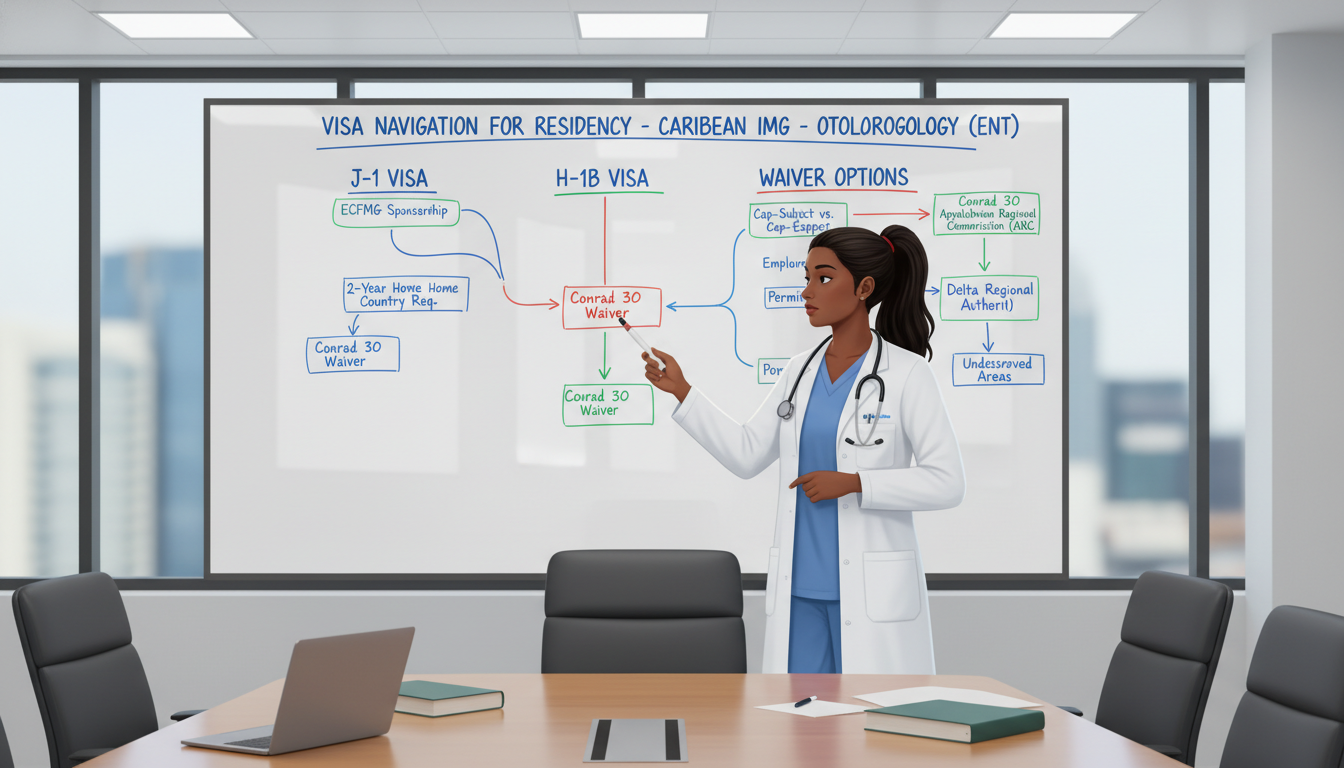
Planning the Visa Timeline: From ERAS to Fellowship
Timing is critical. Visa issues often arise not because options don’t exist, but because of delays or misalignment with application cycles.
1. Pre–ERAS: 12–18 Months Before Match
Key goals:
- Clarify your citizenship and immigration status
- Decide whether H-1B is a realistic target (based on Step 3 timing)
- Build a program list that accounts for visa policies
Action steps:
Review your passport validity.
- Ensure it doesn’t expire during your expected residency period. Renew early if needed.
Confirm school documentation.
- Caribbean schools are usually familiar with ECFMG processes; ensure your paperwork (transcripts, graduation timeline) aligns with ECFMG certification timing.
Research ENT programs intensively:
- Filter for:
- Prior IMG residents in otolaryngology
- Stated visa sponsorship (J-1, sometimes H-1B)
- Institutional stance (academic medical centers may be consistent across specialties)
- Filter for:
Keep a spreadsheet with columns for:
- Program name
- IMG status (Y/N)
- Visa type (J-1 / H-1B / both / unclear)
- Past IMG residents (from websites or alumni lists)
2. ERAS Season and Interviews
During application and interview season:
Align your narrative with your visa reality:
- If you need sponsorship, mention it clearly and positively if asked.
- Present yourself as informed and proactive, not uncertain.
Ask targeted questions during interviews or to coordinators (when appropriate):
- “Does your program routinely sponsor J-1 visas for ENT residents?”
- “Have you previously sponsored H-1B for residents or fellows in your department or institution?”
Avoid overemphasizing visa needs at the expense of your clinical and academic profile, but do not conceal them.
3. Post-Match to Residency Start (For J-1)
If you match on a J-1 pathway:
- Your program and ECFMG will guide you through:
- DS-2019 issuance
- SEVIS fee
- Consular interview (if you’re outside the U.S.)
Be prepared with:
- Statement of Need from your home country
- Proof of funding (usually your residency contract is sufficient)
- Valid passport and prior immigration records
For Caribbean IMGs who may already be in the U.S. for clinicals, discuss with your program and ECFMG whether you’ll require consular processing or can change status within the U.S.
4. Post-Match to Residency Start (For H-1B)
If you match to a program willing to sponsor H-1B:
- Work closely with:
- GME office
- Hospital legal/immigration team
Ensure:
- Your Step 3 score report is available early
- All medical licensing prerequisites are in motion (some states require exams or documentation that tie into the H-1B petition)
Premium processing is often used to ensure approval before July 1, but this depends on institutional policies and budget.
Long-Term Planning: J-1 Waivers, Fellowship, and Career Trajectory
ENT training has multiple stages: PGY-1 prelim year, ENT core years, and potentially a fellowship (e.g., head & neck oncology, otology, rhinology). Visa decisions affect each stage.
1. J-1 Waiver Basics for ENT
If you complete ENT training (and possibly fellowship) on a J-1 visa, you will usually face the 2-year home residency requirement. To avoid physically returning home for two years, you need a J-1 waiver.
Common waiver pathways for physicians:
Conrad 30 Waiver (State-sponsored)
- Each state can sponsor up to 30 J-1 waiver physicians per year
- Most positions are in primary care or generalist specialties in underserved areas
- ENT positions do exist but are much rarer than internal medicine or family medicine roles
Federal programs (e.g., VA, ARC, Delta Regional Authority)
- Certain federal agencies can sponsor waivers
- Again, ENT jobs are less common but possible in larger systems
Hardship or Persecution waivers
- Case-specific, usually require legal counsel
- Based on personal circumstances (e.g., risk of persecution if you return home)
As an ENT specialist, you must be strategic and flexible:
- Be open to practicing in geographically less popular areas willing to sponsor a waiver for subspecialty ENT services.
- Network during training to identify potential future employers who understand waiver processes.
2. Fellowship on J-1 vs H-1B
If you enter ENT residency on J-1, your fellowship will typically also be on J-1, up to your total ECFMG training limit.
Consider:
- How many years of ENT + fellowship will you do (often 5–7)?
- Will that still fit within the J-1 maximum duration at the time?
Discuss these questions with:
- Your ENT program director
- Institutional GME office
- ECFMG (as policies evolve)
If you do residency on H-1B, fellowship can be:
- Another H-1B (either cap-exempt or cap-subject, depending on institution type)
- Or J-1 (but switching from H-1B to J-1 introduces its own complications, including a new 2-year home requirement after J-1 concludes)
Planning ahead avoids being forced into last-minute visa arrangements that harm your career trajectory.
3. Long-Term Immigration (Green Card Considerations)
ENT specialists are in demand, which can help with employer-sponsored green cards (EB-2 or EB-3). However:
On J-1, you generally must:
- Either complete the 2-year home residence or
- Secure and complete a J-1 waiver job before you can adjust status
On H-1B, many employers:
- Can begin the green card process during training or early in post-training employment
- Avoid the J-1 2-year barrier entirely
As a Caribbean IMG, many countries have relatively straightforward government interactions for Statements of Need and consular processes, but the U.S. permanent residency line is still separate. Consult immigration counsel if you have a specific long-term plan (e.g., academic ENT faculty, private practice, or multi-state locums career).
Practical Tips and Examples for Caribbean ENT Applicants
To make this more concrete, here are some practical examples:
Example 1: SGU Grad Targeting J-1 in ENT
- Graduate of St. George’s University with strong Step scores, ENT research, and several U.S. sub-internships
- Realizes most ENT programs with previous SGU residency match outcomes for IMGs sponsor J-1 only
- Strategy:
- Applies broadly to all ENT programs that list J-1 sponsorship and have any IMG presence
- Accepts J-1 as the primary path
- During residency, builds connections to ENT practices in underserved areas, targeting a Conrad 30 waiver after fellowship
Example 2: Caribbean Grad Aiming for H-1B in a Niche ENT Program
- Graduate with top-tier research portfolio, multiple ENT publications, and Step 3 completed before ERAS
- Identifies 3–5 large academic ENT programs with:
- A track record of both IMGs and H-1B sponsorship
- Strategy:
- Prioritizes these programs in applications
- Makes H-1B feasibility a discreet but clear discussion point with faculty and administration
- Keeps J-1-friendly programs on the list as a backup
Example 3: Adjusting Strategy After Matching on J-1
- Caribbean IMG matches into a J-1-only ENT program
- Instead of regretting missing H-1B, they:
- Meet with the hospital’s international office in PGY-1
- Map out:
- How many years of ENT + potential fellowship are allowed on J-1
- When to start searching for waiver-eligible ENT jobs
- Which states are historically more open to non-primary care J-1 waiver positions
In all scenarios, the key principle is clear:
Visa decisions are not detached from your specialty and career goals—they must be integrated into your ENT strategy from day one.
FAQs: Visa Navigation for Caribbean IMGs in Otolaryngology (ENT)
1. As a Caribbean IMG, do I have a realistic chance to match into ENT if I need a visa?
Yes, but the window is narrow. ENT is one of the most competitive specialties, and many programs either do not accept IMGs or do not sponsor visas. You will need:
- Strong USMLE scores and clinical performance
- ENT-focused research and U.S. letters
- A carefully curated list of IMG-friendly, visa-sponsoring programs
Most Caribbean IMGs who match into ENT do so on J-1 visas, though H-1B is possible at select programs.
2. Is J-1 always worse than H-1B for an ENT residency?
Not always. While H-1B avoids the 2-year home requirement, J-1 is more widely available and often the only visa type an ENT program will support for IMGs. If insisting on H-1B drastically reduces your program options, it might actually hurt your overall chance of matching. For many Caribbean ENT applicants, accepting J-1 and planning intelligently for a future J-1 waiver job is the most practical path.
3. Can I start on a J-1 in ENT and later change to H-1B during or after residency?
During residency, switching from J-1 to H-1B is rare and often not feasible because:
- The J-1 is tied to ECFMG and your training program
- The 2-year home requirement attaches once J-1 time is completed
After residency, if you obtain a J-1 waiver job, you can then be sponsored for H-1B (or sometimes directly for a green card) by that employer. The sequence is typically: J-1 residency → J-1 fellowship (optional) → J-1 waiver job (on H-1B) → possible green card.
4. Should I take Step 3 early just to keep H-1B open as an option?
If you are seriously considering H-1B and have a strong application otherwise, taking Step 3 early can be a wise strategic move. It:
- Keeps H-1B on the table at the small number of ENT programs that offer it
- Shows programs that you are proactive and ready for independent licensure requirements
However, don’t rush Step 3 at the expense of poor performance. If your ENT competitiveness is borderline, it may be better to focus first on Step 1/2, research, and ENT exposure, and treat J-1 as your primary visa plan.
By understanding how J-1 vs H-1B, the residency visa process, and IMG visa options intersect specifically with the otolaryngology match, you can approach your Caribbean medical school residency journey with clarity. Visa navigation is complex, but with early planning and realistic expectations, it can be managed in a way that supports—not derails—your path to becoming an ENT specialist in the United States.