
Does "dual intent" mean a J-1 can be treated like an H-1B for Green Cards? No. That's the whole article in one word. But the forums don't work that way, so let me unpack why the myth persists and what actually moves a green-card process forward.
I've watched IMG applicants build entire strategies around a phrase, "dual intent", instead of looking at the DS-2019 sitting in front of them. They assume J-1 plus the words "intent allowed" automatically improves green-card eligibility or speed. That's not evidence. That's hope wearing a legal-sounding hat.
Here's the sharper version: dual intent is an immigration doctrine, not a green-card guarantee. And J-1 vs H-1B is not a 1:1 substitution. Once you factor in the two-year home-country residence requirement, 212(e), the outcomes diverge hard.
This article is for educational purposes only, not financial advice, not legal advice, not tax advice. Immigration outcomes are case-specific and figures vary; consult a qualified professional before acting on any of this.
Quick definitions: what dual intent is (and what it isn't)
H-1B dual intent means U.S. immigration law treats your desire to become a permanent resident as not automatically disqualifying for maintaining H-1B status, extending it, or changing certain filings. That's real. It removes a classic nonimmigrant trap: you don't have to pretend you're going home forever when the evidence says otherwise.
The J-1 story is different. J-1 is a temporary exchange visitor category. Its legal framework doesn't center on intent the same way H-1B does. The actual green-card bottleneck for most J-1 IMGs is 212(e), a statutory requirement tied to the program, not to your mental state. If 212(e) applies, you generally can't adjust status or get certain immigration benefits until you satisfy the requirement or get a waiver. No amount of "immigrant intent" erases that.
Separate two things in your head:
- Intent standards for a nonimmigrant classification. This is where dual intent lives. It affects whether immigration intent can be held against you during specific actions or filings.
- Eligibility gates for permanent residence. This includes green-card category, priority dates, per-country caps, job offer requirements, labor certification, and, crucially, whether 212(e) applies to you.
Dual intent touches the first box. It does not touch the second.
Contrarian takeaway: if you're a J-1 holder, the critical question is whether 212(e) applies and whether you've waived it or fulfilled it. Dual intent alone is a side note.
The J-1 hidden variable: 212(e) and waiver options
212(e) is the two-year home-country physical presence requirement. When it applies, you generally cannot change status inside the U.S. or adjust to permanent residence until you either go home for two years or get a waiver.
What triggers it? For IMGs, the big ones are government funding, graduate medical education, and the skills list. I won't overclaim every category, but if you trained in the U.S. on a J-1, there's a very good chance you need to check. The DS-2019 and any advisory opinion are your friends.
Here's the part that gets buried in the dual intent debate: even if you have full immigrant intent, 212(e) can still block you. Full stop. That's why the "dual intent" story misses the main bottleneck.
Waiver options exist. The No Objection Statement route works for some countries and some programs, but not all. Hardship and persecution waivers exist. Interested government agency waivers exist in specific settings. Extraordinary hardship and exceptional hardship claims have steep evidence burdens. None of these is quick, none is automatic, and some are administratively brutal.
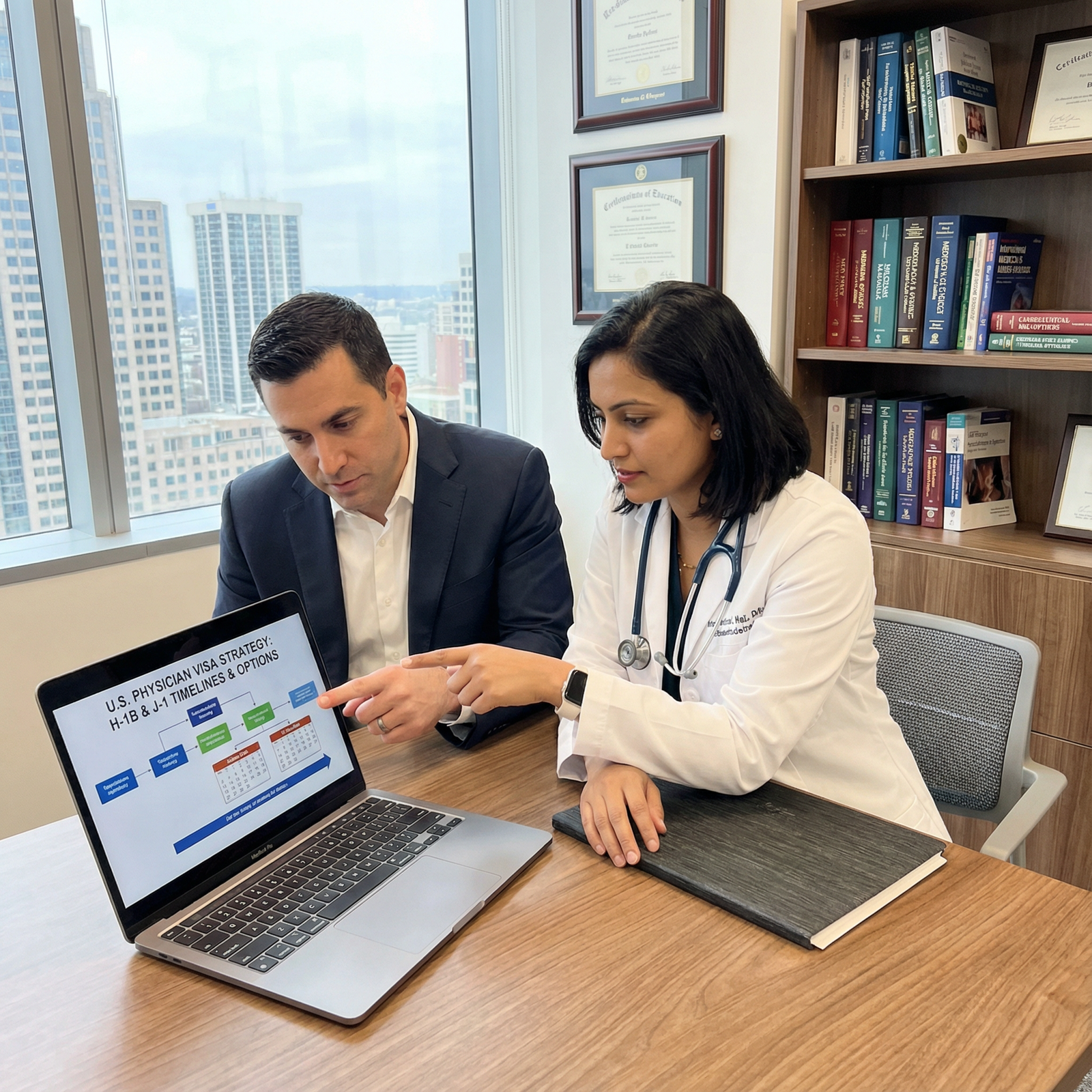
Practical advice: confirm whether 212(e) applies before you build a green-card plan. Most delays I've seen are procedural, late waiver filings, missed timelines, or a strategy built on a forum rumor instead of a DS-2019.
H-1B dual intent: why it feels smoother, and where it still doesn't help
H-1B holders often describe green-card progress as more predictable. That's fair. The H-1B framework is more compatible with immigrant intent for many filings. You can pursue PERM, I-140, and sometimes I-485 adjustment while maintaining H-1B status, provided priority dates and eligibility cooperate. That's a real bridge.
But here's the correction that kills the myth: H-1B dual intent does not bypass priority dates, backlogs, per-country limits, employer sponsorship requirements, or labor certification/EB-2/EB-3 constraints. Not one of them.
I've seen residents treat H-1B as a fast lane. It isn't. It's a stable waiting room. The waiting room still has the same queue out the door.
For IMGs, H-1B is often paired with EB-2 or EB-3 strategies that still depend on qualification evidence, specialty and job offer alignment, and administrative processing. Dual intent doesn't write your recommendation letter or move your priority date forward.
The mermaid flow is blunt. Dual intent sits off to the side, dashed. The main road is 212(e), then category and priority date, then paperwork.
So what's the real impact on green cards: myth-to-fact scenarios for IMGs
Scenario 1: J-1 holder reads a forum post saying "dual intent," but 212(e) applies and no waiver is filed. Green-card effort stalls. Not because of intent. Because of the statutory bar.
Scenario 2: J-1 holder not subject to 212(e), or waiver already approved. The green-card path looks much closer to H-1B in practice. Timelines still hinge on priority dates and category. Dual intent wasn't the differentiator; the waiver absence was.
Scenario 3: H-1B holder with dual intent. Applicant can show immigrant intent without automatic denial. Nice. But they face the same backlog, same employer sponsorship, same labor certification. The benefit is friction reduction, not speed.
Direct debunk number one: "Using J-1 instead of H-1B makes green cards harder or impossible." Too simplistic. The determinant is 212(e) plus waiver status, not the "intent" label. A J-1 without 212(e) can be just as workable as H-1B for green-card planning.
Direct debunk number two: "H-1B dual intent eliminates the requirement to prove nonimmigrant intent later." Wrong. Filings and eligibility must still be consistent. Misrepresentation or a false narrative can wreck the whole case. Intent language matters, but it's not a loophole.
Action plan: how to plan a green-card strategy without betting on myths
Step 1: Confirm J-1 212(e) applicability from your DS-2019/records and any advisory opinions. Don't rely on anecdotal claims from co-residents.
Step 2: If 212(e) applies, map waiver feasibility and evidence readiness early. Lead times matter. Employer timelines matter. Late waiver filings are avoidable.
Step 3: Choose the green-card category strategy, EB-2 vs EB-3, NIW if applicable, based on qualifications and job requirements. Dual intent is not a category selector.
Step 4: Maintain a clean immigration narrative. Your intent language should match your filings. Don't treat "intent" as a magic key.
Step 5: Use a checkpoint calendar: status validity, filing windows, priority date tracking, waiver milestones, and approval/denial events. This is a process, not a slogan.
Bottom line
- Dual intent is not a green-card accelerant. For J-1 holders, the dominant factor is whether 212(e) applies and whether you complete or waive it.
- H-1B dual intent may reduce friction around intent during certain filings, but it does not change priority dates, caps, or core eligibility requirements.