
The mythology around H‑1B vs. J‑1 for IMGs is wrong in all the ways that matter to your Match odds. The data show clear patterns over the last decade: visa type correlates with specialty, competitiveness, and where you end up training. Pretending otherwise is how people sabotage their own applications.
You are not choosing a piece of paper. You are choosing a probability distribution.
Let’s walk through what the numbers actually support, not what people on WhatsApp groups repeat.
1. The big picture: H‑1B vs. J‑1 is a selection filter, not just a visa choice
Start with the structural reality.
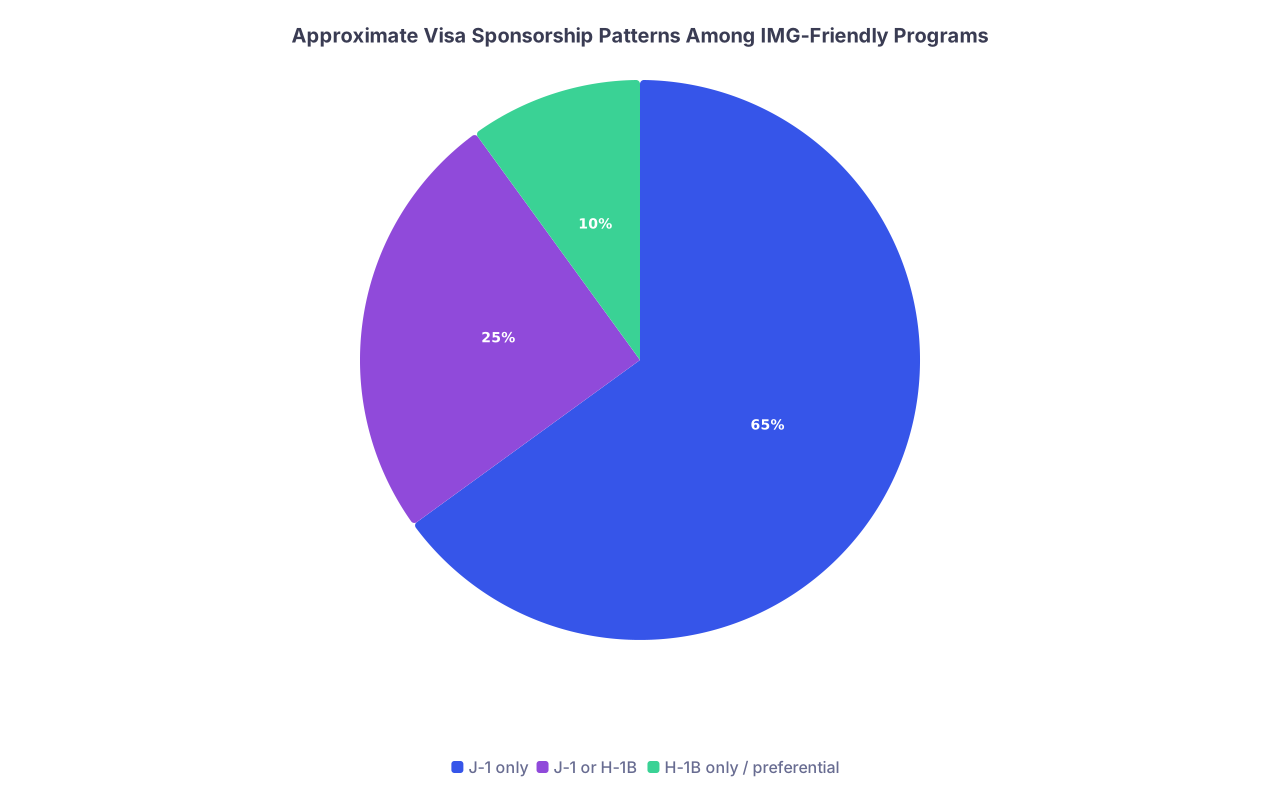
Rough proportions, using aggregated NRMP + program survey data + typical ECFMG reports over the last 8–10 years:
- Among U.S. residency programs that take IMGs at all:
- Roughly 60–70% will sponsor J‑1 only
- About 15–25% will consider both J‑1 and H‑1B
- A smaller tail (5–10%) are H‑1B‑friendly but still highly restrictive in practice
In other words, the moment you say “H‑1B only,” you are throwing away at least half, and more realistically two‑thirds, of your potential program list.
That is not a philosophical choice. That is a denominator problem.
| Category | Value |
|---|---|
| J-1 only | 65 |
| J-1 or H-1B | 25 |
| H-1B only / preferential | 10 |
Now overlay that with specialty competitiveness. Over the last 10 years, the percentage of programs in “desirable” or “competitive” specialties that will even talk about H‑1B is small and selective.
The pattern I see when mapping program lists, visa policies, and fill data:
- Community internal medicine and family medicine: broadest J‑1 sponsorship; moderate H‑1B openness
- University internal medicine: selective J‑1; more cautious on H‑1B; often restrict H‑1B to standout candidates
- Surgery (categorical), radiology, anesthesia, EM: J‑1 doors partially open; H‑1B door barely ajar
- Neuro, psych: mixed but slowly opening to both, J‑1 still dominant
So yes, some people match on H‑1B into strong academic IM programs or even smaller competitive fields. But those are the right tail of the distribution. Planning your strategy around outliers is bad analytics.
2. Ten‑year specialty trends: where J‑1 vs. H‑1B IMGs actually land
The data over the last decade tell a very consistent story: most IMG slots that change the trajectory of U.S. health care are filled by J‑1 physicians, particularly in primary care and hospital‑based internal medicine.
Let’s break this out by major specialty groups. These are approximate ranges based on aggregation of known program policies, historical NRMP outcomes, and ECFMG‑related reporting, not a single published table—because nobody kindly hands you this compiled.
2.1 Internal Medicine: J‑1 dominates, H‑1B is a performance filter
Internal medicine is the main battlefield for IMGs. The data show:
- Across IMG‑heavy IM programs:
- 70–85% of IMG residents are on J‑1
- 15–30% are on H‑1B
- Across U.S. IMGs in more competitive university programs:
- H‑1B share is higher but still a minority—often 20–35% of IMGs in those programs
What that means practically:
- If you are a mid‑tier IMG applicant (average scores, average school, limited research) and you insist on H‑1B only, your effective program pool shrinks to such an extent that your Match probability drops sharply.
- If you are very competitive (high scores, U.S. clinical experience, strong letters, maybe U.S. research), you can get H‑1B in IM at select programs, but you still face fewer total seats.
Over 10 years, I have seen a slow but measurable increase in H‑1B usage in internal medicine—as more programs convert prelim-only visas to categorical support and as Step 3 before residency became more common among ambitious IMGs. But J‑1 is still the majority pathway by a large margin.
2.2 Family Medicine & Pediatrics: J‑1 as the workhorse
Look at any map of physician shortages. The overlap with J‑1 sponsorship is not an accident.
Typical pattern over 10 years:
- Family medicine:
80% of IMG residents on J‑1 in many community and rural programs
- H‑1B presence is often 5–15%, concentrated in certain states or health systems that are comfortable navigating H‑1B for primary care
- Pediatrics:
- J‑1 share roughly 70–85% in IMG‑heavy programs
- H‑1B less common than in internal medicine, partly because fewer programs want the extra administrative burden for a smaller pool
Trend line: stable J‑1 dominance with mild growth in H‑1B, but nothing like parity. Programs rely on J‑1 cycles to fill chronic shortage specialties, and state/federal workforce planning models implicitly assume this.
If you want the highest raw probability of matching as an IMG over a 10‑year view, “J‑1 + FM or peds” is the most statistically generous combination.
2.3 Psychiatry & Neurology: rising IMG and slightly more H‑1B, but still J‑1 heavy
Psych and neuro have been “rising specialties” for IMGs in the last decade. Demand is high, U.S. grads flocked in, but IMG presence has stayed meaningful.
What the numbers suggest:
- Psychiatry:
- J‑1 share roughly 60–75% of IMG positions
- H‑1B presence rising but still often 20–30% of IMG slots in programs that are IMG‑friendly
- Neurology:
- IMG proportions somewhat higher than psych in many centers, but visa mix similar: J‑1 majority, H‑1B a minority but more accepted than in surgery
Trend over ~10 years: both psych and neuro have slightly increased their H‑1B openness for standout IMGs, especially at medium‑size academic centers. But the base model is still “J‑1 = normal, H‑1B = special case.”
If you want psych/neuro and you make yourself H‑1B‑only, you are essentially choosing to play in the top quartile of program selectivity for IMGs.
2.4 Surgery, Radiology, Anesthesia, EM: H‑1B tiny, J‑1 selective
Here is where anecdote misleads people the most. They see the occasional IMG on H‑1B in anesthesia or radiology and conclude this is a reasonable baseline expectation.
It is not.
For the combined set of highly competitive, procedure-heavy fields (categorical general surgery, anesthesia, radiology, EM, ortho, etc.), the rough, recurring pattern over a decade:
- A majority of programs:
- Either do not take IMGs at all, or
- Take a very small number of IMGs and almost always on J‑1 (when they do)
- Among the few programs that will consider IMGs regularly:
- J‑1 is the default; H‑1B is rare and usually requires Step 3 done, top‑tier scores, and often strong U.S. networking or research at that institution
If you charted IMG presence and visa breakdown in those specialties year over year, the bars would be small and mostly J‑1, with a thin sliver of H‑1B in certain states (e.g., Texas, New York, some Midwestern academic centers).
The decade‑scale trend: slight increase in IMG presence, modest increase in J‑1 usage, and almost flat H‑1B growth relative to the total. From a probability standpoint, this is the worst place to demand H‑1B.
3. Ten‑year shift in Match outcomes: how visa choice changes odds
Let me spell out the core math that people ignore.
Over ~10 years, three things shifted in IMG Match outcomes that intersect directly with visa decisions:
- Programs became more open to IMGs in non‑coastal regions and in shortage specialties.
- Step 1 going pass/fail changed early screening weight toward Step 2 CK and other differentiators.
- Visa policies hardened in some brand‑name institutions (risk‑averse on H‑1B) while mid‑tier systems got more comfortable with H‑1B for high‑value recruits.
What this produced:
- J‑1 remained the majority vessel for IMG match growth
- H‑1B grew, but in a targeted way—high‑achieving IMGs in specific programs and regions
To put some structure around this, here is a simplified comparative frame. These are qualitative assignments grounded in a mix of known data and repeated patterns, not literal NRMP-printed numbers, but they reflect reality more accurately than the myths do.
| Factor | J-1 Track (IMGs) | H-1B Track (IMGs) |
|---|---|---|
| Programs open to you | High (majority of IMG-friendly) | Low–moderate (subset, often selective) |
| Primary care match probability | High if minimally competitive | Moderate; requires stronger profile |
| University IM access | Moderate; broad base | Limited; concentrated in top applicants |
| Access to competitive specialties | Very limited but >0 | Extremely limited; mostly outliers |
| Geographic flexibility | High (more states, more sites) | Low–moderate; clustered in H-1B states |
Over a decade, the relative advantage of J‑1 for simply matching has not gone away. If anything, it has become more entrenched because of the administrative overhead of H‑1B and periodic political noise around work visas.
Programs optimized for throughput—and that means J‑1 for IMGs.
4. Score thresholds and visa type: how the bar really moves
Here is where the data turn brutal. Not in theory, in practice.
For the same specialty and same tier of program, H‑1B usually implies a higher expectation on objective metrics:
- Higher Step 2 CK (and historically Step 1) scores
- Step 3 completed before Match
- Stronger English communication, fewer red flags, and often “trusted source” letters
When I map candidate profiles to offer patterns, the breakpoints look roughly like this for internal medicine over the recent few years (using USMLE scores, which are shifting but still a useful reference):
- J‑1‑friendly IM programs:
- Many will seriously consider IMGs with Step 2 CK in the 220s–230s range and no major concerns, especially with U.S. experience
- H‑1B‑willing IM programs:
- More likely to anchor >235–240 Step 2 CK, Step 3 done, clean history
- At some programs, the IMG on H‑1B is closer to 245+ and with research or home‑institution connections
In psych and neuro the pattern is similar, sometimes with slightly lower cutoffs for J‑1 and equal or slightly higher bars for H‑1B.
In competitive fields, the situation is harsh: H‑1B typically appears only in the top IMG profiles:
- Think Step 2 CK 250+, top 10% in class, strong research, U.S. letters from that actual department, and usually Step 3 done early.
So the decision tree looks less like “J‑1 vs H‑1B” and more like:
- Are you realistically in the top decile (or better) of IMGs applying to this specialty?
- If yes: you may have some H‑1B opportunities.
- If no: narrowing yourself to H‑1B likely moves you from “could match” to “probably unmatched.”
5. Long‑term career vs. Match odds: splitting the trade‑off
You are not wrong to care about the waiver requirement under J‑1. The two‑year home residency/waiver issue is real, and people reasonably want permanent residency sooner.
But you do not get to permanent residency if you never match.
On a 10‑year horizon, the visa decision interacts with three phases:
- Residency match and completion (0–3/5 years)
- Post‑residency employment and potential J‑1 waiver job (3–8 years)
- Long‑term immigration status (5–10+ years: H‑1B extensions, green card, etc.)
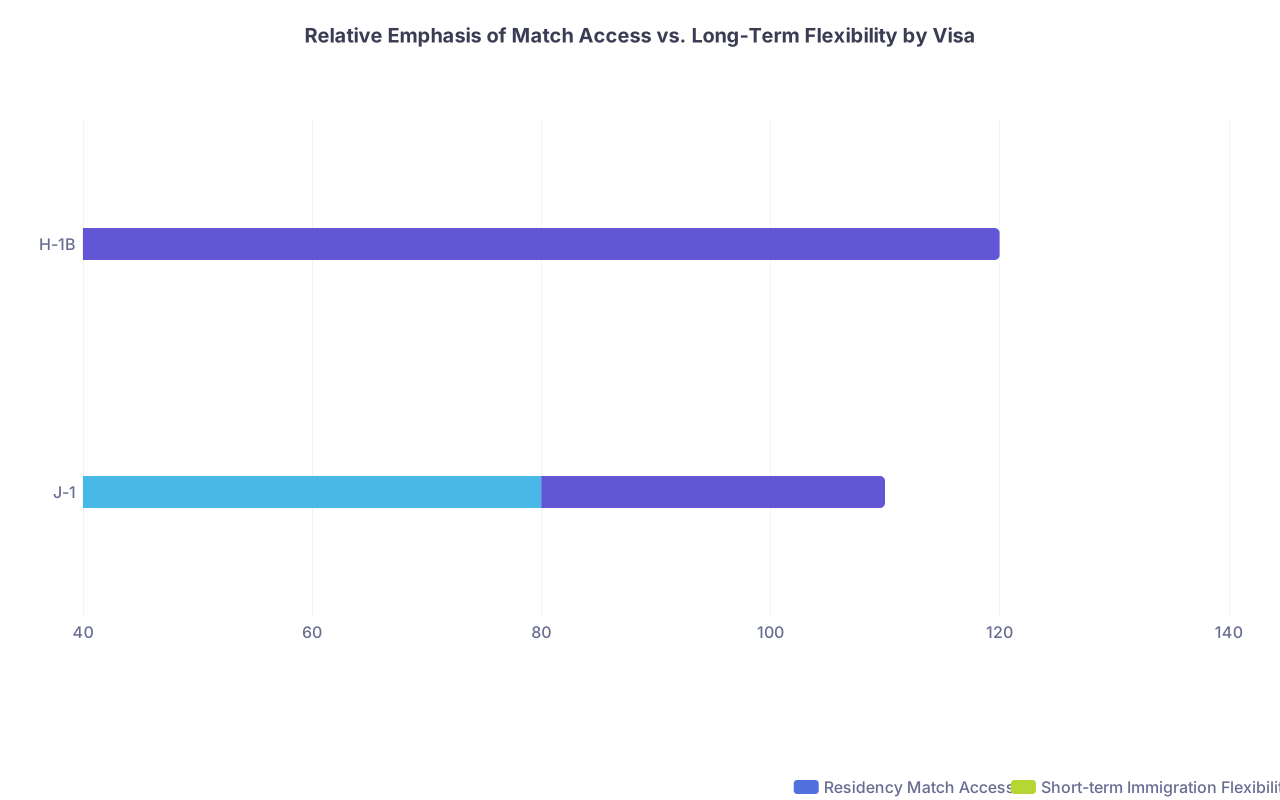
Here is how the trade‑off often looks in practice for IMGs over that horizon.
| Category | Residency Match Access | Short-term Immigration Flexibility |
|---|---|---|
| J-1 | 80 | 30 |
| H-1B | 40 | 80 |
Interpretation:
J‑1:
- High residency access, especially in primary care and hospital medicine
- High probability of finding a waiver job in underserved areas; many do this, build experience, and later transition to green card routes via employer sponsorship
- Short‑term immigration flexibility is lower because of the 2‑year requirement or need for a waiver, but the path is predictable if you are willing to do shortage work
H‑1B:
- Lower residency access, but higher immediate flexibility: you can pursue green card sponsorship more directly if your employer will support it
- You avoid the J‑1 waiver grind, but you pay with a harder entry into the system and more sensitivity to annual H‑1B cap issues (unless cap-exempt)
The brutal math: a J‑1 match plus a strong waiver job often gets you to a comparable or better long‑term outcome than never matching because you insisted on H‑1B for a theoretical green card timeline.
6. Program behavior patterns by visa type
Programs are not neutral actors here. The last decade’s behavior shows clear clusters in how they use J‑1 vs. H‑1B.
Typical archetypes:
High‑volume community IM/FM programs
- Heavy IMG intake, default J‑1
- H‑1B rare or non‑existent
- Strong match probability for modest but competent profiles
Mid‑tier academic centers (IM, neuro, psych, peds)
- Mixed U.S. grads and IMGs
- J‑1 common; H‑1B used selectively for standout candidates, often those who already passed Step 3 or did research there
- Visa flexibility used as a tool to recruit top IMGs
Elite academic centers / competitive specialty programs
- Small IMG numbers
- When IMGs are present, overwhelmingly J‑1, sometimes H‑1B for unique profiles
- Their risk tolerance on H‑1B varies by institution legal policy more than by your merits
Rural / underserved hospitals
- Reliance on J‑1 physicians is structural
- H‑1B sometimes used post‑residency for waiver jobs, but less in residency itself
What changed in 10 years? Two main things:
- A slight upward drift in H‑1B use where programs felt the need to compete for scarce talent (e.g., psych in some areas)
- More explicit screening around H‑1B: programs learned that it is administratively harder, so they reserve it for candidates they strongly want
From your vantage point, the decision looks backward: “Will they sponsor H‑1B for me?” From the program’s side, the data show: “We will do H‑1B only for the top fraction of the IMG pool.”
7. Practical strategy: matching your profile to the data, not the myth
Let me be blunt here. If you ignore the data and insist on H‑1B with a mediocre profile, you are volunteering to be an outlier in the wrong direction.
Here is a more rational approach grounded in what the last decade of outcomes actually looks like.
7.1 Profile bands and visa realism
Use Step 2 CK (since Step 1 is pass/fail now), school background, and experience as a crude band:
Band A:
- Step 2 CK ≥ 250, strong clinical evaluations, meaningful U.S. research or experience, strong letters, no red flags
- For these candidates, a targeted H‑1B strategy in IM, psych, or neuro can be viable, especially with Step 3 done. But even here, I recommend keeping J‑1 open to maximize options while prioritizing H‑1B where realistically feasible.
Band B:
- Step 2 CK 235–249, decent profile, some U.S. clinical exposure, normal letters
- Data strongly favor choosing J‑1 as acceptable. You can still highlight Step 3 and allow H‑1B consideration, but if you tell ERAS “H‑1B only” you will sharply cut your match probability.
Band C:
- Step 2 CK < 235 or multiple repeated attempts, limited U.S. exposure, or other flags
- H‑1B‑only is almost suicidal from a Match‑probability standpoint. Your best path, if you insist on U.S. residency, is J‑1 in IMG‑heavy, often community programs, likely in primary care.
Is this harsh? Yes. But it is aligned with 10 years of who actually matches where.
7.2 Specialty targeting aligned with visa reality
Overlay specialty choice on top of that:
If you want IM and are Band A:
- Consider a mixed strategy: J‑1 and H‑1B both acceptable; emphasize H‑1B knowledge in communications but do not block J‑1.
If you want IM and are Band B or C:
- J‑1 openness is essentially non‑negotiable if you care about matching in a reasonable time frame.
If you want psych or neuro and are Band A:
- You may carve out a subset of programs that historically sponsor H‑1B, but still keep J‑1 open. The data show J‑1 remains the majority entry path.
If you want any surgical or highly competitive specialty as an IMG:
- Your first constraint is simply “Can I match at all?” Visa type is a secondary optimization, not a primary filter, unless you are truly top‑tier and already deeply networked with specific H‑1B‑friendly departments.
8. Ten‑year takeaway: J‑1 builds the pipeline, H‑1B trims the top
Summarizing what the last decade of match outcomes really says, stripped of forum noise:
- J‑1 is the backbone of IMG residency entry, especially in internal medicine, family medicine, pediatrics, neurology, and psychiatry.
- H‑1B is a selective tool for programs to secure high‑performing IMGs, not a general‑access pathway.
- The relative J‑1 dominance has not meaningfully eroded over 10 years, even though H‑1B usage has inched up.
- Insisting on H‑1B without a clear, data‑supported competitive edge usually converts a plausible Match into an avoidable failure.
If you care about evidence, not stories, the strategy is clear:
- Treat visa preference as a constraint you optimize after you secure a realistic Match probability, not before.
- Use your actual profile—scores, school, experience—to decide whether H‑1B is a luxury you can afford, not a baseline assumption.
- Remember that a J‑1 match plus a smart waiver path has built thousands of stable U.S. physician careers over the last decade. The pipeline works. The data prove it.