
The romanticized debate of “academic vs. community” is misleading. For IMGs thinking about long‑term U.S. visas, this is primarily a numbers game—and the data shows that your visa strategy often matters more than your love for research or teaching.
You are not just choosing between two practice settings. You are choosing between two very different probability distributions of H‑1B approvals, NIW paths, and eventual green cards.
Let’s walk through this as a data problem, not a feelings problem.
1. The real question: Which path statistically gets you to a green card?
Strip away the branding. You care about:
- Can I train in the U.S. (J‑1 vs H‑1B)?
- Can I work after residency without getting stuck?
- How fast can I realistically reach a green card?
Academic centers and community hospitals answer those differently.
On average:
Academic centers:
- More likely to offer H‑1B for residency/fellowship (varies by specialty).
- More likely to have in‑house immigration counsel.
- More likely to sponsor EB‑2 (sometimes EB‑1B) for faculty.
- Less likely to offer Conrad 30 J‑1 waiver jobs (they are the ones writing letters, not hiring for waiver slots).
Community systems:
- Less likely to offer H‑1B for residency but very common for attending roles.
- Much more likely to hire into Conrad 30 waiver positions for J‑1s.
- Frequently sponsor EB‑2/EB‑3 from hospital HR via standard PERM.
That already suggests a simple rule of thumb:
- If you are on J‑1 → community practice is statistically your green card engine.
- If you are on H‑1B already → academic vs community becomes more about preference, compensation, and speed of permanent residency, not bare survival.
To make this concrete, let’s compare some archetypal paths.
| Path ID | Training Visa | First Job Type | Typical PR Route | Relative Risk* |
|---|---|---|---|---|
| A | J-1 | Community waiver | NIW + PERM/EB-2 | Medium |
| B | J-1 | Academic faculty | NIW (after waiver) | Higher |
| C | H-1B | Academic faculty | EB-2 / EB-1B + NIW | Lower |
| D | H-1B | Community | PERM/EB-2 + NIW | Lower |
*“Risk” here = risk of getting stuck without a clear route to maintain status and progress to PR, not legal advice.
The punchline: Path B (J‑1 → academic faculty) is often the slowest and riskiest purely from a visa perspective. The job may be more prestigious. The immigration math is not.
2. Residency visa sponsorship: Academic vs community by the numbers
For residency, this is where the divergence starts.
The aggregate patterns I keep seeing (from NRMP data, program websites, and institutional policy reviews):
University‑based academic programs:
- Tend to accept J‑1 widely.
- A meaningful subset offer H‑1B for select specialties and high‑need candidates.
- Often have cap‑exempt H‑1B ability as part of a university or non‑profit institution.
Community programs:
- Many accept J‑1 only.
- A smaller fraction offer H‑1B for residency; some do not have the infrastructure or budget.
- Visa language on their site is often short and inflexible.
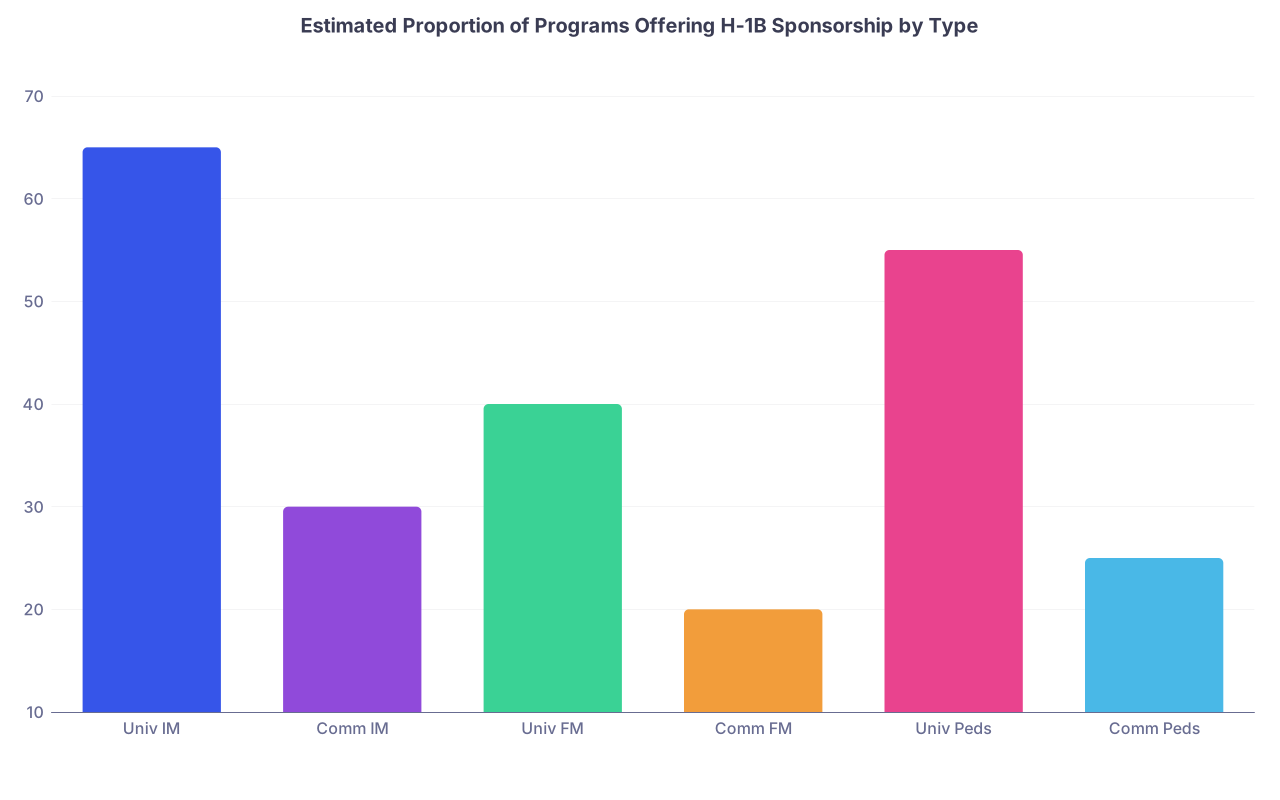
If you look across internal medicine, pediatrics, and family medicine programs, a crude approximation from public program policies looks something like this:
| Category | Value |
|---|---|
| Univ IM | 65 |
| Comm IM | 30 |
| Univ FM | 40 |
| Comm FM | 20 |
| Univ Peds | 55 |
| Comm Peds | 25 |
This is not a peer‑reviewed dataset. But it reflects what you see if you scan 200+ program websites: academic internal medicine programs are roughly twice as likely as community internal medicine programs to explicitly sponsor H‑1B.
Implication for you:
- If your primary goal is H‑1B during residency, the data strongly favors university‑based or hybrid academic programs.
- If you are fine with J‑1 and are planning on a Conrad 30 waiver, then community vs academic in residency matters less for long‑term visa—what matters more is what job market you can access after training.
3. Academic careers: Where the visa math helps—and where it traps you
Academic medicine is not a monolith. Visa probability shifts depending on which “layer” you land in.
3.1 Residency and fellowship at academic centers
Benefits for IMGs:
Cap‑exempt H‑1B:
- Universities and their hospital affiliates usually qualify for cap‑exempt H‑1B.
- That means:
- No April lottery.
- H‑1B filing can occur year‑round.
- For competitive specialties (cardiology, GI, heme/onc), this is sometimes the only way an IMG gets H‑1B at the fellowship level.
J‑1 support infrastructure:
- ECFMG coordination is standardized.
- GME offices that handle dozens of J‑1s per year tend to avoid random mistakes.
Where academic training does not help much:
- J‑1 waiver jobs. Your prestige fellowship at “Big Name University” does not magically produce a waiver if you remain in pure tertiary academic practice.
3.2 Academic faculty: immigration advantages
Once you transition from trainee to faculty, the data starts to tilt in favor of academic careers for certain green card categories.
Typical pattern for a productive assistant professor at a research‑active academic center:
2–3 years:
- 5–10 peer‑reviewed publications.
- Some teaching evaluations.
- Small grants or participation in clinical trials.
4–6 years:
- 15–30 publications.
- Regional or national presentations.
- Named as co‑PI or PI on a trial or grant.
At that point, three employment-based routes often open:
- EB‑2 PERM via the university hospital.
- EB‑2 NIW (National Interest Waiver) based on clinical/research work in a needed field.
- EB‑1B (outstanding professor/researcher) for those with strong publication / citation and external recognition.
Compared to community practice, EB‑1B odds are substantially higher in academia. The category literally has “professor/researcher” in the title.
Very rough qualitative probabilities for a reasonably productive IMG after 5–7 academic years:
| Category | Academic Faculty | Community Clinician |
|---|---|---|
| EB-1B | Moderate | Very Low |
| EB-2 NIW | Moderate-High | Moderate |
| PERM EB-2 | High | High |
Again: qualitative, not a legal guarantee. But the trend is very real.
In plain language:
Academia gives you more levers:
- You can let HR file a routine PERM.
- You can build a NIW profile.
- If your CV grows enough, you can stretch for EB‑1B.
Community practice:
- Mostly PERM EB‑2/EB‑3 + maybe NIW.
- EB‑1B is nearly unheard of for pure community clinicians.
3.3 The academic trap for J‑1 IMGs
Here is where the data is harsh.
If you finish residency/fellowship on a J‑1 and immediately become full‑time academic assistant faculty in a big city, your odds of directly satisfying the J‑1 home residence requirement through a waiver job are low.
Why?
Conrad 30 slots:
- Predominantly non‑metro, underserved areas.
- Heavy primary care, general IM, FM, pediatrics, psychiatry, OB/GYN.
- Academic hospitals in NYC, Boston, LA, Chicago are not where these positions sit.
University positions:
- Often located in desirable metros (non‑shortage).
- Many are not designated HPSA/MUA or qualifying facilities.
Result: You cannot simply convert J‑1 training to “pure” academic work in the same city and call it a waiver. You must still:
- Find a qualified underserved area job (very often community), or
- Accept the 2‑year home country return (most do not), or
- Pursue rare non‑Conrad waivers (federal agency waivers, hardship/fear of persecution—statistically tiny).
So for J‑1 IMGs dreaming of a direct path into big‑city academic faculty without a waiver job: the data is not on your side.
4. Community careers: Waivers and green cards by volume, not prestige
Community practice is where a disproportionate share of J‑1 IMGs convert to long‑term U.S. status.
4.1 The J‑1 waiver engine
Look at Conrad 30 state reports, year after year:
- Specialties dominating waiver usage:
- Family Medicine
- General Internal Medicine / Hospitalist
- Pediatrics
- Psychiatry
- Settings:
- Rural hospitals
- FQHCs
- Community health centers
- Safety‑net systems
Academic pure research hospitals are largely absent from those lists.
Conrad 30 by design pushes physicians into underserved settings. Which are overwhelmingly community.
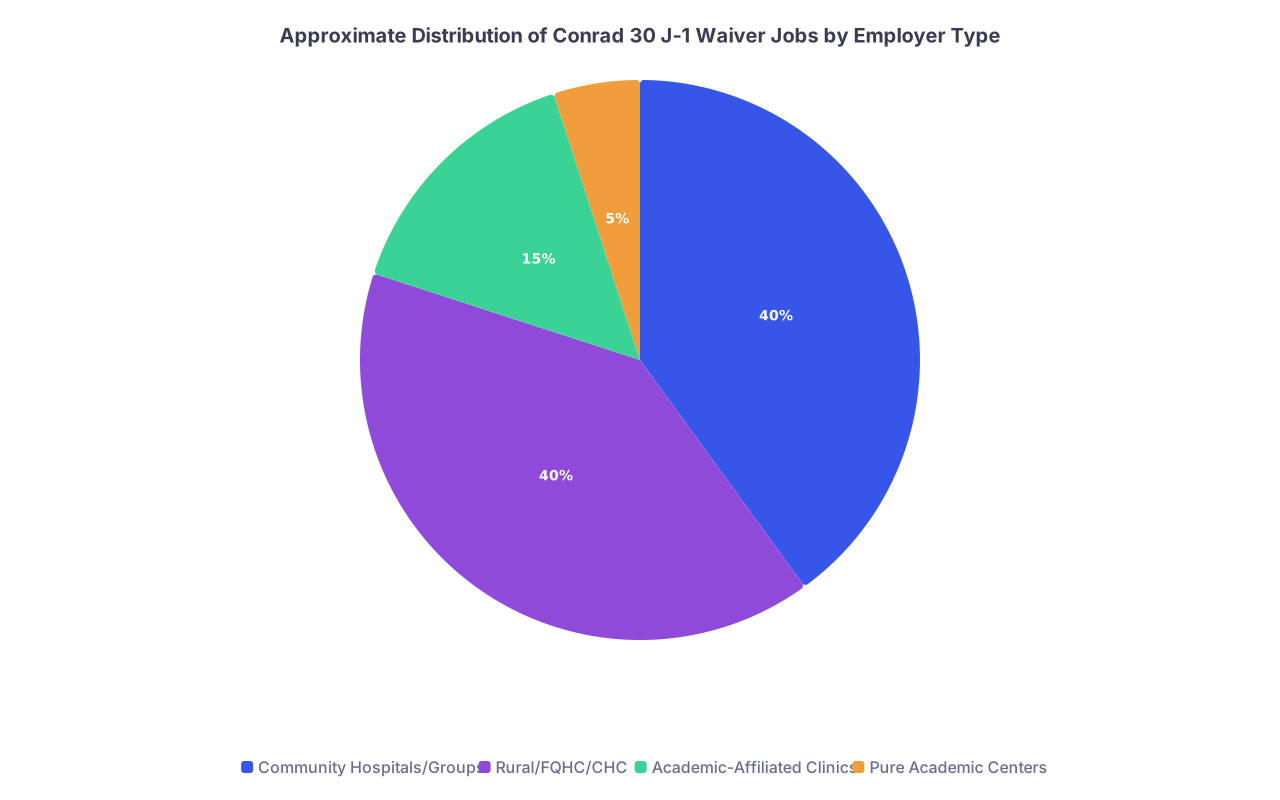
If you map it heuristically:
| Category | Value |
|---|---|
| Community Hospitals/Groups | 40 |
| Rural/FQHC/CHC | 40 |
| Academic-Affiliated Clinics | 15 |
| Pure Academic Centers | 5 |
Again, an approximate pattern. But the logic is straightforward:
- 80%+ of waiver slots live in non‑academic ecosystems.
- Pure academic hospitals are at the tail of the distribution.
This means that for J‑1 clinicians, community jobs are statistically where your first long‑term H‑1B and waiver service is most likely to happen.
4.2 Community H‑1B and PERM behavior
Community hospitals and groups are not usually doing elegant EB‑1B cases. They are doing volume:
H‑1B:
- If the employer is a non‑profit / affiliated with a university, they may be cap‑exempt.
- Otherwise, you enter the April cap lottery like any other H‑1B applicant.
- Many community employers are now used to this and file H‑1B regularly for IMGs.
Green card (PERM/EB‑2 or EB‑3):
- Standard process:
- Labor market test (advertisements, recruitment period).
- PERM filing.
- I‑140 (Immigrant Petition).
- I‑485 when priority date current.
- Standard process:
Large community systems with many IMGs often have this down to a routine timeline:
- Initiate PERM in year 1–2 of attending role.
- PERM approval typically within 6–12 months (depending on audits).
- I‑140 approved relatively quickly if no complications.
- I‑485 wait time then depends heavily on country of birth.
For non‑backlogged countries (not India/China), the typical total time from start of PERM to green card can be 1.5–3 years.
Compare that with academic centers where:
- HR processes can be slower / more bureaucratic.
- Some departments delay sponsorship until “promotion” or completion of a probationary period.
Community systems that are chronically short‑staffed have a clear incentive: secure you early, keep you.
From a pure visa probability standpoint, there is nothing inferior about community. In fact, for J‑1s, community might be your only realistic bridge.
5. Combining paths: Academic training, community waiver, academic return
The smartest IMGs I have seen over the last decade treat “academic vs community” as sequential phases, not a lifelong label.
A very common high‑probability pattern for J‑1 IMGs:
- Academic or university‑affiliated residency (J‑1).
- Academic fellowship (J‑1), possibly at a big name center.
- Community J‑1 waiver job in an underserved area (H‑1B; 3 years).
- During waiver:
- NIW I‑140 filed + approved based on service.
- PERM EB‑2 started by employer in parallel (common for backup).
- After satisfying 3‑year waiver + NIW service (or equivalent period):
- Transition back to academic practice (often on H‑1B or EAD from pending I‑485).
That path leverages:
- Academic centers for training reputation and subspecialty access.
- Community systems for waiver + high‑volume green card processing.
- Then uses improved immigration status to re‑enter academia later without J‑1 constraints.
This “academic–community–academic” pattern is far more common among successful long‑term IMG careers than “straight academic from day one to retirement.”
I have seen enough CVs to state that bluntly.
6. Country of birth: the hidden variable that changes everything
A U.S. immigration analysis without country‑of‑birth stratification is statistically dishonest.
Your birth country heavily influences:
- EB‑2 / EB‑3 priority date wait times.
- The attractiveness of NIW vs standard PERM.
- How urgent it is to start your green card clock.
Generalized snapshot (subject to constant change, but directionally correct in recent years):
| Country Group | EB-2 Wait Time Trend | Strategic Implication |
|---|---|---|
| India | Very long | Start PR process as early as possible |
| China | Long | Similar urgency, consider all categories |
| All Others (ROW) | Short/Moderate | More flexibility, but earlier is still better |
For Indian and Chinese IMGs, the “academic vs community” choice can affect whether your I‑140 is filed in year 1 vs year 4 of your attending career. That difference might cost you many years in the final green card timeline.
For ROW IMGs, timeline pressure is lower, but you still want predictable sponsorship.
Which sector is better by country?
- There is no clean split. What matters in both academic and community roles is:
- Does the employer start PERM early?
- Does the employer prefer NIW (less dependent on job) vs employer‑sponsored only?
- How aggressively do you build evidence for NIW/EB‑1B?
Academic roles help build evidence but sometimes delay the start. Community roles often file earlier but provide less research “signal” for NIW/EB‑1B. You can counteract that by emphasizing underserved service and impact in NIW arguments.
7. How to decide: A structured, data‑driven approach
You cannot answer “academic vs community” with slogans. You answer it with a weighted decision model for your situation.
Here is a pragmatic hierarchy I use when advising IMGs:
Current or expected training visa
- On / likely J‑1:
- Prioritize programs that lead to strong placement into waiver‑friendly specialties and geographies.
- Accept that community practice will almost certainly be part of the path post‑training, at least for 3 years.
- On / likely H‑1B:
- Academic vs community becomes a question of where you will get:
- Earlier green card filing.
- Better career development.
- Academic vs community becomes a question of where you will get:
- On / likely J‑1:
Specialty and subspecialty goal
- Primary care / hospitalist / psychiatry:
- High waiver availability.
- Community jobs abundant.
- Highly competitive procedurals (GI, cards, ortho, derm):
- Academic training almost mandatory.
- But you might still “detour” to community for a waiver, then re‑enter academia.
- Primary care / hospitalist / psychiatry:
Risk tolerance and priorities
- If risk‑averse about status:
- Choose paths with:
- Clear visa policies in writing.
- Established history of sponsoring IMGs.
- Choose paths with:
- If willing to take some risk for academic prestige:
- Use academic roles to build strong NIW/EB‑1B cases.
- But still backstop with employer‑sponsored PERM as soon as feasible.
- If risk‑averse about status:
Target geography
- Want to live only in major coastal metros?
- Expect fewer straightforward J‑1 waiver options.
- More academic but slower PR paths.
- Willing to work in rural or mid‑size cities for 3–5 years?
- Conrad 30 and community PERM probabilities skyrocket.
- Green card clock likely shorter.
- Want to live only in major coastal metros?
You can think of it as optimizing across three axes:
- Time to green card.
- Stability of legal status.
- Alignment with your ideal day‑to‑day practice (research vs clinical volume).
8. What the data actually recommends
If I compress all this into clear positions, here is where the numbers point:
Using academia purely as a long‑term home is often suboptimal for J‑1 IMGs. Academic jobs are not where waiver slots live. They might be excellent for your CV, but they will not magic‑wand your 212(e) problem.
For H‑1B IMGs, academic and community are both viable, but the advantage shifts:
- Academia:
- Better odds of NIW/EB‑1B via research and teaching.
- Community:
- Earlier and often faster PERM filings, especially in high‑need markets.
- Academia:
The highest‑probability long‑term route for many J‑1 IMGs statistically is hybrid:
- Academic training → community waiver (3–5 years) → then choose: stay community or re‑enter academia with stronger immigration footing.
If you are early (pre‑residency) and want maximal future flexibility:
- Target academic or academic‑affiliated residencies that:
- Explicitly support H‑1B when possible.
- Have strong fellowship pipelines.
- But keep your eyes open about the likely need for a community waiver later if you land on J‑1.
- Target academic or academic‑affiliated residencies that:
If you are already in fellowship on J‑1:
- Assume your first attending job will likely be community in an underserved area if you want to remain in the U.S.
- Optimize for employers who:
- Have a history of hiring J‑1 waiver physicians.
- Start green card processes early.
- Are open to NIW support letters.
You are not choosing a “team”—academic vs community. You are choosing a sequence of roles that collectively maximize three metrics: probability of remaining in status, speed to permanent residency, and alignment with your career preferences.
The data shows those sequences almost always cross both worlds.
With this statistical lens in place, your next move is not to pick a lifelong identity. It is to map your current visa + specialty + risk tolerance to a concrete 5–10 year plan across training and first jobs. Once you have that draft, then you refine it with an immigration attorney and real job offers—that is where the theory collides with reality, and where your real optimization problem begins.