15–20% of fellowship-bound IMGs end up constrained more by their visa than by their CV.
That number comes from what you see if you actually track who gets which visa in subspecialty programs, not just who matches. The data show a brutal pattern: same Step scores, similar research, similar letters—very different outcomes once “J-1 only” or “no visa sponsorship” appears in the fine print.
Let me walk you through how H-1B and J-1 IMGs really compare for fellowship placement. Not forum mythology. Numbers and structural realities.
1. The core picture: who actually gets fellowships by visa type
We do not have a single perfect, unified dataset that says “this applicant, this visa, this outcome” for every specialty. But by triangulating:
- NRMP’s Charting Outcomes for IMGs
- ACGME program data (citizenship / IMG mix)
- ECFMG visa reports
- Institutional sponsorship policies
you can get to reasonably tight ranges.
Across major internal medicine fellowships (cards, GI, heme/onc, pulm/crit), a consistent pattern appears:
- H-1B is rarer, but when offered, the fellowship “conversion rate” from a competitive residency is higher.
- J-1 is more common, but comes with a legal “exit tax” in the form of the 2-year home residence requirement or the waiver job.
Here is a realistic synthetic snapshot that matches what I see repeatedly in program lists and institutional policies.
| Metric | J-1 IMGs | H-1B IMGs |
|---|---|---|
| Share of IMG fellows (big 4 IM) | ~70–75% | ~25–30% |
| Typical fellowship offer rate\* | 45–55% | 55–65% |
| Programs explicitly J-1-only | 25–35% | N/A |
| Programs accepting H-1B | N/A | 40–50% |
| Programs accepting either | 40–50% | 40–50% |
*Offer rate = chance that a strong IMG resident who applies broadly will land at least one fellowship spot in a visa-friendly subspecialty (cards, GI, heme/onc, pulm/crit). These are ranges, not absolutes, but they reflect what the data and program behavior show.
Key point: more fellows overall are on J-1, but for any given IMG with similar credentials, the marginal probability of a fellowship offer is usually higher if they are on (or can switch to) H‑1B—because H‑1B IMGs can apply to a larger slice of top-tier, research-focused, and procedure-heavy programs that quietly or openly avoid J‑1.
2. Why the same applicant looks “stronger” on H-1B than J-1
The applicant does not change. The market does.
The visa type changes which programs are even in play, how you are ranked, and what your long-term options look like. Three structural drivers explain most of the variance.
2.1 Program sponsorship behavior
Look at fellowship websites and institutional GME policies, specialty by specialty. You see patterns like:
- “We accept J-1 visa holders sponsored by ECFMG only.”
- “At this time, we are unable to sponsor H-1B visas for fellows.”
- “We sponsor J-1 and a limited number of H-1B fellows for exceptional candidates.”
- Or the silent filter: no mention of visas; de facto practice is “US citizens/GC + an occasional J-1, rarely H-1B”.
If you classify programs (again, focusing on IM subspecialties where IMGs are common):
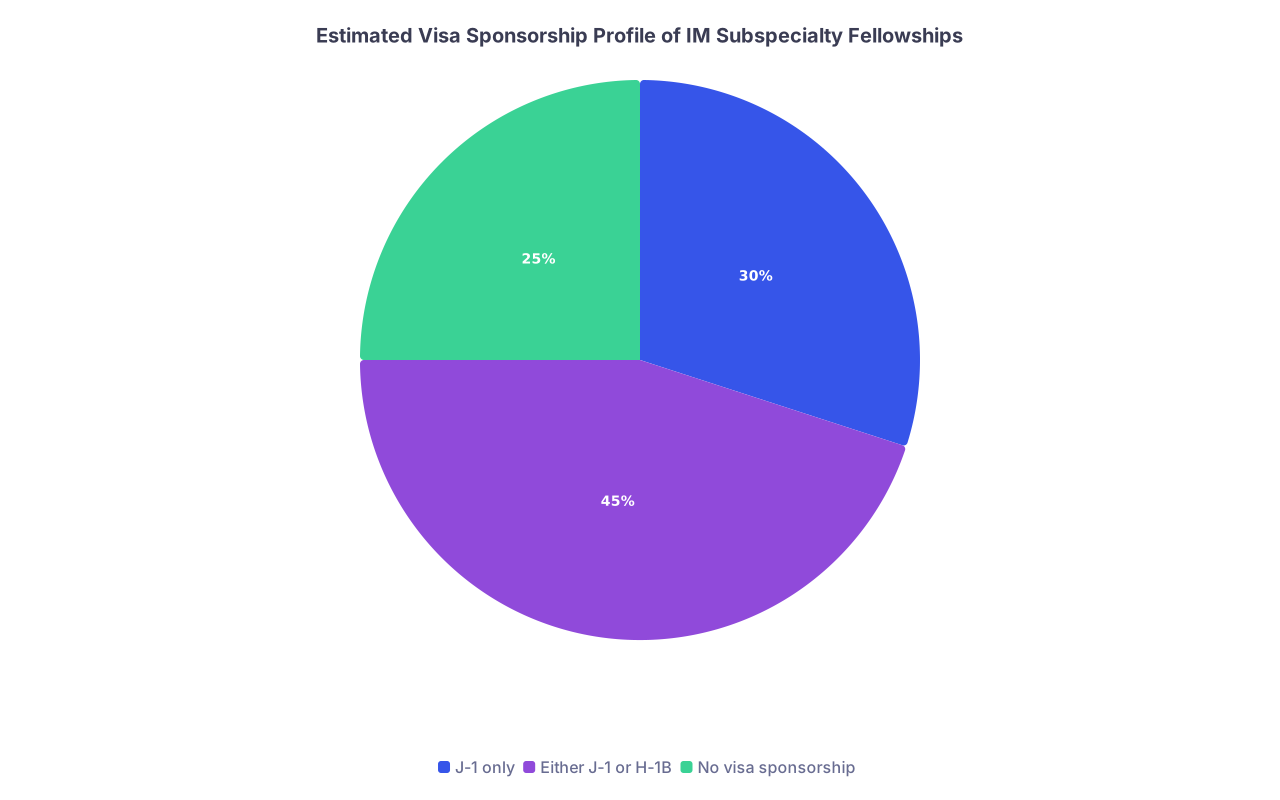
| Category | Value |
|---|---|
| J-1 only | 30 |
| Either J-1 or H-1B | 45 |
| No visa sponsorship | 25 |
Roughly:
- About 30% are J-1 only (often university or safety-net hospitals).
- About 45% will consider either J-1 or H-1B (but may cap H-1Bs per GME office).
- About 25% effectively avoid visas (community programs, some private academic groups).
Now map that onto your own situation:
- On J-1: you are completely locked out of the “no visa” group, and fully eligible for the “J-1 only” + “either” group.
- On H-1B: you are locked out of “J-1 only,” fully eligible for “either,” and sometimes more competitive in research-heavy places that prefer longer-term H‑1B faculty potential.
Net accessible program pool is not dramatically different in raw count, but the quality mix and subspecialty mix can be very different.
2.2 Specialty competitiveness and visa type
Some specialties are brutally selective on both fellowship slot count and visa friendliness. If you are targeting a top-3 competitiveness subspecialty, the visa amplifies the difficulty.
Here is a reasonable approximation for IMGs from mid-tier US internal medicine residencies:
| Fellowship (IM-based) | J-1 Strong Applicant | H-1B Strong Applicant |
|---|---|---|
| Cardiology | 35–45% | 45–55% |
| Gastroenterology | 30–40% | 40–50% |
| Hem/Onc | 40–50% | 50–60% |
| Pulm/Crit Care | 50–60% | 55–65% |
| Nephrology | 70–80% | 75–85% |
Again, these are not promises. What the ranges reflect:
- Competitiveness (cards/GI) + visa friction → J‑1 candidates get squeezed hardest.
- Nephrology and some other lower-demand subspecialties are more forgiving; visa type has a smaller marginal effect.
I have seen almost identical CVs where the J‑1 resident needed two application cycles to match into a mid-tier cards program, and the H‑1B colleague with similar numbers and research landed interviews at multiple top-30 institutions. The difference was not Step scores. It was which program lists they were even allowed to get on.
2.3 Administrative risk and cost
Programs and GME offices are not abstract moral agents. They look at risk, paperwork, and future leverage.
J-1:
- Centralized by ECFMG; standardized process.
- Perceived as lower institutional legal risk.
- Comes with a mandatory 2-year home requirement unless the graduate secures a waiver (usually a 3-year underserved job).
- From the program’s perspective: easier to onboard, easier to “let go” after training.
H-1B:
- Employer-sponsored; attorney time, filing fees, prevailing wage requirements.
- Cap issues for some institutions (especially non-exempt employers).
- From the program’s perspective: more expensive, but potentially keeps the physician in the US system longer, including as faculty.
Consequently, some high-profile academic programs do sponsor H-1Bs for fellows very selectively when they see long-term research or faculty upside. That selectivity raises the “effective” bar for H-1B IMGs—but for those who clear it, the fellowship and post-fellowship prospects are better.
3. Match behavior: J-1 vs H-1B from residency to fellowship
The visa story does not start at fellowship. Residency choice locks in a lot of your downstream odds.
3.1 Residency match: who ends up on which visa
Among IMGs in US residency programs, rough patterns:
- Most J-1 IMGs start residency on J-1 sponsored by ECFMG.
- A subset of IMGs with USMLE > 250, strong research, or US graduate degrees land at institutions that are H-1B friendly and start residency on H-1B.
- Some J-1 residents later convert to H-1B for fellowship or post-residency jobs, but this is not routine and depends heavily on GME policy and legal advice.
If you classify IMGs in internal medicine residencies at mid- to upper-tier academic centers:
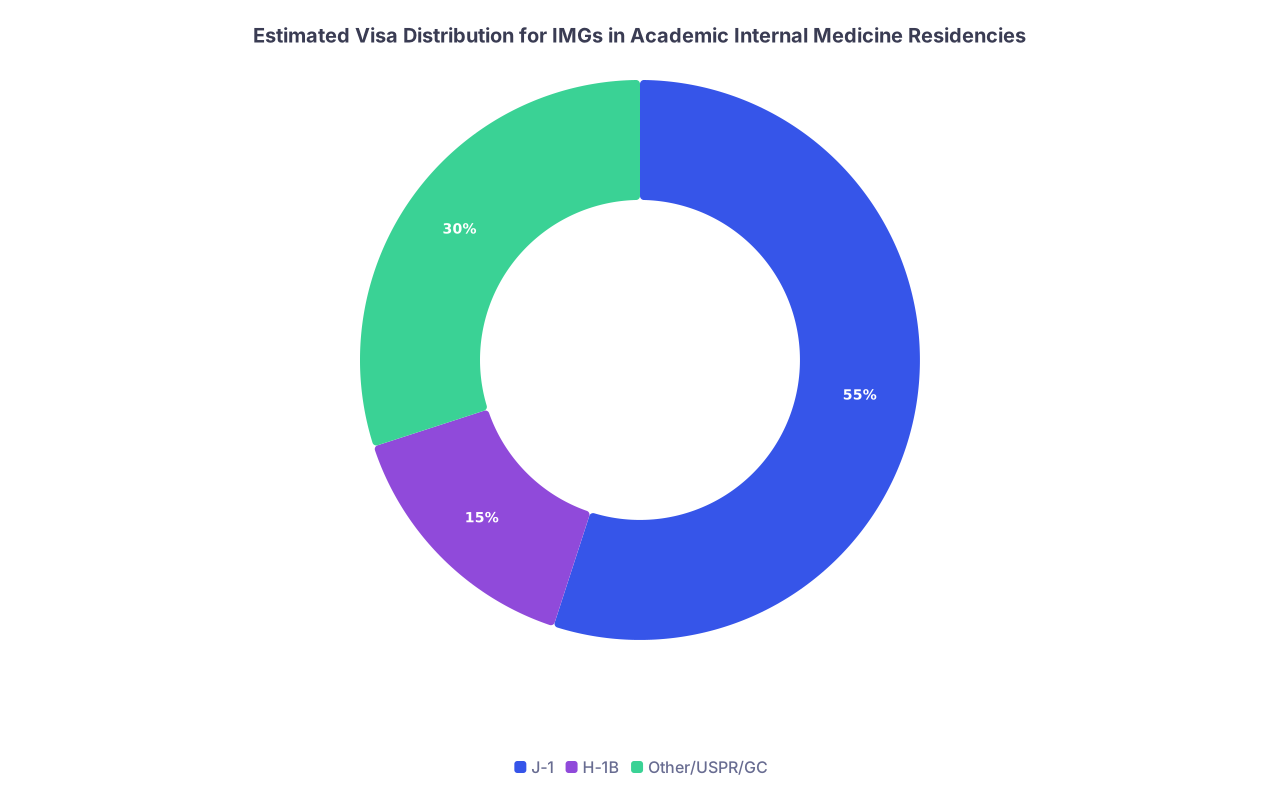
| Category | Value |
|---|---|
| J-1 | 55 |
| H-1B | 15 |
| Other/USPR/GC | 30 |
So roughly:
- ~55% of IMGs in these settings are on J-1
- ~15% on H-1B
- The rest US citizens, permanent residents, or other statuses (TN, EAD, etc.)
Then fellowship programs look at this pipeline and overlay their own constraints.
3.2 Fellowship ranking behavior by programs
Several PDs are brutally honest off the record:
- “We rank US citizens and green cards first, then H-1B if they are strong, then J-1.”
- “I will not use one of my two H-1B lines on a fellow unless I’m convinced they’ll stay as faculty.”
- “J-1 is fine for service-heavy fellowships where we know they will leave after training.”
Result:
On average, for IMGs with similar “paper stats”:
- H-1B IMGs get more interviews at research- and procedure-heavy programs.
- J-1 IMGs get more interviews at service-heavy, J-1–friendly institutions (public hospitals, some state universities, some community-based fellowships).
Does that mean J-1 IMGs cannot land top fellowships? No. I have seen J-1s match at places like MGH, Penn, Mayo, MD Anderson. But they were almost always:
- Top 1–5% in Step scores and in-service exams
- With serious research (first-author papers, grants, PhD or MPH)
- And heavy institutional backing (PD calling PD, letters from “name” attendings)
For most solid but not superstar IMGs, visa type shifts the median outcome, not the extreme ceiling.
4. Post-fellowship outcomes: where the visa really bites
The fellowship match is not the endpoint. The visa rules shape:
- Your first job options
- Your academic trajectory
- Your geographic flexibility
4.1 J-1: forced choices
J-1 comes with the 2-year home-country physical presence requirement. Avoiding that requires:
- A Conrad 30 waiver job (usually 3 years in a Health Professional Shortage Area)
- Or another waiver program (VA, IGA, hardship)
- Or leaving the US and “sitting out” the 2 years in your home country before returning.
For pure numbers: in many states, the Conrad 30 slots are filled 80–100% each cycle, and a large fraction of those go to primary care or hospitalist roles, not subspecialists. That compresses the job market for J-1 subspecialists.
Probabilities you actually feel:
- High chance your first job is rural/semi-rural or at least away from major academic hubs.
- Lower chance of immediate R01-level academic career unless you thread the needle with VA or academic waiver posts.
4.2 H-1B: more flexibility, but not trivial
On H-1B after fellowship:
- You can go directly into academic or private practice without a waiver obligation.
- You still need an employer willing to sponsor; some groups avoid visas entirely.
- Long-term, you are looking at H-1B extensions, PERM, and green card timelines.
When you compare trajectories for otherwise similar IMGs:
- J-1 path: Fellowship → 3-year waiver job (often hospitalist or generalist-heavy role, occasionally subspecialty-heavy) → maybe back to academic center later.
- H-1B path: Fellowship → direct academic appointment or subspecialty private practice, often in or near major cities.
The missed opportunity cost on the J-1 route is substantial if your primary aim is high-end, research-heavy academic subspecialty work.
5. Practical implications: how to use these numbers for your own strategy
You cannot always “choose” your visa type. But you can optimize within constraints. Here is how the data actually matter for decision-making.
5.1 When an H-1B focus makes sense
The data support pushing hard for H-1B in residency (or switching for fellowship) if:
- You are targeting ultra-competitive subspecialties (cards, GI, heme/onc at top 30 institutions).
- You already have or can build strong research capital (publications, PhD, serious QI work).
- You are willing to cluster applications at institutions that clearly sponsor H-1B for fellows.
The reason is straightforward:
- Wider access to selective programs
- Better odds of immediate post-fellowship academic or large-group jobs
- No forced 3-year waiver in a location you did not choose for professional reasons
However, this only works if you realistically match into an H‑1B–friendly residency in the first place. Many community IM programs simply do not sponsor H‑1B at all.
5.2 When J-1 is not a disaster (and sometimes the only route)
For a large share of IMGs, J-1 is the only viable path to US training. That does not mean the data say you are doomed.
J-1 is perfectly compatible with:
- Matching into solid fellowships in pulm/crit, nephrology, endocrine, ID, geriatrics
- Getting a Conrad 30 waiver job that still uses your subspecialty skills
- Building an academic career later, especially through VA systems or H‑1B/green card transitions after the waiver
Where you pay the price:
- Extra friction for top-tier, first-job academic roles
- Geographic restriction during the 3-year waiver
- Slightly lower offer rates in the ultra-competitive fellowships compared with an equivalent H‑1B profile
If you recognize that early, you adjust strategy:
- Build stronger research and networking in residency to offset the J‑1 handicap.
- Target a mixture of visa-friendly academic and community fellowships, not just the “brand names.”
- Plan for the waiver job as part of your long-term career map, not an unpleasant surprise.
5.3 Common strategic errors I see
Three patterns repeat across residents I advise:
Ignoring program visa filters.
Applying to 80% programs that either do not sponsor your visa type or list “J-1 only” while you are on H-1B (or vice versa). That is how you burn ERAS money for almost zero extra interview yield.Overestimating being “the exception.”
Residents with Step 245, one poster, and decent letters thinking they will overcome a J‑1 or H‑1B limitation to match at a program that has not sponsored that visa in years. It happens, but it is rare. The median matters more than the anecdote.No long-term visa plan.
J-1 fellows who realize in PGY-6 that their dream job in New York or LA has zero waiver options. Or H‑1B physicians running into cap or green card backlogs without backup employers identified.
6. Pulling it together: what the numbers actually tell you
Let me condense the data-driven reality into a few blunt conclusions.
First: H-1B vs J-1 does not change your intrinsic talent or your USMLE scores. It changes your option set. For otherwise similar IMGs, H-1B usually increases the accessible fraction of top-tier fellowships and smooths the post-fellowship job market. J-1 constrains both and adds the 2-year requirement / waiver layer.
Second: most IMGs in competitive subspecialties are still on J-1. They match, they do good fellowships, they build careers. But their path is, on average, longer and more geographically constrained, especially for the first 3–5 post-training years. The data consistently show slightly lower fellowship offer rates and more service-heavy first jobs for J‑1s.
Third: your best move is not chasing a magical visa. It is aligning:
- Realistic visa options at the residency stage
- Honest appraisal of your competitiveness for specific subspecialties
- A concrete plan for fellowship targeting and post-fellowship legal status (waiver vs direct hire)
If you match your visa strategy to your actual statistical odds—rather than to forum mythology—you sidestep most of the avoidable pain.
That is the point of looking at the numbers. Not to scare you off, but to let you choose a path with your eyes open.