
The myth that “all J-1 waiver jobs are in the middle of nowhere” is statistically false. The data show a far more nuanced—and frankly more useful—picture for IMGs planning their careers.
I will walk through where international medical graduates actually end up on J-1 waivers, based on patterns in Conrad 30 usage, HPSA/MUA distributions, state-level recruitment behavior, and typical employer types. You are not choosing between “New York City or cornfields forever.” The real trade-offs are subtler: state policy, specialty demand, and how aggressively systems recruit IMGs.
To be precise: what you care about is not where postings exist in theory, but where IMGs actually land jobs year after year. That is a different question. Let’s treat it as such.
1. The Structural Reality: How J-1 Waiver Geography Works
Start with the mechanics, because geography follows rules here, not vibes.
Most IMGs land J-1 waiver jobs through:
- Conrad 30 State Waiver Programs
- Federal programs (VA, ARC, DRA, HHS, etc.)
- Hardship / persecution waivers (much smaller volume and idiosyncratic)
Conrad 30 is the workhorse. Each state can sponsor up to 30 J-1 waiver physicians per year. Some states never fill their slots. Some overfill and turn people away. That utilization pattern drives where IMGs end up.
Key structural constraints that shape geography:
- Positions must be in HPSA / MUA / underserved areas (or “flex slots” serving underserved patients).
- Employer types skew toward:
- FQHCs / community health centers
- Rural hospitals / critical access hospitals
- Small private groups in shortage areas
- Regional health systems with rural satellites
Urban vs rural is not binary. Think “small metro,” “exurban,” “tertiary city,” “rural town,” not just “NYC vs farm.”
The result: J-1 waiver jobs concentrate in three broad buckets:
- Rural Midwest / Great Plains
- Southern states with persistent shortages
- Selected mid-sized metros / exurbs in large-population states that use flex slots aggressively
You will not see many first-year waivers in Manhattan, San Francisco, or downtown Boston. But you will see IMGs in:
- Rochester, MN
- Scranton, PA
- Macon, GA
- Yakima, WA
- El Paso, TX
- Springfield, IL / MO / MA (different flavor but same pattern)
2. States Where IMGs Actually Land J-1 Jobs (By Pattern, Not Wishlist)
We do not have a single national, public “J-1 hire database” with perfect granularity. But if you put together:
- State Conrad 30 annual utilization reports
- Job boards’ historical postings (3RNET, PracticeLink, hospital recruitment reports)
- HPSA physician need maps
- Employer patterns seen across multiple cycles
you get a very consistent geographic profile.
Let us break it into tiers based on real-world IMG placement probability, not fantasy.
High-Probability States (Consistently Filling or Nearly Filling Conrad 30)
These are states where:
- Conrad 30 slots are usually used fully or close to fully
- IMGs are standard, not “exceptional,” hires
- Multiple specialties (FM, IM, psych, peds, IM subspecialties) routinely get waivers
Think of these as “statistically friendly” states if your goal is simply landing a waiver job somewhere.
Examples (not exhaustive, but representative):
- Texas
- Pennsylvania
- Ohio
- Michigan
- Wisconsin
- Minnesota
- North Carolina
- Georgia
- Florida (varies but volume is high)
- Washington
- Missouri
- Indiana
- New York (mostly upstate / non-NYC)
Patterns: large rural catchment, significant underserved populations, and health systems that structurally depend on IMGs.
| State | Typical Conrad 30 Slot Usage | Common Site Types |
|---|---|---|
| Texas | Often fills / close to full | Rural hospitals, border cities |
| Pennsylvania | High usage | Small cities, rural CHCs |
| Ohio | High usage | Community hospitals, FQHCs |
| Michigan | High usage | Northern rural, small metros |
| Georgia | Moderate–high usage | Rural towns, regional centers |
| Washington | High usage | Yakima, Tri-Cities, rural |
If your primary goal is maximizing odds of any waiver job, these states are where the data point.
Moderate-Probability States (Regular J-1 Use, More Competitive Geographies)
These states use J-1s, but:
- More competition for “desirable” locations
- More weighting toward primary care vs subspecialties (or vice versa depending on policies)
- Some years they leave slots unused, some years they scramble at the end to fill
Examples:
- Virginia
- Tennessee
- South Carolina
- Arizona
- Colorado
- Oregon
- Kansas
- Kentucky
- New Mexico
- Arkansas
Here, your success depends heavily on:
- Specialty (FM/outpatient IM/psych often favored)
- Timing (early cycle vs last-minute slot-grab in March–April)
- Flex-slot rules (how willing they are to waive for urban-located but underserved-serving clinics)
Low-Probability / Highly Selective States
These states either:
- Do not routinely fill all 30 slots but are geographically narrow and/or picky
- Or have strong demand but limited political will to expand beyond primary care
- Or have urban IMGs fighting over a very small number of flex slots
Examples:
- California
- Massachusetts
- New Jersey
- Connecticut
- Maryland
- Nevada
- Vermont / New Hampshire / Maine (small numbers, specific geography)
California is the classic problem child. Huge IMG interest, but Conrad 30 historically underused relative to demand, complex politics, and many employers preferring H-1B over J-1 waivers.
So an IMG who says “I must stay in CA/NYC/NJ near family” is not reading the data. Possible? Yes. Statistically smart plan? No.
3. Urban vs Rural Reality: Where Within States IMGs End Up
The fantasy: “J-1 in a major coastal city.”
The actual distribution: heavy skew to small and mid-sized communities, even in big states.
To make this less abstract, divide practice settings into four buckets:
- Major metros (core city or immediate inner suburbs)
- Mid-sized cities / tertiary care hubs (population ~100k–500k)
- Small towns / micropolitan areas (~10k–100k)
- Truly rural (<10k, often hours from a major city)
Based on state reports, job banks, and hiring patterns, a realistic directional split for first J-1 waiver jobs looks roughly like this across the U.S.:
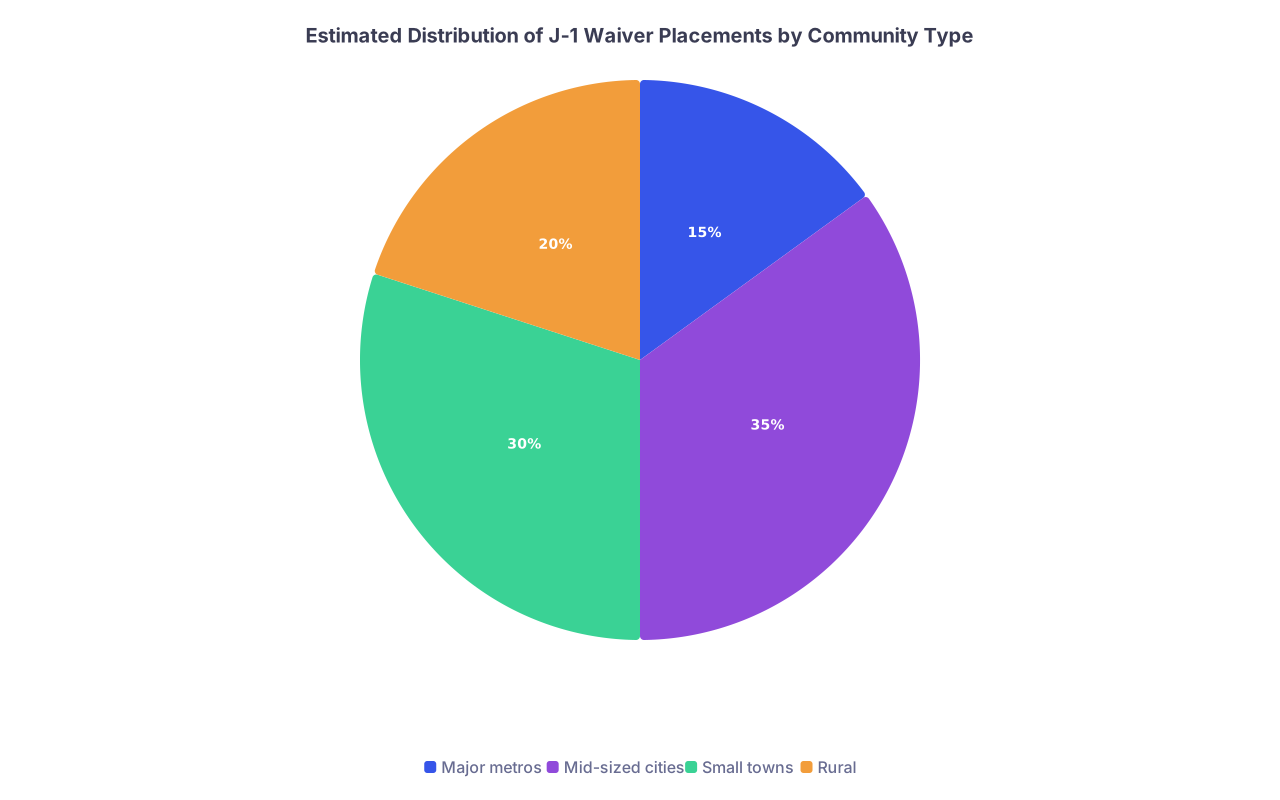
| Category | Value |
|---|---|
| Major metros | 15 |
| Mid-sized cities | 35 |
| Small towns | 30 |
| Rural | 20 |
Interpretation:
- Only about 10–20% of placements are in what most residents would call “big city proper.”
- The bulk is in mid-sized cities and small towns that serve large rural catchment areas.
- The ultra-remote jobs are significant but not the majority.
That matches what you actually see in physician recruitment emails: “1.5 hours from X city,” “College town of 70,000,” “Regional hub for 8-county area,” etc.
4. Specialty-Specific Geography: Where Different IMGs Actually Land
Different specialties cluster differently.
The data from state waiver outcome reports, large system recruitment, and job posting archives show clear patterns.
Family Medicine / Outpatient Internal Medicine
- The backbone of Conrad 30 usage in almost every state.
- States routinely fill a majority of slots with FM and outpatient IM.
- Geography:
- Rural Midwest, Great Plains, Deep South have strong pull.
- Mid-sized Southern and Midwestern cities: very common.
- Decent representation in Washington, Oregon, upstate New York.
If you are FM, you have the broadest geographic menu. That does not mean you choose freely; it means more states want you badly.
Psychiatry
Psychiatry data is blunt: extreme undersupply nationwide.
- Many states prioritize psych waivers as “high-need” placements.
- Psych IMGs place in:
- Rust Belt (Ohio, Michigan, Pennsylvania)
- Upper Midwest (Minnesota, Wisconsin, Dakotas)
- South (Georgia, Alabama, Mississippi, Louisiana, Arkansas, Texas)
- West (Washington, New Mexico, Arizona, Colorado—often rural or mid-sized cities)
Psych has among the best odds of landing in a mid-sized city rather than very remote rural, simply because demand is everywhere and states fight over those few psych physicians.
Internal Medicine Subspecialties (Cardiology, GI, Heme/Onc, etc.)
These are not evenly distributed. Trends:
More concentrated in:
- States with strong tertiary hospitals not in overserved urban cores (e.g., Rochester, MN; Toledo, OH; Spokane, WA; Scranton, PA).
- Regions where private groups serving large catchments cannot recruit enough US grads.
Less common in:
- Highly saturated coastal metros
- States with policies that explicitly prioritize primary care
In practical terms, IM subspecialty J-1s often land in regional hubs of 100k–500k people, not tiny towns. You may cover a huge rural footprint, but you live in a real city.
Pediatrics & Peds Subspecialties
- General peds: frequent in FQHCs, rural hospitals, and midsize cities with high Medicaid populations.
- Subspecialties: cluster in children’s hospitals outside the top 5 mega-systems.
Think Dayton instead of Cincinnati. Tacoma instead of Seattle. Allentown instead of Philadelphia.
5. State “Personality Types”: Where IMGs Actually Feel Wanted
Beyond raw numbers, each state has a behavioral profile. IMGs feel this on the ground.
Recruiter-Heavy, IMG-Dependent States
These states send aggressive recruiter emails, attend IMG-focused fairs, and have HR that understands the waiver process cold.
Examples: Texas, Pennsylvania, Ohio, Michigan, Georgia, Washington, Missouri, Indiana, the Dakotas, Iowa.
Characteristics:
- Multiple offers in the same state is normal.
- Systems often have 5–20 J-1 physicians already—so you are not an experiment.
- Geography still skews non-urban, but mid-sized cities are very accessible.
“We Use J-1s, But We Want Control” States
These states use the program, but on their terms.
Examples: Colorado, Oregon, Arizona, Virginia, North Carolina.
- More paperwork friction.
- Slightly more selective or slower timelines.
- But once in, jobs are relatively stable and often in pleasant, medium-sized communities.
“IMGs Welcome… at a Distance” States
Fair number of J-1 slots go unused despite huge physician shortages. Often due to:
- Administrative inertia
- Political reluctance
- Employers preferring H-1B or local graduates
Examples: California, some New England states, parts of the Mountain West.
This is where many IMGs waste months chasing a local dream while higher-yield states go uncontacted.
6. Timing and Competition: When Geography Gets Decided
Geography is not just where you apply. It is when you move.
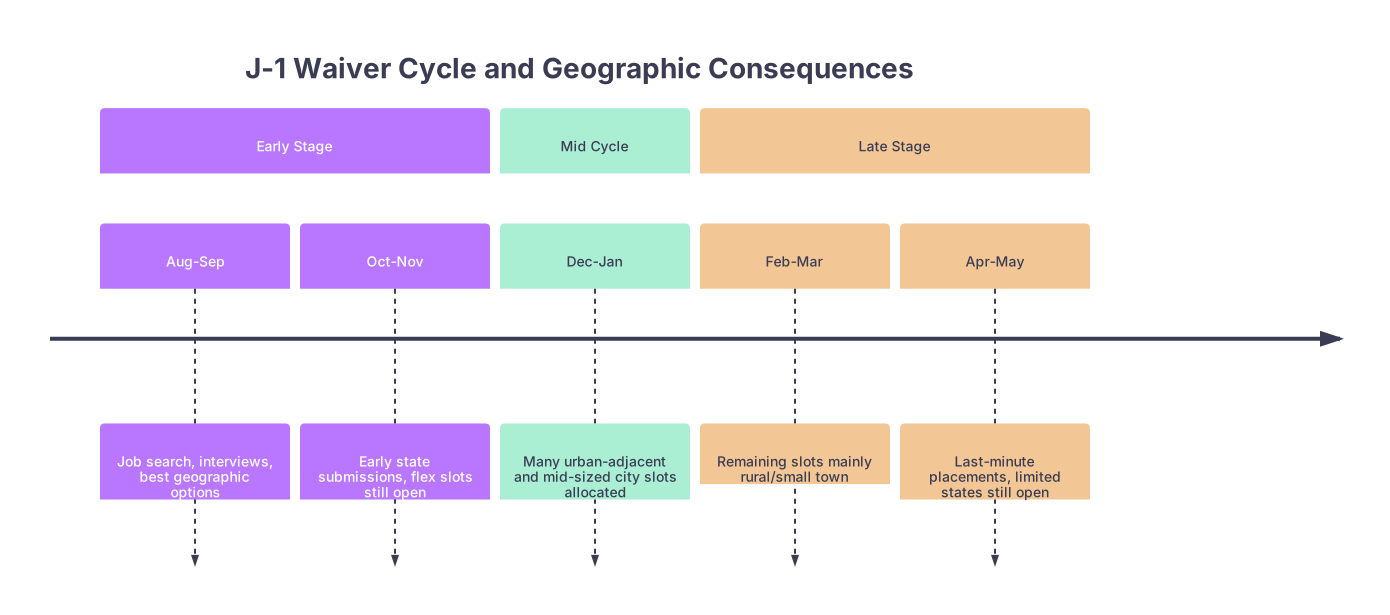
Conrad 30 programs operate on a predictable calendar. First-come, first-served or first-complete, in many states. That matters, because early applicants get urban-ish flex slots; late ones get what’s left.
A typical pattern:
- August–September: Employers finalize offers to graduating residents/fellows.
- September–November: J-1 candidates lock jobs and prepare waiver packets.
- October–January: States start accepting applications and allocating slots.
- February–April: Remaining slots get taken by late hires or “scramble” applicants.
| Period | Event |
|---|---|
| Early Stage - Aug-Sep | Job search, interviews, best geographic options |
| Early Stage - Oct-Nov | Early state submissions, flex slots still open |
| Mid Cycle - Dec-Jan | Many urban-adjacent and mid-sized city slots allocated |
| Late Stage - Feb-Mar | Remaining slots mainly rural/small town |
| Late Stage - Apr-May | Last-minute placements, limited states still open |
Translation: if you wait until February hoping a mid-sized city in a popular state will materialize, you will watch those jobs go to classmates who signed in October.
The data pattern is simple:
- Early cycle: more choice in state + city size.
- Late cycle: fewer states open + more remote locations on offer.
7. A Few Concrete State-Level Archetypes
Let me make this less abstract by outlining a few “if you end up here, this is what it probably looks like” archetypes.
Texas
- High volume of J-1 waivers; routinely near full utilization.
- Geography:
- Rio Grande Valley, West Texas (Midland/Odessa, Lubbock), Panhandle, and East Texas.
- Border communities and oil/energy corridors.
- Specialties: FM, IM, psych, peds, and several IM subspecialties.
- Reality: you likely do not live in Austin or central Houston, but you can be 1–3 hours away from a major city.
Pennsylvania / Ohio / Michigan
- Strong reliance on IMGs in community hospitals.
- Geography: small and mid-sized cities—Erie, Altoona, Youngstown, Toledo, Saginaw, etc.
- Psych and IM subspecialty demand is robust.
- Many IMGs I have seen there commute to bigger metros for social life but practice in the “secondary” town.
Washington
- Uses waivers effectively, especially east of the Cascades.
- Geography: Yakima, Tri-Cities, Wenatchee, Spokane, rural clinics.
- Strong presence of FQHCs and migrant health centers.
- Lifestyle is better than most people imagine: outdoor culture, decent airports, but yes, you are not living in downtown Seattle.
Deep South (Georgia, Alabama, Mississippi, Louisiana, Arkansas)
- Chronic shortages, high need, often strong interest in IMGs.
- Jobs distributed between small cities and rural towns.
- Many hospitals depend on IMGs for core services (night call, hospitalist coverage, clinic volumes).
- Professional leverage is often higher (clear evidence: repeated recruitment bonuses and aggressive contract offers).
8. Strategic Takeaways: How to Use Geography Instead of Being Used by It
Data-driven strategy for an IMG thinking about J-1 waiver geography:
Optimize for state and employer type, not city name.
Cities change. Visa status does not, at least not quickly. A slightly smaller city in a very IMG-friendly state can be a springboard to better options later (H-1B, NIW, I-140, etc).Focus on high- and moderate-probability states early.
Casting all your early energy into California / NYC / New Jersey is like applying only to Harvard for med school. Possible? Statistically dumb.Use the calendar ruthlessly.
Commit to a timeline: if you do not have serious traction in your dream state by, say, November, you widen the net to those IMG-friendly midwestern/southern states before their slots vanish.Understand your specialty leverage.
- Psychiatry and FM: you can be more selective geographically, especially early.
- IM subspecialties: aim for regional hubs and tertiary centers in IMG-heavy states.
- Less shortage-driven specialties: you trade location for visa sponsorship.
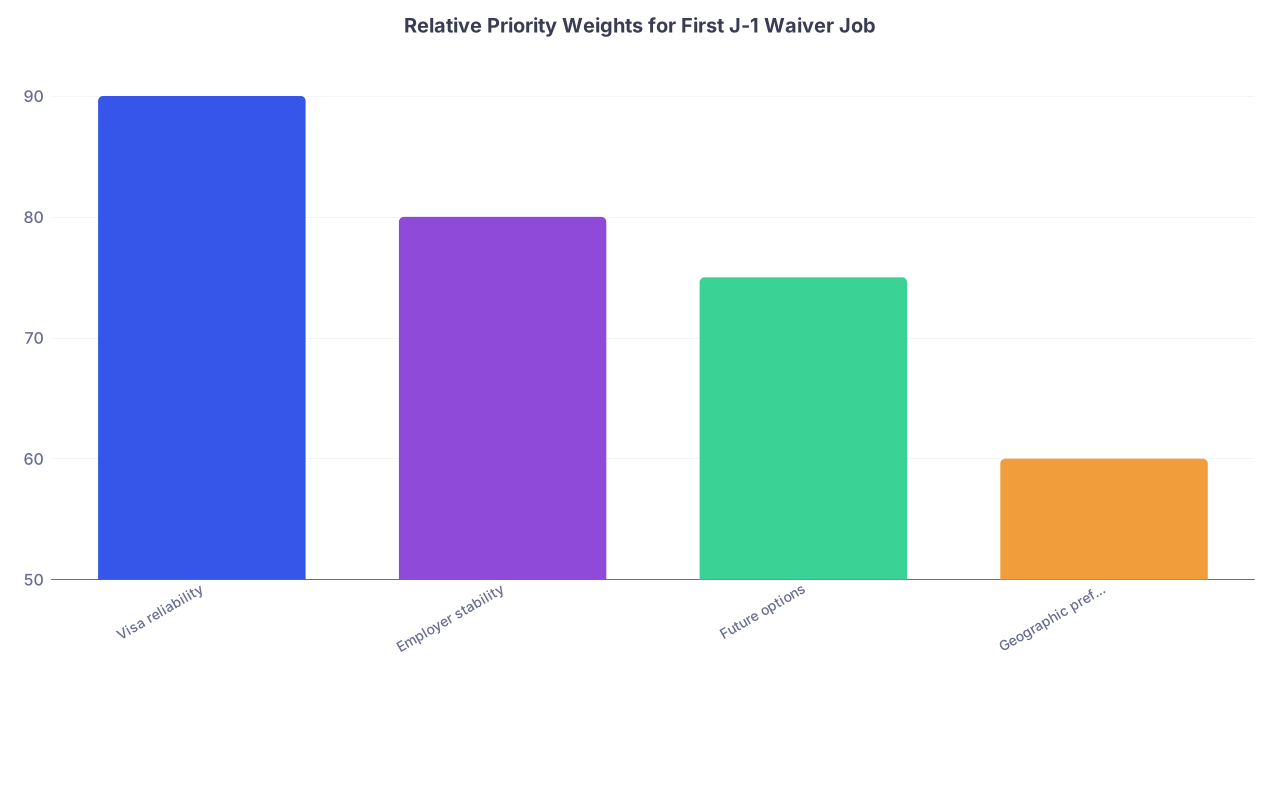
Think in 3–5 year horizons.
The first J-1 waiver job is not your forever life. It is a 3-year data point that unlocks other immigration strategies. You want:- A state that actually processes waivers smoothly
- An employer that pays and documents correctly
- A location you can tolerate, not necessarily adore
| Category | Value |
|---|---|
| Visa reliability | 90 |
| Employer stability | 80 |
| Future options | 75 |
| Geographic preference | 60 |
The rational weighting: geography matters, but not more than visa security and future immigration options.
9. Quick Reality Check: Common Myths vs Data
| Myth | What the Data Show |
|---|---|
| All J-1 jobs are in isolated rural areas | Majority are in small/mid-sized communities |
| Big cities never have waivers | They do, but are a minority and fill early |
| California is best for IMGs | High interest, low waiver throughput |
| Midwest = bad career | High stability, strong IMG hiring |
| You can wait and still get options | Late applicants get fewer states and sites |
The consistent pattern: IMGs who treat this as a statistical problem (states, slots, timelines) do much better than those who treat it as an emotional geography problem.
FAQ (Exactly 3 Questions)
1. Can I realistically get a J-1 waiver job in a major metro like NYC, LA, or Chicago?
Yes, but the probability is low compared with mid-sized and smaller communities. Large metros do have occasional J-1 positions, usually via flex slots or specific underserved clinics, and they tend to be taken early in the cycle by well-connected candidates or internal hires. If you structure your entire plan around landing in one of these metros, you are betting against the statistical majority. A more rational strategy is to apply broadly, including IMG-heavy states and mid-sized cities, then treat large metros as a bonus if they materialize.
2. Which states give me the best balance of “not too rural” and “realistic J-1 chances”?
The data point to states like Texas (secondary cities and border metros), Pennsylvania, Ohio, Michigan, Washington, Missouri, North Carolina, and Georgia. In those places, many J-1 physicians end up in cities of 50k–500k population—regional hubs with hospitals, schools, airports, and reasonable amenities. You sacrifice the absolute biggest metros but avoid deep isolation. These states also tend to have more consistent Conrad 30 utilization, which means your odds of placement are higher.
3. How early should I start looking for J-1 waiver positions if I care about geography?
If geography matters, you should treat August–November of your final training year as critical. By late fall, many of the best-located jobs in strong states are already in contract or in advanced talks. Candidates who wait until January–March are often forced into either less popular states or more remote communities, simply because Conrad 30 slots and desirable sites are already allocated. The data pattern is simple: earlier search = more states + larger choice of mid-sized cities; late search = fewer states open + more rural bias.