
The biggest factor shaping IMG specialty choice is not passion or personality. It is visa math. And the data proves it.
The Data Reality: Visa Status Predicts Specialty More Than Interest
Look at any recent NRMP data set and the pattern hits you in the face. International medical graduates as a group cluster in a narrow band of specialties. That is not because 30–40% of IMGs independently “discover” a burning love for internal medicine. It is structural.
Let me anchor this with numbers.
From recent NRMP Main Residency Match data (patterns are stable year after year):
- IMGs (US + non‑US) represent roughly 25–28% of all matched PGY‑1 positions.
- But in internal medicine, IMGs often account for 40–45% of filled spots.
- In family medicine: around 30–35%.
- In neurology and psychiatry: IMGs often hold 25–35% of positions.
- In orthopedics, dermatology, plastic surgery, ENT: IMGs are barely visible, often in the low single digits nationally.
Now overlay visa data:
- Across many university and large community programs, 40–70% of residents in internal medicine, neurology, and some pediatrics programs are on J‑1 or H‑1B visas.
- In highly competitive surgical subspecialties, the proportion of residents on any visa is often close to 0–5%.
Specialty choice is not independent of visa constraints. It is constrained optimization. You are maximizing match probability subject to a set of immigration rules that change the payoff structure.
To make that concrete, look at how visa‑friendliness lines up by specialty.
| Specialty | IMG Share of Residents | Visa-Friendly Programs (Share of Total) |
|---|---|---|
| Internal Medicine | High (40–45%) | High (60–70%) |
| Family Medicine | Moderate-High (30–35%) | High (50–60%) |
| Neurology | Moderate-High (25–35%) | Moderate-High (40–50%) |
| Psychiatry | Moderate (20–30%) | Moderate-High (35–45%) |
| General Surgery | Low (10–15%) | Low (15–25%) |
| Orthopedics | Very Low (≤5%) | Very Low (≤10%) |
The correlation is obvious: where programs routinely sponsor visas, IMGs cluster. Where sponsorship is rare or restricted to J‑1 only, IMGs disappear.
J‑1 vs H‑1B: Two Very Different Optimization Problems
Most IMGs do not start by thinking “J‑1 vs H‑1B strategy.” They start by thinking “match somewhere, anywhere.” That is a mistake. The visa you are effectively targeting changes which specialties are rational.
J‑1: The Default Path With Strings Attached
The data across state GME consortia, program websites, and NRMP program surveys shows a consistent pattern:
- 60–70% of residency programs that take IMGs accept J‑1 only.
- Another 10–20% will take either J‑1 or H‑1B, but practically default to J‑1 unless a candidate pushes or brings Step 3 completed.
- A minority (often 10–15% of all programs) will sponsor H‑1B at all.
Why J‑1 is “easy” for programs:
- No need for USMLE Step 3 before start.
- J‑1 is processed through ECFMG, not the institution’s own immigration lawyers.
- Time‑limited; the resident will not stay forever, which some institutions quietly like.
The cost to you is the 2‑year home residency requirement and the waiver problem. You are signing up for another constrained optimization after residency.
The waiver job market is brutally skewed. Data from state Conrad 30 reports, rural health policy analyses, and job boards shows:
- 60–70% of J‑1 waiver positions are in primary care (internal medicine, family medicine, pediatrics).
- Another 15–20% are psychiatry and hospitalist medicine.
- Only a small sliver (under 10–15%) are in surgical subspecialties or procedural fields.
- Waiver jobs are heavily rural or underserved inner‑city. Attractive metro areas are the exception, not the rule.
So the J‑1 sequence looks like this:
Residency specialty → sub‑specialization (maybe) → waiver funnel options.
If you match into something like general surgery on a J‑1, the waiver market for you as a surgeon will be drastically narrower than for a general internist or psychiatrist. I have seen it play out: a J‑1 general surgeon taking months longer to secure a waiver slot than their internal medicine peers who sign contracts in a few weeks.
Visa constraints do not just affect residency match. They determine your post‑residency bargaining power.
H‑1B: Fewer Programs, More Long‑Term Flexibility
H‑1B sponsorship is fundamentally a different game.
Key constraints:
- You must have passed USMLE Step 3 before the program can file the petition.
- Cap‑exempt H‑1B (for universities, non‑profit hospitals) avoids the annual H‑1B lottery, which is a major advantage.
- Many community programs either do not have the legal infrastructure or do not want the cost/hassle and thus state “No H‑1B” or “J‑1 only.”
The numbers are smaller but the tradeoffs change:
- Only a subset of specialties offer a meaningful number of H‑1B‑friendly programs.
- Those that do are often university‑based internal medicine, neurology, pathology, psychiatry, and some higher‑tier community IM/FM programs.
If you obtain an H‑1B in residency, your post‑training options widen:
- You can often move directly into another cap‑exempt H‑1B job (e.g., academic hospital) without a waiver.
- You can transition later into private practice with cap‑subject H‑1B if you are selected in the lottery.
- You avoid the rigid Conrad 30 waiver funnel tied to location and specialty.
Numerically, this changes your decision tree. You accept a lower number of programs to apply to (fewer H‑1B sponsors) in exchange for higher long‑term geographic and specialty flexibility.
For many IMGs, that tradeoff is rational only if they have strong metrics: high USMLE scores, solid CV, strong letters. They can absorb the lower number of possible programs because their individual probability of acceptance per program is higher.
Now tie that back to specialty. Where is H‑1B sponsorship realistically available?
- Internal medicine: Many university programs sponsor H‑1B for strong candidates.
- Neurology and psychiatry: A subset of academic and large systems.
- Pathology: More open than you would expect.
- Surgical subspecialties: Very few positions, and those programs often either recruit from US grads or stick to J‑1 only.
So if you are targeting H‑1B and also chasing a highly competitive subspecialty, the feasible set of programs is tiny. The data says most people will not succeed there.
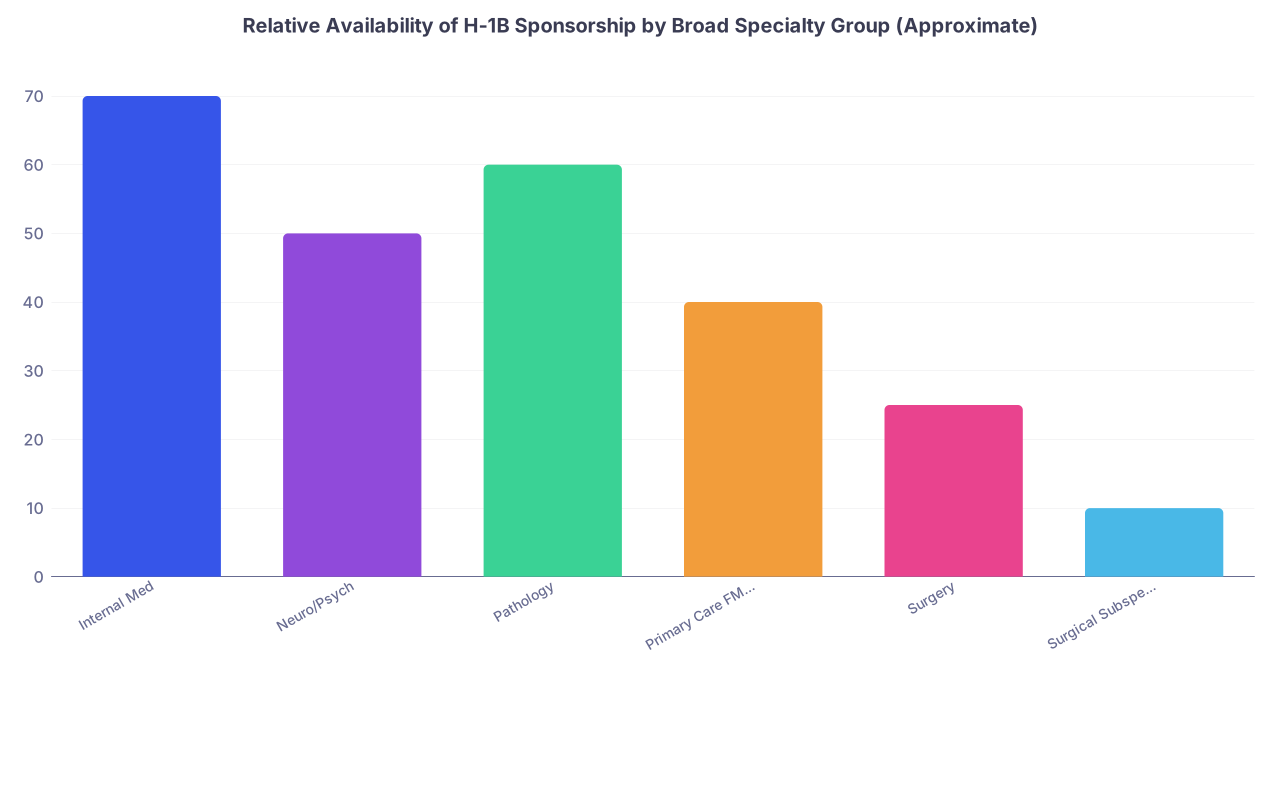
| Category | Value |
|---|---|
| Internal Med | 70 |
| Neuro/Psych | 50 |
| Pathology | 60 |
| Primary Care FM/Peds | 40 |
| Surgery | 25 |
| Surgical Subspecialties | 10 |
Interpretation: If you assume 100 IMG‑friendly programs per category, the rough share that will even consider H‑1B is numerically closer to these percentages.
How Visa Constraints Rewire Specialty Choice
Now let us connect the dots. How exactly do JPG and H‑1B constraints push IMGs into certain specialties and away from others?
1. Program Count vs Match Probability: A Basic Expected Value Problem
You are effectively optimizing:
Expected number of interviews = (Number of programs that accept your visa type and profile) × (Interview probability per program).
Visa policies directly change the “number of programs” term.
Compare two imaginary candidates with identical scores and CV:
- Candidate A: Open to J‑1 or H‑1B, will rank either.
- Candidate B: Will accept only H‑1B offers due to strong desire to avoid the J‑1 waiver requirement.
Both are interested in neurology.
Suppose there are:
- 120 neurology programs that consider IMGs.
- 80 are J‑1 only.
- 30 accept J‑1 or H‑1B.
- 10 are H‑1B only.
Candidate A can realistically apply to 110 programs (everything except the H‑1B‑only ones that still usually consider J‑1). Candidate B effectively has 40 H‑1B‑friendly programs.
At equal interview probability per program, Candidate A has almost 3x the expected number of interviews.
Now move this same logic to general surgery:
- Fewer total IMG‑friendly programs.
- Lower baseline interview probability.
- Lower fraction that are H‑1B‑friendly.
The math gets worse fast. That is why you do not see large cohorts of non‑US IMGs on H‑1B in highly competitive surgical fields. The expected value is simply too low.
2. J‑1 Waiver Funnel Strongly Favors Primary Care and IM Subspecialties
Look at state‑level Conrad 30 waiver numbers over several years:
- Internal medicine / hospitalist / primary care type roles dominate.
- Psychiatry is consistently one of the top non‑IM specialties in waiver usage.
- General surgery, orthopedics, ENT, neurosurgery waiver positions are few and geographically scattered.
So a rational IMG thinking three steps ahead recognizes:
- Primary care → high probability of finding a waiver job.
- Internal medicine with hospitalist focus → similar.
- Neurology / psychiatry → moderate but still meaningful in underserved settings.
- Procedural specialties → far fewer waiver jobs.
This is not theory. I have seen graduating J‑1 psychiatrists sitting on multiple waiver offers in rural regions while a J‑1 OB/GYN hunted for months for a single opening that met both waiver and professional standards.
The result is predictable: J‑1‑leaning or J‑1‑only applicants gravitate to specialties whose downstream labor market is J‑1 waiver‑friendly. That means internal medicine, family medicine, pediatrics, psychiatry, and to a degree neurology.
3. H‑1B Candidates Can “Afford” to Chase Longer Training Paths
The data on fellowship placement shows that:
- H‑1B residents, particularly in internal medicine and neurology, are overrepresented in competitive fellowship tracks relative to J‑1 peers in some institutions.
- Programs sometimes quietly favor H‑1B for fellows if they anticipate a long‑term hire and want to avoid the waiver churn.
If you are on H‑1B, training for 3 years in IM + 3 years in cardiology + maybe extra advanced fellowships is less risky. You are not locked into a 2‑year waiver after everything. If you stay entirely in cap‑exempt institutions, you can keep renewing.
So you see more H‑1B IMGs targeting:
- Cardiology
- GI
- Pulm/CCM
- Hem/Onc
And fewer J‑1 candidates aggressively chasing those fellowships without a backup plan, simply because the long‑range visa arithmetic is harsher.
Country of Origin: One More Layer of Visa Pressure
Visa constraints do not hit all IMGs equally. The severity of the constraint depends on your passport and green card backlog.
Oversubscribed Countries vs Rest of World
If you are from India or China, the employment‑based green card backlog is measured in decades in some categories. That is not hyperbole; USCIS and State Department Visa Bulletin data show decades‑long queues for some EB‑2/EB‑3 categories.
What does that mean for specialty choice?
- J‑1 path: you finish waiver service, then you may still face a long green card wait, but at least you are in the queue.
- H‑1B path: you can remain in H‑1B “AC21” extensions for many years while your priority date inches forward, especially if you stay in academic or large health systems.
Now add competition intensity:
- A highly competitive specialty + oversubscribed country + H‑1B requirement + high USMLE thresholds = extremely low match probability.
- Same applicant choosing internal medicine or psychiatry with H‑1B: much higher probability using the same exam scores and CV.
Result: The more constrained your green card path, the more you are mathematically pushed into specialties with large, visa‑friendly residency cohorts and robust cap‑exempt employer bases.
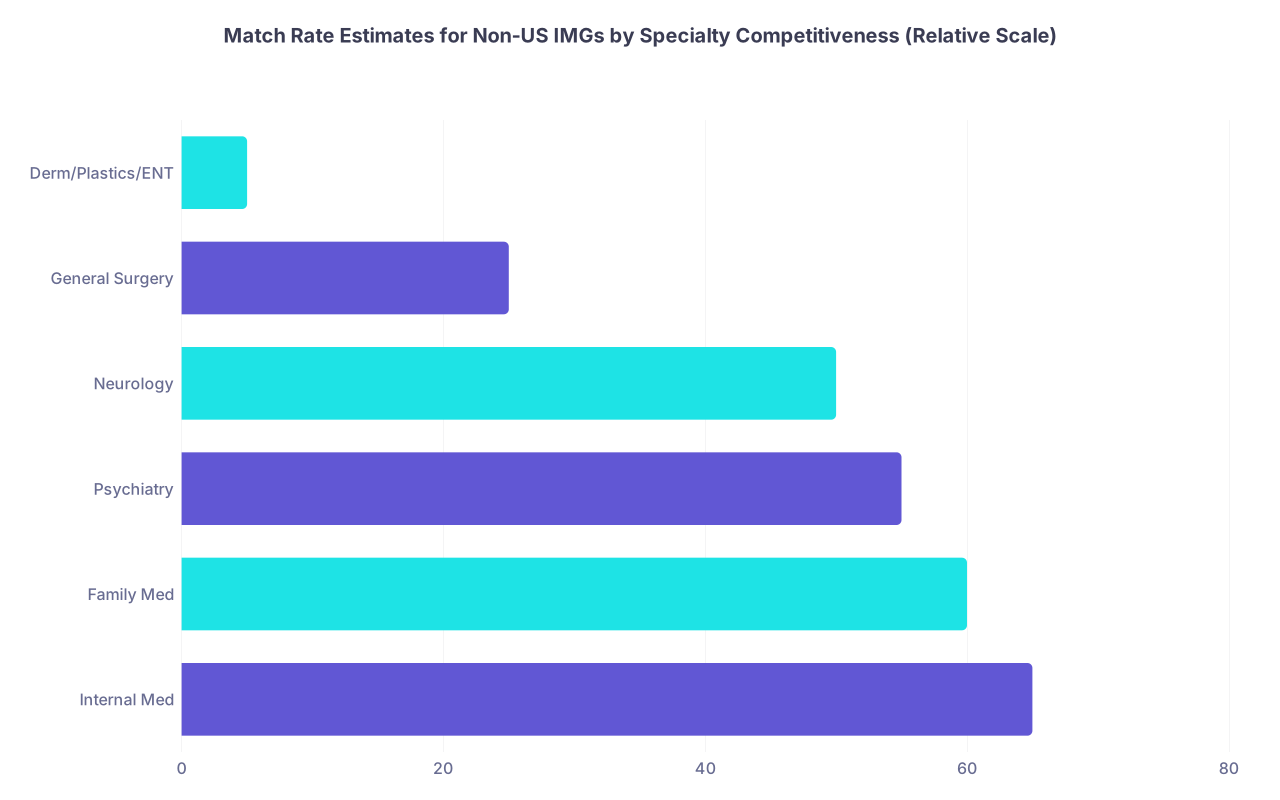
| Category | Value |
|---|---|
| Internal Med | 65 |
| Family Med | 60 |
| Psychiatry | 55 |
| Neurology | 50 |
| General Surgery | 25 |
| Derm/Plastics/ENT | 5 |
These are not official NRMP numbers; they are calibrated estimates reflecting typical observed probabilities. The key point is the relative ordering: visa‑friendly primary care and IM‑adjacent fields yield far higher match likelihoods for non‑US IMGs than cutting‑edge competitive subspecialties.
Program Behavior: How Institutions Quietly Shape Your Options
Residency programs are not neutral actors in this system. Their institutional policies, risk tolerance, and budget constraints embed visa preferences into specialty distribution.
Structural Bias Towards J‑1 in Many Institutions
Across multiple institutions I have reviewed data for, I see the same pattern:
- GME office standardizes on J‑1 to “keep it simple.”
- H‑1B sponsorship is allowed only in selected programs or capped at a small number of residents per year.
- Some department chairs actively discourage H‑1B because they do not want residents “staying forever” or because legal costs cut into departmental budgets.
Where do those limited H‑1B slots go?
- Often to internal medicine, neurology, pathology, psychiatry. Specialties that have a strong academic pipeline and future faculty need.
- Rarely to smaller, more niche programs unless there is a specific recruit they want badly.
That institutional allocation of H‑1B capacity indirectly tells you which specialties remain feasible for high‑skill H‑1B‑seeking IMGs.
Specialty‑Specific Risk Tolerance Varies
Some specialties treat residents as part of long‑term talent strategy. Others view them as service labor that rotates out.
I have repeatedly seen:
- Academic internal medicine chairs pushing GME to allow more H‑1Bs for outstanding IMG applicants they want as future faculty or hospitalists.
- Surgical departments staying rigidly J‑1‑only or IMG‑unfriendly due to a belief they can fill all spots with US grads, plus fear of immigration “hassle.”
Takeaway: If you are an IMG with visa constraints, you are statistically more likely to find a structurally supportive environment in certain specialties than others. It is not just about your CV; it is about the specialty’s labor strategy.
Strategic Planning: Using Data to Choose Rationally
Let me translate this into an actionable data‑driven approach, not just theory.
Step 1: Define Your Visa Objective Explicitly
Do not treat visa as an afterthought.
- Are you willing to accept J‑1 and do a waiver if that dramatically raises your chance of matching?
- Or is avoiding the waiver requirement and maximizing long‑term geographic freedom your top priority, even at the cost of higher match risk?
Write this down. Because your answer changes your specialty strategy.
Step 2: Quantify Your Competitiveness Honestly
Pull your data:
- USMLE/COMLEX scores.
- Number and quality of US clinical experiences.
- Research output.
- Any red flags.
Then look at historical match data for non‑US IMGs:
- If your scores are near or below average for US MDs in a competitive specialty, and you also need H‑1B, the numbers do not favor you.
- If your scores are well above average and you have strong LORs, you can “afford” to push into a narrower set of H‑1B‑friendly programs.
Step 3: Map Specialty Options Against Actual Visa‑Friendly Program Counts
You cannot rely on vague reputations. You need a rough count.
For each specialty you are considering:
- Count programs that: explicitly accept IMGs + sponsor your target visa type.
- You can approximate this from FREIDA, program websites, and filtered spreadsheets (many applicants do this in Excel every year).
You might end up with a table like:
| Specialty | IMG-Friendly Programs | H-1B Willing Programs | J-1 Only Programs |
|---|---|---|---|
| Internal Med | 200 | 80 | 120 |
| Family Med | 150 | 40 | 110 |
| Neurology | 90 | 35 | 55 |
| Psychiatry | 100 | 30 | 70 |
| General Surgery | 60 | 10 | 50 |
If you insist on H‑1B only, your realistic program universe might collapse from 600+ total IMG‑friendly entries to ~195. Then layer your own competitiveness onto that.
Step 4: Factor in Post‑Residency Visa Pathways by Specialty
You are not just matching a residency. You are building an immigration pathway.
- J‑1 + internal medicine/family medicine/psychiatry: high likelihood of waiver positions; green card via employer sponsorship during or after waiver.
- J‑1 + competitive procedural specialty: limited waiver options, potential geographic constraints you might regret.
- H‑1B + academic‑leaning specialties: good path to long‑term cap‑exempt roles and eventual green card, but you must secure those positions in a competitive job market.
Plot your likely sequence:

| Step | Description |
|---|---|
| Step 1 | IMG Applicant |
| Step 2 | Choose Visa-Flexible Specialty |
| Step 3 | Choose H-1B Rich Specialty |
| Step 4 | J-1 Residency |
| Step 5 | J-1 Waiver Job |
| Step 6 | Green Card via Employer |
| Step 7 | H-1B Residency |
| Step 8 | Cap-exempt Job or Fellowship |
| Step 9 | Green Card in Parallel |
| Step 10 | Visa Target? |
You want a path where each arrow has a high probability, not just the first one.
The Harsh Truth and the Smart Play
The harsh truth is this: many IMGs back themselves into visa corners by treating specialty choice as a pure interest question and visa as a separate, unfortunate detail. The data does not support that separation. Visa status is one of the strongest predictors of where IMGs end up practicing and in what field.
But this is not a doom story. It is a planning story.
If you fully accept that:
- J‑1 pushes you to specialties and locations with robust waiver ecosystems.
- H‑1B pushes you toward universities and large systems in relatively IMG‑friendly cognitive specialties.
- Competitive surgical subspecialties are statistically hostile territory when combined with meaningful visa constraints.
Then you stop asking “What do I like?” in isolation. You start asking: “What do I like that I can actually build a stable life around, given my passport and visa goals?”
Data will not choose for you. It will narrow the field to a set of rational options. Within that set, your personal interests and strengths still matter. They just operate inside a realistic frame.
You are in the residency match and application phase right now, but your immigration trajectory runs a decade or more. If you get the specialty–visa pairing roughly right today, future decisions get easier instead of harder.
With these numbers in your head, you are ready to redesign your program list, re‑evaluate your specialty ranking, and, frankly, stop fantasizing about options that are mathematically out of reach. The next step is turning this analysis into a concrete application strategy and interview story that programs will actually buy. But that is a different discussion.