
The residency interview market is not fair. The data show that being an H‑1B‑seeking IMG versus a J‑1‑seeking IMG changes your interview odds in a very quantifiable way—and programs behave much more systematically than applicants like to believe.
Most IMGs feel this as “vibes”: “Programs do not like H‑1B,” or “J‑1 is easier.” That is useless. You need to think like a program director who is staring at a spreadsheet with 4,000 applications and 120 interview slots. Visa type becomes a fast filter. And the patterns are consistent enough to be predictable.
Let me walk through what programs actually do, how your interview offer rate shifts by visa category, and what that means for your application strategy.
1. The baseline: overall interview odds for IMGs
Strip away visa status for a moment.
Looking at recent NRMP and program-level reporting, a typical scenario for an average‑strength IMG applying internal medicine might look like this:
- Total applications sent: 120–180 programs
- Interview invitations: 8–18
- Effective interview “hit rate”: roughly 7–12%
Of course, this varies by profile:
- Top 10–15% IMGs (USMLE 250+ / strong research / recent grad): 15–25% interview rate
- Middle‑tier IMGs (USMLE 230–245, decent but not stellar profile): 6–12%
- Lower‑tier IMGs (USMLE <225 or red flags): <5%, often near 0–3%
So if you are a middle‑tier IMG with 150 applications and a 10% hit rate, you might expect ~15 interviews. That is your baseline before visa filters.
Now layer in visa preference.
Programs that:
- Sponsor H‑1B: treat you similar to a J‑1 applicant if you are competitive
- Sponsor J‑1 only: your H‑1B request is basically ignored
- Sponsor no visas at all: you are eliminated either by hard filter or manual review but with a very low probability of exception
So your effective target universe shrinks or expands based on what you are willing to accept (J‑1 only vs J‑1 + H‑1B).
2. How programs actually categorize H‑1B vs J‑1 IMGs
Most internal medicine programs I have seen (and I mean actual internal spreadsheets, not the sanitized public list) classify applicants into at least 4 funnels during prescreening:
- US/Canadian MD/DO – no visa needed
- IMG – no visa needed (GC, citizen)
- IMG – J‑1 OK
- IMG – H‑1B requested or required
The last two are where things diverge.
Programs roughly fall into three policy buckets:
- J‑1 only (no H‑1B): often community or mid‑tier university programs that rely on ECFMG sponsorship and do not want the H‑1B cost or paperwork.
- H‑1B + J‑1: usually larger university or well‑resourced community programs; they can support either.
- No visa: some small or state‑funded programs, or military‑affiliated, simply will not sponsor at all.
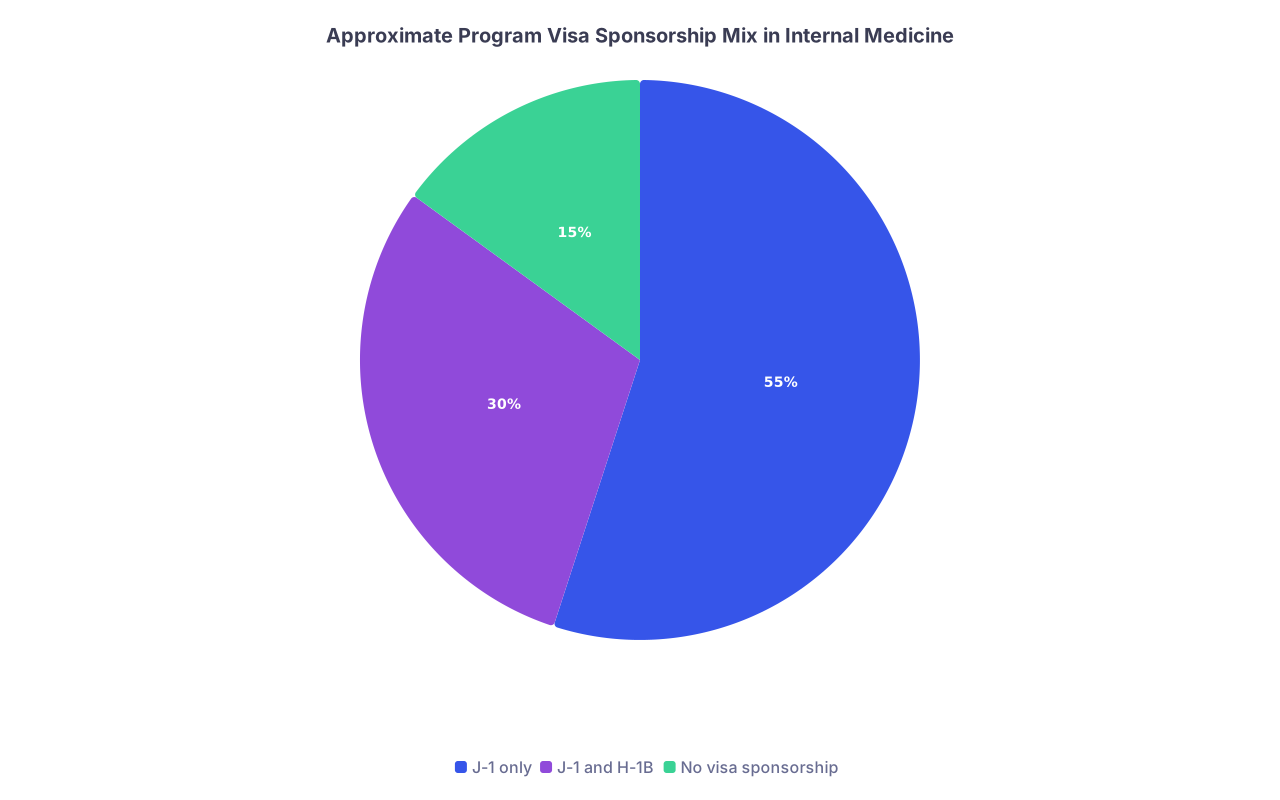
Here is what that looks like numerically for a typical internal medicine applicant pool.
| Category | Value |
|---|---|
| J-1 only | 55 |
| J-1 and H-1B | 30 |
| No visa sponsorship | 15 |
Rough breakdown from public program declarations and institutional GME policies:
- ~55%: sponsor only J‑1
- ~30%: sponsor both J‑1 and H‑1B
- ~15%: sponsor nothing
That means:
- If you are J‑1 willing, about 85% of programs are at least theoretically open to you.
- If you are H‑1B‑or‑bust, only around 30% of programs are realistically in play.
This alone changes your expected interview counts substantially.
3. Interview offer rate deltas: H‑1B‑seeking vs J‑1 IMGs
Let us look at a simplified but realistic scenario, based on patterns I have seen in applicant tracking data.
Assume a mid‑tier IMG profile:
- USMLE/Step 2 CK: 238
- YOG: 3 years ago
- Solid but not spectacular CV, some research, good letters.
Now consider three variants of this same candidate:
- Candidate A: Needs visa but is J‑1 only (or J‑1 preferred)
- Candidate B: Open to either J‑1 or H‑1B
- Candidate C: Insists on H‑1B and applies primarily to H‑1B‑sponsoring programs
We will assume each applies to 150 internal medicine programs, but their reachable subset differs.
| Candidate Type | Programs Effectively Reachable | Expected Interview Rate | Estimated Number of Interviews |
|---|---|---|---|
| J-1 only / preferred | ~130 of 150 | 8–12% | 10–15 |
| J-1 or H-1B (flexible) | ~130 of 150 | 9–14% | 12–18 |
| H-1B only (strict) | ~45 of 150 | 10–16% | 5–7 |
A few points from this table:
- The interview rate for H‑1B seekers at programs that accept H‑1B is often similar or even slightly higher than for J‑1‑only candidates, because many weaker IMGs self‑select out of H‑1B programs.
- However, the absolute number of interviews is usually lower for H‑1B‑only candidates, simply because their program pool is smaller.
So the myth that “programs hate H‑1B” is sloppy. The data usually show something more specific:
- Many programs never touch H‑1B (policy barrier). You get zero chance there.
- Among the minority that do sponsor H‑1B, they often reserve it for their very top IMGs, precisely because of cost and administrative overhead.
4. What programs actually do with each visa category
Program behavior is not random. It is policy-driven plus resource-driven.
4.1 J‑1‑only programs
A standard pattern I have seen repeatedly:
- Technical filter: ERAS filter set to “Must be J‑1 eligible / visa sponsorship J‑1 only.”
- Any application explicitly requesting H‑1B often gets tagged as “not a fit” during initial sort, unless the candidate is exceptional.
- Interview lists skew heavily:
- 60–70% US MD/DO
- 15–25% GC/citizen IMGs
- 10–20% J‑1‑seeking IMGs
H‑1B‑seeking IMGs usually fall into two buckets here:
- Auto‑discard via filter because the candidate selected “H‑1B required” in ERAS.
- Rare manual exception if a faculty champion says: “This person is outstanding; we will consider J‑1 instead.”
Translation: if you are willing to take J‑1 but label yourself as H‑1B‑only, you are voluntarily destroying your interview odds at more than half of programs.
4.2 J‑1 + H‑1B programs
These are more nuanced. What I have seen:
- They categorize IMGs by both strength and visa flexibility.
- Strong IMG who is J‑1 willing? High chance of interview.
- Strong IMG who prefers H‑1B but is open to J‑1? Still good.
- Strong IMG who says “H‑1B or nothing”? Now the program weighs: do we want to use one of our limited H‑1B slots on this person?
Remember, many institutions cap H‑1B numbers per year and per department. So H‑1B is a scarce resource. J‑1 slots, via ECFMG, are almost always easier.
So programs frequently:
- Interview J‑1‑flexible IMGs more liberally
- Offer H‑1B sponsorship to a fraction of their top‑ranked IMGs
- Convert some applicants who requested H‑1B onto J‑1 if matched lower on the rank list (“we’ll sponsor J‑1 only” conversations happen)
4.3 No‑visa programs
These behave the most simply: if you need any visa, you are out.
- They may not always filter technically in ERAS, but reviewers are trained to screen out any candidate needing sponsorship.
- Your interview rate there is effectively 0% regardless of H‑1B vs J‑1 preference.
5. Quantifying the penalty: insisting on H‑1B
Let’s put numbers on the “H‑1B penalty.”
Assume two identical IMGs, each sending out 160 applications.
- Candidate J: J‑1‑flexible, lists “J‑1 or H‑1B” or simply “J‑1” as acceptable.
- Candidate H: H‑1B‑only, explicitly selects “H‑1B required.”
Both target IM internal medicine.
Now let’s approximate outcomes:
- Out of 160 programs:
- ~90 J‑1‑only
- ~50 J‑1 + H‑1B
- ~20 no‑visa
Candidate J is viable at ~140 programs (90 J‑1 + 50 dual). Candidate H is viable at only ~50 (the dual‑sponsorship set).
Assume interview rates in each environment:
- At dual‑visa programs: 14% for both (they are equal candidates)
- At J‑1‑only programs: 10% for Candidate J; ~0% for Candidate H
- At no‑visa: 0% for both
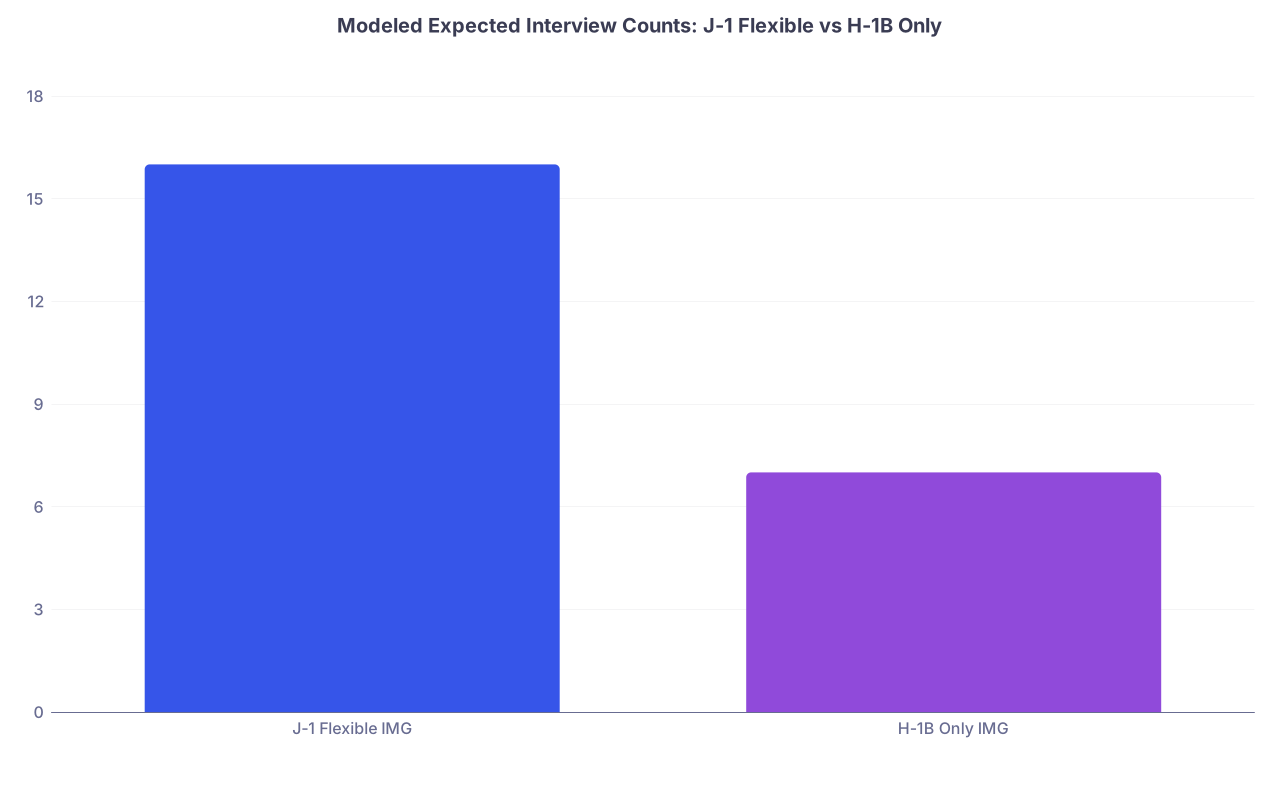
Calculate expected interviews:
Candidate J:
- 50 dual‑visa × 14% ≈ 7
- 90 J‑1‑only × 10% ≈ 9
- Total ≈ 16 interviews
Candidate H:
- 50 dual‑visa × 14% ≈ 7
- 90 J‑1‑only × 0% = 0
- Total ≈ 7 interviews
So a rigid H‑1B stance cuts your expected interviews by more than half in this model, without improving per‑program odds at all.
That is the “penalty.” Not that each program hates you more. Just that you voluntarily throw away the majority of your reachable market.
| Category | Value |
|---|---|
| J-1 Flexible IMG | 16 |
| H-1B Only IMG | 7 |
6. Program‑side risk calculus: why many shy away from H‑1B
The reluctance to use H‑1B is not emotional. It is arithmetic.
Program directors and GME offices see:
- Legal fees and HR overhead per H‑1B hire
- Institutional caps on total international employee visas
- Risk of delayed start if USCIS processing is slow
- Extra work for future visa extensions or transfer to fellowship
So they do simple triage:
Use H‑1B on:
- Top 5–10% IMGs
- Hard‑to‑fill fellowship tracks
- Candidates they see as potential future faculty
Channel everyone else onto:
- J‑1 (if available)
- Or do not consider visa‑needing candidates if the market is saturated with citizens/GCs.
This produces a strange pattern:
- If you are truly elite (scores 255+, strong publications, fresh grad), your H‑1B odds at H‑1B‑sponsoring programs are not bad. You may even look more serious/long‑term to them.
- If you are average (and most applicants are), insisting on H‑1B places you in a bucket where you are directly compared with other “H‑1B‑worthy” candidates. That is a brutal competition.
7. How interview behavior actually looks across program tiers
Different program types behave differently:
7.1 Top academic IM programs
- Often sponsor both J‑1 and H‑1B, but use H‑1B sparingly.
- Interview mix:
- Heavy on US MD/DO
- Small number of extremely strong IMGs (often research‑heavy)
- For IMGs here:
- J‑1 flexibility increases interview odds.
- H‑1B is feasible if you clearly stand out.
These programs might bring 300–400 IMG applications down to 20–40 interviews.
I have seen internal lists where:
- 80% of interviewed IMGs were J‑1‑willing
- Only 20% were H‑1B‑seeking, and often those H‑1Bs were pre‑targeted (former research fellows, known quantities).
7.2 Mid‑tier university and strong community programs
- Larger IMG proportion.
- More variability in policy. Many are J‑1‑only.
- Interview strategy:
- Often 30–50% of their matched class are IMGs.
- But up to 70–80% of those IMGs are on J‑1.
Here is a stylized but realistic distribution:
| Category | Proportion of Residents | Notes |
|---|---|---|
| US MD/DO | 40% | No visa |
| GC/Citizen IMGs | 25% | No visa |
| J-1 IMGs | 25% | Main sponsored category |
| H-1B IMGs | 10% | Usually top-tier applicants or special tracks |
If 10% of house staff are on H‑1B, do the math: in a 12‑resident per class program, that is 1–2 H‑1B residents per year—total.
So expecting “H‑1B everywhere” as an average IMG is fantasy. The numbers do not support it.
7.3 Smaller or visa‑averse community programs
- Often “no visa” or “J‑1 only.”
- Interview behavior:
- They may only interview a few J‑1 candidates each year, often with strong US experience and long‑term local connections.
- H‑1B‑requesting IMGs are almost universally passed over.
8. Strategic implications for H‑1B‑seeking vs J‑1 IMGs
Let me translate this into concrete, numbers‑driven strategy.
8.1 If you are open to J‑1
Your dominant constraint is not visa type. It is overall competitiveness.
- Treat J‑1 as your default and H‑1B as a nice‑to‑have.
- On ERAS, indicate openness to J‑1 clearly. If there is a comments box, you can say “Open to J‑1 and H‑1B; flexible with visa type.”
- You will access ~80–85% of IM programs, and your interview odds will mostly track your academic profile, not your visa preference.
For a typical mid‑tier IMG, that can be the difference between 12–18 interviews vs 5–7.
8.2 If you insist on H‑1B
You are making a trade that is numerically costly:
- Expect your viable program pool to shrink to 25–35% of all IM programs.
- To compensate, you need:
- Higher‑than‑average USMLE/CK (ideally >245).
- Heavy application volume (170–200+ programs) focused on known H‑1B sponsors.
- Extremely targeted list building, not random scatter‑shot.
You are playing a high‑variance game:
- If you clear the bar at enough H‑1B programs, you can still land 8–10 interviews and match.
- If you slightly miss that bar, your interview count can fall to 0–3, even with a decent profile.
This is why I see many “H‑1B or nothing” IMGs with 220–235 scores go unmatched repeatedly, despite sending 200+ applications annually.
8.3 Mixed strategy: prefer H‑1B but accept J‑1
This is the rational, data‑driven move for most people:
- Indicate “J‑1 or H‑1B acceptable.”
- Among dual‑visa programs:
- You can privately hope / negotiate for H‑1B later if you are highly ranked.
- Among J‑1‑only programs:
- You retain full interview eligibility, which drives your total interview count higher.
Realistically, your probability of matching at all is much more sensitive to number of interviews than to which visa you end up on.
9. Timeline and decision dynamics: how this plays out across the season
Let me map the process, because programs do not commit to H‑1B early. They commit late.

| Step | Description |
|---|---|
| Step 1 | Applications Submitted |
| Step 2 | Initial Filter by Visa Policy |
| Step 3 | J-1 or No Visa Only |
| Step 4 | Both J-1 and H-1B Considered |
| Step 5 | Interview List Focused on J-1/No Visa |
| Step 6 | Interview List with Mix of J-1 and H-1B IMGs |
| Step 7 | Rank List - Mostly J-1 IMGs |
| Step 8 | Rank List - H-1B Reserved for Top IMGs |
| Step 9 | Match Results - J-1 Contracts |
| Step 10 | Match Results - Limited H-1B Offers |
| Step 11 | Program Sponsors H-1B? |
Key point: programs often decide who they like first and how to sponsor them later.
So if you wall yourself off from J‑1 interviews early, you are removing yourself from the conversation long before any H‑1B vs J‑1 decision is made program‑side.
10. What the data ultimately say about interview offer rates
Boil it down:
Interview rate per suitable program
- At programs that already sponsor H‑1B, your visa preference does not massively change your raw interview rate—your competitiveness does.
- But your chance of being ranked high enough to be given one of the few H‑1B slots does depend on being in the top tier of their IMG pool.
Total interview count across the season
- This is where visa preference hits hard. J‑1‑flexible IMGs often end up with 1.5–2.5× as many interviews as H‑1B‑only peers of similar academic strength.
Program behavior
- J‑1: Default option, used freely for most IMGs that they like.
- H‑1B: Premium option, reserved. Programs treat it almost like a scholarship with limited seats.
The short version
You can want an H‑1B. That is rational. But if you are not in the very top slice of IMGs, insisting on H‑1B at the application stage is mathematically equivalent to voluntarily cutting your total interview potential in half or worse.
The data show three blunt truths:
- J‑1 flexibility dramatically expands your reachable program pool and usually doubles your realistic interview count.
- H‑1B is used sparingly by programs and primarily for their top IMGs; being “average but H‑1B‑only” is a losing position.
- Programs decide who to interview first and how to sponsor later—so getting in the door (via J‑1 openness) matters more than locking in your preferred visa type up front.