
The 2‑year home requirement is not a death sentence for your U.S. career. It is a rule. And like most rules in immigration, it has more exceptions, workarounds, and side doors than people tell you.
If you’re an IMG on a J‑1 for residency or fellowship, you’ve probably heard some version of this in the call room:
“If you train on a J‑1, you must go home for two full years before you can ever work or do a fellowship in the U.S. again.”
That statement is wrong in three separate ways.
Let’s dismantle the mythology and talk about what J‑1 IMGs can actually do—with data, actual regulations, and real‑world pathways that physicians use every single year.
What the 2‑Year Home Rule Actually Says
You cannot beat an enemy you do not understand. So here is the core of the law without the folklore.
If you’re a J‑1 physician sponsored by ECFMG, you’re subject to INA §212(e), the famous “2‑year home residency requirement.” It says:
You must, in total, spend 2 years physically present in:
- Your country of nationality or
- Your country of last permanent residence before the J‑1
before you’re eligible for certain immigration benefits.
What does it actually block?
You cannot:
- Get an H‑1B or L‑1 visa
- Get a K (fiancé) visa
- Adjust status to permanent residence (i.e., get a green card from inside the U.S.)
- Change status in the U.S. to certain categories that require you not to be 212(e)‑restricted
until you either:
- Fulfill the 2 years physically, or
- Get a waiver approved.
That’s it. It does not say:
- You must leave the U.S. immediately after your J‑1.
- You cannot ever return to the U.S. for 2 years.
- You cannot do research, another J‑1, or short clinical electives in the U.S.
- You cannot get married to a U.S. citizen and then fix it. (Marriage doesn’t erase 212(e), by the way, but it changes your options.)
The restriction is on specific visa types and green card processes, not on your physical presence on American soil in all forms.
That nuance matters a lot.
Myth vs Reality: What J‑1 IMGs Think vs What the Data Shows
Let’s put some of the most common myths side‑by‑side with reality.
| Topic | Myth | Reality |
|---|---|---|
| Must leave US | You must exit as soon as training ends | You can often extend J‑1, change to another non‑immigrant status, or remain while waiver processes |
| US work after training | Impossible without 2‑year return | Thousands work annually via J‑1 waivers (Conrad 30, VA, ARC, HHS, etc.) |
| Marriage to US citizen | Automatically cancels 212(e) | It doesn’t. You still need to fulfill or waive 212(e) |
| Green card | No chance from J‑1 | Very possible after waiver and H‑1B, or after home‑country service |
| Non‑clinical work | Completely blocked | Many do research/academic J‑1s or O‑1s, if no clinical care |
The numbers back this up. In a typical recent year, more than a thousand J‑1 physicians get Conrad 30 waivers alone. Then add VA waivers, federal agency waivers (HHS, DoD, etc.), persecution waivers, hardship waivers. The majority of J‑1 physicians who want to stay manage to either get a waiver or come back in a different capacity.
The horror stories often come from people who:
- Started thinking about all this in PGY‑3 of fellowship
- Trained in an extremely competitive specialty in a saturated market
- Or relied entirely on hospital HR to “figure it out”
If you decide early and plan aggressively, your odds look very different.
What You Can Do On a J‑1 – While Subject to 212(e)
Here’s the part nobody explains clearly during orientation: being subject to 212(e) is not the same as being handcuffed from doing anything else.
You can usually:
- Complete multiple residencies/fellowships on J‑1, as long as ECFMG sponsors you and you have legitimate educational progression.
- Extend your J‑1 for continued training within the rules.
- Do moonlighting in some programs (if ECFMG and your DS‑2019 permit, and institutional GME policies allow it; details vary wildly by state and program).
- Travel in and out of the U.S. during your J‑1, as long as your visa stamp and DS‑2019 are valid.
- Apply for a waiver during your final years of training or fellowship.
- Switch to another J‑1 category (e.g., non‑clinical research) in some very narrow circumstances.
You also can leave the U.S., start working in your home country, and still:
- Get invited back to the U.S. for conferences on a B‑1/B‑2 visa or ESTA (if eligible)
- Do short‑term observerships or visiting scholar roles that do not conflict with 212(e) bars
- Line up H‑1B and green card plans timed to when your 2‑year clock completes
What you cannot do is pretend the rule doesn’t exist and then act surprised in your final year when everyone else is scrambling for waiver jobs.
The Main Escape Hatch: J‑1 Waiver Pathways
Let me be blunt: for most J‑1 IMGs who want to work clinically in the U.S. after training, a waiver job is the default route. Not an exception.
There are several major waiver categories physicians use:
Conrad 30 Waivers (State Health Department)
Every state has up to 30 waivers per year for J‑1 physicians willing to work in underserved areas, mostly on H‑1B. Most are for primary care and psychiatry, but many states give waivers to hospitalists and subspecialists too.Federal Agency Waivers
These come from agencies like:- VA (Department of Veterans Affairs)
- HHS (particularly for research or certain clinical roles)
- Department of Defense
They often have more flexible location rules but more bureaucratic hoops and specific focus areas.
Interested Government Agency (IGA) Waivers
Certain state/federal entities that serve a critical public interest can sponsor waivers for positions that advance their mission.Persecution or Exceptional Hardship Waivers
These are personal‑circumstance‑based:- You fear persecution if you return.
- Your U.S. citizen or permanent resident spouse/child would suffer “exceptional hardship” if you had to do the 2‑year home stay.
They’re harder to win, heavily evidence‑driven, and slow. But they exist and are granted every year.
Here’s what usually happens, in real life, when things go well:
- You’re in PGY‑2–3 of residency or 1st year of fellowship.
- You start tracking which states and employers sponsor Conrad 30, who’s IMG‑friendly, and what their timelines are.
- You interview early for jobs in underserved locations willing to file for you.
- They send a contract and commit in writing to sponsor a J‑1 waiver, then H‑1B.
- The employer attorney files your waiver application via the state or federal program.
- Once the waiver is approved, they file H‑1B to move you from J‑1 to work status.
- You start a 3‑year service commitment in an underserved area. After that, you’re typically free to move and pursue a green card in parallel.
The J‑1 waiver/H‑1B/green card pipeline isn’t fantasy; it’s basically an industry by now.
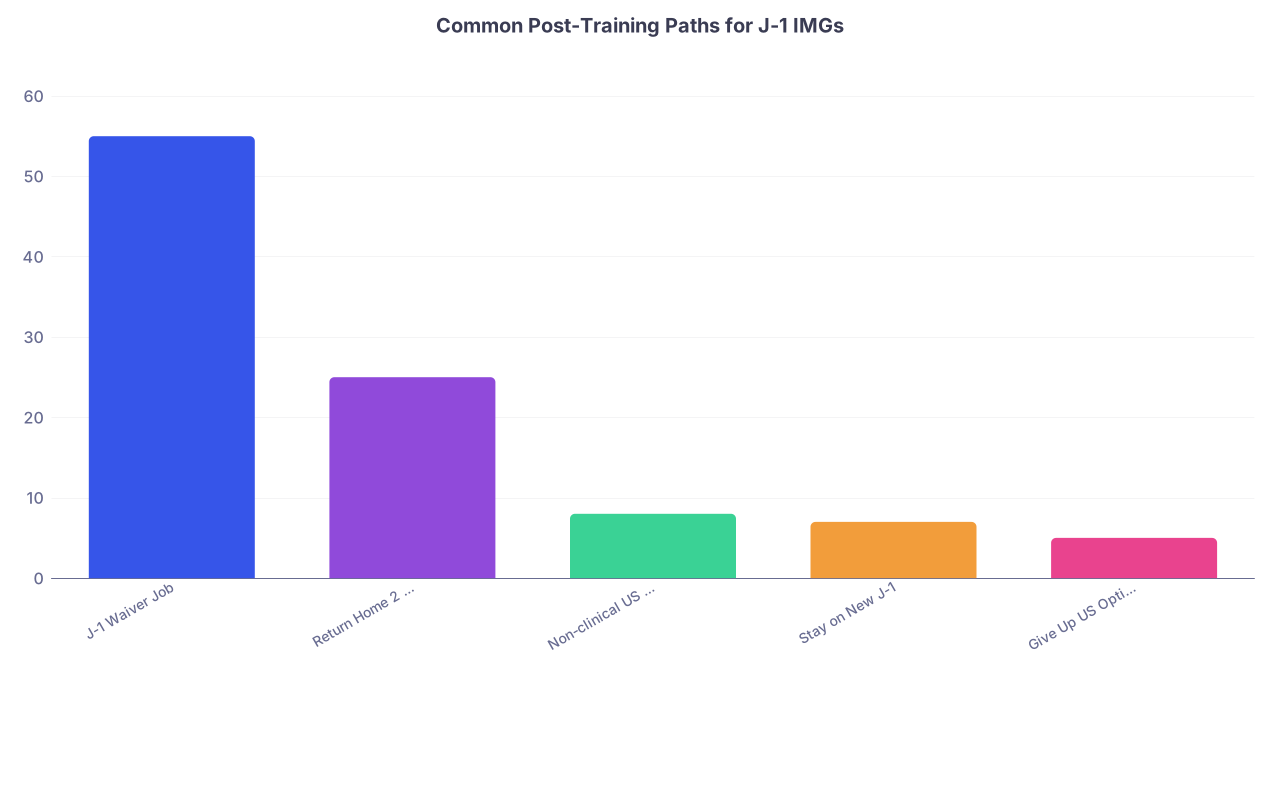
Charting the Real Options: Paths After J‑1 Training
Here’s the landscape in structured form. Not the fear‑based version; the actual option map physicians use.
| Category | Value |
|---|---|
| J-1 Waiver Job | 55 |
| Return Home 2 Years | 25 |
| Non-clinical US Role | 8 |
| Stay on New J-1 | 7 |
| Give Up US Option | 5 |
Those percentages are rough ballpark, drawn from program director and immigration attorney observations, not a single formal dataset. But they’re directionally accurate: more than half of J‑1 IMGs who want to stay clinically in the U.S. use some form of waiver pathway.
To make this even more concrete, here’s how some core post‑training options compare:
| Path | Can stay in US immediately? | Can work clinically? | 2-year rule satisfied? |
|---|---|---|---|
| Conrad 30 waiver + H‑1B | Yes | Yes | Waived (no 2-year return) |
| Federal agency waiver + H‑1B | Yes | Yes | Waived |
| Return home for 2 years | No (must leave) | Only abroad | Fulfilled after 2 years |
| O‑1 (extraordinary ability) | Sometimes | Sometimes (non-J‑1 clinical is tricky) | 212(e) still applies for H/green card |
| New J‑1 for research | Yes (if approved) | Generally no patient care | 212(e) still pending |
Notice that only two things erase 212(e):
- Actually doing the 2 years abroad, or
- Getting an approved waiver.
Everything else is just a way of living with it while you position yourself.
The Marriage Myth, the O‑1 Myth, and Other Half‑Truths
Let’s knock down a few popular “solutions” that people throw around in hallways and WhatsApp groups without actually reading the law.
“If I marry a U.S. citizen, I don’t have to go home.”
Wrong. Marriage to a U.S. citizen can give you a powerful basis for a green card. But 212(e) is a separate bar.
If you’re still subject to 212(e), you cannot adjust status to permanent residency from inside the U.S. even if married to a U.S. citizen, until:
- You fulfill the 2‑year physical presence, or
- You get a waiver (often via hardship to the U.S. citizen spouse or child).
Marriage helps, but it doesn’t erase 212(e) by magic.
“I’ll just get an O‑1 and skip the 2 years.”
The O‑1 (extraordinary ability) visa is the golden ticket people love to fantasize about. Yes, some physicians get it. But:
- The standard is high. Real publications, real impact, real national or international recognition.
- Even if you get an O‑1, it does not cancel 212(e). You’re still barred from H‑1B and permanent residence until waived or fulfilled.
- Clinical work on O‑1 for someone who trained on a J‑1 as a physician can be a regulatory minefield.
O‑1 can be part of a long game, but it’s not a clean bypass.
“I’ll just change to another visa from inside the U.S. and be fine.”
Most status changes that would let you work clinically (like to H‑1B) are exactly what 212(e) blocks until the requirement is waived or fulfilled. You don’t get around 212(e) with clever status hopping.
You either face it head‑on with a waiver or you pay the 2‑year time cost.
What You Can Do Now (Even in PGY‑1)
Here’s where you actually have leverage: early, when everyone else is still pretending this is “a later problem.”
You should be:
- Confirming your 212(e) status from your DS‑2019 and visa stamp. Do not assume; read it.
- Learning which states you’d realistically work in. Some are IMG‑friendly and flexible (e.g., TX, WI, ND, MN). Others are stingy or late with Conrad slots.
- Looking at specialty‑specific patterns. Family medicine and psychiatry have more waiver options than derm or plastics. Hospitalist jobs exist but cluster geographically.
- Building CV strength that makes waiver‑sponsoring employers chase you, not the reverse: procedures, leadership roles, local connections.
If you’re in fellowship, this is now urgent, not theoretical.
And be very clear‑eyed about timing: many states open Conrad 30 applications around October 1 for jobs starting the following July. If you wake up in February of your last year, you may simply be too late for that cycle.
Realistic Future After a Waiver: It’s Not Just Rural Exile Forever
Another myth: “If you do a J‑1 waiver, you’re stuck in the middle of nowhere for life.”
Here’s how it usually plays out—assuming decent planning and no disasters:

| Step | Description |
|---|---|
| Step 1 | Residency/Fellowship on J-1 |
| Step 2 | Secure waiver job offer |
| Step 3 | Conrad 30 / Federal waiver approved |
| Step 4 | Switch to H-1B status |
| Step 5 | 3-year service in underserved area |
| Step 6 | Employer files green card |
| Step 7 | Permanent resident |
| Step 8 | Freedom to move employers/locations |
During those 3 years, you’re:
- Working as an attending.
- Earning a full attending salary (often higher in underserved areas).
- Building U.S. experience.
- Starting your permanent residence process if you and your employer are smart.
After the 3‑year service is done, most physicians have:
- I‑140 immigrant petition approved.
- Often an approved or pending I‑485 if priority dates allow (for most non‑backlogged countries).
- Freedom to move to a more desirable city, academic post, or private group.
The waiver years feel long when you are in them. Five years later, they feel like residency: rough, formative, and very much over.
The Hard Truths Nobody Likes to Say Out Loud
Not everything is rosy. Here are the pieces people gloss over:
- If you’re in a highly saturated subspecialty (cards, GI, heme‑onc in a major metro), waiver jobs may be scarce where you want to live. Geography is the real currency.
- If you refuse to work in any underserved area—ever—you’re basically choosing the 2‑year home option or a very creative non‑clinical/academic path.
- If you procrastinate planning until your final year of fellowship, you may end up in panic mode, taking the first job that will file anything at all for you.
- Some states use all their Conrad slots quickly. You need to know which ones those are and what their timelines look like.
But none of that equals “You must disappear for two years before you can ever step back into the U.S. system.” That line is pure mythology.
The Bottom Line: The 2‑Year Rule is a Constraint, Not a Career Ending
Here’s the honest summary:
- The 2‑year home requirement does exist, and it has teeth.
- It does not force you to leave the U.S. immediately in all cases.
- It does not block you from all future U.S. training, work, or immigration.
- It can be waived—in multiple ways used by physicians every single year.
- And if it isn’t waived, it can be fulfilled surgically, with those 2 years spent in a way that sets up your longer‑term plan, rather than just punishes you.
You’re not powerless here. But you are on the clock.
If you treat the 2‑year rule like a vague rumor you’ll “figure out later,” it will ambush you. If you treat it like a constraint to be engineered around, you’ll join the large, very quiet group of J‑1 IMGs who finished residency, did a waiver, got a green card, and are now attendings in exactly the jobs they once thought were impossible.
Years from now, you won’t remember the late‑night panic Googling “J‑1 2 year rule trapped forever??” from the call room. You’ll remember whether you treated this like a fixed fate—or like a problem you were smart enough to solve.