
No, J-1 Doesn’t Kill Your Academic Career: Paths IMGs Overlook
Did someone already tell you, “If you want an academic career in the US, you have to get H-1B—J-1 will kill your chances”?
That’s the myth. And it’s wrong. Not abstractly wrong. Factually, numerically, historically wrong.
I’ve seen this play out every single cycle: a strong IMG turns down better academic programs or delays applying because they’re terrified of the J-1 “career death sentence.” Then three years later, they’re in a mediocre setting, burned out, still trying to break into research that they could’ve started during residency.
Let’s dismantle this properly.
Myth vs Reality: What J-1 Actually Means
First, the core fear: J-1 = you’ll never do US academics, never do research, never come back to the US as faculty.
Reality: A huge chunk of current US academic attendings—especially in IM, subspecialties, peds, heme/onc, ID, cards—came through J-1. Many of them had to do two things:
- A waiver job
- Smart timing on when to push research/academia
That’s it. Not some magical alternate visa universe.
Let’s separate the rumor from the facts.
What J-1 actually requires
Basic J-1 clinical category reality:
- You’re sponsored (usually) by ECFMG
- You do residency/fellowship on J-1
- At the end, you’re subject to the 2-year home residency requirement unless you:
- Get a waiver (e.g., Conrad 30, federal programs like VA, HHS, etc.), or
- Go home for 2 years cumulatively, or
- Get an exceptional waiver (hardship/persecution – rare and messy)
That’s the “problem” everyone screams about.
But here’s what they gloss over: the 2-year rule doesn’t say “you may never again have a US academic life.” It says “you cannot change to H/L or get an immigrant visa until this is dealt with.” That’s an obstacle. It is not a permanent professional ban.
The Numbers: J-1s Do Not Disappear After Training
Look at the workforce, not Reddit threads.
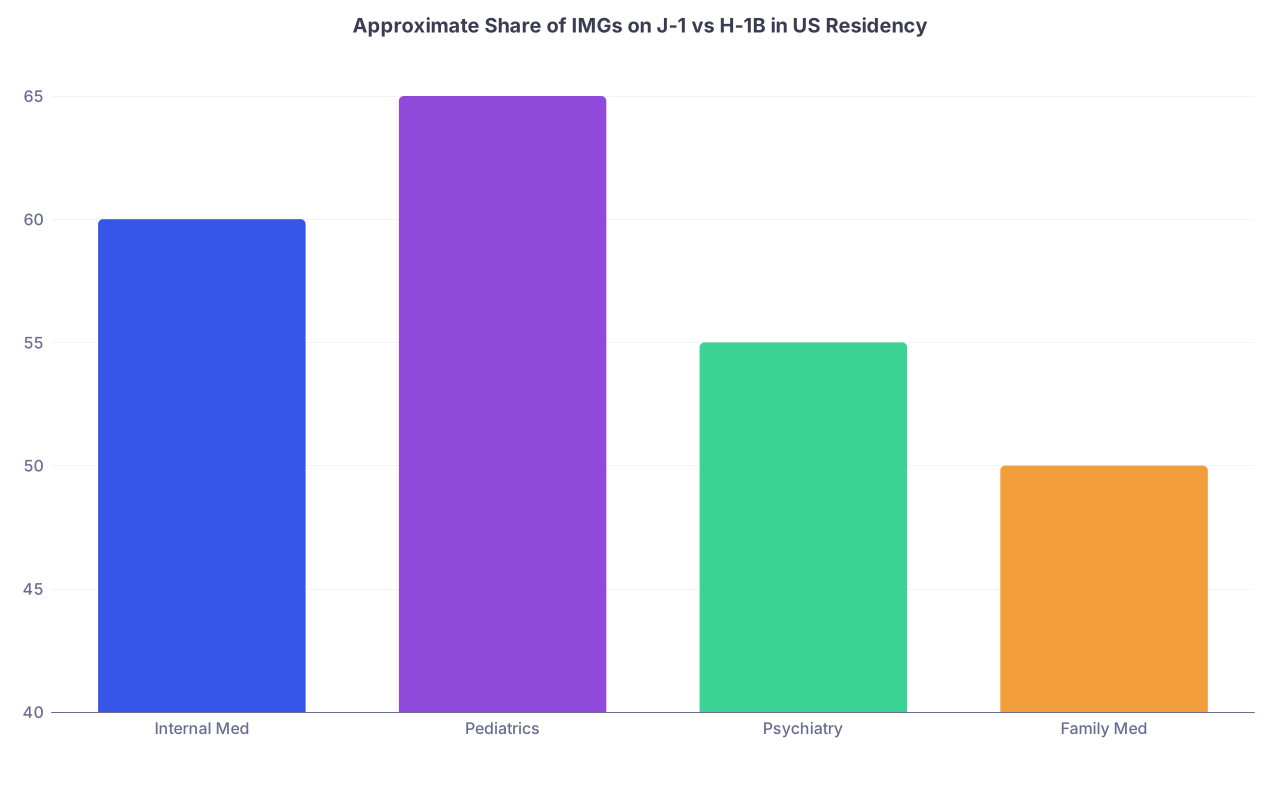
| Category | Value |
|---|---|
| Internal Med | 60 |
| Pediatrics | 65 |
| Psychiatry | 55 |
| Family Med | 50 |
In many internal medicine, pediatrics, and psychiatry programs, well over half of IMGs are on J-1. If J-1 truly “killed” US careers, you’d expect an army of unemployed ex-residents floating around. That’s not what’s happening.
Look around:
- Academic hospitals in the Midwest and South? Packed with ex-J-1s.
- Community teaching hospitals with fellowship programs? Same story.
- Subspecialty fellowships (cards, GI, heme/onc)? Tons of people who did J-1 + waiver job + then returned to academics.
The people telling you “J-1 ruins everything” are usually:
- Med students who’ve never held a visa
- A random senior who once heard of a friend with a bad case
- Or faculty who did H-1B 20 years ago and haven’t kept up with reality
Does J-1 make your path less straight? Yes.
Does it block you from US academic medicine? No.
Where the J-1 Panic Actually Hurts You
Here’s the real damage: people obsess so much about avoiding J-1 that they sabotage their own training.
I’ve watched this pattern:
- Candidate A: solid IMG, strong scores, decent research. Gets multiple academic IM offers, all J-1. Panics because “I must have H-1B for academic career,” then:
- Applies again next year
- Or accepts a weaker, non-academic program only because they promise H-1B
- Candidate B: similar profile. Takes top J-1 academic IM spot, kills it, gets into good fellowship, builds publications.
Five years later:
- Candidate A: average community program, weaker letters, weaker research; visa is easier, but fellowship odds are worse.
- Candidate B: competitive fellowship, stronger CV, more academic doors open—even if they still need a waiver job.
Visa status is part of the equation. Training quality and network beat it almost every time.
You don’t build an academic career on a visa type. You build it on:
- Mentors who vouch for you
- Research productivity
- Fellowship placement
- Reputation from your training programs
J-1 doesn’t block those. It just inserts an extra phase: the waiver years.
The “J-1 Then Academics” Playbook Nobody Explains
Let me walk you through the actual routes IMGs use. Not fantasy. Real tracks I’ve seen repeatedly.
Path 1: J-1 → Fellowship → Waiver Job → Back to Academics
Common for: IM + subspecialties, peds, psych, neuro.
Rough flow:
- Residency on J-1 at an academic or solid community program. You focus on:
- Getting into a fellowship
- Building some research foundation (even a few case reports, QI, abstracts)
- Fellowship on J-1 at an academic center. This is where you can:
- Get mentored by people with NIH funding
- Publish more solid work
- Build your name in a niche (e.g., HFpEF, leukemia, IBD, etc.)
- Waiver job (H-1B) – usually 3+ years in:
- Underserved / rural / smaller city community hospital
- Sometimes a teaching hospital in a less popular location
- During the waiver:
- Keep publishing if possible (tele-collaborations, retrospective work)
- Keep attending conferences, networking
- Stay visible to your academic mentors
- After waiver:
- Move into an academic attending role (often at your fellowship institution or similar place) once you’ve cleared the 2-year condition and have stable H-1B or green card process.
Is it fast? No. But it’s workable. And common.
I can name multiple heme/onc and cards attendings who did exactly this: J-1 → fellowship J-1 → rural Midwest waiver → assistant professor at university hospital by late 30s or early 40s.
Path 2: J-1 → Waiver in a Teaching Hospital → Grow Academics in Place
This one people rarely talk about because it doesn’t fit the “waiver = isolated middle-of-nowhere clinic” stereotype.
Here’s what they miss: not all waiver sites are tiny private clinics. There are:
- Community hospitals with residencies
- Regional academic affiliates (think “University of X – Community Campus”)
- Hybrid setups where you can:
- Teach residents
- Do QI research
- Eventually become faculty (clinical educator tracks, hospitalist educator roles, etc.)
This looks like:
- Residency/fellowship on J-1
- Get a waiver job at a site that:
- Has residents or is starting a program
- Has some protected time or is open to QI/research initiatives
- Over 3–5 years:
- Get promoted internally (lead hospitalist, program director track, etc.)
- Apply for adjunct or clinical faculty appointments at nearby med schools
- Leverage that into an official academic appointment
Is this Harvard-level R01 scientist track? No.
Is it legitimate US academic medicine with teaching, research, titles? Yes.
Path 3: J-1 → Return Home Strategically → US Academics Later
Nobody wants to hear this, but for some specialties and for some countries, this is actually a strong play.
Especially if:
- Your home country values US training
- You can quickly step into an academic post back home
- You keep collaborations with your US mentors active
Flow:
- IM/Other residency on J-1 → fellowship on J-1
- Go home for 2 years:
- Start as faculty in a teaching hospital
- Keep co-authoring projects with US teams
- Build your CV and maybe secure external funding or regional reputation
- After meeting the 2-year requirement:
- Re-enter US on H-1B or green card route for a targeted academic appointment
- You’re now “experienced faculty with international profile,” not just “fresh grad needing visa sponsorship”
Does this fit everyone? No.
But pretending it’s automatically the “fail” route is lazy thinking.
H-1B vs J-1: The Real Tradeoffs (Not the Fantasy Version)
Let’s be adult about this. Both visas have pros and cons. People oversell H-1B like it’s a golden passport. It isn’t.
| Factor | J-1 | H-1B |
|---|---|---|
| Availability at programs | Very common | Limited, program-dependent |
| Research/academic training | Equally possible | Equally possible |
| Need for USMLE Step 3 at start | No | Often yes |
| Two-year home requirement | Yes (unless waived) | No |
| Post-training flexibility | Structured (waiver or home) | More flexible early on |
| Long-term academic potential | High with planning | High with planning |
The single biggest practical advantage of H-1B is avoiding the 2-year requirement. That’s it. H-1B does not magically:
- Get you more publications
- Get you a better fellowship
- Guarantee an academic job
Meanwhile, there are real constraints:
- Many top academic fellowships do not sponsor H-1B.
- Some big-name IM residencies prefer J-1 because it’s administratively easier.
- H-1B can limit moonlighting or extra income in some setups, depending on how your job is structured.
People act like: “H-1B = academics, J-1 = exile.” It’s childish. Visa does not equal career type. It equals paperwork route.
The Parts IMGs Actually Underestimate
Here’s what really determines whether J-1 will “hurt” you or not:
1. How strong your training choices are
Going to a no-name program just because they offer H-1B may hurt your academic odds more than going to a strong program on J-1. Harsh but true.
I’ve seen:
- J-1 residents at strong university programs match competitive fellowships
- H-1B residents at weak, non-academic programs struggle to get any fellowship interviews
If you want an academic future, quality of program and mentorship beat the visa label 9 times out of 10.
2. How early you think about the waiver strategy
The people who really get stuck are usually those who ignore the waiver issue until PGY-3 or late fellowship. Then:
- They’re geographically inflexible
- They’re picky about practice type
- They have no idea about Conrad 30 timelines or HHS waivers
The ones who do well typically:
- Start learning state waiver rules during residency
- Keep an open mind about location for a few years
- Use mentors who’ve been through the process

| Step | Description |
|---|---|
| Step 1 | Residency on J-1 |
| Step 2 | Fellowship on J-1 |
| Step 3 | 3-year Waiver Job |
| Step 4 | Home Academic Post |
| Step 5 | Academic Position in US |
| Step 6 | Waiver Option? |
3. How you maintain academic momentum during the “non-glamorous” years
The waiver years feel like a detour. They do not have to be a pause.
Smart people:
- Keep remote research collaborations alive
- Present at conferences even if they’re from a small site
- Get promoted early by being the “academic person” in their waiver hospital
- Use that to transition into full-time academic roles once the requirement is cleared
The ones who truly lose the academic track are the ones who disconnect entirely for 3–5 years, then try to come back “cold.”
So, Should You Avoid J-1 at All Costs?
No. You should avoid bad decisions at all costs. J-1 is not one of them by default.
Be blunt with yourself:
- If your main offers are strong academic programs but they only give J-1, and your H-1B options are weaker community programs with no research, the “I must have H-1B” mindset is sabotaging your long-term goals.
- If you already have a stellar H-1B offer at an academic powerhouse, great. Take it. But do not pretend that J-1 would have killed your dreams.
The better question isn’t “J-1 or H-1B?”
It’s:
- “Which program will give me the best shot at the career I want—fellowship, research, mentorship?”
- “If that program is J-1, am I willing to tolerate a few structured years (waiver / home country) to get there?”
For many IMGs, the honest answer is yes.
Three Things to Actually Do Now
Not theory. Concrete steps:
Ask programs explicitly about J-1 to academia stories.
“How many of your J-1 grads went into academic positions after their waiver or 2-year home period?” If they can name names, that’s a good sign.Get educated on waiver options early.
Look at Conrad 30 in 3–4 states, not just NYC/California fantasy land. Check what kinds of sites are approved: teaching hospitals, hybrid academic centers exist.Stop using visa type as a proxy for career potential.
Use it as one factor among many—below program reputation, fellowship match, mentorship, and research environment.
Bottom Line
J-1 does not kill your academic career.
What kills it is:
- Weak training choices made for the wrong reasons
- No strategy for the waiver or 2-year rule
- Letting 3–5 post-training years go by without staying academically active
J-1 adds friction and structure to your path. It doesn’t close the door. Academic medicine in the US is absolutely possible after J-1—if you stop listening to fear-based folklore and start planning like an adult.