
Most programs do not “refuse” H‑1B for IMGs. They simply never offered it in the first place.
The H‑1B myth is everywhere in IMG circles: “Programs hate H‑1B now.” “USMLE Step 3 is useless because no one sponsors H‑1B anymore.” “Only unicorn programs on the coasts do it.” I see these lines on WhatsApp groups and Telegram channels almost daily.
Let’s kill that narrative properly and replace it with data you can actually use.
What the Data Actually Shows About H‑1B vs J‑1
Let me be blunt: If you walk into residency planning assuming “H‑1B or bust,” you’ve already crippled your match odds.
Here’s the reality pattern I’ve seen year after year in FREIDA data, program websites, and visa surveys from ECFMG/NRMP–plus the behavior of programs I’ve worked with:
- A minority of programs sponsor H‑1B at all
- A large majority of programs accept/sponsor J‑1 only
- A non-trivial chunk of programs avoid visas entirely (US citizens/GC only)
Depending on specialty and region, you’ll see something roughly in this ballpark for IMGs:
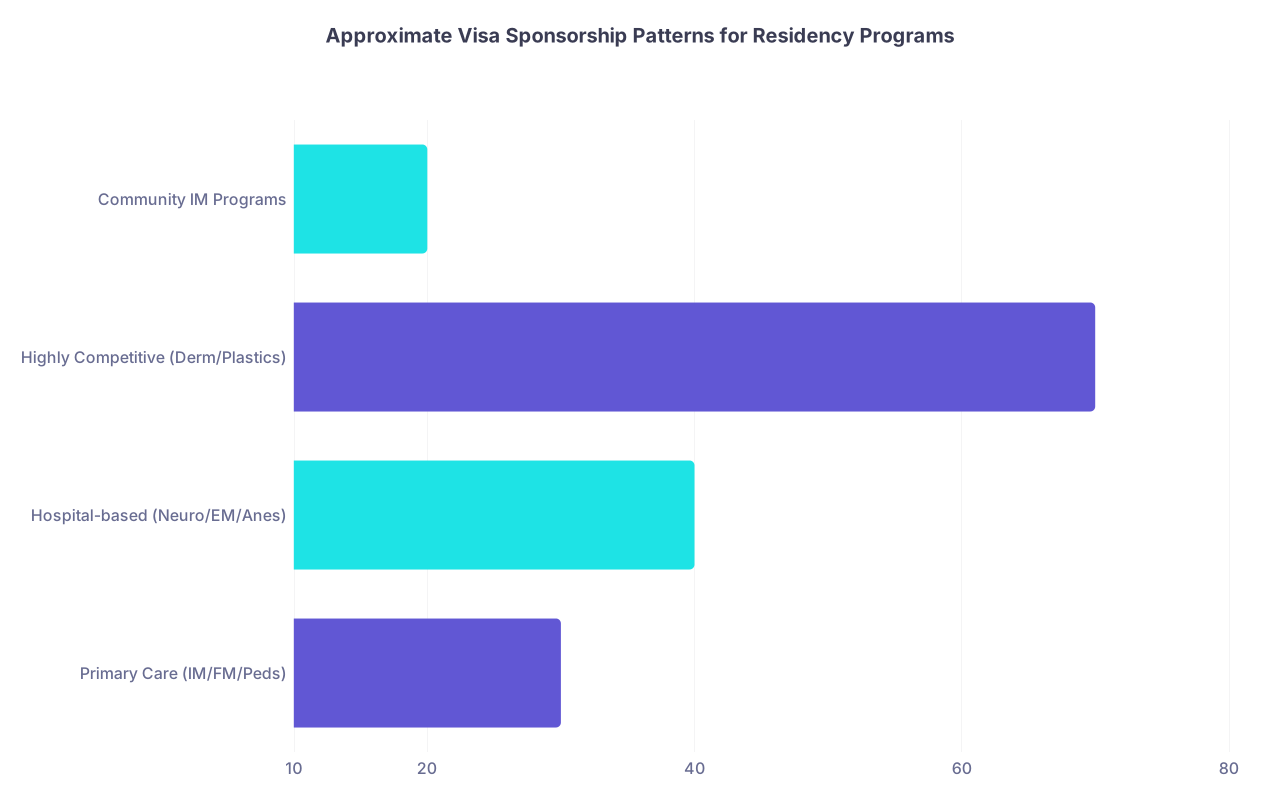
| Category | Value |
|---|---|
| Primary Care (IM/FM/Peds) | 30 |
| Hospital-based (Neuro/EM/Anes) | 40 |
| Highly Competitive (Derm/Plastics) | 70 |
| Community IM Programs | 20 |
Interpretation (not exact percentages, but the trend is correct):
- In primary care–oriented fields (IM, FM, Peds): maybe ~25–40% of programs will do H‑1B for at least some IMGs
- In hospital-based but competitive fields (EM, Anesthesia, Neuro): H‑1B is less common, often <25%
- In highly competitive specialties (Derm, Ortho, Plastics): visa sponsorship of any kind is already rare; H‑1B is almost nonexistent
- In smaller community IM programs: H‑1B is often rare because administration hates the paperwork, or the hospital’s legal team blocks it
The key point: it’s not that “most programs refuse H‑1B” in the sense of turning you down for H‑1B that they normally offer. It’s that a big majority are structurally J‑1-only, by policy, by HR, or by their sponsoring institution.
Two different worlds:
- World A: Program does H‑1B. You ask for H‑1B. They evaluate you.
- World B: Program does not do H‑1B for anyone. You asking changes nothing. You just wasted emotional energy.
You need to stop treating those two like the same thing.
Why So Many Programs Are “J‑1 Only” (And It’s Not Personal)
Programs are not sitting in a dark room plotting how to decline H‑1B for IMGs they “could have sponsored.” The decision is usually made way above the PD’s head.
The main drivers:
Institutional risk-aversion and legal costs
H‑1B requires:
- Prevailing wage determinations
- Labor Condition Application (LCA)
- Petition filing with USCIS
- Ongoing compliance
J‑1 requires:
- DS-2019 sponsorship through ECFMG
- Less direct employer immigration liability
Busy hospital systems with HR departments that barely understand GME do the predictable thing: they standardize on the simpler, lower-risk path. That’s J‑1.
Department culture and tradition
I’ve literally heard: “We’ve always done J‑1. Why change?” from older PDs. Once a department is used to J‑1 cycles, waiver pipelines, and service obligations, there’s no incentive to fight the system for H‑1B unless:
- They’re in a state that struggles to keep doctors and loves waivers; or
- They’ve repeatedly lost top IMG candidates who insist on H‑1B.
Contractual ties to state workforce needs
Some states quietly prefer J‑1 because it funnels physicians into underserved areas via waivers. That shapes hospital policy. Not about you. About workforce planning.
Payroll and salary structure constraints
H‑1B ties salary to “prevailing wage” categories. For some hospitals, their resident salary scale is below the category that would be required for an H‑1B petition. Fixing that means changing salary structure or job codes. Many just avoid it.
So no, the majority of programs are not “refusing” H‑1B in some active way. They’re locked into J‑1 by institutional gravity.
The Real Split: H‑1B-Friendly vs H‑1B-Dead Zones
Let’s stop asking, “Do most programs refuse H‑1B?” and ask something useful:
In my target specialty and region, how big is the H‑1B-friendly pool?
Because that’s what your strategy has to be built on.
Here’s a simplified snapshot using plausible, pattern-based numbers (not official NRMP data, but very close to what you’ll see on FREIDA/individual websites if you spend a weekend checking):
| Category | J‑1 Only Common? | H‑1B Available? | Visa-Free (US/GC Only)? |
|---|---|---|---|
| Community Internal Medicine | Very common | Some | Some |
| University IM (big academic) | Common | Often | Rare |
| Family Medicine (community) | Very common | Some | Some |
| Neurology (mid-competitive) | Common | Limited | Some |
| General Surgery | Common | Limited | More common |
| Derm/Plastics/ENT/Ortho | Extremely common | Rare | Very common |
Patterns you can actually use:
- Large academic IM programs: Best bet for H‑1B. They often have in-house immigration counsel and an institutional template.
- Community FM/IM: Mixed bag. Many are J‑1 only. Some are surprisingly H‑1B-friendly if the hospital has used H‑1B for other staff (hospitalists, etc.).
- Surgery, competitive subspecialties: If you’re IMG + H‑1B-only + aiming here, you’re basically playing on “hard mode plus extra penalties.”
If your WhatsApp group is full of people applying to programs that never touch H‑1B and then screaming “everyone refused me,” you’re not learning anything useful from them.
What Programs Actually Look For When They Do H‑1B
When a program does offer H‑1B, the bar is usually higher than for J‑1. And yes, this is where people feel “refused.”
I’ve watched multiple cycles where programs said something like:
“We’ll only sponsor H‑1B if they’re truly exceptional. Otherwise we default to J‑1.”
Translation: H‑1B is a premium option they reserve for candidates who are clearly in the top tier of their IMG pool.
Common unwritten filters I see in H‑1B-friendly programs:
- USMLE scores: Often at or above their average matched US grad scores. Think:
- Step 2 CK ≥ 240s+ for competitive internal medicine academic centers
- Passing Step 3 on first attempt (if required)
- No exam failures: H‑1B + multiple attempts + IMG = many programs quietly move on.
- Already passed USMLE Step 3 before rank list certification:
- Not always required, but pragmatically huge. Saves them time and risk.
- Strong US clinical experience:
- Real hands-on rotations, sub-I’s, or strong LORs from US attendings, not just “observership at community clinic.”
H‑1B is an extra hassle. Programs will absolutely use that hassle to justify a higher cutoff.
Step 3 and H‑1B: Clearing Up the Messy Myth
Another bad meme: “Step 3 is useless because programs are going J‑1 anyway.”
Flatly wrong.
Here’s what I consistently see:
- Many H‑1B-sponsoring programs require Step 3 passed before they file the petition.
- Some require it before ranking you at all. Others will rank you, but clearly prefer candidates who already have it.
- Step 3 is still a strong positive signal even at J‑1 programs (it says: this person can pass licensing exams and may be easier to keep for fellowship or waiver jobs).
Where the confusion comes from:
- People hear “you don’t need Step 3 for J‑1.” True. But that’s not the same as “Step 3 doesn’t matter anymore.”
- Others burn 6+ months chasing Step 3 and then apply to almost entirely J‑1-only programs. Then they’re angry that they “wasted” the exam. That’s not Step 3’s fault. That’s bad targeting.
If you’re serious about H‑1B and you can realistically score decently (no disaster attempts on Step 1/2), Step 3 is strategically smart.
Strategy: How a Serious IMG Should Handle the H‑1B Question
Let me lay out a practical framework, no sugar-coating.
1. Decide your true priority: H‑1B… or matching
If you tell me:
“I will only accept H‑1B. I’d rather go unmatched than take J‑1.”
Then:
- You’ve just voluntarily shrunk your possible program pool by more than half in many specialties.
- You must be applying extremely broadly to every single H‑1B-friendly program you can find.
- You must accept a higher risk of going unmatched. That’s the trade-off.
If you tell me:
“My preference is H‑1B, but I’d rather match J‑1 than not match.”
Then your play is:
- Apply to all H‑1B programs in your realistic reach
- Also apply to a significant number of J‑1 programs
- Be completely transparent in interviews: “I’m open to both J‑1 and H‑1B if your institution offers them.”
2. Do real homework, not rumor-based planning
You have tools. Use them like an adult, not like a panicked group chat.
- FREIDA: Filter programs by “Visa Sponsorship” but then confirm on the program website; FREIDA is often outdated.
- Program sites: Look for explicit language:
- “We sponsor J‑1 only.” → Believe them. Do not try to “convince” them.
- “We sponsor J‑1 and H‑1B visas.” → Mark as H‑1B-capable.
- Silence on visas → Usually a bad sign. Email politely if you’re truly interested.
Keep a simple spreadsheet:
| Program Name | Specialty | State | H‑1B? | J‑1? | Step 3 Required? |
|---|---|---|---|---|---|
| Big U Med Center | IM | NY | Yes | Yes | Before Rank |
| City Community Hosp | IM | OH | No | Yes | No |
| State U FM | FM | TX | Yes | Yes | Before Start |
| Regional Med Center | Neuro | MI | No | Yes | No |
This takes a weekend. It saves you a year.
3. Stop trying to “negotiate” H‑1B with J‑1-only programs
One of the fastest ways to get quietly dropped:
- Program: “We are J‑1 only.”
- Applicant: “Can you make an exception? I prefer H‑1B.”
They usually can’t. Or won’t. Either way, you’ve just marked yourself as a potential administrative headache.
If they explicitly say J‑1 only, take them at their word. Your choice is to apply or not apply. Not to “convince” them.
4. Understand the long game: J‑1 isn’t necessarily a dead end
People overvalue H‑1B and undervalue reality.
Yes, H‑1B:
- Avoids the 2-year home residency requirement
- Can lead toward eventual green card via employer sponsorship
But J‑1 + waiver job:
- Is a very standard path that thousands of IMGs use every year
- Often comes with stable employment in underserved areas
- Still leads to H‑1B or green card down the road via waiver employers
The real “myth” is that J‑1 equals “permanent exile from the US” and H‑1B equals “guaranteed green card and city lifestyle.” Both are stories IMGs tell themselves, not the law.
Visualizing the Realistic Applicant Pools
To make this less abstract, think of it this way: if 100 IMGs all say “I only want H‑1B,” their effective program pool shrinks sharply.
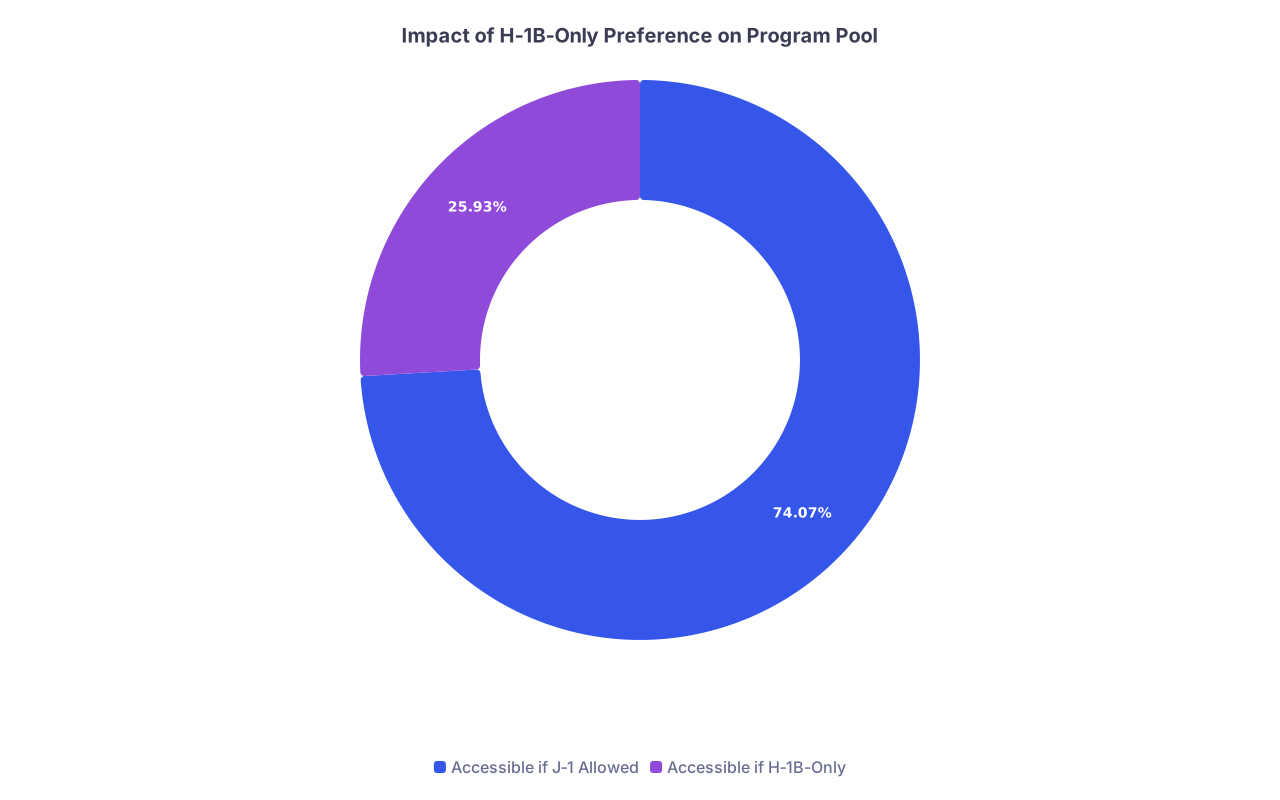
| Category | Value |
|---|---|
| Accessible if J‑1 Allowed | 100 |
| Accessible if H‑1B-Only | 35 |
Meaning: out of 100 programs that would consider you if you were open to J‑1, maybe only ~35 (or fewer) are viable if you insist on H‑1B.
Does that mean you should never prioritize H‑1B? No. It means if you do, you need a different level of application volume and realism.
The Bottom Line: Are H‑1B Programs “Refusing” IMGs?
Here’s the honest answer, stripped of drama:
- Most programs are not refusing H‑1B for IMGs. They simply do not offer H‑1B at all.
- Among programs that do offer H‑1B, they:
- Use higher filters (scores, attempts, Step 3)
- Often reserve it for top candidates or specific departmental needs
- The real loss happens when IMGs:
- Don’t map out where H‑1B is even possible
- Waste cycles applying mostly to J‑1-only programs while being H‑1B-or-nothing in their head
- Believe social media myths instead of reading actual program policies
You don’t beat this system by complaining about refusals. You beat it by understanding the actual structure and playing the odds smartly.

| Step | Description |
|---|---|
| Step 1 | Start: IMG planning to apply |
| Step 2 | Identify all H-1B programs in specialty |
| Step 3 | List both H-1B and J-1 programs |
| Step 4 | Pass Step 3 early |
| Step 5 | Prioritize H-1B but apply broadly |
| Step 6 | Apply very broadly, accept higher unmatched risk |
| Step 7 | Higher match odds, mixed visa outcomes |
| Step 8 | H-1B only or open to J-1? |
FAQ (4 Questions)
1. If a program says “we sponsor J‑1 visas,” should I assume they also might do H‑1B?
No. Assume the opposite. Unless they explicitly list H‑1B sponsorship (on their website, FREIDA, or via direct confirmation), treat them as J‑1-only. Asking for “exceptions” usually just irritates them.
2. Do I need Step 3 before applying if I want H‑1B?
Not strictly before applying, but realistically before ranking at many H‑1B programs. If you’re serious about H‑1B and your Step 1/2 history is clean, taking and passing Step 3 before interview/rank season significantly strengthens your case.
3. Are community programs less likely to sponsor H‑1B than academic centers?
In general, yes. Large university programs with institutional immigration support are more likely to offer H‑1B. Some community hospitals do sponsor, especially if they use H‑1B for other staff physicians, but many default to J‑1-only to keep things simple.
4. Is it a bad idea to tell programs I strongly prefer H‑1B during interviews?
If they already offer both, it’s fine to say you’d prefer H‑1B but are happy with either. If they’re J‑1-only, pushing for H‑1B makes you look like a problem, not a recruit. The smart move: align your stated preference with what that specific program can realistically do.
Key takeaways:
- The problem isn’t that most programs “refuse” H‑1B; it’s that relatively few are structurally able to offer it at all.
- If you insist on H‑1B only, you shrink your program pool dramatically and must compensate with extreme targeting and broad applications.
- J‑1 isn’t the enemy, and treating it as such leads IMGs to bad strategies and unnecessary unmatched outcomes.