

The blanket advice that “H‑1B is always better than J‑1” for IMGs is wrong. Not just oversimplified. Wrong—and in some cases, actively harmful.
I’ve watched candidates tank good offers, mis-rank programs, or delay their careers by years because some senior resident or WhatsApp group told them: “Bro, never take J‑1. You’ll be stuck.” That’s not strategy. That’s superstition dressed up as mentorship.
Let’s dismantle this properly.
The Myth: H‑1B = Freedom, J‑1 = Trap
The slogan version goes like this:
H‑1B is “dual intent,” leads straight to a green card, no home-country requirement, and is always the smarter move.
J‑1 supposedly locks you into a two-year home return, makes you ineligible for certain paths, and destroys your long-term chances.
That narrative sounds clean. Reality is messy.
In actual practice for IMGs in residency and fellowship, both visas are constrained, both have risks, and both can be the wrong choice depending on your specialty, competitiveness, and long-term plans.
The right question is never “H‑1B or J‑1 in general?”
It’s “For my profile, my specialty, and my timeline, which one minimizes risk and maximizes options?”
First, the non-negotiable facts (not Reddit opinions)
Let’s put some hard structure down so we’re not arguing vibes.
| Factor | J-1 (ECFMG Sponsored) | H-1B (Cap-Exempt for Residency) |
|---|---|---|
| Intent | Non-immigrant, no dual intent | Dual intent allowed |
| Exam requirement | USMLE Step 3 *not* required for entry | USMLE Step 3 required before start |
| Two-year home rule | Yes, unless waiver or change of status | No home-return requirement |
| Max duration in training | Typically 7 years (extensions rare) | 6 years H-1B limit (but cap-exempt renewable with green card process) |
| Who controls it | ECFMG + program | Program + their legal team |
That’s the basic framework. But the devil is in how this plays out in real careers.
Where “Always Choose H‑1B” Quietly Fails You
1. When chasing H‑1B makes you lose the match
Programs are not neutral on this. Many explicitly prefer J‑1. Not because they hate you, but because it is:
- Simpler administratively
- Standardized through ECFMG
- Cheaper in legal time and headache
I’ve seen this play out on rank lists. Faculty love a candidate, PD is neutral, GME office says: “H‑1B only? That’s a problem.” Suddenly you drop a tier. Not because you are worse. Because you are more work.
You will not see this in an email. You hear it in hallways:
- “He’s strong, but she’s J‑1 flexible and he’s H‑1B only. We have to think about that.”
- “Legal said no more new H‑1Bs this year if we can avoid it.”
If you are moderately competitive—not a Step 270 superstar with three Cell papers—demanding H‑1B only can quietly shrink your interview pool and rank position.
And the irony? A lot of IMGs insisting on H‑1B do not have Step 3 in hand at rank-list time. Programs cannot even offer H‑1B without it. So they just move on.
If your stats are average or below for your specialty, pure H‑1B-or-nothing is often self-sabotage. J‑1 may be the only realistic path into U.S. training at all.
2. When your Step 3 timing makes H‑1B mathematically stupid
H‑1B for residency is not the same as H‑1B for tech. Residency H‑1Bs are cap-exempt, but they still require USMLE Step 3 passed before the visa is filed.
Many IMGs do this:
- Apply without Step 3.
- Insist they want H‑1B.
- Take Step 3 late winter or spring.
- Get results in March/April.
- Now the program has 2–3 months to scramble H‑1B paperwork, and some just won’t.
You know what programs do then? They either:
- Push you to J‑1
- Move down the list to someone whose visa is easier
I’ve watched candidates turn a sure J‑1 position into a “we’re sorry, we couldn’t process your H‑1B on time, we’re withdrawing” scenario.
If you don’t have Step 3 done by, say, January of the application year, your leverage to demand H‑1B drops fast. You might still get it, but you’re now asking a GME office for a favor, not exercising a right.
3. When you want fellowship in a J‑1-dominant field
Here’s what people rarely admit: in several fellowships, J‑1 is the institutional default.
Think cardiology, GI, heme/onc. Big-name academic fellowships often assume their fellows will be on J‑1 because ECFMG handles the puzzle. Their GME policies literally say: “We sponsor J‑1 only except in unusual circumstances.”
So picture this:
- You insist on H‑1B for internal medicine.
- Graduate on H‑1B.
- Now you apply to cardiology.
- Half the fellowships you want do not sponsor H‑1B at all.
Congratulations: your “better visa” just shrank your fellowship options.
People who tell you “H‑1B is always better” rarely talk to the heme/onc IMG who matched a mediocre fellowship because the top ten programs on their list were J‑1 only.
4. When waivers actually make the J‑1 path more predictable
The three letters almost no one explains properly to MS4 IMGs: J‑1 waiver job.
If you finish training on J‑1, yes, there’s a two-year home-country physical presence requirement. But there are standard, well-worn escape hatches:
- Conrad 30 waivers (state-sponsored, underserved areas)
- VA facility waivers
- ARC/Delta waivers in certain regions
You do three years in a qualifying underserved job, and your two-year home rule is waived. In those three years, you can then move onto H‑1B and often kick off a green card.
Here’s the punchline: For many IMGs in internal medicine, pediatrics, psychiatry, or family med, it is easier and faster to get a J‑1 waiver job than to:
- Convince an academic center to do green card sponsorship early on H‑1B,
- Hope your H‑1B timing and 6-year clock line up with I‑140/adjustment perfectly,
- And compete with a flood of domestic grads for big-city jobs.
Ask around in community hospitals in rural Texas, the Midwest, or upstate New York. You’ll find tons of attendings who went:
J‑1 → waiver job → H‑1B → green card.
And they will tell you their path was linear and predictable. Not glamorous. But predictable.
Where H‑1B Is Actually a Stronger Play
Let’s flip it. There are absolutely scenarios where fighting for H‑1B is rational, not ego.
1. You are highly competitive in a high-demand field
If you’re applying to internal medicine with a 260+, multiple U.S. LORs, serious research, and top-tier programs courting you, H‑1B negotiations become real.
Top academic programs that usually “prefer J‑1” will bend for a rockstar. I’ve sat in meetings where PDs say: “We’ll do the H‑1B. This candidate is worth it.”
Same for competitive specialties like:
- Dermatology
- Radiology
- Anesthesia
- Some surgical subspecialties
If your profile actually stands out, not just in your head, asking “Would the program consider H‑1B if I have Step 3?” is entirely reasonable.
2. Your spouse or personal situation makes the two-year rule toxic
Sometimes the home-country rule is not just an inconvenience. It’s a real legal or safety problem.
Examples I’ve seen:
- Partner is already a green card holder or citizen and cannot leave the U.S.
- You come from a politically unstable region where returning is dangerous or career-ending.
- You’ve already invested years building U.S.-based research or business interests you cannot pause.
In those cases, avoiding J‑1 entirely might be justified. But again, you don’t solve this by saying “H‑1B is always better.” You solve it by being very clear on your non-negotiables and only ranking programs that explicitly and reliably handle H‑1Bs.
3. You’re aiming for long academic careers where early green card matters
If your endgame is long-term academic medicine at a big university in a major city, earlier green card filing can be a meaningful advantage.
On H‑1B, an institution can often:
- File an I‑140 (EB-2/EB-1 if you’re exceptional) relatively early
- Extend H‑1B beyond 6 years based on a pending green card process
- Give you mobility in grants, leadership, and roles that require permanent residency
If you have the CV and mentors to realistically get onto that path, H‑1B can align nicely with your trajectory.
Just remember: most IMGs never actually hit those early-EB‑1‑level milestones. So be honest about whether that’s a plan or a fantasy.
The Money and Risk Piece Everyone Glides Over
A quick reality check on risk:
- J‑1 for residency and fellowship is almost always predictable if you maintain good standing. ECFMG knows this game cold.
- H‑1B depends heavily on each institution’s lawyers, HR, and GME. A program that “supports” H‑1B this year may quietly stop next year after a bad audit or a policy change.
I’ve watched residents get burned when:
- An institution merges or changes legal vendors, and suddenly “no new H‑1Bs for trainees.”
- GME reinterprets their internal policy and decides only certain specialties will get H‑1B.
No one tells the MS4s. It just hits cohort by cohort.
And yes, cost matters. Programs are usually not paying out of their PD’s pocket, but they are juggling limited administrative bandwidth. If they can fill all spots with low-friction J‑1s, many will.
Visualizing the trade-offs
Here’s a simple way to think about the career arc for many IMGs, stripped of the myth-making.
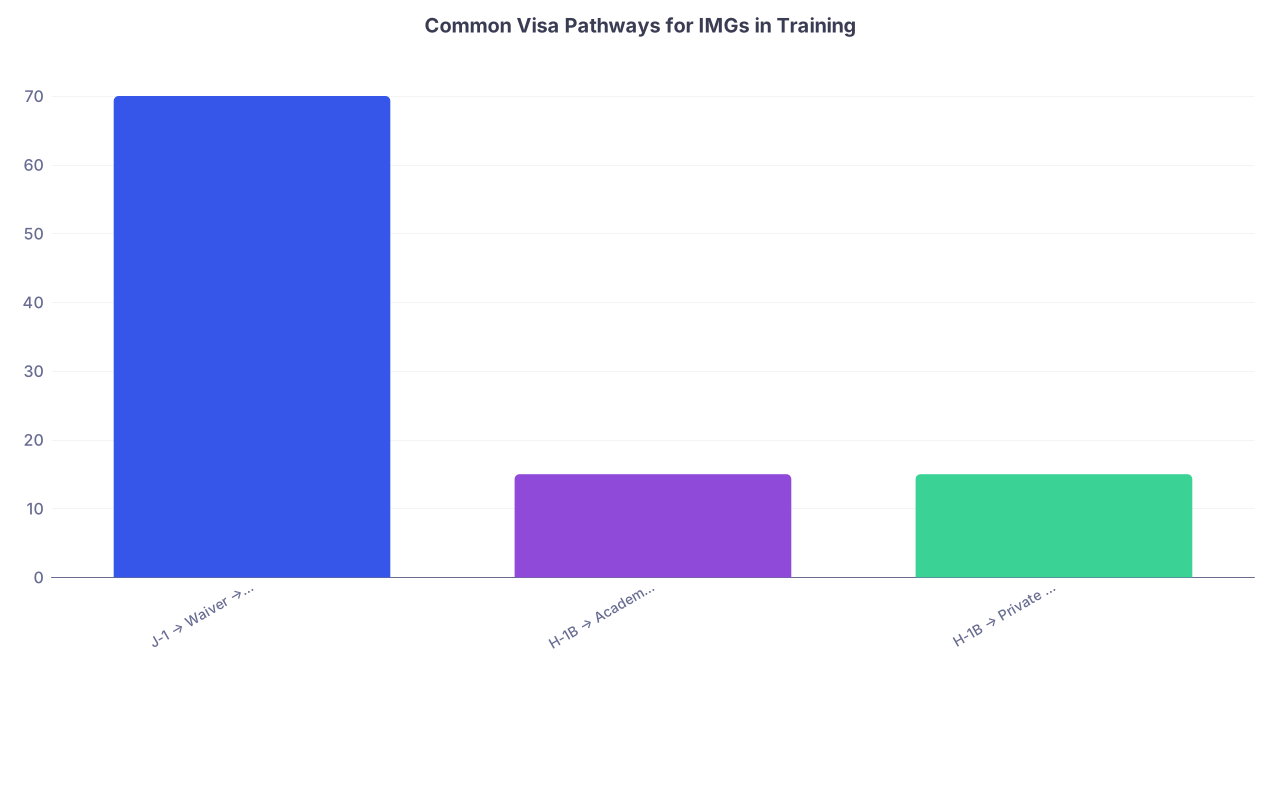
| Category | Value |
|---|---|
| J-1 → Waiver → H-1B → GC | 70 |
| H-1B → Academic → GC | 15 |
| H-1B → Private Practice → GC | 15 |
That’s not a formal study, but it roughly matches what you see if you talk to a random sample of IMGs practicing in non-coastal America. The majority end up doing a J‑1 waiver plus H‑1B pivot, not some clean H‑1B residency-to-GC pipeline.
Process reality: how this actually shows up in your application year
To make this less abstract, here’s the kind of timeline mess people run into:
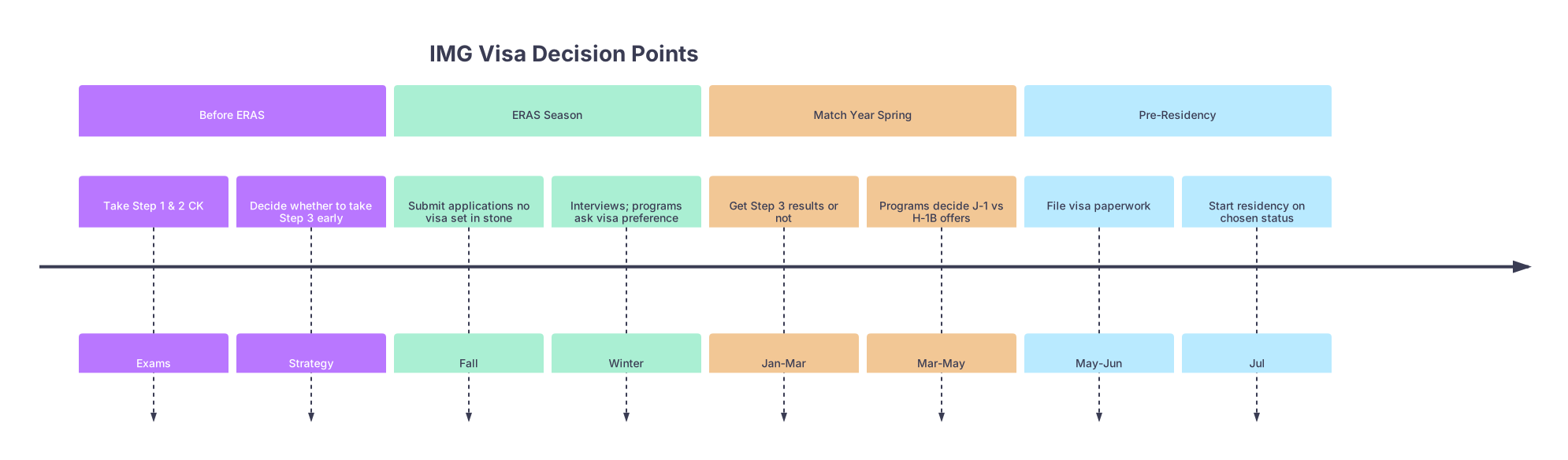
| Period | Event |
|---|---|
| Before ERAS - Take Step 1 & 2 CK | Exams |
| Before ERAS - Decide whether to take Step 3 early | Strategy |
| ERAS Season - Submit applications no visa set in stone | Fall |
| ERAS Season - Interviews; programs ask visa preference | Winter |
| Match Year Spring - Get Step 3 results or not | Jan-Mar |
| Match Year Spring - Programs decide J-1 vs H-1B offers | Mar-May |
| Pre-Residency - File visa paperwork | May-Jun |
| Pre-Residency - Start residency on chosen status | Jul |
You don’t “choose your visa” in a vacuum. You express a preference. Programs express their capacity. Then the constraints of your Step 3 timing and your competitiveness decide who blinks.
So when does “H‑1B is better” hold, and when is it nonsense?
Let me distill this without hand-waving.
“H‑1B preference” makes sense when:
- You already have Step 3 passed early in the application cycle.
- Your profile is strong enough that multiple programs are actively interested.
- You have personal or safety reasons making the J‑1 two-year rule unacceptable.
- You’re targeting institutions and specialties where H‑1B is commonly supported and you’ve confirmed it.
“H‑1B or nothing” is dumb when:
- Your stats are borderline for your chosen specialty.
- You’re applying broadly to programs that mostly say “J‑1 only” on their websites.
- You think H‑1B magically avoids all immigration headaches (it does not).
- You haven’t passed Step 3 and are hoping to “figure it out later.”
And J‑1 is not synonymous with “career death.” For a huge proportion of IMGs, it is the workhorse path into the system. You tolerate a constrained training period, then use the well-established waiver ecosystem to convert that into long-term practice and eventual green card.
Use the tools, not the slogans
You have better tools than rumor and group chat.
At minimum, you should be doing this before you decide how hard to push for any visa:
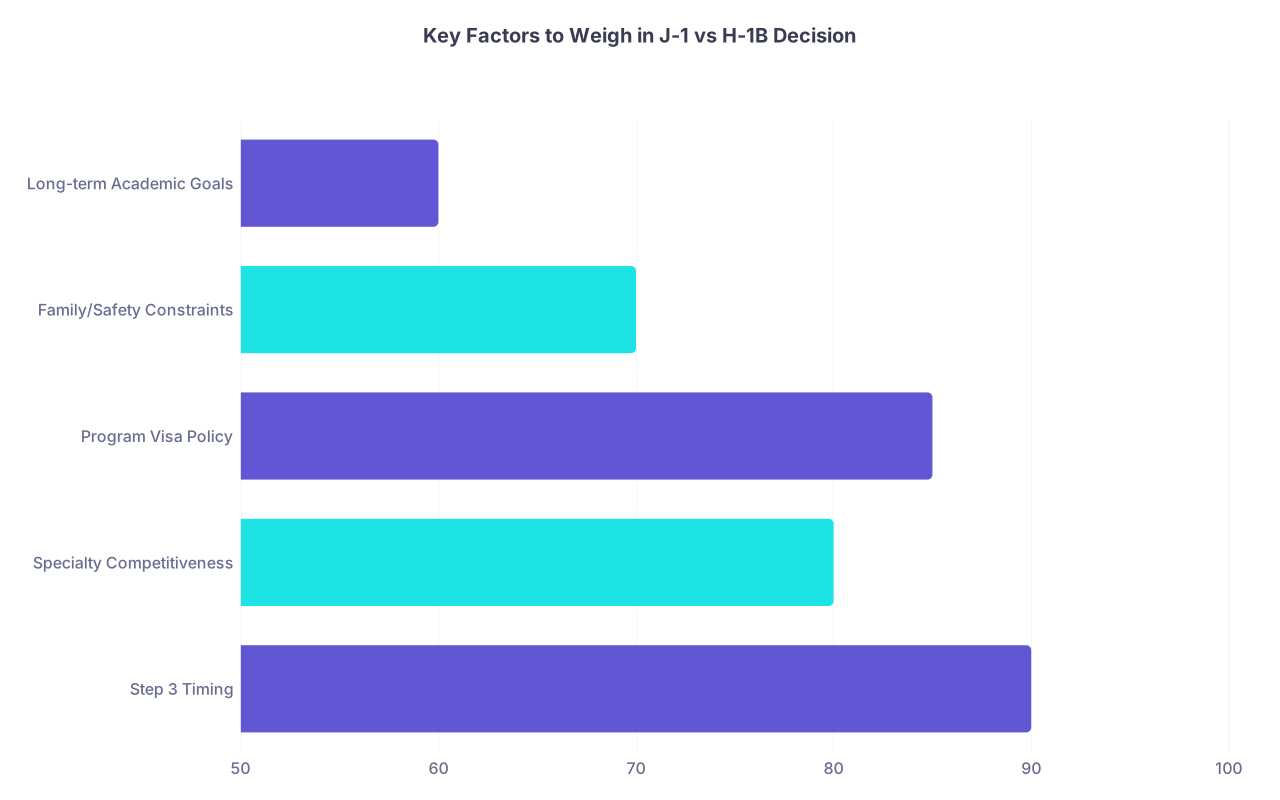
| Category | Value |
|---|---|
| Step 3 Timing | 90 |
| Specialty Competitiveness | 80 |
| Program Visa Policy | 85 |
| Family/Safety Constraints | 70 |
| Long-term Academic Goals | 60 |
That’s the real decision tree. Not “H‑1B good, J‑1 bad.”
And yes, I’m being blunt because the consequences are real: lost matches, delayed fellowships, unnecessary returns home, or years stuck in limbo because you optimized theoretically instead of strategically.
Final takeaways
Strip away the mythology and you’re left with three hard truths:
- Neither H‑1B nor J‑1 is universally “better.” Each is the wrong choice in specific, very common situations.
- Your Step 3 timing, specialty, and competitiveness matter more than the visa label. A guaranteed J‑1 spot beats a fantasized H‑1B that never materializes.
- For many IMGs, the most reliable path is J‑1 → waiver job → H‑1B → green card. Not sexy, not simple, but real—and far more common than the straight-line H‑1B fairy tale you keep hearing about.
Use data, not dogma.


