

You do not need a green card before fellowship. That belief keeps more talented IMGs stuck than any other visa myth in training.
I see the same script every year. A strong IMG resident on J‑1 or H‑1B says, “I’ll just wait for a green card before applying to competitive fellowships. Programs don’t want visa issues.” Then they sit out a cycle (or two), their CV cools down, and they discover the “green card first” strategy was built on half-truths and gossip, not actual data.
Let’s fix that.
This is the reality: your visa type shapes your options. It does not erase them. And in several situations, trying to secure a green card before fellowship is actually the dumbest move you can make for your long‑term career.
The Big Myth: Green Card as a Prerequisite
The common narrative in resident workrooms goes like this:
- “Only green card holders or citizens match into top fellowships.”
- “Most fellowship programs don’t sponsor visas.”
- “If I do fellowship without a green card, I’ll be stuck later.”
All three are exaggerated at best, and flat‑out wrong in many specialties and institutions.
Here’s what the data and real-life match patterns actually show:
- Every match cycle, hundreds of IMGs on visas match into ACGME-accredited fellowships in internal medicine subspecialties, anesthesia, neuro, pathology, OB/GYN, you name it. Cardiology. GI. Heme/Onc. Even in “visa-unfriendly” stereotypes like ortho subspecialties, there are examples.
- Many major academic centers sponsor H‑1B and/or J‑1 for fellowship. Some do one, some do both, a few do neither. But the idea that “almost nobody sponsors” is fantasy.
- A green card is a long game. For many countries, especially India and China in EB‑2/EB‑3, you can do med school, residency, fellowship, and several years of attending life before that green card shows up.
The real question is not “Do I need a green card?” The real question is:
Given my current visa and specialty, what is the smartest path that keeps doors open instead of shutting them?
That’s where nuance matters.
What Programs Actually Care About (Spoiler: It’s Not Just Status)
I’ve sat in conference rooms where fellowship rank lists are made. I’ve heard the conversations. The order is almost always:
- Candidate quality (letters, research, interview, fit)
- Board scores / In‑training exams
- Reliability and professionalism (what PDs say about you)
- Then, way down the list: logistics, which includes visa.
Visa is not nothing. Programs don’t love dealing with extra paperwork. Some chairs simply say no because they’re lazy, risk‑averse, or have had a bad past experience. But when a program does sponsor, here’s what they really care about:
- Can you legally train here on day one of fellowship?
- Will visa status interrupt training (delays, transfers, weird gaps)?
- Are we going to get burned by some issue mid‑fellowship?
If the answer to those is reassuring, your green card status is far less of a problem than residents think.
Let’s break it down by visa, because this is where the real myths live.
J‑1 Residents: “I’m Stuck Until I Finish the 2-Year Rule”
J‑1 IMGs are the most misinformed group about fellowship.
The myth: “I cannot do fellowship until I serve my 2-year home residency requirement or get a waiver.”
Wrong. Completely.
The truth:
- The J‑1 two-year home residency requirement (212(e)) applies to immigrant or H visas and permanent residency.
- It does not prevent you from doing another J‑1 for fellowship.
- You can do: J‑1 residency → J‑1 fellowship 1 → J‑1 fellowship 2 → then deal with waiver/return.
ECFMG sponsors J‑1 for residency and for fellowship training. The 2‑year rule kicks in after your last J‑1 training if you want to change to H‑1B or get a green card.
So the usual sequence for many IMGs is:
- 3 years IM residency on J‑1
- 3 years Cardiology fellowship on J‑1
- 1 additional year EP/Interventional/etc. on J‑1
- Then: J‑1 waiver job (Conrad, ARC/HHS, etc.) or return home for 2 years; then later green card or H‑1B.
Where you don’t have a realistic green-card-before-fellowship path: most J‑1s. Because you typically cannot file employment-based permanent residency while subject to 212(e) unless you resolve the waiver/home requirement issue.
So for J‑1 residents who say, “I’ll just wait for a green card before applying to fellowship,” the strategy is absurd. You’ll be waiting on something you legally cannot get in the straightforward way while you’re still under 212(e).
Your leverage move on J‑1 is simple:
- Maximize your competitiveness.
- Apply broadly to programs that accept J‑1 for fellowship.
- Use the J‑1 waiver period after fellowship to transition into a stable attending job and then green card.
Waiting for a green card first? That’s how you lose 3–6 years of subspecialty training and possibly never re-enter that track.
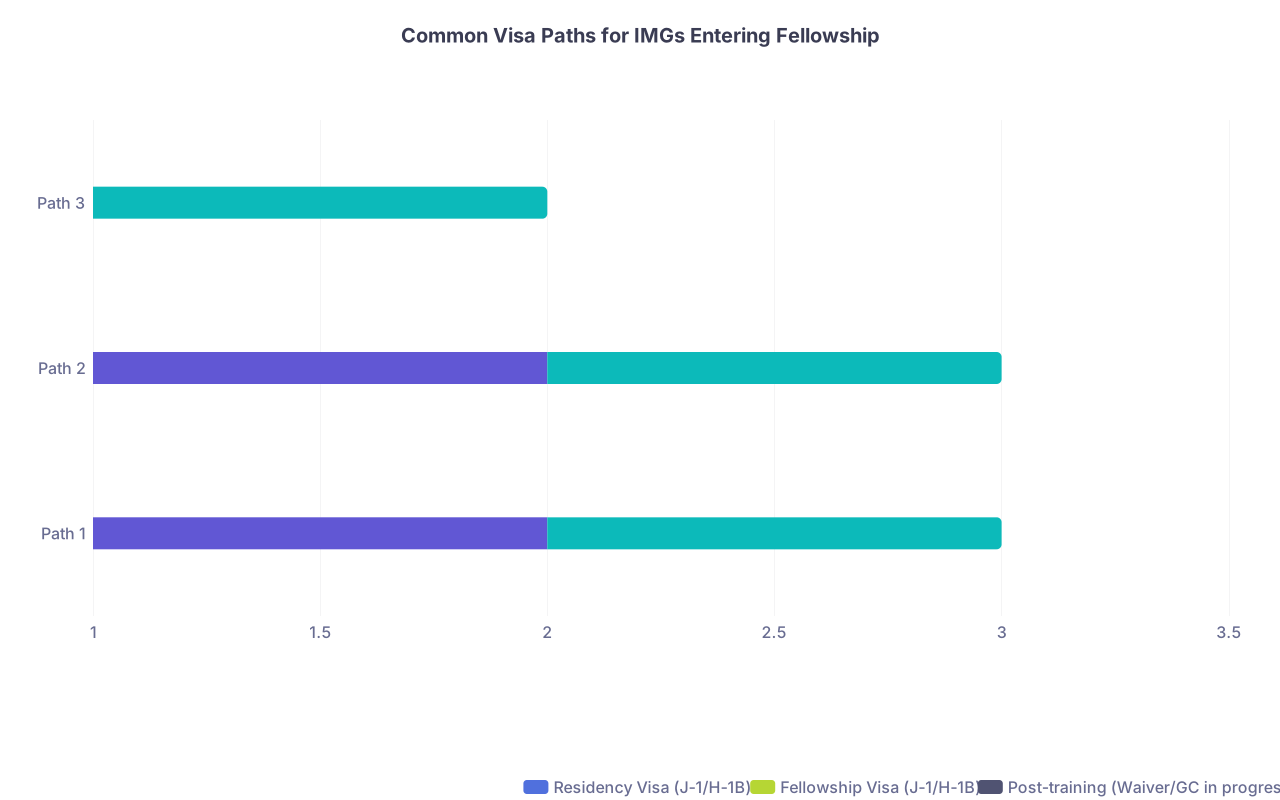
| Category | Residency Visa (J-1/H-1B) | Fellowship Visa (J-1/H-1B) | Post-training (Waiver/GC in progress) |
|---|---|---|---|
| Path 1 | 1 | 1 | 1 |
| Path 2 | 1 | 1 | 1 |
| Path 3 | 1 | 0 | 1 |
H‑1B Residents: The Most Mismanaged Advantage
H‑1B residents have actual, concrete immigration leverage. And many still waste it by obsessing over “green card before fellowship.”
Here’s what the law and practice say:
- H‑1B is a dual intent visa. You can be on H‑1B and simultaneously pursue a green card. No conflict.
- An academic hospital or big health system can start your PERM/EB‑2 green card process during residency or fellowship.
- Your 6‑year H‑1B clock includes all prior H‑1B time, not just your current job. That’s the trap.
If you did:
- 1 year research on H‑1B
- 3 years IM residency on H‑1B
You’ve already burned 4 out of 6 years. So a 3‑year Heme/Onc or Cards fellowship entirely on H‑1B is not possible unless:
- Your employer files PERM and I‑140 early,
- It gets approved, and
- You qualify for H‑1B extensions beyond 6 years under AC21.
This is where competent immigration counsel matters more than rumor.
The real questions you should ask yourself (and an immigration attorney), if you’re on H‑1B in residency:
- How much H‑1B time do I have used vs remaining?
- Can my current program sponsor PERM/I‑140 before fellowship?
- Will potential fellowship programs sponsor H‑1B and understand AC21 extensions?
What you should not do is sit on your hands, skip or delay fellowship, and tell yourself, “Once I get my green card, then I’ll apply.” For Indians and Chinese in EB‑2/EB‑3, those visa bulletin dates are a slow-moving train. You might be mid‑attending career before you see approval.
I’ve seen H‑1B residents who:
- Got PERM started PGY‑2,
- I‑140 approved by PGY‑3,
- Moved to H‑1B fellowship,
- Extended past the 6‑year cap,
- Then adjusted to green card during or after fellowship.
No gap. No “wait first, then train.” Just intelligent timing.
Does Visa Status Hurt Your Fellowship Competitiveness?
Here’s the uncomfortable but honest answer: sometimes, yes. But nowhere near as much as people complain.
Where visa is a big problem:
- Small private programs with no HR bandwidth.
- Institutions that explicitly say “No visa sponsorship.”
- Highly competitive fellowships at visa-averse places that already have more US‑grad, US‑citizen applicants than they can handle.
Where visa is a manageable problem:
- University hospitals that regularly sponsor J‑1 and/or H‑1B.
- Programs that have a pipeline of IMGs and are used to ECFMG, DS‑2019, or I‑129 paperwork.
- Internal medicine subspecialties, nephrology, endo, ID, geriatrics, heme/onc, many cardiology programs.
To put it bluntly, if your application is borderline, visa is a convenient excuse to say no. If your application is strong, programs that actually sponsor visas will take you seriously.
This is where strategy, not whining, matters.
| Program Type | J-1 Friendly | H-1B Friendly | Notes |
|---|---|---|---|
| Big university IM fellowships | High | Moderate | Many sponsor both, J-1 slightly easier |
| Community Cards fellowships | Moderate | Low | Some sponsor J-1 only |
| Top-tier GI in big cities | Moderate | Low-Mod | Visa okay if you are exceptional |
| Small private subspecialty | Low | Very low | Some no-sponsorship policies |
| Pathology/Neuro fellowships | High | Moderate | IMGs and visas common |
These patterns come from watching match lists, NRMP/ERAS data, and actual program websites, not folklore.
The Real Risks of Chasing Green Card First
Let me flip the script. Everyone talks about the risk of doing fellowship without a green card. Almost no one talks about the risk of waiting for a green card first.
Here’s what I’ve seen go wrong when people delay fellowship:
- Academic CV decay: You stop doing research, stop presenting, your letters get stale. Two or three years of hospitalist work, and now you’re competing with fresh grads with recent publications and enthusiastic letters.
- Family and mortgage trap: You settle into a well-paying hospitalist/primary care/Hospital‑Employed role. Then moving for a 2–3 year lower-paid fellowship becomes financially and psychologically painful.
- Visa timing mess: You wait for an I‑140. It gets approved, but visa bulletin retrogression drags final approval out for years. Now you’re neither here nor there, no longer in training, and competing for fellowship with a weird gap.
When you actually map out timelines, for many IMGs it looks like this:
- Residency (3 years)
- Fellowship (2–3 years)
- J‑1 waiver / early attending years or H‑1B with I‑140 pending (3+ years)
- Green card somewhere in this window or later, not magically right after residency.
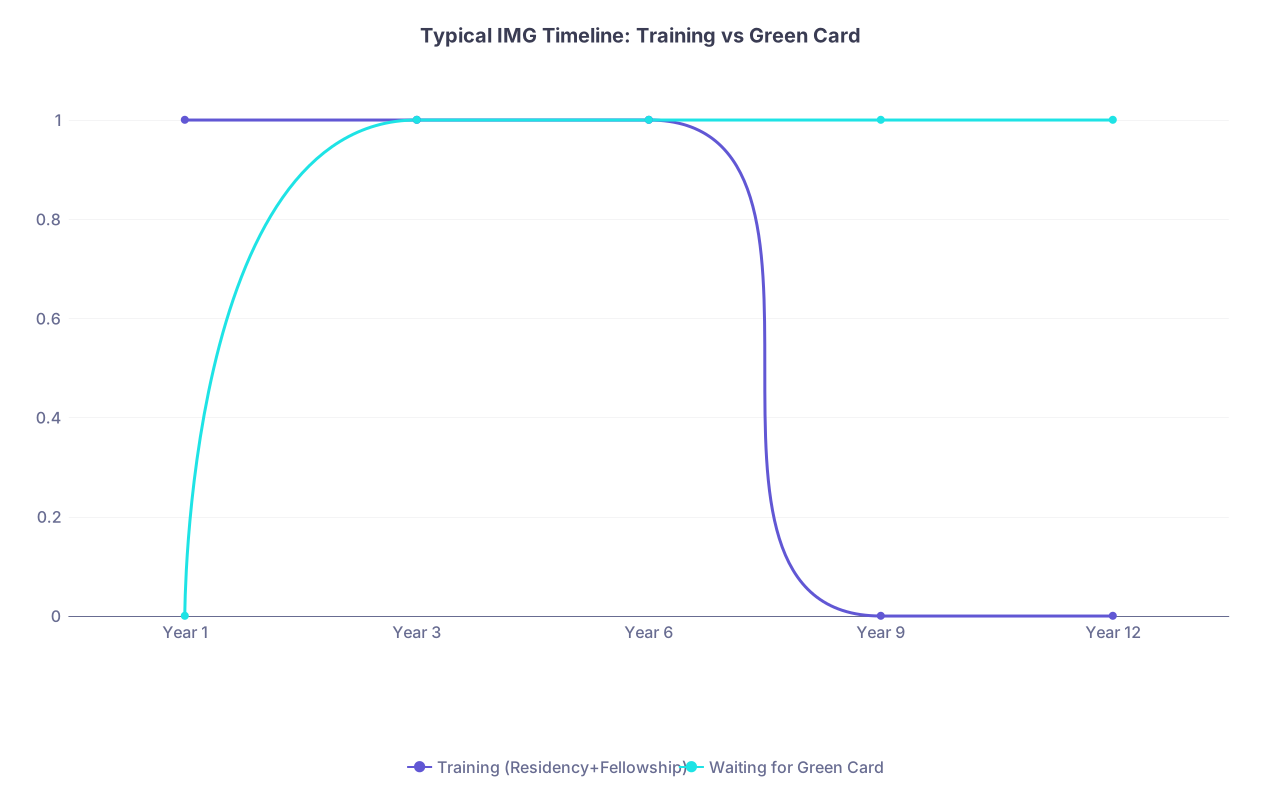
| Category | Training (Residency+Fellowship) | Waiting for Green Card |
|---|---|---|
| Year 1 | 1 | 0 |
| Year 3 | 1 | 1 |
| Year 6 | 1 | 1 |
| Year 9 | 0 | 1 |
| Year 12 | 0 | 1 |
Notice how much overlap there is between training and the green card waiting period. Trying to “finish” immigration before you continue training is usually fantasy.
So What’s the Smart Play for IMGs?
Let’s cut the noise and lay out practical, contrarian rules of thumb.
If you’re on J‑1 in residency:
- Assume you’ll stay on J‑1 for fellowship.
- Stop asking whether you need a green card before applying. You usually cannot get one easily anyway due to 212(e).
- Focus on matching into the best fellowship you can at a J‑1‑friendly institution.
- Plan your waiver strategy early: Conrad 30, VA, HHS/ARC, etc. That’s your bridge to long‑term employment and eventually a green card.
If you’re on H‑1B in residency:
- Find out your exact H‑1B usage history. No guessing.
- Ask your GME/HR and an immigration lawyer whether they can start PERM and I‑140 during residency.
- When searching for fellowship, strongly favor places that:
- Sponsor H‑1B, and
- Have experience with AC21 extensions beyond 6 years.
- Do not assume you must be a green card holder before fellowship. Instead, assume you need an employer who will play the long game with you.
If you’re already a green card holder or citizen:
- Congratulations, you have fewer headaches.
- But do not fall into the “visa-blind” trap of underestimating how many IMGs on visas are competing hard and still matching into the same fellowships.
Where You Actually Do Need a Green Card (or It Really Helps)
There are situations where green card or citizenship becomes a serious factor:
- Federal jobs and some VA positions that restrict non‑citizens.
- Certain sensitive research positions funded by agencies with nationality restrictions.
- Some ultra‑competitive fellowships where leadership simply doesn’t want to deal with any visa, period. They’ll never say it out loud, but behavior speaks.
Fine. Those are edge cases. If your entire plan is “MGH GI or bust,” yes, lack of a green card may hurt you. But that’s not the majority of fellowship options in the country.
For most IM subspecialties at most ACGME programs, being on J‑1 or H‑1B is a hurdle. Not a wall.
How to Vet Programs Without Wasting Cycles
Stop guessing which programs are visa‑friendly. There are better ways than gossip.
Do this:
- Check the program’s website and ACGME/ERAS listing. Many explicitly state “J‑1 only,” “J‑1 and H‑1B,” or “No visa sponsorship.”
- Look at current and recent fellows. If you see multiple IMGs with foreign med schools, that’s a strong clue some are on visas.
- Email the coordinator before burning an application slot: “Do you sponsor J‑1/H‑1B visas for fellowship?” Simple, direct.
- Talk to senior residents and fellows who actually matched last cycle, not the guy who graduated 7 years ago and still repeats 2015-era rules.
You’ll quickly see a pattern: the idea that you “need a green card before fellowship” doesn’t survive contact with real program behavior.
Let’s wrap it cleanly.
- You do not need a green card before fellowship. You need a program that sponsors your current visa type and a realistic long‑term plan (waiver, PERM, I‑140, AC21, etc.).
- For J‑1s, waiting for a green card first usually makes no legal or strategic sense. For H‑1Bs, the key is early green card processing and smart use of the 6‑year clock—not pausing your career.
- The biggest risk isn’t doing fellowship on a visa. It’s paralyzing yourself with myths, delaying training, and discovering years later that the green card didn’t magically solve everything anyway.


