
Most IMGs are worrying about the wrong visa concept at the wrong time.
You hear “dual intent” thrown around constantly in forums, WhatsApp groups, even by some program coordinators. Half the time, it is misapplied to J‑1s. The other half, people underestimate how critical it is for H‑1B physicians.
Let me break this down very specifically, because for residency applications and long‑term planning, misunderstanding dual intent is how careers get tangled in unnecessary risk.
Dual Intent in One Sentence
Dual intent means you can be in the U.S. on a temporary visa and openly plan to become a permanent resident later without violating your current status.
For physicians, this matters a lot for H‑1B.
For J‑1 clinical physicians? Practically not at all. Different legal logic, different real‑world consequences.
The Core Legal Difference: H‑1B vs J‑1
Let us get the legal architecture right first. If you do not understand this, every downstream decision becomes guesswork.
| Feature | H-1B Physician | J-1 Physician (ECFMG) |
|---|---|---|
| Dual intent allowed? | Yes, explicitly | No, in principle |
| Immigrant petition (I-140) allowed while in status? | Yes | Highly risky / discouraged |
| Nonimmigrant visa at consulate with pending I-140? | Usually OK | Often problematic |
| Typical clinical use | Residency/Fellowship, Physicians in practice | Residency/Fellowship only |
| Subject to 2-year home rule? | No (unless prior J-1 with rule) | Yes, almost always |
Statutory reality
H‑1B is a dual intent category.
The government explicitly accepts that H‑1B workers may apply for permanent residence while in H‑1B status. You can have an I‑140 approved, continue your H‑1B, and still get H‑1B visa stamps abroad.J‑1 is a pure nonimmigrant category.
The statute and regulations assume you do not intend to immigrate. You are here for training or exchange and then you leave. The classic test: you must show a “residence abroad you have no intention of abandoning.”
However—and this is where most people get confused—J‑1 clinical physicians are already locked into a different constraint that makes dual intent almost irrelevant: the 2‑year home‑residency requirement (INA 212(e)).
Why Dual Intent Matters Deeply for H‑1B Physicians
If you are an IMG planning a U.S. career beyond residency, H‑1B’s dual intent is not a nice‑to‑have. It is your legal safety net linking training to a green card.
1. You can pursue a green card while in H‑1B status
H‑1B allows you to:
- Start a PERM labor certification process (employer‑sponsored green card route).
- Have an employer file an I‑140 immigrant petition for you.
- Extend H‑1B beyond the 6‑year limit in many cases if your green card process is pending or approved.
This is why you see so many physicians on:
- H‑1B in residency
- H‑1B in fellowship
- Then H‑1B in attending roles while the EB‑2/EB‑3 process runs.
The dual intent structure is what permits this layering.
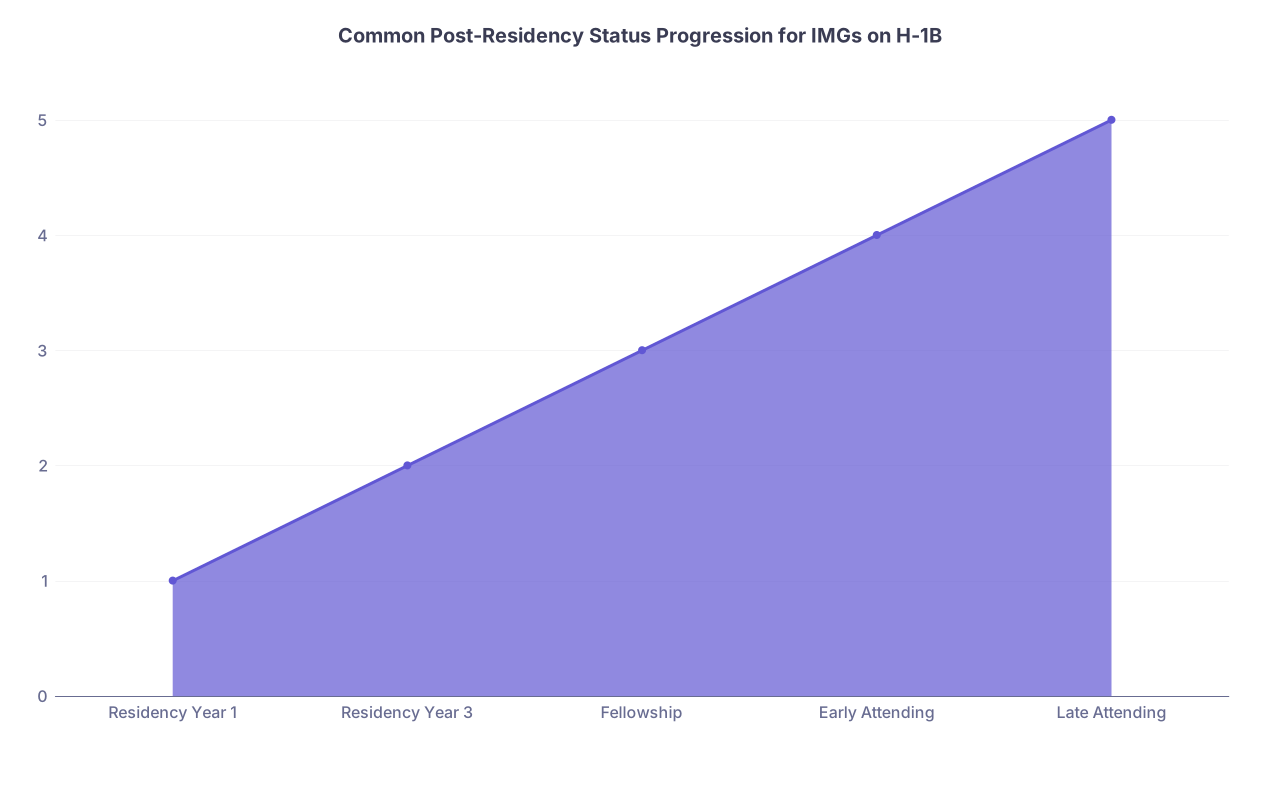
| Category | Value |
|---|---|
| Residency Year 1 | 1 |
| Residency Year 3 | 2 |
| Fellowship | 3 |
| Early Attending | 4 |
| Late Attending | 5 |
That line is not about numbers; it is about legal continuity. Most physicians flow seamlessly from training into longer‑term practice because they can stack immigrant intent on top of a nonimmigrant status.
2. Visa stamping abroad is compatible with future immigrant intent
This is where residents actually feel dual intent in the real world.
Scenario I have seen repeatedly:
- You are a PGY‑2 on H‑1B.
- Your employer started your EB‑2 PERM, your I‑140 is filed (or even approved).
- You need to go home to India, Pakistan, Nigeria, or Brazil for a family emergency and then return.
At the consulate, the officer sees:
- You are on H‑1B (dual intent allowed).
- You have an I‑140 petition pending/approved (clear immigrant intent).
For H‑1B, this is legally fine. The officer does not have to deny a nonimmigrant visa because you want to immigrate. That is the whole point of dual intent.
So you can:
- Leave the U.S.
- Get your H‑1B visa stamped.
- Re‑enter.
- Keep working and pursuing your green card.
Is there still risk? Sure—221(g) delays, background checks, occasional scrutiny. But immigrant intent itself is not a disqualifier.
3. Staying in status while your green card process drags on
Green cards for physicians, especially from high‑demand countries (India, China), can be painfully slow. Priority dates back up. The I‑485 adjustment of status filing can be delayed for years.
Because H‑1B is dual intent:
- You can extend H‑1B beyond six years (under AC21 provisions) if:
- Your PERM or I‑140 has been pending at least 365 days, or
- Your I‑140 is approved and you are waiting on a visa number.
- You can maintain lawful status and work authorization while clearly and openly intending to immigrate.
If H‑1B did not allow dual intent, this entire structure would collapse. You would have to hide your immigrant plans to preserve your temporary status. That is exactly the tension J‑1 physicians live with if they try to play both sides.
Why Dual Intent Mostly Does Not Matter for J‑1 Clinical Physicians
Now the part everybody keeps twisting online.
You will see messages like:
“Can I get a J‑1 if I plan to stay in the US? Is J‑1 dual intent?”
Or, worse: “J‑1 is bad because it does not permit dual intent.”
For residency and fellowship planning, that is the wrong frame.
1. The real jailer is 212(e), not lack of dual intent
If you are a J‑1 clinical physician (ECFMG‑sponsored):
- You are almost always subject to the 2‑year home residency requirement under 212(e).
- That means: after completing J‑1 training, you must either:
- Spend 2 full years physically present in your home country (or country of last permanent residence), or
- Get a waiver of 212(e).
Without satisfying or waiving 212(e):
- You cannot change status to H‑1B in the U.S.
- You cannot get an immigrant visa (green card) abroad.
- You cannot adjust status to permanent resident inside the U.S.
So the real question is not “Is J‑1 dual intent?”
The real question is: “How are you going to deal with 212(e)?”
Dual intent becomes functionally irrelevant while 212(e) is hanging over you. The law is not asking what your long‑term intent is. It is saying: you must either go home for 2 years or clear this waiver hurdle before any immigrant path becomes realistic.
2. Consular officers and J‑1 immigrant intent
Now, technically:
- J‑1 is a nonimmigrant category.
- You are supposed to show that you will go back after your program.
- If you obviously intend to immigrate, the consular officer can deny your J‑1 visa.
So if you show up at a consulate:
- With a recently filed I‑130 from a U.S. citizen spouse.
- Or an I‑140 immigrant petition on record.
- Or clear evidence that you are mainly using J‑1 as a backdoor to stay.
You may have a problem.
But for medical trainees specifically, two realities soften this:
ECFMG sponsorship is structured and standardized.
Officers see thousands of these. They know many J‑1 doctors will later pursue waivers and long‑term work options. The key is that the paperwork and program narrative is consistent with “training, then return,” at least on its face.The 212(e) requirement already enforces the “go home first” policy.
Because the law forces you to go home or obtain a waiver before permanent residence, consulates tend to rely on that structure rather than micromanaging your long‑term life plans at visa issuance.
So, yes, formally, J‑1 does not allow dual intent. Practically, for clinical IMGs, the government’s real leverage is 212(e), not hypotheticals about your mindset.
This is why you will see people do:
- J‑1 residency
- J‑1 fellowship
- Conrad 30 waiver job on H‑1B
- Then EB‑2 green card
…without their J‑1 visa ever being denied for “immigrant intent,” because they played the sequence correctly.
Where J‑1 and Dual Intent Can Collide
There are, however, a few situations where dual intent theory and J‑1 reality collide in an uncomfortable way. You need to know these because they affect strategy.
1. J‑1 while an immigrant petition is already on file
If you, or a family member on whose petition you are a derivative, already have:
- An I‑140 immigrant petition filed or approved, or
- An I‑130 family‑based petition filed or approved,
then trying to get a J‑1 visa can attract scrutiny. Consular logic is simple:
- J‑1 is not dual intent.
- You have clear immigrant intent on record.
- Why should we issue you a nonimmigrant visa for temporary training?
Will it always be denied? No. I have seen it go both ways.
Is it a clean case? Absolutely not.
This is where J‑1’s lack of dual intent does hurt you. For many IMGs with long‑term U.S. career goals, filing an immigrant petition before J‑1 training is finished is strategically unwise.
2. Repeated J‑1 renewals plus obvious U.S. ties
Imagine this pattern:
- You are on J‑1 for a 3‑year residency.
- You then match into a 3‑year fellowship, also on J‑1.
- You are married to another IMG. Children born in the U.S. You rent a house long‑term. You talk openly about “staying forever.”
Each J‑1 visa renewal at a consulate is a fresh opportunity for an officer to ask:
Are you actually intending to return home?
Most of the time, if your program sponsorship is properly documented and your SEVIS status is fine, the visa will be issued. But you are skating closer to the line where the officer could say: this no longer looks temporary.
Again, H‑1B does not have this problem; dual intent is built‑in. J‑1 does not enjoy that shield.
Where Dual Intent Becomes a Planning Tool for IMGs
Let me connect this to the decision you actually care about in the match and application phase: Should I aim for H‑1B or J‑1 for residency?
Dual intent is a major factor in that choice.
1. H‑1B in residency: clear green card runway
If you can secure H‑1B sponsorship for residency (not all programs will do this), dual intent gives you:
- Freedom to start green card processes earlier, especially if:
- Your spouse is in another specialty,
- You anticipate a long wait due to country of birth.
- Flexibility to travel abroad for weddings, funerals, or conferences, even with I‑140s pending.
- The ability to avoid the 212(e) trap entirely if you never touch J‑1.
For example, an IMG from India in internal medicine on H‑1B:
- Completes 3 years residency on H‑1B.
- Does 3 years cardiology fellowship on H‑1B.
- Joins a private practice willing to file EB‑2 with PERM.
- Extends H‑1B beyond 6 years based on I‑140 approval while waiting for priority date.
Dual intent is what makes this continuous and legally coherent.
2. J‑1 in residency: delayed green card, forced detour
If you go J‑1 (the majority do, because many programs prefer it), your path looks very different:
- J‑1 residency
- Maybe J‑1 fellowship
- Then you must:
- Secure a J‑1 waiver job (Conrad 30, VA, HHS, etc.) on H‑1B, and
- Work there for the required period (often 3 years full‑time).
Only then:
- You have satisfied 212(e) by serving a waiver job.
- Or you got a No‑Objection or hardship/persecution waiver earlier.
- Now, you can pursue a green card (EB‑2/EB‑3) and leverage H‑1B’s dual intent.
Notice what happened:
- Dual intent helps you later (once on H‑1B after waiver),
- But it does not protect you during the J‑1 training years.
So for J‑1 physicians, dual intent is deferred benefit. You must escape 212(e) first.
Practical Consequences During Residency Applications
You are applying for residency. You are filling out ERAS. People tell you: “Choose J‑1, H‑1B is too much hassle.” Or: “Aim for H‑1B, dual intent is better.” Let us be honest about what actually matters.
1. At the match phase, nobody is asking about your immigrant intent on paper
Program directors are not immigration lawyers. They care about:
- Can we sponsor you?
- How complicated will it be?
- Are you going to show up on July 1 without visa issues?
They are not quizzing you on future green card plans. But you must be.
Dual intent should guide your preference, even if you cannot always enforce it.
2. Common realistic patterns
Let me give you three concrete IMG scenarios.
A. Pakistani IMG, matched to community internal medicine program
- Program: “We only sponsor J‑1 through ECFMG. No H‑1B.”
- Reality: You have no leverage. You accept J‑1 or you do not train there.
- Dual intent: Mostly theoretical during residency. Your real planning focus: how to secure a strong J‑1 waiver job afterward.
B. Indian IMG, high‑scoring, matched to academic neurology program that “prefers J‑1 but can do H‑1B on case‑by‑case basis”
- You are from a high backlog country for EB‑2/EB‑3.
- Long‑term U.S. career almost certain.
- Here, dual intent is a strong argument to push hard for H‑1B, even if it means extra effort with GME and legal.
- Each year on H‑1B in training is a year you potentially shave off later uncertainty.
C. Latin American IMG, spouse is a U.S. citizen
- You already have a straightforward family‑based green card path later.
- J‑1’s lack of dual intent and the 212(e) issue can still complicate and delay I‑485, but your overall odds of residency are more important than fine‑tuning visa type.
- Here, dual intent is less decisive; you may accept J‑1 more readily.
Travel, Family, and “What If I Need to Leave the U.S.?”
This is where dual intent hits real life: weddings, illnesses, visa stamps, and airport anxiety.
H‑1B physician with immigrant petition on file
You:
- Have a PERM in process or an I‑140 approved.
- Need to renew your H‑1B visa at a consulate.
Dual intent means:
- The officer is allowed to issue you a nonimmigrant H‑1B visa even though you plainly intend to immigrate.
- You can answer questions honestly without inventing “I will go home soon” narratives.
Is there always 100% safety? No. There are still administrative delays, random security checks, and chaos. But immigrant intent alone is not grounds to deny H‑1B.
J‑1 physician thinking about immigrant petitions mid‑training
You are J‑1 PGY‑3. Your U.S. citizen spouse wants to file an I‑130 now. Or your employer hints at starting a green card.
You need to think:
- Future J‑1 visa renewals may become more fragile if there is an immigrant petition on record.
- You are still blocked by 212(e) anyway; early petitions do not meaningfully accelerate your timeline.
- You are better off:
- Completing training on J‑1 cleanly.
- Getting a waiver and switching to H‑1B.
- Then launching immigrant petitions from the safety of H‑1B’s dual intent.
This is where you see the practical asymmetry. Dual intent makes H‑1B an honest status: you can say what you mean regarding your future. J‑1 is more of a performance: you must legally present as temporary, even if everyone knows you will try to stay via a waiver later.
Strategic Takeaways for IMGs Choosing Between H‑1B and J‑1
Let me strip it down to what actually matters during the residency match/application phase.
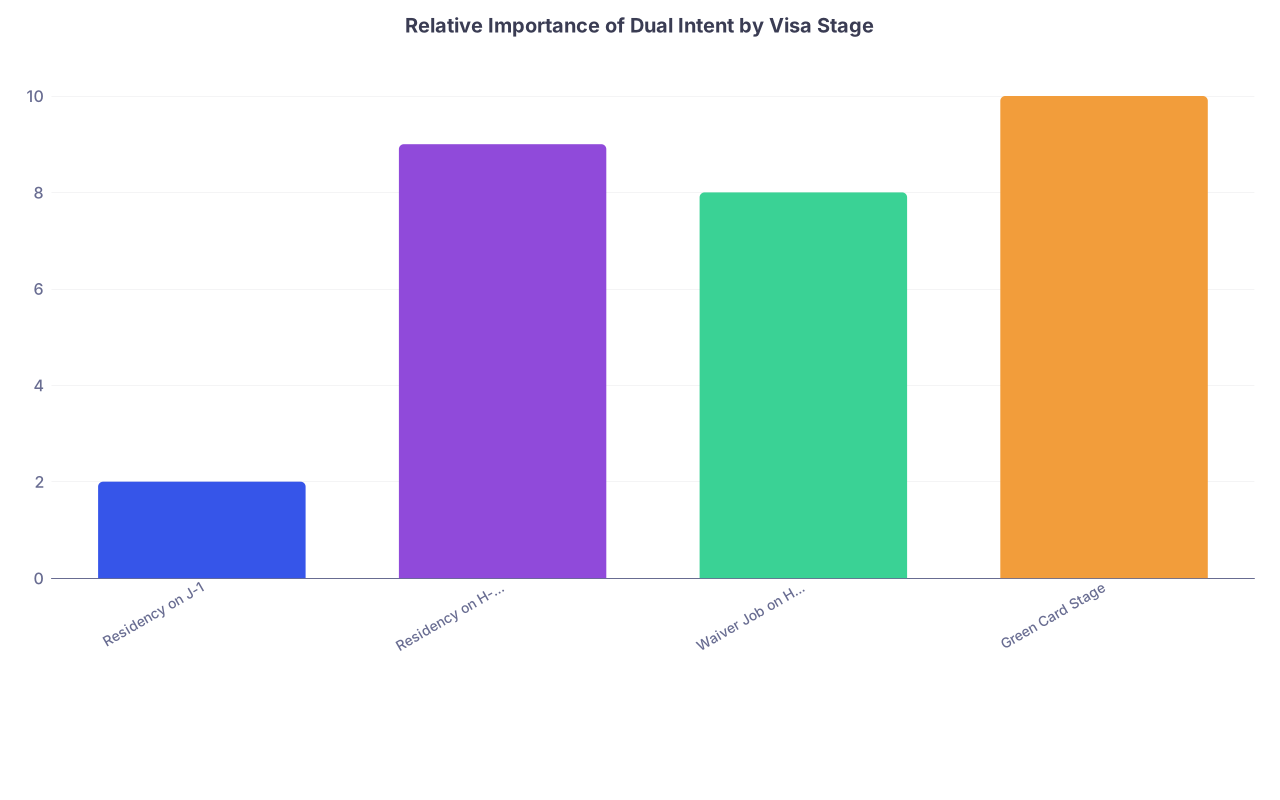
| Category | Value |
|---|---|
| Residency on J-1 | 2 |
| Residency on H-1B | 9 |
| Waiver Job on H-1B | 8 |
| Green Card Stage | 10 |
(Think of those values as “how much dual intent really shapes your life” on a 1–10 scale.)
For J‑1 candidates
- During residency and fellowship, dual intent is legally disallowed and practically secondary to the 2‑year home rule.
- Your top concerns:
- Will I be subject to 212(e)? (Almost always yes for clinical J‑1.)
- How strong are my chances of a waiver job later in my specialty and preferred location?
- Do not let dual intent discourse distract you from the reality that J‑1 is, by design, a temporary training track that you must exit strategically via a waiver.
For H‑1B candidates
- Dual intent is central to:
- When you can safely start your green card process.
- How confidently you can travel and renew visas with immigrant petitions pending.
- Whether you can maintain uninterrupted lawful status while waiting out backlogged priority dates.
- If you have credible options for both J‑1 and H‑1B, the dual intent advantage of H‑1B is not theoretical. It shapes your next 5–10 years.
Visualizing the Process Flow
To make this brutally clear, here is the actual divergence in possible paths:

| Step | Description |
|---|---|
| Step 1 | Match to Residency |
| Step 2 | J-1 Clinical |
| Step 3 | H-1B |
| Step 4 | Residency on J-1 |
| Step 5 | Fellowship on J-1 |
| Step 6 | Subject to 212(e) |
| Step 7 | J-1 Waiver Job on H-1B |
| Step 8 | Start Green Card (EB-2/EB-3) |
| Step 9 | Permanent Residence |
| Step 10 | Residency on H-1B |
| Step 11 | Fellowship on H-1B |
| Step 12 | Start Green Card (EB-2/EB-3) |
| Step 13 | Visa Type |
Notice where dual intent is relevant:
- Almost nowhere on the J‑1 side until you reach H‑1B after waiver.
- Constantly on the H‑1B side from day one.
Why This Distinction Is Constantly Misunderstood
Three reasons I see again and again:
People conflate “can eventually stay in the US” with “dual intent.”
J‑1 physicians can, in practice, stay long‑term via waiver + H‑1B + green card. That does not make J‑1 a dual intent status.Doctors listen to each other more than to immigration attorneys.
In lounges and call rooms, I hear: “I was J‑1 and I stayed, so dual intent is not that big a deal.” That is survivorship bias. You are talking to the ones who successfully navigated the obstacle course.Programs oversimplify for their own convenience.
Some GME offices say “We prefer J‑1 because it is simpler.” Often true from their paperwork perspective. Totally different story from your 10‑year career perspective, especially in high‑backlog countries.
Final Key Points
Dual intent is structurally built into H‑1B, not J‑1. For physicians, that makes H‑1B the only status where you can openly and safely pursue permanent residence while maintaining your current visa.
For J‑1 clinical IMGs, the dominant issue is the 2‑year home‑residency rule (212(e)), not dual intent. Until you satisfy or waive 212(e) and move to H‑1B, immigrant petitions do not help you much and can sometimes complicate your life.
During residency planning, treat dual intent as a major strategic advantage of H‑1B—but not the primary deciding factor for J‑1. For J‑1, focus on waiver prospects. For H‑1B, leverage dual intent to design a clean, continuous path to a green card.