
You are PGY-2 on medicine. It is midnight between admissions. Your co-resident just mentioned she signed a contract in a medically underserved area on a Conrad 30 waiver and will be “locked in for three years but at least I am staying.” You nod like you understand, but you do not. You know you are on a J‑1. You know you have a 2‑year home requirement. But the alphabet soup of Conrad 30, HHS, VA, DRA, ARC, IGA? Blurry.
Let me clean this up.
This is the core decision for many IMGs: which J‑1 waiver pathway makes sense and what each one actually demands from you. The choice affects where you live, what you earn, how constrained your practice will be, and how easily you can move later.
We are going to dissect:
- The underlying J‑1 problem: the 2‑year home residency rule
- Conrad 30 waivers (state programs): structure, pros, traps
- Federal J‑1 waivers (HHS, VA, DRA, ARC, IGA, etc.): who they fit, how they differ
- Strategic trade-offs for residents and fellows choosing between them
I am not going to sugar‑coat. Some options are functionally closed for most residents. Others look flexible but will box you in hard if you misunderstand the rules.
The baseline: What problem is the J‑1 waiver solving?
J‑1 clinical exchange physicians almost always carry the “212(e)” 2‑year home residence requirement. That means:
- After finishing training, you must either:
- Go home for an aggregate of 2 years; or
- Get a waiver of that requirement; or
- Switch to another status that does not trigger enforcement (rare, messy)
For almost every IMG who wants to work in the U.S. after residency, this boils down to:
- Get a J‑1 waiver
- Change status to H‑1B (or occasionally O‑1)
- Work 3 years full‑time in a shortage/qualifying setting under the terms of that waiver
- Then you are free from 212(e) and can move into standard employment-based immigration strategies (PERM/EB‑2/EB‑3, NIW, etc.)
The waiver is not a general “forgiveness.” It is a contract: “We will waive your 2‑year home requirement if you give us at least 3 years of needed service under specific conditions.”
Two big families of waivers for IMGs:
- State-based: Conrad 30
- Federal agency-based: HHS clinical waivers, VA, ARC, DRA, IGA, and a few niche others
Everything you are weighing is inside that structure.
Big picture: Conrad 30 vs. Federal – clear differences
Let me put the core contrasts in one place before we unpack the details.
| Feature | Conrad 30 (State) | Federal Programs |
|---|---|---|
| Sponsoring Entity | State health department | Federal agency (HHS, VA, ARC, DRA, etc.) |
| Annual Slot Count | 30 per state per year | Varies by agency; often small, uncapped or managed internally |
| Primary Focus | Clinical primary care & specialists in underserved / need areas | Depends on agency: clinical service, research, institutional needs |
| Geographic Limits | Within that state | Often tied to certain regions, facilities, or populations |
| Flexibility by Specialty | Good in many states, especially for primary care | Often narrower (e.g., primary care, VA-eligible populations, research) |
| Oversight Level | State rules + DOS + USCIS | Agency-specific rules + DOS + USCIS |
You are choosing between:
“State health department as my sponsor” vs “Federal agency as my sponsor.”
The tricky part is that the responsibilities on you are the same at the USCIS level: 3 years of full‑time work on H‑1B in the approved job, under the waiver terms. But the flavor of that job – location, specialty constraints, clinical vs research mix – differs a lot.
Conrad 30 basics: the workhorse for clinical IMGs
For the average internal medicine, FM, pediatrics, or hospitalist IMG finishing residency or fellowship, Conrad 30 is the default path. Not because it is perfect, but because:
- Every state has up to 30 slots / year
- Slots are mostly aimed at direct clinical care
- Broad acceptance of multiple specialties in many states
What is Conrad 30, concretely?
Each state (plus D.C. and some territories) can sponsor up to 30 J‑1 physicians per federal fiscal year for a waiver of the 2‑year home residency rule, in exchange for:
- A 3‑year full‑time employment contract
- In a designated shortage area or an allowed flexibility slot
- With defined clinical duties and usually some reporting
The application flow is:
- You get a job offer in a qualifying site in that state
- The employer and you sign a contract that meets that state’s Conrad rules
- The state health department reviews and, if they support, issues a recommendation to DOS
- DOS recommends approval to USCIS
- You/your employer file H‑1B and waiver package with USCIS
- Once approved and H‑1B is active, you start the 3‑year clock
If the state does not recommend you, nothing else matters. There is no appeal to DOS/USCIS from that.
Where you must work: HPSA/MUA and FLEX slots
Most states require your job to be in:
- A Health Professional Shortage Area (HPSA); or
- Medically Underserved Area (MUA)/Population (MUP); or
- For hospitalists, a facility serving a shortage population
Each state has their tolerance for nuance. Some things to know:
- “FLEX” slots: Up to 10 of the 30 can be used for jobs outside a HPSA/MUA if you serve patients mostly from shortage areas. These are gold for suburban hospitals or city practices that draw significant underserved populations.
- Some states essentially never use FLEX. Others use all 10 every year.
- Specialty rules vary wildly. One state may prioritize FM, IM, peds only. Another may welcome cardiology, GI, heme/onc, etc., as long as need is justified.
You are not choosing “Conrad vs Federal” in a vacuum. You are choosing between State A’s Conrad rules and, say, a federal agency’s rules. States matter.
Inside Conrad 30: the contract and service obligations
Most residents hear “Conrad 30 = three years in an underserved area.” That is cartoonishly simplistic. The devil is in your contract.
Core universal elements
You will see some version of:
- Term: 3 years of full‑time employment (at least 40 clinical hours/week in most states, some specify 32 direct patient-care hours + admin)
- Location(s): specific sites (clinics/hospitals) listed in the waiver request; floating everywhere is not allowed
- No moonlighting outside the approved employer without written permission (and possible amendment)
- Requirement to start work within a set period (e.g., 90 days) after H‑1B approval or J‑1 completion
And you will sign an attestation that you are satisfying a community need, often with a sliding fee scale or Medicaid/Medicare patient requirements.
State-specific add‑ons you should not ignore
Here is where people get burned:
- Liquidated damages or penalties for breaking the contract (some states forbid these; others allow them)
- Restrictions on non‑compete clauses (some states ban non‑competes in Conrad contracts, others shut their eyes)
- Required minimum Medicaid/Medicare/low‑income patient mix
- Reporting: annual confirmation letters, encounter logs, site visits
I have seen residents sign contracts with absurd “pay back $150,000 if you leave early” clauses when the state guidelines explicitly stated they would not enforce such penalties.
Talk to an immigration attorney that actually handles Conrad waivers in that state, plus a healthcare employment lawyer. Not your cousin who does divorces.
Federal J‑1 waivers: a different animal
Federal waivers are not one thing. They are several creatures sharing a family name.
The key federal waiver programs that actually show up for IMGs:
- U.S. Department of Health and Human Services (HHS) clinical waivers
- Veterans Affairs (VA) waivers
- Appalachian Regional Commission (ARC) waivers
- Delta Regional Authority (DRA) waivers
- Federal agency “IGA“ waivers (Interested Government Agency) – including specific institutions like NIH, CDC, etc.
Each has its own standards for “we are sufficiently interested in you that we want to keep you in the U.S.”
Let me break down the more common ones you will actually see.
HHS clinical waivers for IMGs
Historically, HHS waivers were heavily focused on research and academic roles. More recently, HHS has been granting clinical waivers for certain primary care and mental health physicians, especially:
- Family medicine
- Internal medicine
- Pediatrics
- Psychiatry
- OB/GYN
- Geriatrics, sometimes
But it is narrower and more rigid than a typical state Conrad program.
Key features of HHS clinical waivers
- Focus is on primary care and mental health in high‑need communities
- Location requirements usually tied to high‑score HPSAs (serious shortage)
- Requires strong documentation of need, underserved populations, often safety-net context
- Typically full-time clinical work, similar 3‑year commitment
The difference from Conrad:
You are not going through a state health department. You are going directly under federal agency standards, which can be more standardized, but also less flexible to local negotiation.
Why pick HHS over Conrad?
- Your state’s Conrad slots are full or very restrictive
- Your job is in a high‑need site that meets strict HHS criteria
- The employer has repeated experience with HHS waivers and a poor history with state programs
For most internal medicine residents with standard community jobs, Conrad is easier to land. HHS can be powerful if you fit the exact template they like.
VA J‑1 waivers
VA is simple conceptually: you are serving veterans. The VA hospital wants you enough to sponsor a waiver.
Characteristics:
- Work is at VA facilities (or VA-serving settings tied to the VA mission)
- Specialty can be broad – VA needs everything from primary care to subspecialists
- Extreme population need, but not necessarily HPSA-labeled the way community clinics are
Pros:
- Strong, respected federal sponsor
- Often decent salary/benefits relative to community Medicaid-heavy clinics
- Some VA sites in big cities, which is appealing if you do not want remote rural
Cons:
- Bureaucracy of VA hiring and credentialing is legendary
- Competition for VA waiver‑eligible positions varies by specialty and region
- You are firmly tied to the VA system for those 3 years
For some subspecialists and those who actively like VA work, a VA waiver is more attractive than a state program pushing you to frontier-level rural.
ARC and DRA waivers: regional federal programs
These are regional developmental agencies with authority to recommend J‑1 waivers when you serve their target populations.
- ARC: Appalachian Regional Commission – covers all or parts of states like Kentucky, West Virginia, Tennessee, Pennsylvania, Ohio, etc.
- DRA: Delta Regional Authority – covers historically underserved counties in southern states around the Mississippi Delta (parts of Mississippi, Arkansas, Louisiana, Alabama, etc.)
They sit at the intersection:
- Not state Conrad slots
- Not pure HHS or VA
- They function like specialized Conrads focused on poor rural regions
Core themes:
- You are working in high-need rural or semi‑rural communities
- Primary care and key specialties are often welcomed, but you must meet strict geographic and service criteria
- Often used when state Conrad 30 is saturated or when a site is particularly tied into ARC/DRA funding and planning
If you dream of Manhattan or LA, ARC/DRA waivers are not for you. If you like the idea of long‑term small town practice and community integration, they can be very efficient.
IGA (Interested Government Agency) waivers: the “special projects” bucket
These are what they sound like: any federal agency that can demonstrate a strong interest in your continued presence for national/public interest can ask DOS to waive your 2‑year requirement.
Typical scenarios:
- NIH/CDC/USDA research physicians on J‑1 doing critical research or public health work
- Physicians in high‑priority public health projects (epidemics, bioterrorism work, rare diseases)
- Some specialized roles at federal facilities beyond the usual VA scope
For trainees in standard internal medicine residencies, these are rare. You usually need:
- A research-heavy or policy-heavy role
- An agency that knows how to do these waivers and is motivated
- A clear “national interest” argument
The structure of your 3 years can sometimes be more mixed (research + limited clinical) versus pure community practice.
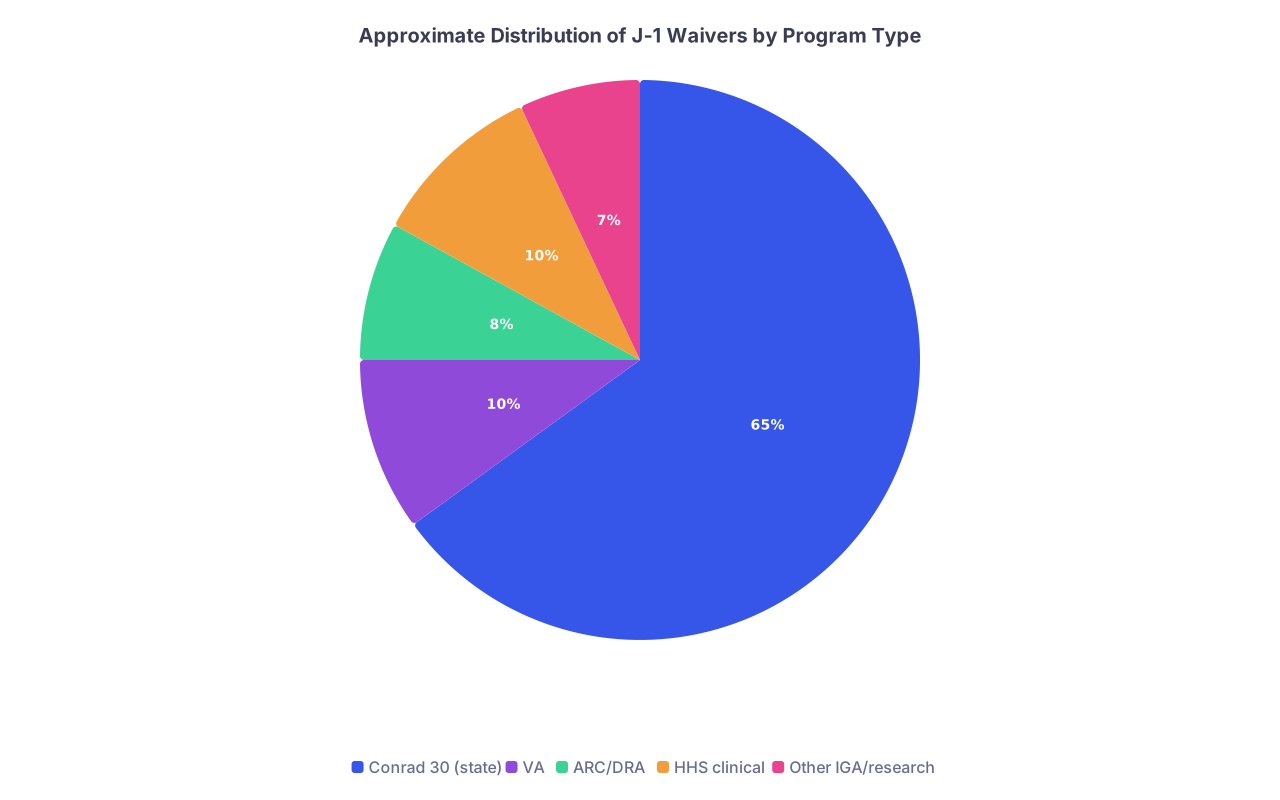
Visual: Where waivers actually go by type
| Category | Value |
|---|---|
| Conrad 30 (state) | 65 |
| VA | 10 |
| ARC/DRA | 8 |
| HHS clinical | 10 |
| Other IGA/research | 7 |
This is not exact, but directionally correct: Conrad 30 carries the bulk of IMG clinical waivers. Federal waivers fill specific niches.
Comparing what life looks like under each waiver type
Forget the paperwork for a moment. Think about your day‑to‑day and long‑term career.
Geography and lifestyle
Conrad 30:
- You are limited to that state
- Within that state, you have many location possibilities if you plan early and target open slots
- Mix of rural, small town, and some urban/inner‑city, depending on state policy
HHS clinical:
- Highly underserved regions, often rural or inner‑city with serious primary care shortages
- Less location choice; you must fit their HPSA-level rigor
VA:
- You will live where there is a VA hospital/clinic that needs your specialty
- Often mid-sized cities, sometimes large metros
ARC/DRA:
- Rural and small-town in specific multi-state regions
- Lifestyle is strongly “community medicine” in poor areas
IGA/research:
- Tied to federal labs, universities, or large urban institutions
If your spouse’s job or children’s schooling ties you to a specific metro, sometimes only VA or a FLEX-slot Conrad in that metro will work.
Clinical scope and specialty flexibility
Let us be blunt.
Conrad 30:
- Many states lean heavily to primary care (FM, IM, peds, psych, OB/GYN)
- Some states use a decent portion of their slots for hospitalists and subspecialists
- Flexibility to justify need if the state is cooperative and your employer makes a proper case
HHS clinical:
- Heavily primary care / mental health oriented
- Subspecialists often not a fit unless there is a documented, extreme shortage
VA:
- Very open to subspecialties – they need cardiologists, GI, nephrology, heme/onc, etc.
- Good route for integrated IM subspecialists who cannot find a convincing Conrad slot
ARC/DRA:
- Primary care and broad-based medicine favored
- Some specialties possible in key referral hospitals that serve the region
IGA/research:
- Often near-zero pure clinical requirement; heavy research
- Ideal for physician-scientists who do not want 40 hours/week of clinic
Salary, leverage, and “exploitation factor”
No one likes to say this out loud in front of hospital administration, so let me say it.
Being on a J‑1 waiver reduces your leverage. Employers know you are geographically and legally constrained. Some build reasonable contracts anyway. Others milk it.
Conrad 30:
- Rural or heavily underserved communities: salaries might be average or slightly above, but call burdens and resource deficits are real
- Urban underserved: sometimes lower pay than private practices but with loan repayment or benefits
- You have some leverage if your specialty is in demand and the state has leftover slots late in the cycle
HHS clinical:
- These are high-need settings. Compensation can range from “modest” to “quite good,” depending on funding and how desperate they are
- Less flexibility to negotiate terms that conflict with HHS requirements
VA:
- Federal pay scales with locality adjustments. Not private-practice money for proceduralists, but stable, with pensions and benefits
- Less likely to see predatory contracts, more likely to see rigid HR structures
ARC/DRA:
- Think small hospitals and FQHCs: may add bonuses or housing to attract you
- The trade-off is often professional isolation and thinner subspecialty back-up
IGA/research:
- Salary may be heavily academic (lower than private) but with grants, robust institutional reputations, and serious CV value
If you choose purely on salary and ignore immigration flexibility and specialty fit, you will regret it. But ignoring salary completely is naïve. Balance both.
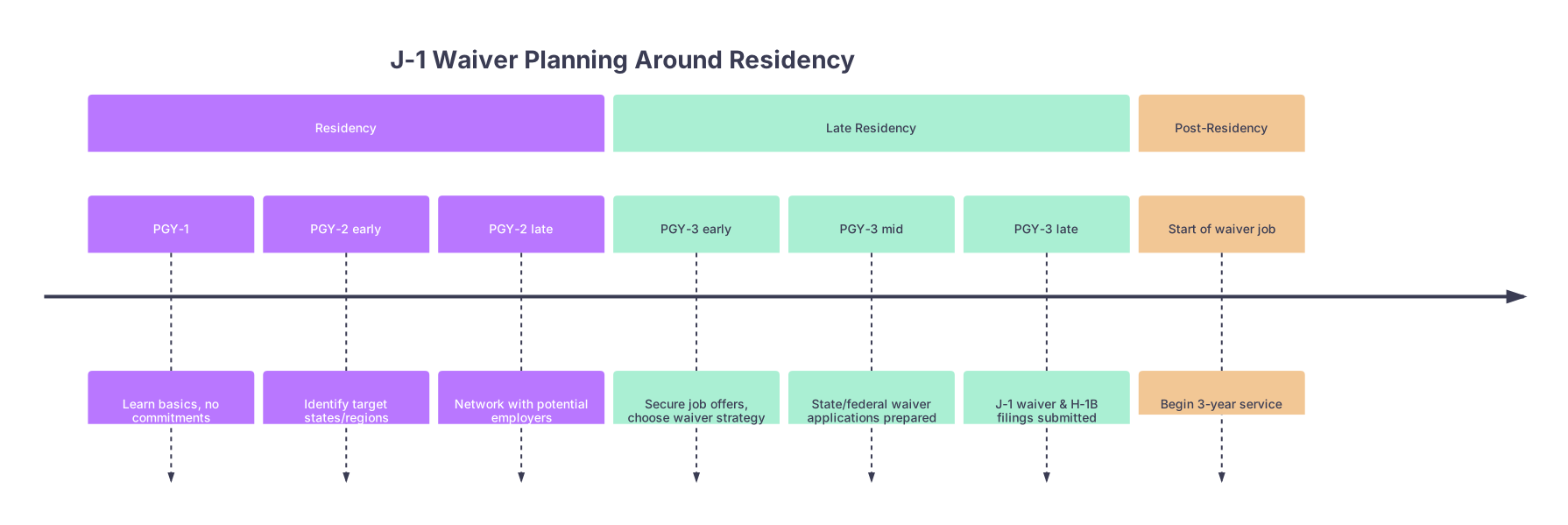
Timing and competitiveness: when you actually apply
You do not apply for a waiver in PGY‑1. But you need to plan like you will.
Typical timeline:
| Period | Event |
|---|---|
| Residency - PGY-1 | Learn basics, no commitments |
| Residency - PGY-2 early | Identify target states/regions |
| Residency - PGY-2 late | Network with potential employers |
| Late Residency - PGY-3 early | Secure job offers, choose waiver strategy |
| Late Residency - PGY-3 mid | State/federal waiver applications prepared |
| Late Residency - PGY-3 late | J-1 waiver & H-1B filings submitted |
| Post-Residency - Start of waiver job | Begin 3-year service |
Critical points:
- Conrad 30: Some states fill by November; others have rolling acceptance into spring. If you want a top-choice state (e.g., popular coastal states), you cannot wait until February of PGY‑3 to start.
- Federal programs: Often case-by-case with no hard public “cycle,” but internal agency timing and budgets affect them. You need the employer on board very early.
- Subspecialty fellows: The whole process shifts 2–3 years later, but the structure is identical. Just with more stress because you are older and more specialized.
Your fellow PGY‑3s who are calm in March are usually the ones who locked jobs and waiver strategies 6–9 months earlier.
Strategic trade-offs: Conrad vs Federal – how to actually decide
Let us move from theory to decision-making. Here is the real calculus for most IMGs.
Scenario 1: General IM resident, wants hospitalist, open to smaller cities
You:
- Are on J‑1 in internal medicine
- Want a hospitalist job
- Do not care strongly which state, as long as it is not truly remote rural
Best bet:
- Conrad 30 in a moderately competitive state that accepts hospitalists, using regular or FLEX slots
- VA waiver as possible backup if you find a VA with need and they sponsor waivers
You probably do not need HHS or ARC/DRA unless you explicitly want rural or are geographically tied to those regions.
Scenario 2: FM or peds resident, spouse anchored to a specific metro
You:
- Family medicine
- Spouse in tech/academia anchored to a few major cities
- Absolutely do not want to move to frontier-level rural regions
Options:
- Target states where your metro has HPSA/MUA/FQHC sites using Conrad 30
- Check whether nearby VA hospitals sponsor waivers – often located in or near major cities
- HHS clinical could be an option if the area qualifies as high-need and an FQHC/CHC there is used to HHS waivers
If your spouse insists on big-city only, your realistic waiver pathways are usually Conrad FLEX in that metro, VA, or possibly IGA if you are in academic primary care.
Scenario 3: Cardiology fellow, wants big academic practice
You:
- Did IM on J‑1, now cardiology fellow, still on J‑1
- Want major urban academic center with cath lab, EP team, the full package
Hard truth:
- Many Conrads prioritize primary care and mental health. Getting a cardiology waiver slot in a top metro is not impossible, but it is not easy.
- VA is a major lever: VA cardiology jobs in larger cities are often waiver‑eligible and can support procedural practice.
- IGA or HHS research‑heavy roles if you are strongly academic and can live with significant non-clinical time.
You need to start networking early in fellowship, not in the last 6 months.
Scenario 4: Physician-scientist, heavy research focus
You:
- Spend 60–80% of your time in lab or clinical trials
- Want an R01 trajectory, not 40 hrs/week of outpatient clinic
Pure Conrad 30 will be tough. States want service delivery.
Your best fits:
- IGA waiver through NIH/CDC or similar if your host institution can coordinate that
- HHS research waivers rather than clinical-only, depending on evolving guidelines
- Conrads that tolerate mixed roles (but do not assume they allow 70% research; many do not)
Here, you are squarely in “federal IGA” territory more than general state waiver land.
Quick comparison table: who fits where?
| Physician Profile | Strongest Fit | Secondary Options |
|---|---|---|
| FM / IM outpatient in underserved | Conrad 30 | HHS clinical, ARC/DRA |
| Hospitalist open to multiple states | Conrad 30 | VA, ARC/DRA |
| Subspecialist (e.g., cardiology, GI) | VA | Conrad 30 (select states) |
| Psych in shortage areas | Conrad 30, HHS clinical | VA, ARC/DRA |
| Research-focused physician-scientist | IGA (NIH/CDC/etc.) | HHS research, limited Conrad |
Common mistakes I see IMGs make around J‑1 waivers
Let me be direct about patterns that repeat:
- Assuming “any job” can be converted into a waiver job later
– No. The job has to fit the program’s geography, service, and administrative rules. - Waiting until late PGY‑3 (or late fellowship) to think about this
– By then, good state slots and many VA positions are already committed. - Ignoring state-by-state differences in Conrad 30
– Some states are incredibly IMG-friendly, others are restrictive or political. - Letting an employer’s lawyer “handle immigration” without expert oversight
– Many hospital counsels know employment law, not J‑1 nuance.
You do not need to obsess in PGY‑1, but you cannot ignore this until graduation.
Process perspective: what your path actually looks like
Here is the workflow many successful IMGs follow:

| Step | Description |
|---|---|
| Step 1 | Identify desired region/specialty |
| Step 2 | Target Conrad-eligible employers |
| Step 3 | Explore VA/HHS/ARC/DRA options |
| Step 4 | State Conrad application |
| Step 5 | Federal waiver application |
| Step 6 | Broaden search to other states/regions |
| Step 7 | USCIS H-1B + waiver approval |
| Step 8 | 3 years full-time service in approved role |
| Step 9 | Freedom from 212(e), broader job options |
| Step 10 | Is state Conrad 30 favorable? |
| Step 11 | Job offer in qualifying site? |
| Step 12 | Federal agency employer interested? |
The key decision fork is not mystical. It is:
“Is my target state’s Conrad route realistic and decent for my specialty? If not, which federal flavor might actually want me?”
One more thing: changing jobs during the 3 years
Everyone plans as if the first job will be perfect. It will not always be.
Whether you are on a Conrad, VA, HHS, or other federal waiver:
- Changing employers in the 3‑year period is possible but painful
- You need new employer + same or similar service model + amended H‑1B + sometimes updated waiver agency consent
- Gaps in employment or major duty changes can trigger issues with counting your 3‑year service
States vary in how flexible they are with transfers. Federal agencies vary too. But do not assume you can “swap jobs easily after one year.” You are shackled, at least partially.
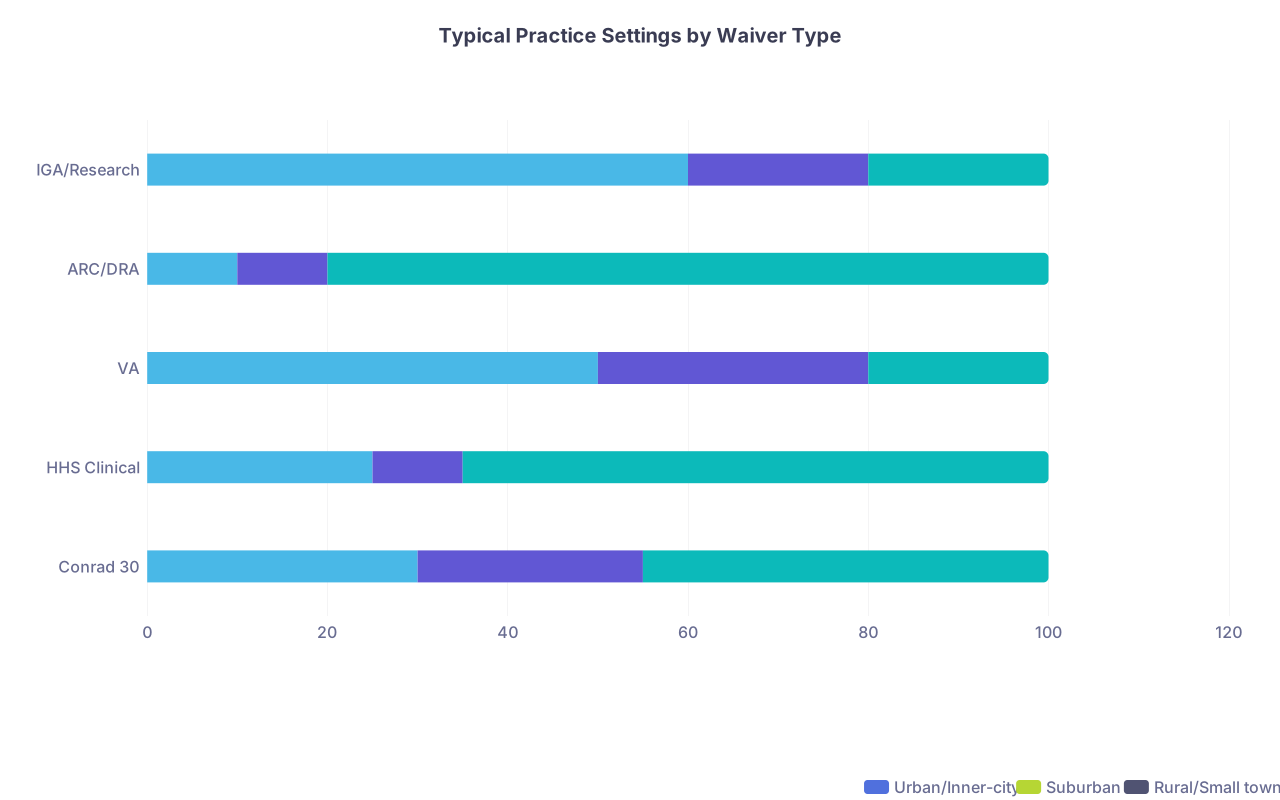
A brief visual on where different programs tend to place you
| Category | Urban/Inner-city | Suburban | Rural/Small town |
|---|---|---|---|
| Conrad 30 | 30 | 25 | 45 |
| HHS Clinical | 25 | 10 | 65 |
| VA | 50 | 30 | 20 |
| ARC/DRA | 10 | 10 | 80 |
| IGA/Research | 60 | 20 | 20 |
Directionally correct: Conrad gives you a broad spread, federal programs cluster at mission-critical geographies.
How to actually move forward from where you are now
If you are:
Early PGY‑2:
- Learn your home state’s and 1–2 backup states’ Conrad rules in detail.
- Start building a quiet list of employers used to sponsoring J‑1s.
Late PGY‑2 / early PGY‑3:
- Decide if Conrad in your target geography is viable or if you must pivot to VA/HHS/ARC/DRA.
- Have an immigration lawyer review your top-choice contracts before signing.
In fellowship:
- Start at least one year before graduation. Subspecialists need more lead time and narrower targets.
You are not just picking a first job. You are choosing the 3‑year cage you will live in while you escape the 2‑year home requirement. Pick the cage carefully.
Key takeaways
- Conrad 30 is the main clinical J‑1 waiver path for most IMGs, but its details vary dramatically by state and specialty. Learn your target state’s rules; do not assume.
- Federal waivers (HHS, VA, ARC, DRA, IGA) are not backup clones of Conrad; they serve different missions: VA for veterans and subspecialists, HHS/ARC/DRA for high-need underserved regions, IGA for serious research/national-interest roles.
- Your real decision is about geography, specialty fit, and how much control you want over your clinical scope for the three years it takes to clear 212(e). Plan that choice in PGY‑2/early PGY‑3—not at the end when the best options are already gone.