
The wrong visa choice in residency can quietly kill your chances at the fellowship you actually want.
Let me be blunt: in competitive specialties, your visa type is not a side detail. It is strategy, leverage, and in some cases, a hard ceiling on what programs will even look at you.
We are talking cardiology, GI, heme/onc, pulmonary/critical care, vascular surgery, interventional specialties. The stakes are high, and the rules are not evenly applied.
I will walk you through how J‑1 vs H‑1B actually plays out in fellowship selection, what different specialties really do (not what they claim on their websites), and how to plan from MS4 or PGY‑1 so you are not backed into a corner at exactly the wrong time.
1. The Three Visa Types That Actually Matter for Fellowship
I am going to ignore tourist, B‑1, and the rest. For fellowship decisions in competitive specialties, the battlefield is basically this:
- J‑1 (ECFMG sponsored)
- H‑1B (employer-sponsored, dual intent)
- Permanent resident / US citizen status (for comparison and planning)
F‑1 with OPT is mostly a temporary bridge into one of the above and usually does not carry directly into fellowship.
J‑1: The Double-Edged Sword Most IMGs End Up With
J‑1 is the default for most IMGs in residency. ECFMG sponsors it. It is relatively predictable. But it comes with the famous 2‑year home residency requirement (212(e)).
Key consequences for fellowship:
You cannot “skip” the 2‑year requirement just by starting a fellowship.
J‑1 clinical training visa is for GME only. When you finish the last period of training on J‑1, you either:- Go home for a total of 2 years (cumulative) to your home country, or
- Get a waiver (Conrad 30, federal waiver, VA, hardship/persecution, etc.) and then switch to H‑1B or another status.
You can do multiple fellowships on J‑1… but you keep stacking the problem.
Example I have seen repeatedly:- Internal medicine residency: 3 years on J‑1
- Cardiology: 3 years on J‑1 extension
- Interventional cardiology: 1 year on J‑1 extension
You have now done 7 years on J‑1. You still owe 2 years at the end, unless you get a waiver job. No waiver, no US permanent practice. That simple.
Some fellowships love J‑1; others quietly avoid it.
- Many academic programs: very comfortable with J‑1; institutional processes are established.
- Some private or hybrid programs: want H‑1B only or “US citizen/GC only” for billing/credentialing/employment pipeline reasons.
H‑1B: Powerful, but Narrow and Fragile
H‑1B for residency is less common, and for good reason:
- It is employer-sponsored (the program must file).
- Higher legal and filing cost.
- Wage requirements (prevailing wage) that some GME offices do not want to touch.
- Strict maximum: generally 6 years of H‑1B time, including any previous H‑1B employment in the US.
For fellowship, H‑1B gives you:
No 2‑year home requirement.
You can move from residency → fellowship → job without “paying back” time abroad or needing a J‑1 waiver.Dual intent.
You can actively pursue a green card while in training. For some specialties (e.g., GI, advanced endoscopy, some surgical fellowships), this helps tremendously when employers want long-term stability.But the 6‑year clock gets dangerous in multi-step training paths.
Example:- IM residency: 3 years H‑1B
- Cardiology: 3 years H‑1B
That is 6 years.
Where exactly do you fit: - Interventional cardiology (1 year) or
- EP (2 years)?
You do not, unless: - You recapture time spent outside the US, or
- You already have an I‑140 approved and can extend H‑1B beyond 6 years.
That nuance is where a lot of people get burned.
US Citizen / Green Card: The Control Group
Why bother talking about this? Because programs compare you to this group.
Programs think like this:
- US citizen/GC: Zero visa work, low risk, long-term employability.
- H‑1B: More work, but potentially long-term hire, can get green card, dual intent.
- J‑1: Time-limited, must leave or get waiver job, harder pipeline for post-fellowship retention.
In hyper-competitive fellowships, that ranking matters. They may not say it outright, but it shows up in:
- Rank list behavior
- Who gets “unofficial” pre-match assurances
- Who gets offered research chief or advanced fellowship slots
2. How Visa Type Plays Out by Specialty Tier
Not all competitive specialties behave the same way. Let’s break it down by broad groups.

Group 1: The Big Four IM Subspecialties (Cards, GI, Heme/Onc, Pulm/CC)
These are the classic competitive internal medicine fellowships, with high demand from both AMGs and IMGs.
Patterns I see over and over:
J‑1 is widely accepted, but with hidden constraints.
- Many top academic programs list “J‑1 and H‑1B accepted.”
- In reality, they often:
- Rank J‑1s slightly lower because of post-fellowship retention concerns, or
- Expect J‑1s to pursue academic/research careers abroad afterward.
H‑1B is a luxury some programs simply will not provide.
Reasons programs give (verbatim):- “Our GME office does not support H‑1B for fellows.”
- “Hospital legal wants to minimize non-cap-exempt H‑1B filings.”
- “We reserve H‑1B only for very rare cases; default is J‑1.”
Translation: If you must have H‑1B, subtract those programs from your realistic list.
Multi-fellowship paths get constrained by H‑1B years.
Example:- 3 years IM + 3 years heme/onc on H‑1B = 6 years.
- Want BMT (bone marrow transplant) or cellular therapy fellowship (1–2 more years)?
- You are at or over your H‑1B limit unless:
- You had limited or no prior H‑1B, or
- You have an approved I‑140 and can extend.
Bottom line for Group 1:
- If your primary goal is just to land cards/GI/heme‑onc/pulm‑CC somewhere in the US, J‑1 is fully viable.
- If you are aiming top 10 programs + possible advanced fellowship + long-term US practice in a desirable city, H‑1B or early green card planning becomes much more important.
Group 2: Ultra-Competitive Niche Fellowships
Think:
- Interventional cardiology
- Cardiac electrophysiology
- Advanced IBD / advanced hepatology
- Advanced endoscopy
- BMT / cellular therapy
- Critical care-only programs in famous centers
- Some surgical subspecialty fellowships (vascular, minimally invasive, transplant)
Here, visa type can be the silent tiebreaker.
What I have seen directors do:
“We’ll consider J‑1 but realistically prefer H‑1B or GC.”
They will rarely say “no J‑1” publicly because it looks bad.
In practice, the short list ends up heavily skewed to:- US grads
- GC holders
- H‑1B IMGs they can keep long-term
Concern about total H‑1B years becomes real.
If you are already in year 5 of H‑1B during general fellowship, some advanced programs simply do not want the legal headache of:- Extending you beyond 6 years
- Dealing with your green card timing
- Risking a mid-fellowship visa complication
Funding sources and billing models matter.
Some advanced fellowships are:- Largely funded by institutional/departmental money or philanthropy.
- Blended roles with junior attending time.
Those structures can make H‑1B more complicated or desirable depending on how HR classifies your role.
In simple terms:
- For ultra-competitive and small programs, your visa type often decides whether your application is “worth the trouble” when they already have plenty of strong, low-risk candidates.
Group 3: Surgical Subspecialties and Highly Procedure-Driven Fields
Things like:
- Vascular surgery fellowship (for general surgery grads)
- Minimally invasive / bariatric
- Surgical oncology
- Transplant
- Complex spine, etc.
Visa reality here:
Many surgical fellowships are more conservative with visas than IM subspecialties.
Sometimes you will see:- “US citizens or permanent residents only”
- “We cannot sponsor H‑1B at the fellow level”
- Or just complete absence of any visa statement, meaning you must email directly.
When they do sponsor, H‑1B is often acceptable but rare.
You will see a pattern where 1–2 fellows in a 10-year window were H‑1B, usually:- Extremely strong CV
- Strong internal advocate (chair or PD)
- Already within the institution on H‑1B
J‑1 is technically possible but may be institution-dependent.
Some surgery departments are wary of J‑1 because:- Complex malpractice issues
- Credentialing for high-risk procedures
- Long training paths with unclear post-training waiver options
Here, compared with medicine subspecialties, the bar for any visa sponsorship is simply higher.
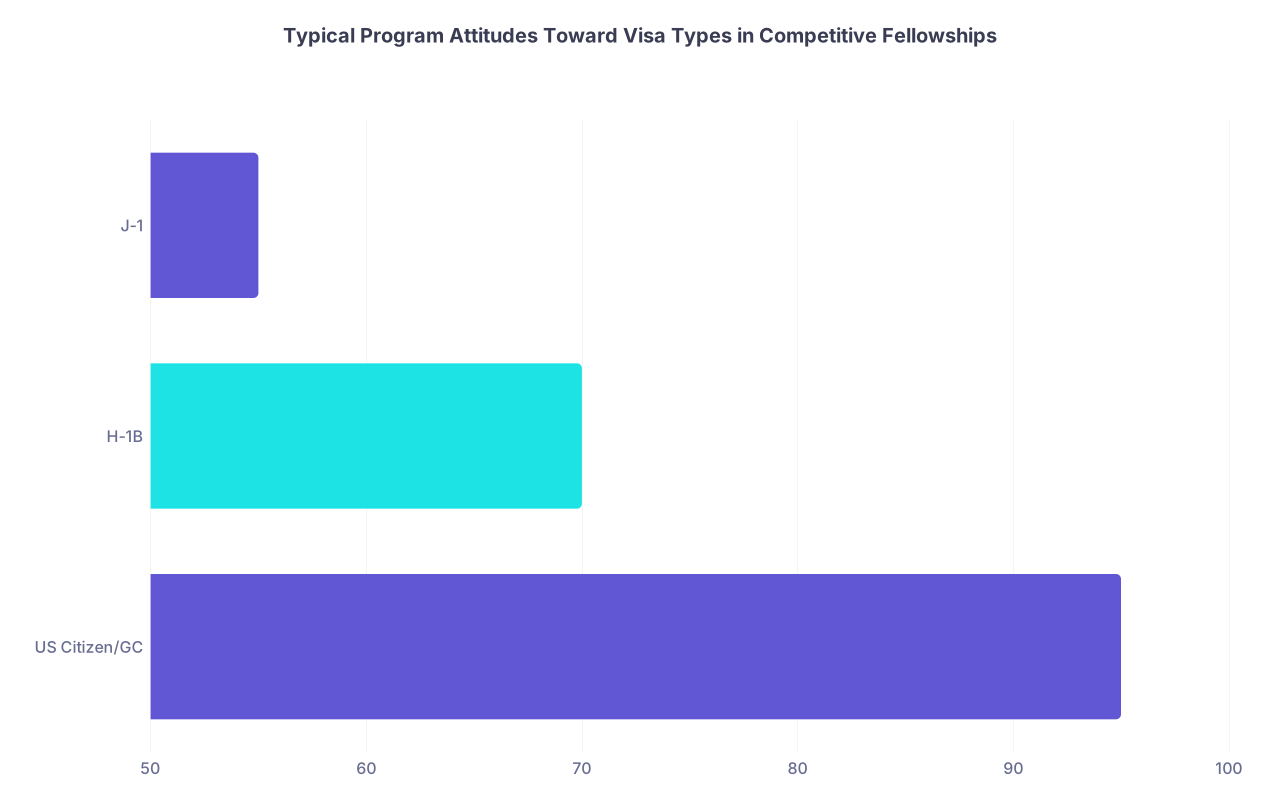
3. The Hidden Filters Programs Use On Visa Status
Programs rarely admit this on their websites, but you will see it in email replies and casual conversations at conferences.
| Category | Value |
|---|---|
| US Citizen/GC | 95 |
| H-1B | 70 |
| J-1 | 55 |
The chart above is not strict data from one source; it reflects the relative comfort level I see repeatedly across competitive fellowship programs.
Here are the unspoken filters:
“Is this candidate going to be a long-term asset to our institution or city?”
- J‑1: Maybe not; they will need a waiver job, which is often somewhere else (rural, underserved, etc.).
- H‑1B: Good chance; employer can often transition you to faculty with minimal disruption.
- GC/US: Easiest.
“How much administrative headache will this person add?”
- If the program coordinator already manages 6 different J‑1s and 2 H‑1Bs, they may resist adding more complexity.
- Smaller programs: often lack robust legal/HR support and default to J‑1 only or no visas at all.
“Will this candidate’s visa timeline collide with our training length?”
- For multi-step IM → fellowship → advanced fellowship paths, H‑1B year limits become a deal-breaker if not managed proactively.
- Programs do not want to be the ones to “discover” your time is over mid-fellowship.
“If something goes wrong, do we have to scramble?”
- Any visa denial, delayed extension, DS‑2019 problem = coverage issue.
- In critical care, interventional, high-acuity specialties, they are particularly sensitive to this.
4. Concrete Strategy: Choosing Visa Type in Residency if You Want Competitive Fellowship
Let me break this down into actual decisions you can act on.
Step 1: Decide Your Risk Appetite and End Goal
Be specific. “I want a good fellowship somewhere” is not a plan.
Examples of real goals:
- “I want academic cardiology with interventional in a large city, and I plan to stay in the US long-term.”
- “I want heme/onc, I am open to rural/underserved jobs afterward if needed, and I might eventually return to my home country.”
- “I want GI or advanced endoscopy, very preferably in the Northeast, plus long-term US practice.”
Your visa choice should match the tightest version of your end goal, not the vague, flexible version you tell yourself to feel better.
Step 2: If You Can Realistically Secure H‑1B for Residency, Think Long-Term Math
Ask these specific questions before committing:
How many total years of residency + fellowship do I expect?
For IM example:- IM: 3
- Cards: 3
- Interventional: 1
Total = 7 years.
Have I ever held H‑1B status in the US before?
- Prior H‑1B work (even 1–2 years in tech or research) counts against the 6-year limit, though you may recapture time outside the US.
Can I start a green card process early enough (e.g., during general fellowship) so that by the time I need >6 years, I already have an approved I‑140?
- University-based employers are often cap-exempt and accustomed to this.
- Private hospital systems vary widely.
If your math shows 7–8 years of training and you cannot rely on timely I‑140 approval, pure H‑1B from day one may backfire.
In those cases, some residents deliberately:
- Use J‑1 for residency and even general fellowship.
- Then aim for H‑1B only at the final stage (e.g., advanced fellowship or first attending job) after getting a J‑1 waiver.
Step 3: If You Are J‑1 in Residency, Be Ruthlessly Clear About the Waiver Reality
Here is the pattern I watch repeat every cycle:
- PGY‑2 realizes they want highly competitive fellowship.
- PGY‑3 matches into a strong but not top‑3 cards/GI fellowship on J‑1.
- End of fellowship: now needs a J‑1 waiver job to stay.
- Those waiver jobs are rarely in the exact cities or roles they dreamed about.
If you are J‑1 and determined to do multiple fellowships:
- Assume you will likely:
- Do a J‑1 waiver job before or after advanced fellowship,
- Possibly in an underserved or rural area,
- And only then transition back to your “dream” location after obtaining H‑1B and starting a green card.
Not impossible. But slower. And definitely not as flexible as people think in PGY‑1.
5. Realistic Fellowship Prospects by Visa Type (Side-by-side)
Here is a simplified comparison to ground all this.
| Factor | J-1 | H-1B | US Citizen / GC |
|---|---|---|---|
| Acceptance in big IM subspecs | High | Moderate to high, program-dependent | Very high |
| Acceptance in ultra-competitive niches | Moderate, uneven | Moderate, can be strong with planning | Very high |
| Post-fellowship US job flexibility | Low until waiver completed | High (no home requirement) | Maximal |
| Multi-step training (e.g., cards + interventional) | Visa OK, but piles on 2-year obligation | Constrained by 6-year limit unless I-140 | No structural constraint |
| Program admin burden | Lower (well-standardized via ECFMG) | Higher (employer filings, wage rules) | Lowest |
Use this table as a mental model, not gospel. Individual programs vary, but the trends are consistent enough that you should factor them into your decisions.
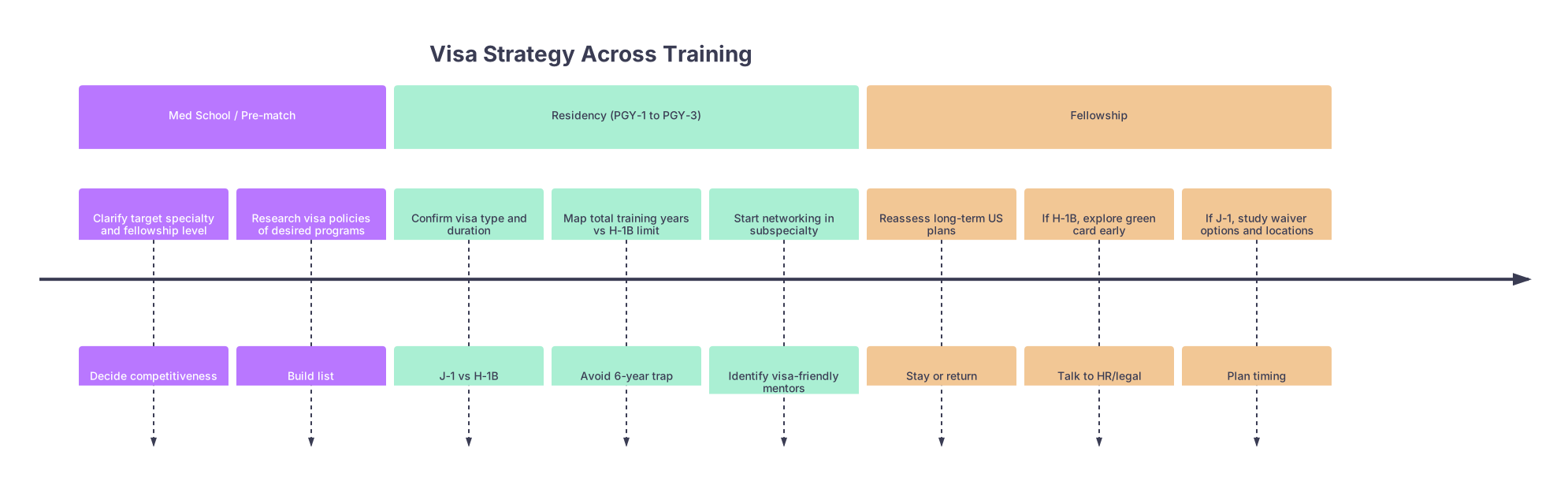
6. Practical Moves You Can Make Right Now (Depending on Your Phase)
| Period | Event |
|---|---|
| Med School / Pre-match - Clarify target specialty and fellowship level | Decide competitiveness |
| Med School / Pre-match - Research visa policies of desired programs | Build list |
| Residency (PGY-1 to PGY-3) - Confirm visa type and duration | J-1 vs H-1B |
| Residency (PGY-1 to PGY-3) - Map total training years vs H-1B limit | Avoid 6-year trap |
| Residency (PGY-1 to PGY-3) - Start networking in subspecialty | Identify visa-friendly mentors |
| Fellowship - Reassess long-term US plans | Stay or return |
| Fellowship - If H-1B, explore green card early | Talk to HR/legal |
| Fellowship - If J-1, study waiver options and locations | Plan timing |
If You Are Pre‑Match or Early Applicant (MS4 / Pre‑residency IMG)
You have the most leverage, but most applicants waste it.
You should:
Decide how important location + long-term US practice really is to you.
If staying in the US in a major metro with a competitive subspecialty is non‑negotiable, lean strongly toward:- H‑1B-compatible residency programs, or
- Programs that have a track record of residents obtaining green cards during training.
Actually ask programs about visa paths during interview season.
Ask targeted questions:- “Do you sponsor H‑1B for residents and fellows?”
- “Do your graduates in competitive subspecialties typically stay in the US afterward, and on what visas/status?”
- “Have previous residents on J‑1 successfully matched into cards/GI/heme‑onc with you? Where did they go?”
Track the answers in a simple spreadsheet.
Programs blur together. Their websites are often outdated or vague. Your own written notes will be more reliable.
If You Are Already in Residency on J‑1
You are not doomed. But you must be clear-eyed.
Your realistic playbook:
Accept that J‑1 will probably remain your status through fellowship.
Focus on making your fellowship application so strong that programs overlook visa-related concerns:
- Actual research productivity (first-author papers, not just posters)
- Distinctive letters from recognized names
- Niche expertise or procedural skills that make you valuable
Parallel plan for post-fellowship:
- Learn which states and systems offer a lot of J‑1 waiver jobs in your specialty.
- Know that some competitive subspecialties have very limited waiver positions in big cities.
Sometimes the smartest move for a J‑1:
- Do general cards or heme/onc,
- Take a waiver job in a place that offers intensive procedural exposure,
- Then apply for an advanced fellowship or high-end job after getting H‑1B or green card.
Slower. But workable.
If You Are Already in Residency on H‑1B
Your key priority is to not let the 6-year cap ambush you.
You should:
Sit down and map:
- Current H‑1B time used
- Expected residency + fellowship years
- Any prior H‑1B years in the US
Ask your GME or hospital legal about:
- Recapturing time spent outside the US
- Policies for H‑1B extensions beyond 6 years after I‑140 approval
During fellowship interviews, be transparent but strategic:
- “I am currently in year X of H‑1B. I am planning on applying for a green card during fellowship or early attending years, and I have confirmed with my current institution that I qualify for recapture/extension because of [reason].”
Programs hate surprises. If they know you understand your visa timeline, they are more willing to take you seriously.
7. Brutal but Honest Ranking: Which Visa Type Helps You Most in Competitive Fellowships?
If all you care about is maximizing probability of matching into a competitive US fellowship and building a long-term career in that subspecialty in the US, the ranking looks like this:
- US Citizen / Green Card
- H‑1B (with well-managed timeline and early I‑140)
- J‑1 (with realistic waiver planning and location flexibility)
But that is the surface answer. The deeper truth:
- A J‑1 resident with strong research, letters, and networking will beat a mediocre H‑1B candidate.
- A smart J‑1 with an aggressive publication strategy and a clear two-stage career plan (fellowship → waiver → return to desired city) can still absolutely build a high‑level subspecialty career.
Visa is a constraint, not destiny. But in competitive specialties, it is a constraint you cannot ignore or “deal with later.”
FAQ (Exactly 5 Questions)
1. Does choosing J‑1 for residency automatically block me from competitive fellowships like cardiology or GI?
No. Many J‑1 residents match into cards, GI, heme‑onc, and pulm‑CC every year, even at strong academic programs. What J‑1 complicates is not matching itself, but your post-fellowship options in terms of waiver jobs, location flexibility, and ability to stack multiple fellowships without being forced into specific underserved locations.
2. Is it always better to push hard for H‑1B in residency if I want a competitive fellowship?
Not always. If your training path will likely exceed 6 total H‑1B years (for example, long prior H‑1B work plus residency plus multi-step fellowship), you can hit the H‑1B time cap at a bad moment. Without an approved I‑140 to extend beyond 6 years, this can be worse than having been on J‑1. The “best” choice depends on your expected total years of training, prior H‑1B history, and how early you can realistically start a green card.
3. Do fellowship programs prefer H‑1B over J‑1?
Many competitive programs say they welcome both, but internally, some directors and hospital HR teams privately favor H‑1B or green card holders because they are easier to retain as faculty and do not require J‑1 waiver arrangements. That said, J‑1 is more standardized through ECFMG, and some programs actually prefer the predictable DS‑2019 process. You must look program by program and, ideally, ask current fellows what actually happens.
4. Can I move from J‑1 in residency to H‑1B for fellowship to avoid the 2‑year home requirement?
In general, no. If you are subject to the J‑1 2‑year home residency requirement (212(e)), you are not eligible for H‑1B or permanent residence until you have either fulfilled the 2‑year requirement or obtained a waiver. Simply switching from J‑1 in residency to H‑1B for fellowship does not erase that obligation. There are narrow exceptions, but for almost all clinical J‑1 IMGs, the rule holds.
5. How early should I involve an immigration lawyer if I am aiming for a highly competitive fellowship?
Earlier than you think. If you are on H‑1B, I would involve an experienced physician-focused immigration attorney no later than PGY‑2 or early fellowship to map your 6‑year limit, recapture options, and I‑140 timing. If you are on J‑1 and considering multi-step fellowships, talking to a lawyer during fellowship (not at the end) helps you understand waiver categories, states with more waiver positions in your field, and whether hardship or persecution waivers are even remotely realistic in your case.
Key takeaways:
Visa type is not a checkbox; it shapes which fellowships will seriously consider you, how many years of training you can stack, and where you can actually work afterward. J‑1 can absolutely coexist with competitive fellowships, but it forces a narrower, more structured path, usually involving a waiver in less‑desirable locations. H‑1B buys you more direct continuity in the US but only if you actively manage the 6‑year clock and green card process from early in residency or fellowship.