It is late November. You are refreshing your email between consults, waiting for interview invites. At the same time, an associate program director just asked you on Zoom: “So what’s your immigration plan? Are you thinking J‑1 clinical or a research route first?”
You smiled and said something vague. But if you are honest, you are not completely sure what “J‑1 research vs. clinical” actually means in practice. You have heard rumors:
- “If you take a research J‑1 you are stuck, you can never do residency.”
- “Clinical J‑1 is only for people already matched.”
- “Research J‑1 is easier to get but kills your chances later.”
Most of that is either oversimplified or wrong.
Let me walk through this like I would with a strong IMG on a Zoom mentoring call who wants to end up in US academic medicine and does not want to shoot themselves in the foot with the wrong J‑1 choice.
1. The Real Landscape: What “J‑1” Actually Covers for IMGs
First, you are not choosing between two different visas called “J‑1 Research” and “J‑1 Clinical.” You are choosing between categories of J‑1 exchange programs, with completely different rules, sponsors, and long‑term consequences.
For IMGs heading into academic medicine, you are usually looking at three J‑1 “worlds”:
J‑1 Clinical (Alien Physician – Graduate Medical Education)
For residency and fellowship with direct patient care.
Sponsored almost exclusively by ECFMG.J‑1 Research Scholar / Professor
For research or teaching roles, usually in academic departments.
Sponsored by the university or research institution, not ECFMG.J‑1 Short‑Term Scholar
Short visits, observerships, workshops, non‑degree training.
Sponsored by the institution. Minimal long‑term utility.
This guide is about the first two — ECFMG J‑1 Clinical vs. Institutional J‑1 Research Scholar — and how they play out for an IMG who wants an academic career.
To ground this, here is a concise comparison.
| Feature | J-1 Clinical (ECFMG) | J-1 Research Scholar (Institutional) |
|---|---|---|
| Primary purpose | Residency/Fellowship with direct patient care | Full-time research / teaching, no patient care |
| Main sponsor | ECFMG | University / research institution |
| Licensing requirement | Requires USMLEs + ECFMG cert | No USMLE or license required (for pure research) |
| Cap on duration | Usually max 7 years | Usually max 5 years |
| Clinical work allowed | Yes, in ACGME programs only | Generally no direct patient care |
| 2-year home residency rule | Almost always applies | Frequently applies (check DS-2019/consulate stamp) |
2. J‑1 Clinical (Alien Physician): The “Standard” for Residency/Fellowship
If you match into a US residency or fellowship as an IMG and you choose a J‑1, you are almost certainly talking about ECFMG‑sponsored J‑1 Clinical status. This is the classic “J‑1 physician” path.
Why programs like it
From the program side, J‑1 clinical is cleaner than H‑1B:
- ECFMG handles most immigration admin.
- No prevailing wage headaches.
- Clear rules and a familiar process.
- No 6‑year cap like H‑1B; J‑1 covers full training (up to 7 years).
So many academic programs essentially default to J‑1 for IMGs unless there is a specific reason to go H‑1B.
Requirements for J‑1 Clinical
To qualify for J‑1 Clinical as an IMG, you typically must:
- Be ECFMG certified (USMLE Steps + medical school verified).
- Hold a valid residency/fellowship contract with an ACGME‑accredited program.
- Have adequate financial support (salary from program usually suffices).
- Demonstrate home country residence and intent to return (yes, this matters).
- Clear English proficiency (often implicitly through USMLEs and interviews).
What this gives you:
- Legal status to perform direct patient care as part of training.
- Up to 7 years for residency + fellowship combinations.
- Eligibility for moonlighting only if ECFMG and program approve (tightly regulated).
The catch: the 2‑year home‑residency requirement
Almost all J‑1 Clinical IMGs are subject to the INA 212(e) 2‑year home country physical presence requirement. It means:
- After training, you must either:
- Return to your home country for a total of 2 years, or
- Obtain a waiver (e.g., Conrad 30, VA, HHS, hardship, persecution).
No shortcuts. No “I did a few months of telemedicine back home.” It is physical presence.
Important point: the 2‑year requirement attaches to you, not only the visa stamp. Once you are subject, that follows you until fulfilled or waived, even if you change to H‑1B, F‑1, O‑1, etc.
When J‑1 Clinical is clearly the right choice
You should favor J‑1 Clinical when:
- You have already matched into ACGME residency or fellowship.
- The program is experienced with ECFMG‑J‑1 and not keen on H‑1B.
- You plan to pursue Conrad 30 or similar waiver and work in underserved areas.
- You want the most straightforward path to complete all your training in the US.
What J‑1 Clinical is not:
- It is not a visa for “clinical research fellow” jobs that involve seeing patients but are not ACGME positions. Those are messy and often not eligible.
- It is not for observerships or externships.
- It is not for full, unrestricted attending work.
3. J‑1 Research Scholar: The Academic Side Door
Now the other side: J‑1 Research Scholar.
This is the category you see for “Postdoctoral Research Fellow,” “Research Associate,” “Visiting Scientist,” or “Non‑accredited Research Fellow” positions. The stroke lab at Mass General. The outcomes research group at Mayo. A T32 fellowship at a large university. Those typically run under J‑1 Research Scholar or J‑1 Professor.
Key features of J‑1 Research Scholar
- Purpose: Full‑time research and/or teaching.
- Sponsor: The academic institution, not ECFMG.
- Duration: Usually up to 5 years total in the Research Scholar category.
- Clinical work:
- No direct patient care that requires a US license.
- You can interact with data, specimens, and maybe patients only in a research‑designated way without independent clinical responsibility.
And this is where many IMGs get confused.
You can work in a department of medicine, in an ICU research group, attend rounds as an observer, consent patients to clinical trials, but you cannot function as a treating physician under J‑1 Research Scholar.
Does J‑1 Research Scholar help or hurt later residency chances?
Here’s the part people get wrong:
- Being on J‑1 Research Scholar absolutely does not block you from later obtaining J‑1 Clinical from ECFMG.
- However, it can complicate your immigration narrative, timing, and waiver options.
Three main effects:
Time away from clinical work
- Two to five years in research means you are getting older, your graduation date is moving further away, and your on‑paper “clinical gap” is increasing.
- Some PDs are fine with 2‑3 years of research at a top place. Beyond 5+, questions start.
You may acquire the 2‑year home residency requirement twice
- Many J‑1 Research Scholar positions also trigger 212(e), especially if funded by US or home‑government money or on the Skills List.
- If you then switch to J‑1 Clinical for residency, you could stack multiple J‑1 programs all subject to 212(e). The requirement is still 2 years total, but the waiver reasoning can get more tangled.
You get “too settled”
I have watched people do:- 4–5 years of research on J‑1 Research Scholar
- Then 3–7 years of residency/fellowship on J‑1 Clinical
And now they sit at 35–40+ years old, with multiple 212(e) triggers, a spouse, kids in US school, and need a waiver in a very specific state. Harder, not impossible, but harder.
That said, a well‑timed, strategically chosen J‑1 Research Scholar period at a strong institution can dramatically improve:
- Your CV (publications, US letters, grant exposure).
- Your network (mentors who can call PDs directly).
- Your interview rate for competitive specialties.
I have seen IMGs go from 0 interviews one year to >20 the next after 1–2 years of J‑1 research at a powerhouse lab.
4. Side‑by‑Side: Which Category Fits Which Goal?
Let me make the decision tree more explicit.
If your primary goal is: “Match into residency as soon as possible”
You should:
- Prioritize J‑1 Clinical via ECFMG if:
- You have or are about to have a residency offer.
- Your scores and attempts are decent enough to be competitive now.
- Use research only if:
- You failed to match and need 1–2 years maximum of solid research to strengthen your application.
In that second scenario, an F‑1 (if degree‑granting) or J‑1 Research Scholar research position can be a bridge. But you should treat it as a short, focused sprint, not a permanent job.
If your primary goal is: “Establish an academic research career, maybe clinician‑investigator later”
Then a longer J‑1 Research Scholar route can be reasonable, especially if:
- You land at a serious academic center (e.g., Hopkins, UCSF, WashU) with:
- NIH‑funded labs
- Strong track record of placing research fellows into residency
- You will build:
- First‑/senior‑author papers
- Strong US letters
- A defined niche (e.g., sepsis outcomes, interventional cardiology devices, neuroimaging biomarkers)
Then, after 2–3 years, you pivot:
- Apply to residency using that research platform.
- Switch to J‑1 Clinical if matched.
The risk: you must keep a clean immigration trail and not let the “clinical gap” become excessive for your chosen specialty.
5. Real‑World Timelines and Pitfalls
Let me show you common patterns I have actually seen play out.
Pattern A: The “surgical IMG with late Step 2 score”
- Strong home country surgical training, scores OK but not stellar, needs US exposure.
- Gets J‑1 Research Scholar position in a surgical oncology lab at MD Anderson.
- Spends 2 years:
- 3–4 publications
- Assists with databases, maybe animals, tumor board observation
- Builds strong relationships with attendings
Year 2: Applies to general surgery / prelim surgery:
- Now has US mentors calling PDs.
- Scores are not magically higher, but story is better.
- Matches prelim or categorical.
- Switches from J‑1 Research Scholar → J‑1 Clinical.
This path works. As long as you do not stretch the research to 5+ years with no residency applications.
Pattern B: The “lost in research” IMG
- Does not match. Accepts a J‑1 Research Scholar postdoc at a mid‑tier hospital.
- Minimal mentorship, PI is busy, no publications for 18 months.
- Stays 4+ years, multiple extensions.
- Little to show beyond “data collection,” maybe 1 middle‑author paper.
- Now 7–8 years from graduation, no recent clinical experience.
Result: PDs see a candidate who looks more like a career PhD‑level researcher than someone they want to train clinically. Match chances drop sharply.
Pattern C: The “straight through clinical” IMG
- Good scores, ECFMG certified quickly.
- Matches into internal medicine.
- Comes on J‑1 Clinical, completes residency + fellowship
(say 3 years IM + 3 years cardiology). - Total 6 years under ECFMG J‑1. No research J‑1 at all.
- Gets a Conrad 30 waiver job in a community but academically affiliated site.
- Later transitions to academic faculty.
Clean, direct path. Less research time, but for many IMGs this is the most efficient and realistic.
6. Immigration Mechanics: Switching, Waivers, and Traps
Can you switch from J‑1 Research to J‑1 Clinical?
Yes, but with caveats.
- You cannot “convert” your J‑1 category in place most of the time.
- Typically, when you switch from J‑1 Research Scholar (institutional) to J‑1 Clinical (ECFMG), you:
- End your current J‑1 program.
- Obtain ECFMG sponsorship documents.
- Get a new DS‑2019 for J‑1 Clinical.
- Often require consular processing (new visa stamp) depending on timing and status.
And underlying all this: if your J‑1 Research Scholar status triggered 212(e), you are already subject. Moving to J‑1 Clinical adds more J‑1 time, but the 2‑year requirement remains one obligation, not additive per program.
Multiple J‑1 periods and the “5‑year” vs “7‑year” caps
Key points:
- Research Scholar category usually: maximum 5 years total in that category.
- Clinical (ECFMG): usually maximum 7 years total.
Those clocks are separate. It is possible to do:
- 3 years J‑1 Research Scholar
- Then 6–7 years J‑1 Clinical for training
Legally possible, but again, that is 9–10 years of J‑1 presence and a very entangled immigration story at the end.
The waiver problem
For J‑1 Clinical:
- Most IMGs pursue waivers such as:
- Conrad 30 (state‑sponsored underserved area positions).
- VA waivers.
- HHS waivers (especially for research physicians in certain fields).
- Exceptional hardship or persecution (much rarer).
Adding long periods of J‑1 Research Scholar can complicate:
- Your timing (when you are looking for waiver jobs).
- Your family situation (spouse’s status, children in school).
- Your eligibility for academic H‑1B roles after waiver completion.
There is no simple rule like “J‑1 Research automatically ruins waivers.” But if you plan to build a serious academic career in the US, you want a coherent plan from the start, not a random sequence of visas.
7. Strategic Choices: How to Decide for Your Situation
Let me be blunt. You cannot optimize everything simultaneously. You trade off:
- Time to match
- Depth of research CV
- Immigration simplicity
- Long‑term academic upside
Here is how I’d frame common scenarios.
Scenario 1: Strong profile, already competitive this cycle
- You have good Step scores, no attempts, recent graduation, some home‑country research.
- You are getting interview bites in internal medicine, pediatrics, FM, maybe neuro/psych.
In this case:
- Do not delay residency chasing J‑1 Research Scholar unless:
- Your dream is a hyper‑competitive specialty (derm, rad onc, neurosurg) and you knowingly want to take a long research road.
- If you match, accept J‑1 Clinical if H‑1B is not clearly on the table.
- You can still do research during residency/fellowship, and you can do post‑residency research years on O‑1/H‑1B later.
Scenario 2: No match, decent scores, big clinical gap forming
- You are 5–7+ years from graduation.
- You have limited US clinical experience.
- You did not match this cycle.
For you, a carefully chosen J‑1 Research Scholar position can genuinely rescue your trajectory — if:
- It is at a recognizable institution.
- There is a clear expectation you will publish and present.
- The PI has a track record of helping IMGs get into residency.
You aim for 1–2 strong years, not 5.
Parallel track: keep applying each cycle while in research. Do not wait “until I have more papers.” Apply early, with your PI’s backing.
Scenario 3: You truly want to be 80% researcher, 20% clinician long term
Here, you might consciously choose:
- 2–3 years J‑1 Research Scholar postdoc at a top lab.
- Then residency/fellowship on J‑1 Clinical or H‑1B (if your CV becomes strong enough and a program will sponsor).
- Later, an O‑1 or EB‑1/NIW path anchored on your research portfolio.
But you should go into that path sober. It is long, often 10–15 years from first entry to stable academic position. And you need consistent productivity, not just “I worked in a lab.”
8. Practical Signals: How Programs and Visa Offices View You
Programs and immigration offices look for coherence.
Red flags I have seen:
- Candidate has done:
- 4 years J‑1 Research in cardiology
- 3 years F‑1 doing some unrelated MPH
- Tries to apply for residency in pathology with almost no clinical continuity
- Story feels like: “I am just collecting visas to stay in the US.”
Better narrative:
- 2 years Research Scholar in stroke neurology → publications, stroke meetings.
- Then neurology residency on J‑1 Clinical.
- Then vascular neurology fellowship.
- Then waiver job in a stroke‑heavy community practice with research collaboration.
Everything lines up: specialty interest, visa history, and eventual waiver employment.
9. Visualizing Paths and Timelines
Here is a rough visual of two common trajectories.
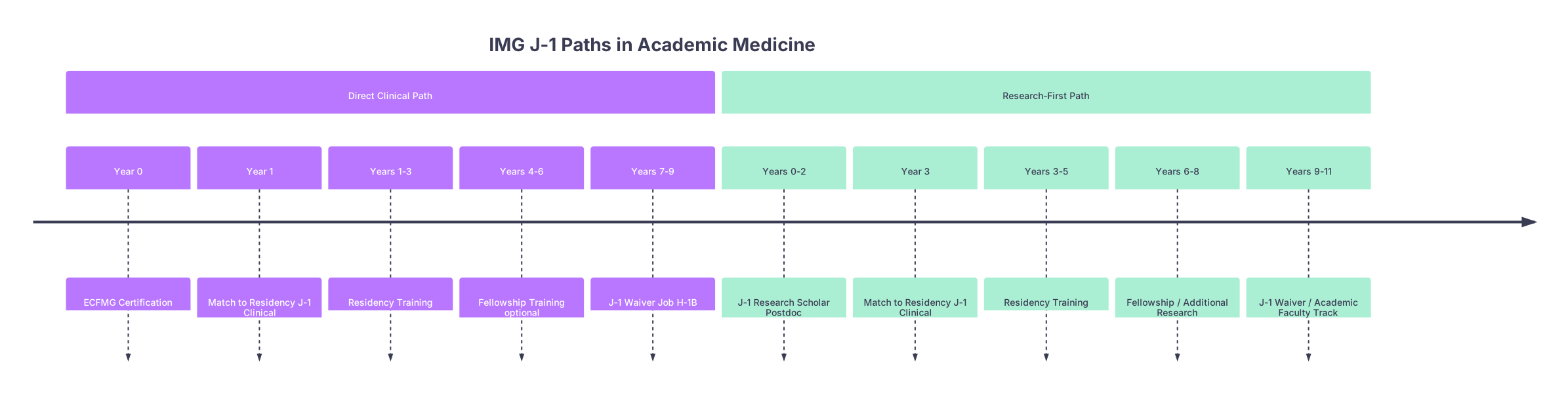
| Period | Event |
|---|---|
| Direct Clinical Path - Year 0 | ECFMG Certification |
| Direct Clinical Path - Year 1 | Match to Residency J-1 Clinical |
| Direct Clinical Path - Years 1-3 | Residency Training |
| Direct Clinical Path - Years 4-6 | Fellowship Training optional |
| Direct Clinical Path - Years 7-9 | J-1 Waiver Job H-1B |
| Research-First Path - Years 0-2 | J-1 Research Scholar Postdoc |
| Research-First Path - Year 3 | Match to Residency J-1 Clinical |
| Research-First Path - Years 3-5 | Residency Training |
| Research-First Path - Years 6-8 | Fellowship / Additional Research |
| Research-First Path - Years 9-11 | J-1 Waiver / Academic Faculty Track |
And because people underestimate how much non‑clinical time they are stacking up, look at the rough “non‑independent” years:
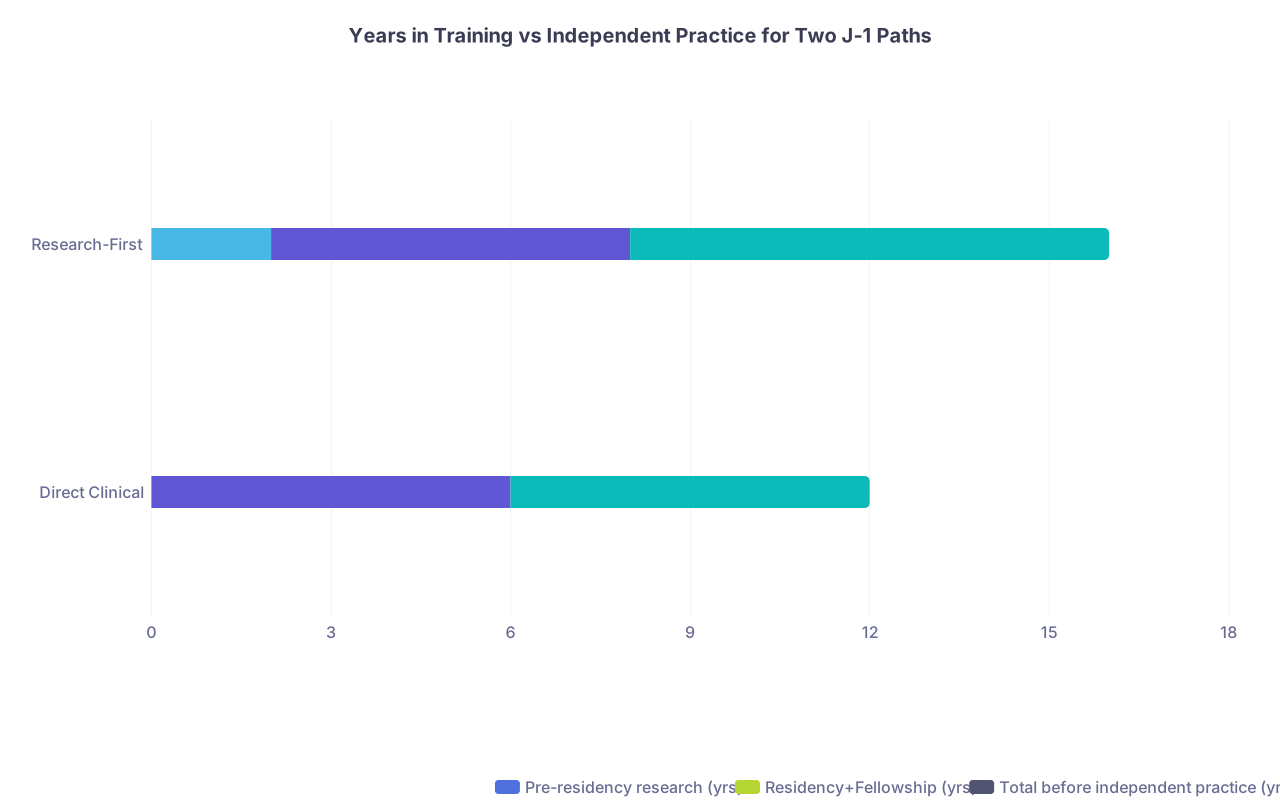
| Category | Pre-residency research (yrs) | Residency+Fellowship (yrs) | Total before independent practice (yrs) |
|---|---|---|---|
| Direct Clinical | 0 | 6 | 6 |
| Research-First | 2 | 6 | 8 |
Not exact, but it shows the delta. Two additional years may be worth it for the right research environment and future goals; it may be a waste in a weak lab.
10. Concrete Questions You Should Ask Before Accepting Any J‑1 Offer
When you get an offer for a “research fellow” position or a residency spot, you must interrogate the visa side just as hard as the job description.
For research positions:
- “Will this be sponsored under J‑1 Research Scholar, J‑1 Short‑Term Scholar, or something else?”
- “Will my J‑1 carry the two‑year home residency requirement (212e)?”
- “How many prior IMGs from your lab have successfully transitioned into US residency or fellowship?” Names and specialties matter.
- “How long do people typically stay in this position before moving on?”
For residency/fellowship positions:
- “What visa types do you sponsor for IMGs — H‑1B, J‑1, or both?”
- “How many current residents/fellows are on J‑1?”
- “Do you have experience with ECFMG and J‑1 renewals?”
- “For J‑1 residents, do your graduates typically secure waiver jobs after training?”
If the program coordinator sounds lost when you say “ECFMG‑sponsored J‑1 physician,” that is a sign.
11. Putting It All Together: A Sane Strategy
To wrap this into a usable rule set:
If you have a solid shot to match now → prioritize J‑1 Clinical.
Do not detour into long research J‑1 positions unless there is a very clear specialty‑driven reason.If you need to strengthen your profile → consider 1–2 years of J‑1 Research Scholar at a strong academic center.
But treat it as a temporary, targeted intervention — not a default long‑term job.Always verify whether your J‑1 will trigger the 2‑year rule (212e).
Check the DS‑2019 form and consulate stamp. Keep copies forever.Think about your endgame from day one.
Where do you want to be 10–15 years from now? A community attending? Academic PI? Division chief? Then back‑calculate what combination of clinical and research J‑1 periods makes the story coherent.Keep your clinical identity alive.
Even during J‑1 Research years, maintain contact with clinical mentors, attend conferences, do chart‑based research that keeps you within your intended specialty. Do not let yourself be seen purely as a data technician.
You are not just choosing between two visas. You are laying down rails for the next decade of your life.
With these distinctions clear, you are better equipped to answer that APD on Zoom when they ask about your immigration strategy — and more importantly, to choose a path that does not close doors you will need later.
Once you clarify J‑1 research vs. clinical, the next questions are about H‑1B vs. J‑1 for residency, and how to time an eventual waiver and green card strategy around your academic goals. That is the next layer of the game, and frankly, a story for another day.
FAQ (Exactly 5 Questions)
1. If I do J‑1 Research Scholar first, can I later get J‑1 Clinical for residency?
Yes. The categories are separate. You can complete a period on J‑1 Research Scholar and then, if you match, obtain ECFMG sponsorship and enter J‑1 Clinical status for residency or fellowship. However, your prior J‑1 may have already triggered the 2‑year home residency rule (212e), which still applies after your clinical training unless you obtain a waiver.
2. Does J‑1 Research Scholar time count against the 7‑year limit for J‑1 Clinical physicians?
No. The typical 5‑year limit for J‑1 Research Scholar and the 7‑year limit for ECFMG‑sponsored J‑1 Clinical are separate. You could, legally, spend several years in research and still get the full clinical training period. The problem is not the formal cap; it is the long overall timeline and immigration complexity that creates practical issues.
3. Is a J‑1 Research Scholar position always better than unpaid observerships for residency chances?
Usually yes, if it is a serious, productive research role with strong mentorship and publications. A well‑structured J‑1 Research Scholar postdoc at a good institution often carries more weight than a string of short observerships. But a weak research position where you never publish or get meaningful letters may not help much more than observerships and will cost you more time.
4. Can I do any clinical work while on J‑1 Research Scholar?
You cannot provide independent patient care that would require a professional license. Limited patient contact in the context of research (e.g., consenting patients, administering questionnaires) is sometimes allowed if the institution approves and it does not constitute clinical practice. You are not a treating physician under J‑1 Research Scholar, and trying to function as one can put both you and the institution in serious immigration and licensing trouble.
5. Which looks better to residency programs: a few years of J‑1 research or going straight to residency on J‑1 Clinical?
All else equal, going straight into residency on J‑1 Clinical is more efficient and often preferred, because it shows clear clinical progression and avoids long gaps. That said, for candidates who are not competitive enough to match initially, 1–2 years of focused J‑1 research at a strong academic center can transform their application. Beyond that, very long research periods without strong output tend to hurt more than help.