
The biggest misunderstanding IMGs have about H-1B visas is this: you are not the one who is “cap-exempt” — the institution is. And most of you do not really understand what that means until a coordinator tells you, “We can’t sponsor H-1B; we’re not cap-exempt.”
Let me break this down specifically, the way program directors and in-house immigration attorneys actually think about it.
1. The Core Concept: What “Cap-Exempt” Really Means
Cap-exempt H-1B is not some “special visa category for doctors.” It is regular H-1B, but filed by an employer that is legally exempt from the annual H-1B lottery cap.
The U.S. law (INA §214(g)(5)) carves out three main groups that can hire in H-1B status without going through the cap:
- Institutions of higher education (universities and similar)
- Nonprofit entities related to or affiliated with such institutions
- Nonprofit or governmental research organizations
For IMGs, 95% of the time, your path runs through bucket #2: nonprofit teaching hospitals affiliated with a medical school.
Here is the key legal test that immigration lawyers use. A cap-exempt H-1B employer must be:
- A nonprofit or governmental entity
- And either:
- “Related to” an institution of higher education by shared ownership or control, or
- “Affiliated with” an institution of higher education as a member, branch, cooperative, or part of an “associated entity” under a formal agreement
That glosses over some ugly regulatory language, but practically, it boils down to this:
Does this hospital have a formal, documentable academic affiliation with a qualifying university that is central to its mission and to your job?
If yes → it can usually file cap-exempt H-1B.
If no → welcome to the lottery.
2. How Teaching Hospitals Actually Prove Cap-Exempt Status
Most residents never see these documents. Your GME office and immigration counsel live in this world; you just hear “We’re cap-exempt” or “We’re not.” But if you want to play this game intelligently — choosing programs, planning fellowships, structuring your long-term visa path — you need to know what they are looking at.
2.1 The Affiliation Documents
To qualify as “affiliated with” a university, hospitals rely on a set of documents that USCIS officers actually read:
Affiliation Agreement or Sponsorship Agreement
- Example: A formal contract between “XYZ University School of Medicine” and “XYZ University Hospital” that states:
- The hospital is a primary teaching site
- Medical students and residents train there
- The university participates in governance, faculty appointments, or curriculum
- Example: A formal contract between “XYZ University School of Medicine” and “XYZ University Hospital” that states:
GME / Residency Sponsorship Evidence
- ACGME program descriptions listing the hospital as a primary training site for a university-sponsored residency
- Faculty appointment letters showing academic titles through the medical school (“Assistant Professor of Medicine, ABC School of Medicine”)
Nonprofit Status Proof
- IRS determination letter confirming 501(c)(3) status, or proof of governmental status
When a hospital files your H-1B petition as cap-exempt, the filing usually includes:
- A copy of the affiliation agreement (or a key excerpt)
- A letter from the university confirming the relationship
- A GME letter describing the hospital as an affiliated teaching site
- Proof the hospital is nonprofit (or government)
If that chain is tight, USCIS says: fine, cap-exempt.
If it is loose, sloppy, or missing, you get a Request for Evidence (RFE). Sometimes a denial.
3. The Three Main Ways IMGs Get Cap-Exempt H-1B
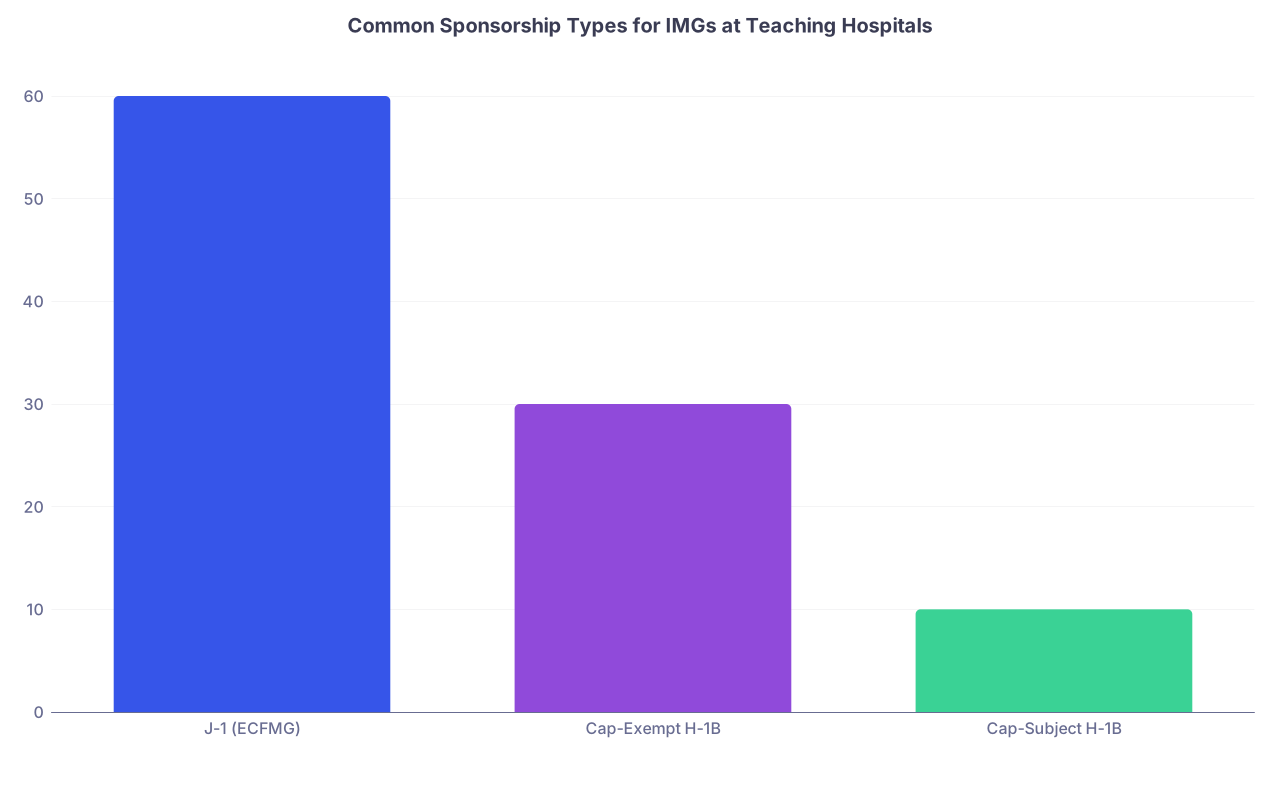
| Category | Value |
|---|---|
| J-1 (ECFMG) | 60 |
| Cap-Exempt H-1B | 30 |
| Cap-Subject H-1B | 10 |
Here is the actual playbook I see repeatedly across academic centers:
Pathway 1: Direct Employment by a University Hospital
This is the simplest and strongest case.
Scenario:
You match into Internal Medicine at “University Medical Center,” which is literally owned and operated by “ABC University.”
- Employer on your contract: “ABC University” or “ABC University Hospitals”
- Entity is clearly part of an institution of higher education
- H-1B petitions are straightforwardly cap-exempt
These systems almost always have in-house or dedicated immigration counsel. They know what they are doing. If they tell you “we do H-1B,” they mean cap-exempt.
Red flags? Almost none here, except occasionally:
- Very rigid start dates (H-1B not approved in time)
- Limited willingness to extend beyond the training period
Pathway 2: Nonprofit Teaching Hospital with University Affiliation
This is the classic situation for community-based but university-affiliated programs.
Example:
“St. Mary’s Hospital” is a standalone 501(c)(3) nonprofit. It sponsors a Family Medicine residency through an affiliation with “State University School of Medicine.”
How they qualify:
- They have a signed academic affiliation agreement with the med school
- Their residency program is ACGME-accredited with the university as sponsoring institution or clear educational partner
- The hospital uses that agreement to claim cap-exempt H-1B status for residents and fellows
This is where things get messy between institutions.
Some hospitals have rock-solid documentation and decades of history using cap-exempt H-1B. They rarely get RFEs. Others technically are teaching sites, but their paperwork is flimsy, and USCIS sometimes pushes back.
If you are considering an H-1B route, you want to know which one you are dealing with.
Pathway 3: “Concurrent” Employment — The Hybrid Fix
This is the trick that many IMGs never hear about until they are stuck.
Even if a hospital itself is not cap-exempt, you can sometimes still obtain cap-exempt H-1B by arranging concurrent employment with a qualifying university or affiliated entity.
Mechanically, it looks like this:
- Primary job (e.g., hospitalist) at a private, cap-subject hospital
- Secondary appointment (e.g., 5–10% effort) at a university or its cap-exempt affiliate where you:
- Teach residents or medical students
- Supervise clinics
- Participate in academic activities
Then:
- The university (cap-exempt employer) files a cap-exempt H-1B petition for your secondary appointment
- Once that is approved, your cap-subject hospital can file a concurrent H-1B petition, also treated as cap-exempt because of your existing exempt role
This is completely legal when structured correctly, but it requires:
- A university willing to put you on payroll (even minimal)
- Immigration counsel who understands concurrent cap-exempt H-1B strategy
- A private hospital that agrees to work with that setup
This is much more common at the attending level than at the residency level, but it can matter for senior fellows stepping into almost-attending roles.
4. What Your Job Must Look Like for Cap-Exempt H-1B
Another misconception: people think only “professors” or research-heavy positions qualify. That is wrong.
USCIS does not require that your entire day be teaching or research. But there must be a clear nexus between your clinical duties and the academic mission of the affiliated university.
For residency and fellowship positions, this is usually easy:
- You are training in an ACGME-accredited program
- You are explicitly part of the university’s GME structure
- You participate in teaching, conferences, and sometimes student supervision
Your petition will often frame your role as “Clinical Resident / Fellow Physician” participating in patient care and educational activities in a teaching environment tied to the med school.
For attending positions at teaching hospitals:
- Job description will highlight:
- Supervision of residents/fellows
- Teaching at conferences, didactics, bedside rounding
- Participation in clinical research or quality improvement
If your offer letter looks like this — “outpatient-only, no teaching, independent private practice in a regionally affiliated hospital” — good luck arguing cap-exemption. That is where USCIS starts asking: how exactly is this job tied to the university?
5. How This Intersects with Match, Timing, and Visa Strategy
Now let us connect this to what you actually care about: matching and starting residency on time on the right visa.
5.1 J-1 vs H-1B at Teaching Hospitals
Most university-affiliated hospitals are happy to sponsor J-1 (via ECFMG). Many are far more conservative about H-1B.
Why?
- J-1 risk is offloaded to ECFMG
- H-1B requires Prevailing Wage, LCA, institutional salary attestations
- H-1B is more complex to manage with moonlighting and outside activities
Typical pattern I see across major academic centers:
- Big-name IM programs (e.g., university flagships): J-1 default, H-1B selectively for highly competitive applicants or subspecialty tracks
- Some community-university hybrids: either J-1 only or H-1B for a limited number of residents each year
- Certain surgical and procedural subspecialties: often prefer H-1B for fellows who are staying in the U.S. long-term
You cannot “force” a program to file H-1B, even if they are clearly cap-exempt. It is a policy choice.
5.2 Timeline Reality for PGY-1 H-1B
The H-1B timeline is not forgiving for July 1 starts.
Basic path for cap-exempt H-1B for an incoming PGY-1:
- Match Day in March
- Graduate med school / ECFMG certificate ready by late spring
- Hospital’s lawyers:
- Obtain Prevailing Wage (if needed) or verify wage compliance
- File LCA (7+ days)
- Prepare and file H-1B petition with premium processing
- USCIS approval ideally by mid-late June
- Visa stamping at consulate, travel, onboarding
Problems I have repeatedly seen:
- Applicant delays document submission (degree, ECFMG cert)
- Hospital drags its feet or waits for all foreign grads to be identified
- Premium processing not used or delayed
- Consulate appointments backed up
Result: late arrival, emergency B-1 in lieu of H-1B patch (sometimes used), or forced change to J-1.
If you are serious about H-1B as a PGY-1, you must:
- Ask programs explicitly during interview season:
- “Do you sponsor cap-exempt H-1B for incoming residents?”
- “How many new H-1Bs did you sponsor last year?”
- “Do you use premium processing for residents?”
- Have all your documents lined up early (degree, ECFMG, translations)
And yes, some programs will quietly down-rank you if you “insist” on H-1B when their default is J-1. You need to read the room.
6. Cap-Exempt Now, Cap-Subject Later: The Hidden Trap

Let me be blunt: cap-exempt H-1B is excellent for residency and fellowship. It is far less comfortable when you are trying to transition to private practice or a non-university job.
Here is why.
6.1 Two Separate “H-1B Worlds”
Cap-exempt H-1B:
- Employers: universities, nonprofit teaching hospitals, research institutes
- Can file anytime, no annual lottery
Cap-subject H-1B:
- Employers: most private groups, non-teaching hospitals, large private hospital systems without qualifying affiliation
- Must go through the April 1 lottery for an October 1 start
If your first H-1B status is obtained through a cap-exempt employer, you have not been “counted against the cap.” You are still cap-subject if you ever move to a non-exempt employer.
So the IMG story often looks like this:
- PGY-1 to PGY-3 on cap-exempt H-1B at a teaching hospital
- Cardiology fellowship PGY-4 to PGY-6, also cap-exempt
- Job offer from a private cardiology group at a non-teaching hospital
Now:
- You cannot just “transfer” your H-1B from cap-exempt to cap-subject. That is not how it works.
- The private employer must either:
- Win the H-1B lottery and get a cap-subject H-1B, or
- Use concurrent H-1B with a cap-exempt partner (if they can engineer it)
This catches many people by surprise in the final year of fellowship.
6.2 Strategic Consequences
If your long-term goal is:
- Staying permanently in academia → cap-exempt H-1B fits perfectly; you may never need the lottery.
- Working in underserved or university-affiliated safety-net systems → many of those are also cap-exempt; still fine.
- Joining a high-income private group, procedural-heavy specialty, or purely private hospital → you likely will need to win the H-1B lottery at some point unless you get a green card first.
A few real-world patterns I have seen:
- Some fellows try to move to a cap-subject job and lose the lottery two years straight → forced to stay in cap-exempt roles longer or pivot back to academia.
- Others coordinate with a university to create a concurrent clinical-educator role so that their private practice job rides on a cap-exempt foundation. That requires serious institutional cooperation.
Plan early. Do not wait until the last year of fellowship to understand this.
7. Teaching Hospitals That Look Academic But Are Not Cap-Exempt
This one burns people.
Not every hospital with residents and students is safely cap-exempt. There are a few tricky categories:
7.1 For-Profit Teaching Hospitals
Some large for-profit systems run residency programs with medical school affiliations. They can be fantastic for training.
But for immigration purposes:
- They are not nonprofit
- They may not qualify under the “related or affiliated nonprofit” category
- They often cannot claim cap-exempt H-1B, even with residents and ACGME programs
Result: they default heavily to J-1 for IMGs. H-1B, if used at all, is often cap-subject (lottery) and usually for attendings, not residents.
7.2 Nonprofit Hospitals with Weak or Indirect Affiliations
Example patterns I have actually seen in RFEs:
- Hospital shows a vague “clinical rotation agreement” for med students that only mentions short-term rotations, no integrated academic mission
- Affiliation is between the university and a different corporate entity in the same health system, not the actual entity employing you
- The hospital uses an expired or unsigned agreement to prove affiliation
In these cases, USCIS sometimes says: not enough, denied as cap-exempt. Then the hospital is stuck — either refile as cap-subject (too late for your July start) or switch you to J-1.
This is why asking, “Do you sponsor H-1B?” is not enough. The better question:
- “Has your program successfully sponsored cap-exempt H-1B for residents/fellows in the last 2–3 years? How many?”
If the answer is vague or hesitant, treat that as a bright red warning.
8. The Documentation Trail You Never See (But Should Understand)

| Step | Description |
|---|---|
| Step 1 | Match at Teaching Hospital |
| Step 2 | Program Confirms H-1B Policy |
| Step 3 | Collect Credentials & ECFMG |
| Step 4 | Prevailing Wage & LCA |
| Step 5 | Prepare H-1B Petition with Affiliation Evidence |
| Step 6 | USCIS Filing (Premium Processing) |
| Step 7 | Consular Visa & Travel |
| Step 8 | Response or Switch to J-1 |
| Step 9 | Start Residency on Cap-Exempt H-1B |
| Step 10 | Approved? |
Let me walk you through the guts of a typical cap-exempt H-1B resident petition. Knowing what exists behind the curtain helps you ask better questions and avoid getting blindsided.
8.1 Core Components
Your hospital’s immigration lawyer is assembling:
- Form I-129 with H-1B supplement
- LCA (Labor Condition Application) filed with DOL
- Evidence of:
- Your medical degree
- ECFMG certification
- License or training license eligibility
- Program description and offer letter
- Proof of cap-exempt employer status:
- IRS 501(c)(3) letter or governmental documentation
- Affiliation agreement with the university
- Sometimes ACGME documentation or GME statements
Where this fails for IMGs:
- ECFMG cert delayed
- Degree documents incomplete or not properly translated
- State training license process slower than expected, making the hospital nervous about H-1B timing
8.2 Your Moves to Reduce Risk
You cannot write the legal brief, but you can:
- Prepare all degree and ECFMG documents early and in clean, clear scans
- Request program policy information before rank list submission if H-1B is important
- When you get an offer, respond quickly to any request from the hospital’s legal or GME office
You are not the main character in the hospital’s life. If you are slow, you become the “problem file.” Do not be that file.
9. Practical Takeaways for IMGs Choosing Between Programs
Let us boil this into actual decisions you will face.
| Program Type | Cap-Exempt H-1B Likelihood | Typical Visa Pattern |
|---|---|---|
| University-owned university hospital | Very high | J-1 default, H-1B possible |
| Nonprofit teaching hospital w/ strong med school affiliation | High | J-1 + some H-1B |
| Community hospital w/ limited academic ties | Variable / Low | Mostly J-1 |
| For-profit teaching hospital | Low | Mostly J-1, rare H-1B |
| Pure private hospital, no teaching | Cap-subject only | H-1B via lottery or none |
If H-1B (especially cap-exempt) is a priority for you:
Favor:
- University hospital programs directly owned by a med school
- Long-established nonprofit teaching hospitals clearly branded as the university’s main teaching site
Ask concrete questions during interviews:
- “How many international residents do you currently have on H-1B?”
- “Have any H-1B petitions for residents been denied in the last few years?”
- “Do you support H-1B for fellowship as well?”
Think long-term:
- If you aim to stay in academia → a string of cap-exempt posts is fine.
- If you aim for private practice → start talking with immigration counsel early about timing for cap-subject H-1B or employment-based green card options (EB-2 NIW, PERM) during training.
FAQ (Exactly 5 Questions)
1. If I start residency on a cap-exempt H-1B, can I later “transfer” to any hospital without the lottery?
No. A cap-exempt H-1B is tied to a cap-exempt employer. You can move freely between cap-exempt employers (e.g., one university hospital to another). The moment you want to move to a cap-subject employer (private hospital, non-teaching system), you must either: win the H-1B lottery or structure a concurrent cap-exempt arrangement. There is no universal “transfer” that makes you cap-free for life unless you were previously counted under the cap with a cap-subject employer.
2. My program says they only sponsor J-1, but they are clearly a big academic center. Are they lying?
Probably not. Being legally eligible to file cap-exempt H-1B does not mean they are willing to. Many large academic programs have made an institutional decision: J-1 only for residents because it is simpler administratively. They may reserve H-1B for fellows or faculty only. You cannot force them to change that, and arguing too hard about it before Match can absolutely hurt you.
3. Can I convert from J-1 to cap-exempt H-1B at the same hospital after a few years?
Not if you are subject to the 2-year home residency requirement (which most J-1 clinical IMGs are). To change to H-1B, you would need a J-1 waiver first (via Conrad 30, IGA, VA, or hardship/persecution). After the waiver is approved, you can move into H-1B — usually for a new job that satisfies the waiver terms, often in an underserved area. Straight conversion in-place without a waiver is not possible.
4. My fellowship offer is at a nonprofit hospital that says they use cap-exempt H-1B, but my residency H-1B was filed by a different university hospital. Is that a problem?
No, that is normal. You can hold successive cap-exempt H-1Bs with different cap-exempt employers. Each employer files its own petition. There is no limit on the number of cap-exempt H-1B roles you can string together, as long as each employer independently qualifies (nonprofit/government + valid university affiliation).
5. Does having a cap-exempt H-1B make it easier to get a green card later?
Not directly. Cap-exempt vs cap-subject is about H-1B quotas, not green card eligibility. However, cap-exempt jobs are often in academic or research settings that align well with EB-2 NIW (national interest waiver) or EB-1 (outstanding researcher / extraordinary ability) categories. On the flip side, if you stay only in cap-exempt roles at low-paying positions without research or major achievements, you might have fewer arguments for those faster categories. The visa type does not decide the green card; your achievements and employer sponsorship strategy do.
Key points:
- You are not inherently cap-exempt; your employer either is or is not, based on nonprofit status and a real, documented academic affiliation.
- Cap-exempt H-1B is excellent for training in teaching hospitals but does not magically solve later moves into private practice, where the cap and lottery reappear.
- Smart IMGs ask precise questions about H-1B sponsorship before ranking programs and build a long-term plan that connects residency, fellowship, and eventual employment into one coherent immigration strategy.