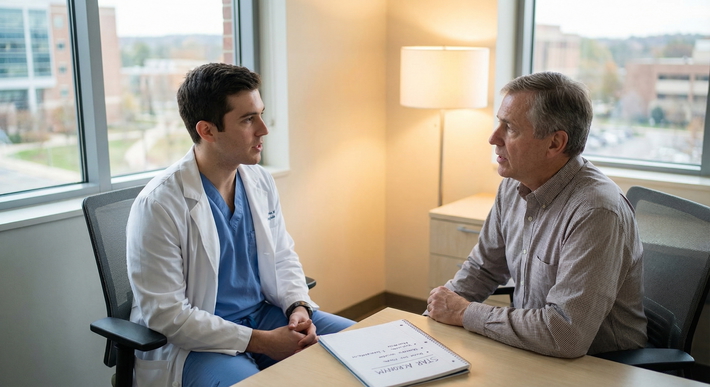
You should absolutely talk about medical errors in your residency interview. Just not the serious one you're thinking of.
That's the trap everyone falls into. You think total honesty about your worst moment will prove maturity. Program directors think they just met a liability risk.
This is for educational purposes only and is not legal advice. It is also not financial advice and not tax advice. Figures vary and every situation is different, so consult a qualified professional before discussing any case with potential legal implications.
For further guidance on navigating self-disclosure, read more about the truth about vulnerability in behavioral interview responses.
The Short Answer: To Share or Not to Share
Avoiding accountability is a red flag. Oversharing accountability is career suicide. You have to live in the middle.
Program directors ask about mistakes for one reason: can I trust you when you inevitably mess up on my watch? They are not looking for technical perfection. They've all missed something. They've all written the wrong dose, called the wrong consult, stayed silent when they should have spoken up.
Here's the distinction that matters:
To refine your approach, review these tips on mastering behavioral interviews common mistakes to avoid in medicine.
A systemic failure or near miss: You caught the heparin dosing error because you double-checked the pump. The lab result almost got missed because the handoff was chaotic. This is gold for interviews.
A minor, resolved misstep: You forgot to order DVT prophylaxis, realized it on rounds, corrected it immediately, no harm done. Also excellent. Shows vigilance.
A catastrophic, negligent, or litigated error: Wrong-site procedure, massive harm, active M&M with lawyers involved, a death where you were directly responsible. Never. Ever. Bring this to an interview.
I've seen applicants torpedo a top-10 rank because they wanted to show "vulnerability" and described a HIPAA violation that led to a patient complaint. The interviewer wasn't moved. The interviewer wrote: "Judgment concerns." Game over.
You want to show responsibility without handing them a reason to rank you last.
The Decision Framework: When a Medical Error is Interview-Appropriate
Stop choosing the story that still keeps you up at night. Choose the story that shows growth without needing a root cause analysis.
My rule: If you have to ask your risk management office if you can talk about it, you can't talk about it.
Use this filter:
1. The Near Miss Strategy is king. Whenever possible, pick an error where harm was prevented. "I almost administered..." is infinitely safer than "I administered and harmed..." You still show ownership, situational awareness, and a fix. No patient privacy issues. No legal exposure.
2. If you must use an actual harm event, it has to pass three checks:
- Non-catastrophic and non-permanent. The patient recovered fully.
- You resolved it immediately and yourself. You escalated, disclosed to the attending, told the patient/family with supervision.
- The lesson is transferable. Not just "I will never do that again," but something you actually changed about how you practice.
3. Red lines. Do not cross these:
- Active or potential litigation. Even hinting at it is an automatic fail.
- Anything with identifiable patient information. No names, dates, MRNs, rare diagnoses. "A 68-year-old male in the MICU" is enough.
- Stories where you blame the nurse, the attending, the EMR, the system, and you are the hero. That's not accountability. That's immaturity on display.
If your only error stories are in the red zone, don't use an error at all. Pivot to a different behavioral question about a time you received difficult feedback, or a time you had to speak up. It's smarter to not answer the exact error prompt than to answer it badly.
Anatomy of a High-Yield Response: The STAR Method for Mistakes
Program directors have short attention spans during behavioral interviews. They want structure. Don't ramble through clinical minutiae. Use STAR, but weighted correctly.
Most applicants spend 70% on Situation. Flip it. Spend 70% on Action and Result.
S - Situation & Task: 20 seconds. Brutally brief.
No jargon dump. No 5-minute history of present illness. Give context and your role.
Bad: "So the patient was a 54-year-old female with a history of CHF exacerbation, CKD stage 3, diabetes, admitted for shortness of breath, her creatinine was trending..."
Good: "During my ICU month as a sub-I, I was responsible for pre-rounding on two patients and entering daily labs into our sign-out sheet before rounds."
That's it. Done.
A - Action: This is the interview. Show ownership.
This is where you prove you're not defensive. What did you actually do in the moment you realized?
Say: I noticed. I stopped. I told my senior immediately. I disclosed to the team. I apologized to the patient with my attending present. I stayed late to fix it.
Don't say: "The system is flawed" or "I was tired because we'd been on call 28 hours." Even if true. Save it for your friends. In the interview, it's all "I."
Here's a real example I coached: A student missed that potassium had been repleted twice and it was now 6.1. Instead of "The EMR is confusing," she said: "I had chart-checked quickly and didn't verify the repletion history. When I saw the repeat BMP, I immediately held the next dose, notified my senior, rechecked an EKG, and we treated it. I told the patient what happened."

R - Result: Prove it changed you and the system.
This is what separates a forgettable answer from a rank-to-the-top answer.
Personal growth is expected: "Now I have a hard-stop checklist for all electrolytes before rounds."
System growth is exceptional: "I brought it up at our resident QI meeting. We added a column for last repletion to our sign-out template. My attending now uses that template for all students."
You went from making a mistake to improving the unit. That's resilience, humility, and leadership in 45 seconds.
Comparative Analysis: Good vs. Bad Error Narratives
Program directors aren't scoring your story. They're scoring your framing. The same error can sound like a liability or like a future chief resident.
The Defensive Answer (What not to do):
"I was on a really busy surgery service and the intern told me to discharge a patient, but the patient hadn't voided. I thought the intern should have checked. The patient ended up with urinary retention and had to come back to the ED. It wasn't really my fault, I was just following orders, but I guess I learned to double-check interns."
What they hear: Blame-shifting. Zero teachability. Will be a nightmare to supervise.
The Accountable Answer (What to do):
"I discharged a patient post-op without confirming voiding, because I was rushing to finish discharges before rounds. The patient returned with retention and needed re-catheterization. As soon as I heard, I went to the ED to evaluate him with my senior, apologized, and explained what I missed. It taught me my tell, when I rush, I cut corners. Now I use a 3-item discharge checklist even when I'm slammed, and I've shared it with our junior clerks."
What they hear: Self-aware. Honest. Takes ownership. Fixable and actually teachable.
And please, avoid the humble-brag. "My biggest error was caring TOO much and staying late to double-check labs so I burned out." No one believes that. It signals you don't have real insight.
The data is made up. The bias is real. Interviewers trust accountable framers far more, even for the exact same clinical error.
Practical Guidance and Next Steps
Don't walk into an interview with an untested error story. That's how you ramble, get emotional, or accidentally disclose too much.
1. Rehearse with the right mentor. Not your best friend. Find an attending who has sat on a selection committee. Run your 90-second narrative by them and ask one question: "Would you be worried having me on your service after hearing that?" If they hesitate, rewrite.
2. Final checklist before you use any error story:
- Can I tell this without violating HIPAA?
- Is any part of this in litigation or peer review?
- Did I use "I" more than "they"?
- Does the patient ultimately have a good outcome?
- Did I spend more time on the fix than the mistake?
- Can I explain what I do differently now in one sentence?
If any answer is no, pick a different story.
3. Build a portfolio, not a single story. You need three behavioral stories ready: one near miss, one communication failure, one feedback moment. That way you're never forced to use your worst case when asked.

You will make errors in residency. Big ones. The interview isn't about proving you won't. It's about proving you're safe when you do.
So don't bring your darkest case to get emotional points. Bring your smartest small case to prove you're thoughtful, coachable, and system-minded.
Pick your near miss. Structure it tight. End with the checklist you now live by. Then stop talking.
Want help pressure-testing your story? Run it through that flowchart, cut it to 90 seconds, and record yourself. If it sounds calm, owned, and forward-looking, you're ready.