
42% of program directors say “self-awareness” is a top interview factor—yet most applicants actively hide anything that sounds like a flaw.
You feel that tension, right? Behavioral questions are literally designed to expose how you think, react, and recover when you are not perfect. But premed and med school culture has trained you to present flawless narratives with tidy hero endings. Those two things do not mix.
Let me be blunt: the way vulnerability is preached in blogs, coaching services, and Reddit threads is wrong for residency interviews. “Just be yourself.” “Share your biggest weakness.” “Open up emotionally.” That’s how you turn a solid profile into a confusing risk.
Here’s what vulnerability in behavioral interviewing actually does, how programs interpret it, and how to use it strategically instead of self-sabotaging in the most important 20–30 minutes of your career.
What Programs Actually Care About (Not Your Therapy Journey)
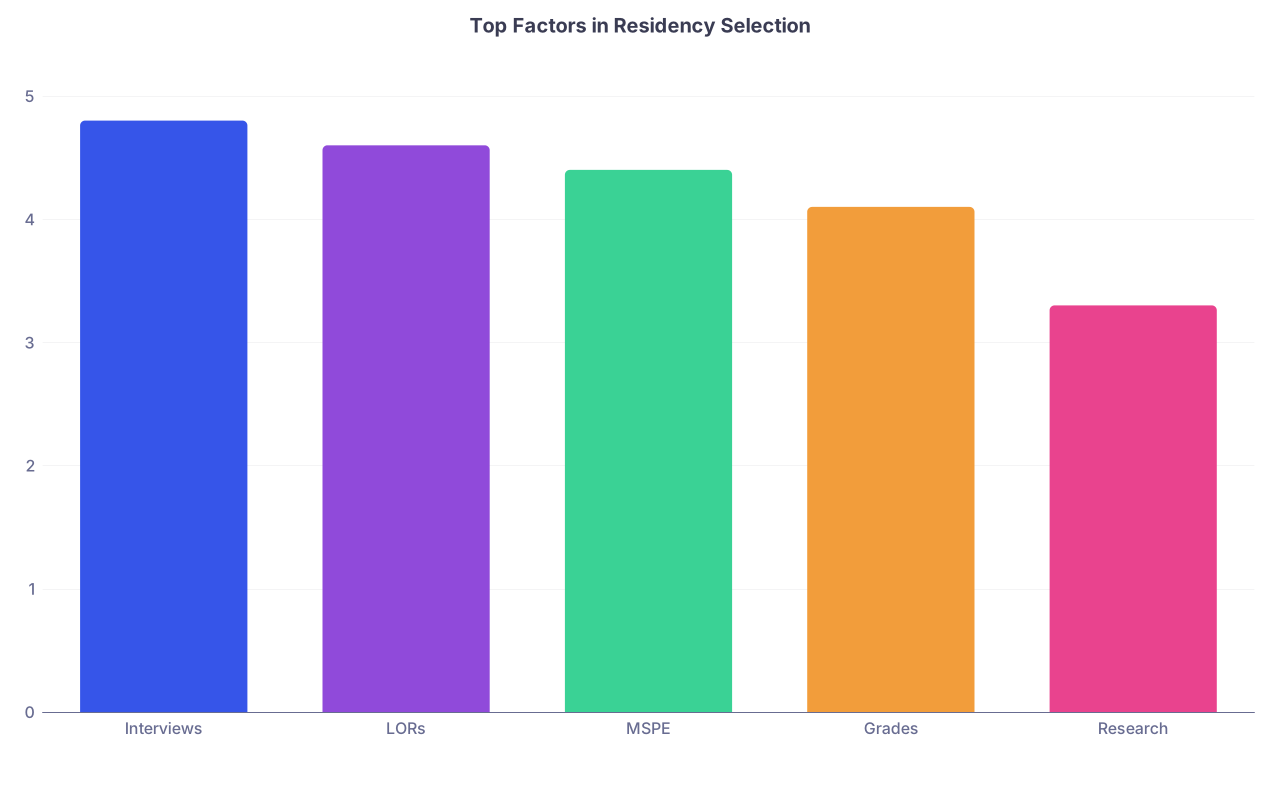
| Category | Value |
|---|---|
| Interviews | 4.8 |
| LORs | 4.6 |
| MSPE | 4.4 |
| Grades | 4.1 |
| Research | 3.3 |
Look at the NRMP Program Director Survey. Across specialties, interview performance is consistently at or near the top for deciding how to rank you. But “performance” does not mean “how touching your vulnerability monologue was.”
When you answer behavioral questions (“Tell me about a time you made a mistake,” “Describe a conflict with a colleague,” “Tell me about a time you were overwhelmed”), programs are screening you for:
- Judgment
- Accountability
- Learning and course correction
- Predictability under stress
- Risk of professionalism problems or burnout drama
I’ve sat in post-interview debriefs where someone said:
- “She was very open, but I have no idea if she actually learned anything.”
- “He told us three sad stories and never once took responsibility.”
- “That was… a lot. Feels unstable.”
Too much raw “vulnerability” without direction doesn’t read as mature. It reads as uncontrolled.
Programs are not asking these questions to see if you’re “authentic.” They’re trying to confirm one thing: If I put this person on nights with a sinking census and a grumpy nurse, are they going to handle it… or become another problem?
So the myth that “being vulnerable = being authentic = you’ll be loved for it” is half-true at best. The missing half? You need structure, boundaries, and a clear upward arc.
The Myths About Vulnerability in Interviews
Let’s kill a few popular myths fast.
Myth 1: “You should share your deepest struggles to stand out.”
No. Absolutely not.
You’re not on a podcast. You’re in a risk assessment.
Interviewers are trying to predict:
- Will you show up?
- Will you work hard without constant supervision?
- Will you implode in PGY-2 when life hits hard?
If the main takeaway from your “vulnerable” answer is that your life is barely stitched together, you will not get points for honesty. You’ll just get ranked lower.
Vulnerability is not the depth of how broken you’ve been. It’s the clarity with which you can:
- Name a real problem
- Own your role
- Show how you systematically improved
If your moment of “honesty” requires interviewers to do emotional labor (comfort you, reassure you, or decode a messy story), you miscalibrated.
Myth 2: “Never show weakness; always spin everything as a strength.”
Also wrong.
The research on interviews—both in medicine and corporate HR—is consistent: over-polished, zero-flaw personas are rated as less trustworthy and less credible. Program directors are physicians; they’ve watched thousands of humans fail in predictable ways. They know you’ve screwed up.
When someone answers “What’s a weakness of yours?” with, “Sometimes I work too hard and care too much,” everybody in the room silently downgrades them. You didn’t just dodge the question; you showed poor judgment and a lack of self-awareness.
The sweet spot is: specific, bounded weakness + evidence of real improvement.
Myth 3: “If you cry, they’ll see how much you care.”
You know who usually cries in interviews? People who are already running on fumes. Sometimes with genuinely tragic stories. I’ve seen interviewers respond with empathy—and then quietly say later, “I worry this person is at high risk for burning out.”
Crying is not an automatic fail. But if your emotional regulation looks shaky in a 20-minute, scheduled, one-on-one conversation, they will absolutely wonder how you’ll handle a crashing patient plus three admits at 2 a.m.
Caring is shown far better through how you talk about your team, your patients, and your mistakes—calmly and with perspective—than through tears.
What “Healthy Vulnerability” Actually Looks Like

Forget the fluff. In residency behavioral interviews, vulnerability has three jobs:
- Demonstrate accurate self-assessment
- Show you can tolerate discomfort and feedback without collapsing or getting defensive
- Prove you actually change your behavior based on that feedback
Here’s the structure that works consistently well.
1. Choose the right kind of example
Good vulnerability topics:
- A real clinical mistake (bounded, no catastrophic harm)
- A conflict with a colleague where you contributed to the problem
- A time feedback hit hard and you initially reacted poorly but recovered
- A period of overwhelm where you built better systems or sought support appropriately
Bad vulnerability topics:
- Unresolved, active crises (current severe mental health crisis, untreated substance use, ongoing professionalism investigation—these need care, not interview airtime)
- Highly charged interpersonal drama (“My co-resident was toxic, my attending was abusive, my school was out to get me”)
- Vague, cliché flaws without behavior (“I’m a perfectionist,” “I care too much,” “I get imposter syndrome”)
If you wouldn’t be comfortable with that story summarized in one sentence on a rank meeting slide (“Had documentation error, owned it, now triple-checks notes”), don’t use it.
2. Use a tight, adult version of STAR
STAR is everywhere, but people butcher it into a 5-minute ramble. You want: 60–120 seconds, max.
- Situation – 1–2 lines
- Task – what your role actually was
- Action – what you did, including what you did wrong
- Result – outcome plus what changed in your behavior afterward
Notice the twist: vulnerability is not about how bad the situation was. It’s about how clearly and calmly you can narrate your role in it.
Example for “Tell me about a time you made a mistake”:
- Situation: “On my medicine sub-I, I was covering a patient with CHF and CKD.”
- Task: “I was responsible for adjusting diuretics and monitoring labs overnight.”
- Action: “I misread the prior note, thought the creatinine trend was stable, and increased the furosemide dose without clarifying with my resident. The next morning creatinine had bumped more than expected. I immediately told my resident, we re-evaluated volume status, adjusted the meds, and monitored closely. No lasting harm, but it was a real scare for me.”
- Result: “Since then, I’ve built a rule for myself: any med change on a borderline kidney patient requires me to look at graph trends, not just yesterday’s number, and confirm the plan with a senior if there’s any ambiguity. I also started keeping a short checklist in my progress notes. I haven’t repeated that mistake, and it’s made my notes and sign-outs tighter.”
That’s vulnerability. Real mistake. Clear ownership. Concrete behavioral change.
3. Show both emotion and control
Emotionless robots don’t do well in interviews. But neither do people who seem flooded.
The tone you’re aiming for:
- “This bothered me, I take it seriously, and I can talk about it clearly now.”
You can say things like:
- “I was embarrassed.”
- “I felt defensive at first.”
- “I was anxious for days about that patient.”
Then pivot quickly to, “Here’s what I did with that emotion.”
That’s what reads as maturity.
Common Questions Where Vulnerability Goes Sideways
| Question Type | Risky Version | Strong Version |
|---|---|---|
| Weakness | Vague, personality label | Specific behavior with fix |
| Conflict | Blame others heavily | Owns share, shows repair |
| Failure | Catastrophic, unresolved | Bounded, with learning |
| Stress | Ongoing meltdown | Shows coping systems |
“What is your greatest weakness?”
Disaster version:
“I’m a perfectionist and I just care too much. I often stay late rechecking everything because I’m anxious my notes aren’t good enough, and sometimes this makes it hard for me to sleep.”
Looks honest? Maybe. Also screams: anxiety-driven, poor boundaries, not under control.
Better:
“One area I’ve had to work on is over-editing my documentation. Earlier in third year, I spent too long polishing notes and then felt rushed on pre-rounding. A chief noticed and gave me direct feedback. Since then, I’ve forced myself to complete a working draft note within a time limit, accept that 90% is ‘good enough,’ and ask seniors what actually matters in our notes. It’s helped me focus more on the patient and less on the formatting.”
You admitted a real flaw. You controlled the risk.
“Tell me about a time you had a conflict with a team member.”
Risky:
“My co-intern was lazy and never did their share. I had to keep confronting them about not doing notes, and eventually I went to the chief because I couldn’t take it anymore.”
This reads as: blames others, might be difficult, might escalate fast.
Stronger:
“On one rotation, I felt like I was taking on more admissions than my co-student. Initially I vented to a friend, which did not help. I realized I hadn’t actually had a direct conversation. I asked my co-student to grab coffee, shared my perspective using specific examples, and asked how they saw it. It turned out they felt slower on notes and were anxious about being judged. We agreed on a clearer way to divide work and checked in weekly. It didn’t become a perfect partnership, but the tension dropped and we finished the month without further issues.”
No heroics. Just adult behavior.
Where Vulnerability Should Be Limited

| Step | Description |
|---|---|
| Step 1 | Behavioral Question |
| Step 2 | Use structured vulnerable story |
| Step 3 | Stick to competence & impact |
| Step 4 | Choose different example |
| Step 5 | Show insight & behavior change |
| Step 6 | About failure/conflict? |
| Step 7 | Active crisis? |
Some topics belong with your therapist, support network, or physician—not in a 15-minute faculty interview.
Be wary of centering your answers on:
Active, untreated mental health crises
Saying, “I’m currently really struggling to get out of bed and have missed a lot of recent responsibilities, but I’m working on it,” is an enormous red flag. Programs are not equipped to parse that safely in an interview setting.Unresolved professional misconduct
If there was a major professionalism or conduct investigation and it’s not clearly resolved and contextualized, this is legally and practically complicated. Do not impulsively “confess” in the name of vulnerability without guidance.Highly charged legal or institutional conflicts
Long stories about how your school wronged you, you fought back, and now you’re in a grievance process—this reads as drama and unpredictability, even if you were right.
You are not obligated to disclose every struggle you’ve experienced. That’s not dishonesty; that’s judgment.
A Simple Calibration Test: The 3-Sentence Rule
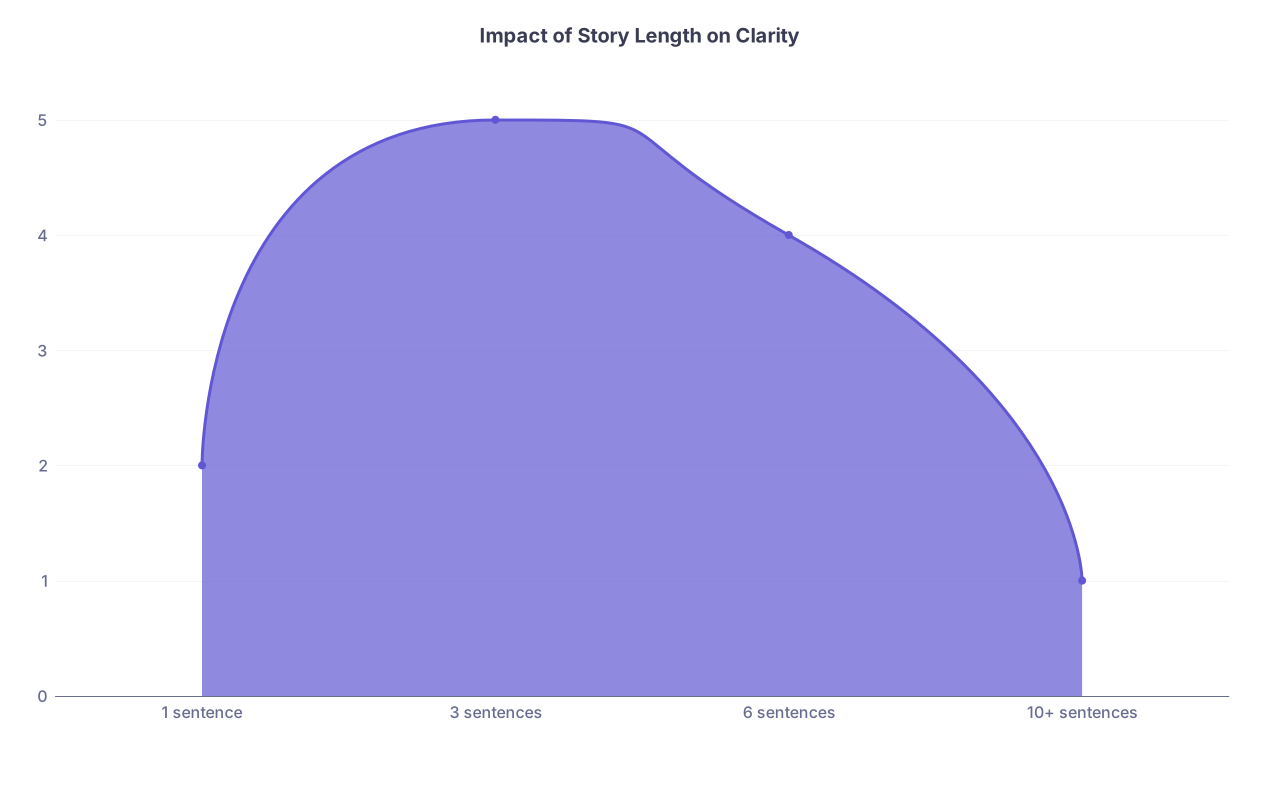
| Category | Value |
|---|---|
| 1 sentence | 2 |
| 3 sentences | 5 |
| 6 sentences | 4 |
| 10+ sentences | 1 |
Try this when practicing:
For any “vulnerable” story you plan to use, distill it into three sentences:
- What went wrong / what you struggled with
- What you did about it
- How you now behave differently
If you cannot say it cleanly in three sentences without sounding like a walking disaster or a vague cliché, you either:
- Picked the wrong story, or
- Don’t have enough distance from it yet
You want the interviewer to think: “That’s a normal human failure handled in an above-average way.” Not: “Wow, that’s a lot,” or “Wait, what actually happened?”
Quick Do/Don’t Checklist

Do:
- Use specific, bounded examples of failure, conflict, or stress.
- Name your own mistakes in plain language.
- Describe your emotional reaction briefly, then pivot to actions.
- Show concrete, behavioral changes you’ve continued over time.
- Keep answers tight: 1–2 minutes max, with a clear arc.
Don’t:
- Trauma-dump or seek emotional validation from the interviewer.
- Over-disclose unresolved crises or legal/institutional issues.
- Blame others as the main point of your story.
- Pretend you have no weaknesses or errors.
- Turn every answer into a TED Talk about your inner journey.
FAQ (Exactly 3 Questions)
1. Should I ever talk about mental health challenges in a residency interview?
Yes, but carefully and only if it’s genuinely relevant and clearly stabilized. Example: “During second year I struggled with depression, sought professional help, adjusted my schedule, and since then I’ve maintained care and consistent performance.” The emphasis must be on effective treatment, insight, and stable functioning—never on active crisis. If you feel unsure, run it by an advisor who knows you and understands your specialty’s culture.
2. How honest should I be about clinical mistakes? Could they think I’m unsafe?
Programs assume you’ve made mistakes. The red flag is not the mistake itself; it’s minimization, blame-shifting, or lack of process change. Pick an error with limited harm, show that you recognized it quickly, escalated appropriately, and built a specific safeguard so it doesn’t happen again. That reads as safer than someone who claims they “haven’t really made any big mistakes.”
3. What if I feel like my life has been pretty smooth—no big failures or dramatic conflicts?
Good. You’re not applying to a reality show. Use smaller, everyday examples: feedback that stung, a miscommunication on a team, a time you dropped the ball on a task, or a situation where your default tendencies (over-preparing, being blunt, avoiding confrontation) backfired. Programs are looking for realistic self-awareness and growth, not a tragic backstory.
Key points: Vulnerability in residency interviews is not about emotional nakedness; it’s about controlled, specific honesty that highlights judgment and growth. Over-sharing active chaos hurts you; hiding all weakness makes you look shallow or evasive. Pick bounded examples, own your role, show concrete change, and stop turning behavioral questions into therapy sessions.