
The idea that “weakness” questions are traps is wrong. They’re lazy, but not malicious—and the evidence shows they’re measuring something very different than what applicants obsess over.
The Myth: “They’re Just Trying to Catch Me”
You’ve heard it in group chats and late‑night Discord vent sessions:
“They only ask ‘what’s your biggest weakness’ to trip you up.” “Never give a real weakness. Use a fake one and spin it.” “Say you’re a perfectionist. Everyone does it.”
This is how you get 20 different applicants in one interview day all answering:
“I’m a perfectionist, so sometimes I work too hard and hold myself to high standards.”
Faculty roll their eyes for a reason.
The uncomfortable truth: programs are not playing 4D chess trying to trick you into confessing that you’re unsafe, lazy, or unprofessional. They’re mostly trying (imperfectly) to answer much simpler questions:
- Can this person reflect on their own behavior?
- Will they respond sanely to feedback?
- Are they going to be a nightmare to remediate if something goes wrong?
And we actually have data—yes, real studies, not Reddit anecdotes—that show what traditional behavioral questions like “weakness” do and do not predict.
What the Evidence Actually Shows About Behavioral Questions
Let’s start with the basics: where does “tell me your biggest weakness” even come from?
From the business world. Behavioral interviewing—“tell me about a time when…” and “describe a weakness”—was imported into medicine from corporate HR with the claim that past behavior predicts future behavior.
The American Association of Medical Colleges (AAMC), NRMP, and multiple specialty organizations have pushed structured and behavioral interviews to try to reduce bias and increase fairness. That includes the dreaded weakness question.
So does it work? Sort of. But not in the neat way applicants imagine.
Reliability: They’re Better Than “So, Tell Me About Yourself”
Meta-analyses in industrial–organizational psychology (e.g., Schmidt & Hunter, 1998; Huffcutt et al., 2013) consistently show:
- Unstructured interviews (freeform conversation, random questions) have mediocre reliability and validity.
- Structured interviews (standardized questions, behavioral prompts) perform significantly better at predicting job performance.
Residency data mirror this. Program director surveys and smaller validation studies show:
- Structured behavioral questions correlate modestly with later resident performance, professionalism ratings, and need for remediation.
- Unstructured “vibes-based” interviews correlate more with likeability and shared background than with actual performance.
So the “weakness” question—when used as part of a structured set—can add something. But here’s the catch: what it adds isn’t what students fear.
Validity: They Are NOT Measuring “How Bad Your Flaw Is”
Most applicants think the content of the weakness is what matters. That’s not what the research or faculty behavior suggests.
Several studies of selection interviews (including healthcare training programs) show:
- Interviewers often can’t recall the specific content of weaknesses later.
- What they remember is:
- Whether the answer sounded honest vs. obviously canned.
- Whether the applicant showed insight and a plan.
- Whether the applicant got defensive, evasive, or blamed others.
In other words, the “weakness” itself is not the point. Your relationship to it is.
Programs care less about whether you struggle with saying no or with speaking up in a crowd—and more about whether you:
- Recognize it.
- Can describe it clearly.
- Are already doing something specific about it.
- Can talk about it without collapsing or becoming combative.
The evidence from professionalism and remediation literature backs this up: the biggest predictor of long‑term distress isn’t having flaws. It’s lack of insight, resistance to feedback, and blaming everyone else.
That’s exactly what the weakness question is probing. Clumsily, but still.
What Residency Programs Say They’re Looking For (Not a Guess)
Let’s stop pretending this is mysterious. Program director survey data are public.
| Factor | % Rating as Very Important |
|---|---|
| Perceived professionalism | 94% |
| Ability to work in a team | 90% |
| Interpersonal skills | 88% |
| Interview performance overall | 84% |
| USMLE Step scores (any) | 78% |
Notice what’s not there: “number of weaknesses” or “type of weakness.” They care about professionalism and interpersonal skills. The weakness question is just one crude tool to sample those.
When I’ve sat in debrief meetings after interview days, comments sound like:
- “She was honest about struggling with time management and gave a concrete example of what changed. I trust her.”
- “He gave this polished ‘I’m a perfectionist’ nonsense and dodged follow‑ups. I don’t know who he actually is.”
- “He blamed his team for everything in that ‘tell me about a conflict’ answer. Red flag.”
The “trap,” such as it is, is very simple: if you respond like someone who can’t handle reality or feedback, they’ll notice.
That’s not a trick. That’s just them doing baseline screening for people they won’t have to drag through remediation.
The Real Traps (And They’re Not What You Think)
If there’s a trap here, it’s not that they’re hoping you confess a fatal defect. It’s that applicants consistently walk into a few predictable self‑inflicted disasters.
Trap 1: Fake Weaknesses
“Sometimes I care too much.” “I’m such a perfectionist.” “I work too hard and forget to take breaks.”
This sounds “safe.” It’s not. It’s boring, transparent, and signals one of two things:
- You lack insight into your own behavior, or
- You think the interviewer is too naive to notice the spin.
Evidence from selection research is brutal here: impression management that comes off as inauthentic hurts you. You don’t gain points for fluff; you lose trust.
Trap 2: Catastrophic Over‑Sharing
The opposite extreme: full confession booth.
- Admitting to repeated professionalism violations.
- Talking about uncontrolled anger or explosive behavior without any credible remediation.
- Describing ongoing, unmanaged impairment.
Yes, honesty matters. No, you don’t need to blow up your application to prove you’re authentic. The literature on resident selection is clear: serious, ongoing professionalism or safety issues are strong predictors of future problems. If you present yourself as an unsolved risk, they’ll believe you.
There’s a middle ground: real but bounded.
Trap 3: Blame‑Shifting
This one kills you faster than the content of the weakness.
If your answer sounds like:
- “My weakness is I sometimes care too much, and my team doesn’t match my standards.”
- “I get frustrated when others are incompetent.”
- “I struggle when attendings are disorganized.”
What they hear:
- You externalize.
- You lack humility.
- You’re going to be “that resident” who writes scathing emails about everyone else.
No program wants the constant complainer who needs a weekly meeting with the PD because “no one understands how right I am.”
Trap 4: No Growth Arc
Another common pattern: you name a plausible weakness, then… nothing.
“I struggle with time management.”
And then you stop. Or you offer one vague throwaway: “So I’m working on it.”
This is where the evidence from competency‑based medical education intersects with interviewing: programs want growth‑oriented trainees. People who can identify a gap, try something, observe the result, and iterate.
No growth arc → no reassurance you’ll get better at anything.
What a Strong Answer Actually Signals (Backed by Data)
Let’s translate this to what we know from evaluation research.
Assessment folks talk constantly about:
- Insight – Do you perceive your own strengths/limitations accurately?
- Responsiveness to feedback – Do you adjust behavior after feedback?
- Growth orientation – Do you see skills as improvable with effort?
These attributes correlate with better performance, fewer remediation needs, and lower burnout risk. So interviewers are hunting for early signs of them.
A strong weakness answer, therefore, isn’t about flaw minimization. It’s about demonstrating these three things in about 60–90 seconds:
- You can name a behavior clearly and specifically.
- You can place it in context (not global self‑loathing, not total denial).
- You’ve already run at least one experiment to improve it.
Here’s what that looks like in practice.
Example of a Weak (But Very Common) Answer
“My biggest weakness is that I’m a perfectionist. I hold myself to very high standards, so sometimes it takes me longer to finish notes or I spend too much time double‑checking things. I’m working on finding balance.”
It sounds polished. It says nothing.
Example of a Strong, Evidence‑Aligned Answer
“My consistent weakness has been over‑preparing and not delegating enough when I’m stressed.
On my sub‑I in medicine, I realized that when the service got busy, my instinct was to try to personally control everything—calling every consultant myself, rewriting interns’ notes, triple‑checking every lab. It came from a good place, but my seniors pointed out that I was actually slowing the team down and burning myself out.
Since then I’ve been working on two things: first, being explicit about roles at the start of the day—who’s doing what, what I actually need to touch vs. just supervise. Second, I set a time limit for certain tasks, like pre‑rounding or note‑editing, and force myself to stick to it unless there’s a safety issue.
It’s still a tendency under pressure, but compared to the start of fourth year I’m much better at asking, ‘Does this need me or does this just need to get done?’ and trusting the team.”
What does this answer signal?
- Insight into a behavior pattern, not vague trait.
- Prior feedback accepted, not fought.
- Specific changes tested.
- Ongoing but improving issue.
That’s exactly the kind of growth‑orientation the competency crowd loves, and interviewers (consciously or not) are trained to reward.
What the Numbers Say About Over‑Optimizing This
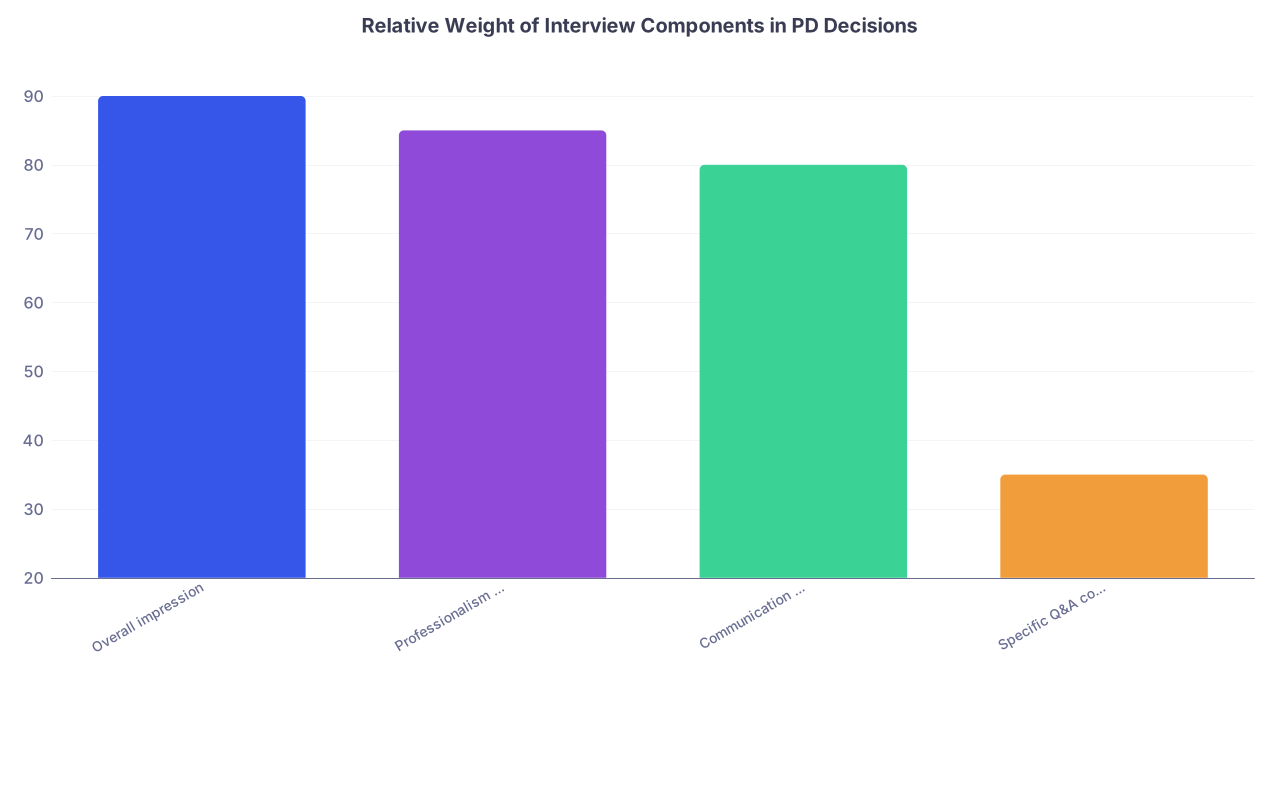
Let’s zoom out. Applicants massively overestimate the impact of one behavioral question.
From NRMP and specialty‑specific program director surveys:
- Interview performance as a whole matters a lot.
- One particular question? Almost never decisive.
| Category | Value |
|---|---|
| Overall impression | 90 |
| Professionalism concerns | 85 |
| Communication skills | 80 |
| Specific Q&A content | 35 |
Program directors care if:
- You had a professionalism red flag in the interview (disrespectful, evasive, arrogant).
- You couldn’t communicate clearly.
- You presented as inflexible or unteachable.
The specific wording of your weakness is a minor detail unless it reveals something bigger. That’s what you should optimize: not clever phrasing, but underlying attitude.
How to Prepare Without Turning Into a Robot
You don’t need a script. You do need a framework.
Step 1: Pick a Real, Bounded Weakness
Avoid:
- Anything directly implicating patient safety that isn’t clearly resolved (e.g., “I zone out during long cases”).
- Anything that sounds like “I hate people” (e.g., “I don’t like working in teams.”)
- The overused humble‑brag clichés.
Solid, realistic areas many trainees work on:
- Time‑boxing tasks / note efficiency.
- Delegating and not over‑controlling.
- Speaking up in large groups.
- Asking for help earlier instead of trying to fix everything solo.
- Prioritizing when there’s too much to do.
Step 2: Attach It to a Concrete Anecdote
Not a 5‑minute story. Just enough context to prove this is real, not manufactured.
- Where did you notice this?
- Who gave you feedback (if anyone)?
- What was at stake?
Step 3: Show the Intervention and Result
This is where most answers collapse. Be specific.
Bad: “So I worked on my time management.”
Better: “I started pre‑charting with a strict 10‑minute limit per patient and forced myself to leave incomplete sections for later rather than going down every rabbit hole. My pre‑rounding went from 2 hours to about 1 hour without missing key issues, and my attending specifically commented that I’d become more efficient.”
That’s the kind of behavioral detail program faculty trust.
Step 4: End with Trajectory, Not Perfection
You’re not done. You’re improving. That’s the point.
That might sound like:
“It’s still my default under stress, but now I catch it earlier and I’m more comfortable asking, ‘What actually needs my level of attention here?’ I expect this will keep evolving in residency as my responsibilities grow.”
Notice: no desperate insistence that “it’s totally fixed now.” That’s not credible. Growth is.
Why This Matters More in Residency Than Med School
Residency is different from med school in one crucial way: your weaknesses now affect other people—interns, students, nurses, and a lot more patients.
Program directors are on the hook for:
- Graduating safe, competent physicians.
- Not burning out their current residents dealing with one colleague’s chaos.
- Not ending up in endless remediation meetings with someone who refuses to change.
So they’re scanning for early warning signs of high‑risk patterns:
- Zero insight.
- Chronic defensiveness.
- Fragility in the face of mild criticism.
- Blame‑shifting and entitlement.
The “weakness” question is just a cheap stress test of those traits. It is not a morality play or a sting operation.

| Step | Description |
|---|---|
| Step 1 | Weakness Answer |
| Step 2 | Low Insight / Inauthentic |
| Step 3 | Blame-Shifting Risk |
| Step 4 | Passive / Fixed Mindset |
| Step 5 | Growth-Oriented, Teachable |
| Step 6 | Real & Specific? |
| Step 7 | Blames Others? |
| Step 8 | Has Plan to Improve? |
You want to land in H. Not by being clever. By being actually reflective.
Stop Playing Defense Against an Imaginary Enemy
The ironic thing: the more you approach this like a trap, the worse you perform.
- You over‑script.
- You sound robotic.
- You dodge follow‑up questions.
- You leak anxiety.
Interviewers aren’t CIA interrogators. They’re mostly tired clinicians squeezing interviews between service and charting. They’re not waiting for you to confess your darkest secret. They’re trying to answer:
“Can I imagine this person on our wards at 3 a.m. when things go sideways? Will they own their part, learn, and not implode?”
If your weakness answer helps them say “yes,” you’re fine.

Quick Reality Check: How Hard Should You Work on This?
Don’t spend 10 hours crafting the perfect line. Spend one hour doing real reflection:
- List 3 genuine, workable weaknesses.
- For each, jot 1–2 real situations where it showed up.
- Write down what you actually did—or will credibly do—about it.
- Practice saying it out loud until you can do it without sounding rehearsed.
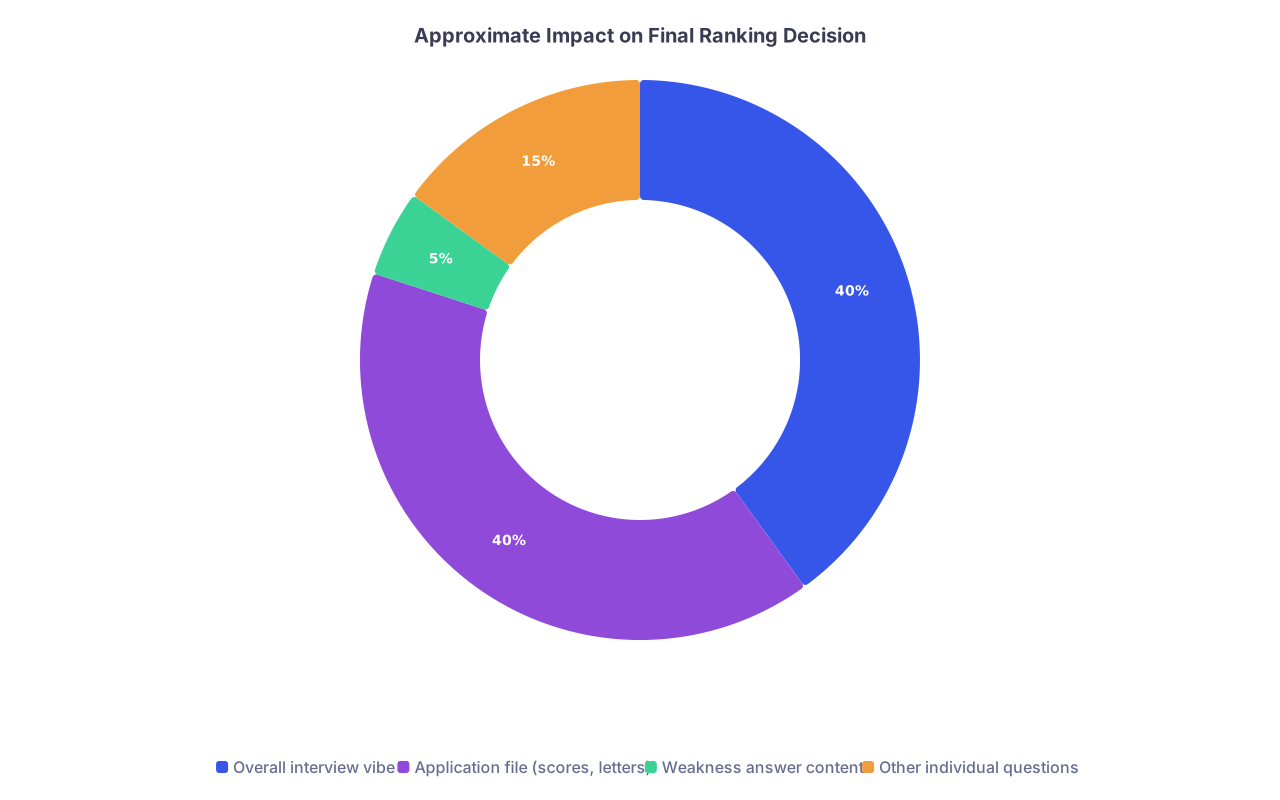
Then move on. Step scores, letters, and the whole interview matter far more than wordsmithing this single answer.
| Category | Value |
|---|---|
| Overall interview vibe | 40 |
| Application file (scores, letters) | 40 |
| Weakness answer content | 5 |
| Other individual questions | 15 |
The Bottom Line
- Weakness questions are not elaborate traps. They’re crude—but useful—tests of insight, teachability, and professionalism, and the evidence from selection research backs that up.
- Interviewers care less about which weakness you pick and far more about whether you own it, contextualize it, and show a believable pattern of improvement.
- Stop trying to outsmart the question. Pick a real, bounded weakness; tie it to a specific example; explain what you did about it; and show that you’re still moving in the right direction. That’s what programs actually reward.