
Myth vs Reality: How Much Your Behavioral Interview Actually Affects Rank
What if the thing you’re obsessing over—crafting the perfect “Tell me about a time you failed” answer—isn’t actually what decides where you land on the rank list?
Everyone tells you the behavioral interview is “critical,” “make or break,” “where they really get to know you.” Sounds dramatic. But when you strip away the folklore and look at data, committee habits, and what programs actually do behind closed doors, the story is a lot less mystical and a lot more… bureaucratic.
Let’s kill the myths and talk about what your behavioral interview really does to your rank. And what it absolutely does not.
What Programs Say vs What They Actually Do
Programs say interviews are crucial. And to be fair, they’re not lying. They’re just not telling you the part where most of the decision is already made before you show up on Zoom or walk into that conference room.
Here’s how it actually plays out in many programs (I’ve seen versions of this at large IM programs, surgical subspecialties, and community hospitals):
- Before interview season even starts, applicants are informally tiered off paper: “High priority,” “standard,” “backup,” “probably reject unless desperate.”
- Interview invites go almost entirely to the top two tiers.
- After interviews, the list gets adjusted—sometimes slightly, sometimes a lot. But almost never from “we’d never rank you” to “top 5.”
The NRMP Program Director Survey backs this up conceptually: programs rate “interview performance” as one of the most important factors for ranking applicants. But that gets misinterpreted constantly.
Important for ranking ≠ the only thing that matters at ranking. It means: once you’re in the pile of people they’re already willing to rank, interviews matter relative to that group.
Your behavioral interview is usually not fighting against your USMLE, your class rank, or that failed year of med school. It’s fighting against the other 15 people who look disturbingly similar to you on paper.
So yes, it matters. But you’re fighting in a small arena, not the entire war.
The Real Role of Behavioral Interviews: Gatekeeper, Not Kingmaker
Programs lean on behavioral interviews for three main things, none of which are the polished “STAR” stories you’ve been rehearsing all month.
They’re trying to answer:
- Will this person be a professionalism problem?
- Will this person be a nightmare to work with at 3 a.m.?
- Do I trust this person with my patients, my reputation, and my existing residents?
Behavioral questions are just a cheap way to probe that. They’re far less about the story content and far more about your patterns: blame, insight, humility, emotional regulation, coherence under stress.
In practice, the behavioral interview tends to do three things to your rank:
- Knock you down or off the list if you show red flags
- Nudge you up within your tier if you click with the culture and seem low-risk
- Leave you mostly where you were if you’re fine but not memorable
Here’s the uncomfortable truth: for at least half of applicants at any one program, behavioral interviews barely move the needle. You came in as “solid mid-rank,” you leave as “solid mid-rank.”
Where they are absolutely lethal: when you trigger “do not rank” discussions.
What Actually Gets You Dropped After Behavioral Interviews
Programs do not tank you for having an imperfect answer or pausing to think. That’s applicant paranoia talking.
They do tank you for repetitive patterns that point to risk. I’ve sat in debriefs where people said things like:
- “Every example he gave ended with ‘but it really wasn’t my fault.’”
- “She got weirdly defensive when I asked about a conflict with a nurse.”
- “He couldn’t give a single honest failure without reframing it as a secret win.”
That’s what kills you. Not stumbling over one answer.
Here’s what commonly moves you to the “do not rank” or “rank at the bottom if we must” bucket:
Obvious blame-shifting in every conflict or mistake story
(“The attending totally overreacted… the nurse exaggerated… the patient just didn’t understand.”)Lack of insight about your own behavior
You describe a major interpersonal eruption and when asked what you’d do differently, you basically say: “Nothing.”Ethical ambiguity
Minimizing charting errors, handwaving consent problems, or joking about “creatively documenting” to protect yourself.Arrogance toward non-physicians
A surprisingly common one. Stories that casually slam nurses, MAs, RTs, or case managers. People remember that.Anger leaking through under mild pressure
You get slightly challenged and your energy changes—voice sharper, posture closed, answers clipped.
Most programs don’t document this in some magical behavioral scorecard. They just come out of the room and say, “No. Absolutely not.” And that’s enough.
This is why the myth “As long as my stats are good, the interview is fine” is nonsense. A poor behavioral interview can absolutely undo years of achievement. Not by bumping you from #5 to #20, but by moving you from “rankable” to “hard no” in a 20-minute window.
When Behavioral Interviews Help You More Than Your Scores
Now the part nobody tells you: the behavioral interview is often more powerful for applicants with merely average or slightly below-average stats.
High-stat applicants usually walk in with a halo. Great scores, top 25 school, AOA. The interview confirms they’re normal humans and they stay near the top. The spread between them is fairly small.
Mid-pack folks—pass/fail pre-clinicals, average Step scores, mixed clinical comments—live in a huge gray zone. That’s where behavioral interviews can make a real difference.
I’ve watched programs bump someone from the middle third of the pile into the top 10 because:
- They handled a “tell me about a time you got critical feedback” question with zero ego and clear growth.
- They gave a conflict example where they owned their part without self-flagellating.
- They actually seemed to understand what frontline residency life looks like and weren’t romanticizing it.
Those people didn’t win the day because they had polished, rehearsed answers. They won because their answers aligned with exactly what PDs worry about: “If I put this person on nights with our most burned-out senior, are we going to have a meltdown or a quiet, competent shift?”
So no, you’re not doomed if you’re not a 260+ AOA superstar. In that mid-zone, your behavioral interview is often the tiebreaker.
How Much Does Interview Performance Statistically Matter?
You want a number. Fair.
We don’t have a randomized controlled trial of “robotically identical applicants with different behavioral answers.” What we do have are:
- NRMP Program Director Survey data
- Observed rank-list behaviors inside programs
- Match outcome patterns by interview count and perceived fit
Most PD surveys put “interview performance” and “perceived fit with program” very high when ranking factors are listed. But that headline is misleading unless you understand what happens before the interview even occurs.
By the time you walk into an interview, you’re already in some small band of “likely rankable.” The interview then shuffles positions inside that band, with occasional people being dropped out of it.
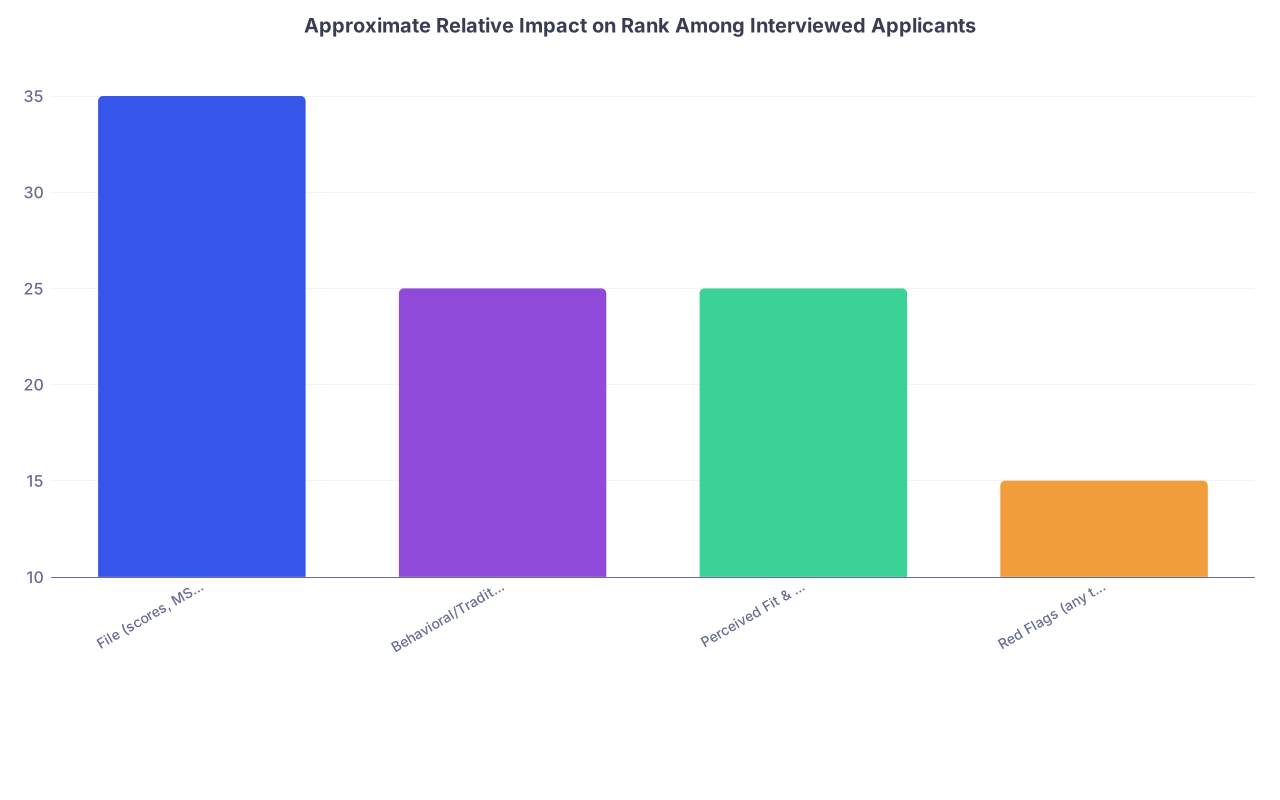
To make this a bit more concrete, here’s a rough approximation of what drives rank among interviewed candidates only at many programs. This isn’t official NRMP math. It’s closer to what you’d hear at 5 p.m. in a conference room when the whiteboard comes out.
| Category | Value |
|---|---|
| File (scores, MSPE, letters) | 35 |
| Behavioral/Traditional Interview | 25 |
| Perceived Fit & Culture | 25 |
| Red Flags (any type) | 15 |
Interpretation:
- Your file (scores, MSPE, letters, experiences) still matters post-interview. Especially in specialties obsessed with board scores.
- Behavioral + traditional interview (we’ll lump them together) are a big chunk—often a quarter to a third of the decision about where in the rankable group you land.
- “Fit” is largely a synthesis of your behavioral interview, vibes, and what residents say about you.
- Any red flag—behavioral, professionalism, attitude—can override all of this and push you off the list.
So does the behavioral interview “make or break” your rank?
It usually doesn’t build the house. But it absolutely can set it on fire.
The Scripted Answer Myth: Why Perfect Stories Don’t Save You
There’s a whole cottage industry built around convincing you that if you memorize the right framework—STAR, SOARA, whatever—you’ll “ace” the behavioral interview.
Let me be blunt: seasoned faculty can smell a canned answer in under ten seconds.
You know the ones:
- Every answer is exactly 60–90 seconds.
- All “failures” are really humblebrags.
- Every conflict is resolved with comically perfect communication.
- You “learned so much” from that time the attending yelled, but you give zero specifics about how your behavior changed.
These answers don’t tank you outright. They just fail to help you. You come across as generic. Uninteresting. Hard to differentiate from the 17 other people that day.
Where canned answers do hurt you is when they crack under even mild pushback.
Interviewer: “You said you learned to communicate better with nurses. Give me an example from the month after that incident where you handled it differently.”
Applicant: “Uh… well… I mean, I just, like, made sure to listen more.”
At that point, it’s obvious this is theater, not reflection.
The myth here is that content is king. It’s not. Consistency is. If your body language, tone, examples, and follow-ups all line up with someone who’s honest, owns their part, and doesn’t spin everything, you win—even with “imperfect” stories.
Where Behavioral Interviews Matter Less Than You Think
Now the part you probably need to hear to reduce your cortisol level: behavioral interviews are overhyped in some scenarios.
They matter less when:
A program cares obsessively about one metric
Some surgical subspecialties will quietly admit: if your Step 2 is way below their cutoff, your brilliant story about conflict with a scrub nurse is not saving you.You’re already in their “must rank high” bucket based on pre-existing relationships
Home students, rotators who killed it on audition, people with powerhouse letters from known faculty. The behavioral interview would have to be a disaster to drop you far.There’s very little variation among interviewed applicants
Some community programs interview 60 people who all look very similar on paper and behave reasonably well on interview day. Rank lists there can be driven by random small things—who vibed with which resident, who expressed interest in a particular clinic—more than fine-grain behavioral nuance.
Also, programs are exhausted during interview season. Some interviews happen after 20+ Zoom calls that week. Subtle differences in your answer structure just don’t matter as much as consultants would like you to believe.
Reality Check: What You Should Actually Focus On
If you strip away the noise, here’s what behavioral interviews really reward:
- Owning real failures without collapsing into self-pity or deflection
- Talking about conflict without trashing the other person
- Showing that you understand residency is hard, not a Hallmark montage
- Giving specific, concrete examples, not vague personality claims
You do not need:
- A polished story for every theoretical question in a 40-page list
- To never say “um”
- To have saved an entire hospital system from collapse in your M3 year
You do need to not set off alarms.
One Last Myth: “If They Liked Me, I’m Ranking High”
The most common self-delusion I hear from applicants after interview day: “They really liked me. I think I’ll be near the top of their list.”
Maybe. Or maybe they said the same thing to 80% of the people they interviewed.
I’ve been in rooms where:
- Everyone is “great,” “easy to work with,” “seems nice.”
- The actual meaningful comments revolve around: minor concerns about insight, a resident saying “I’d love to work nights with her,” or someone quietly flagging an interaction that felt off.
Programs are legally bound not to reveal real ranking intentions. So the warm fuzzy email you got? Or the “we’d love to have you here” line? It’s marketing. Not data.
Your behavioral interview influences how they talk about you in that room. But the conversation is messier than “We loved her, rank #1.”
Final Takeaways: Myth vs Reality
The behavioral interview rarely builds your rank from scratch. Your file, scores, and letters get you into the room and into a tier. The interview mostly shuffles you within that tier—or knocks you out if you show red flags.
Perfect, rehearsed answers are overrated. Programs care less about flawless structure and more about whether your stories show insight, accountability, and that you’re not going to be a professionalism disaster at 3 a.m.
Your goal is not to be unforgettable. Your goal is to be obviously safe, reasonably self-aware, and aligned with what they actually need: a competent, non-toxic colleague. If you clear that bar, the rest is noise.