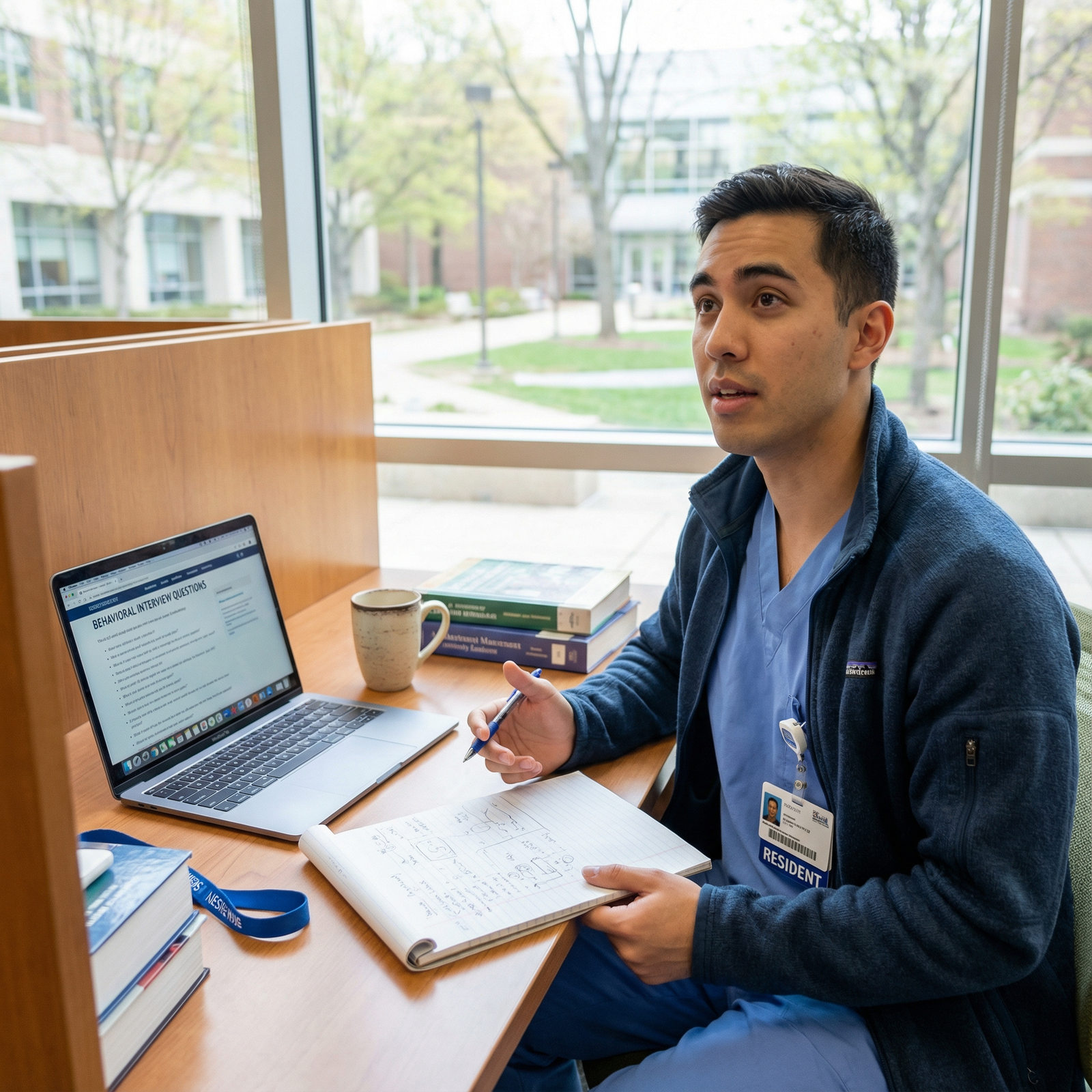
Understanding the Landscape: Urology Interviews as a US Citizen IMG
Urology is one of the most competitive specialties in the Match, and this is especially true for the urology match process that runs through the AUA (American Urological Association) rather than the NRMP. As a US citizen IMG (often an American studying abroad at a Caribbean, European, or other international medical school), you face a specific set of challenges and opportunities in urology residency.
Programs will often be trying to answer three big questions about you:
Can you do the work?
– Clinical skills, medical knowledge, research experience in urology or surgery.Do you fit our culture and team?
– Professionalism, communication, teachability, how you work in the OR and on call.Why should we take a chance on a US citizen IMG in such a competitive specialty?
– Clear narrative, maturity, unique value, and evidence that you understand US training and urology specifically.
Most common residency interview questions—especially behavioral interview questions in medical training—are built to explore these three areas. Knowing what’s coming and how to structure strong answers will help you stand out.
This guide focuses on common urology residency interview questions, with particular emphasis on how a US citizen IMG can answer them strategically and authentically.
Core “Tell Me About Yourself” and Fit Questions
Some questions appear in almost every urology residency interview. They may seem basic, but they set the tone for the entire conversation.
1. “Tell me about yourself.”
This is almost guaranteed. Interviewers are not asking for your life story; they want a concise, focused professional narrative.
Goal of the question:
- Understand your background and where you trained (including being an American studying abroad).
- See how you structure information and communicate.
- Identify what makes you different from other applicants.
Strong structure (2–3 minutes max):
Brief background
- Origin (e.g., where you grew up, undergrad).
- Medical school, including that you are a US citizen IMG.
Key experiences and strengths relevant to urology
- Clinical strengths, OR exposure, research, leadership.
Why urology and what you’re looking for in a program
- Tie your story to your interest in urology and patient care.
Example (US citizen IMG–specific):
“I grew up in New Jersey and completed my undergraduate degree in biomedical engineering at Rutgers, where I first became interested in surgical technology and device innovation. I’m a US citizen and chose to attend medical school at [X University] overseas because of its strong clinical exposure and small-group teaching.
During my clinical years, I gravitated towards surgery, and my urology rotation was a turning point—I enjoyed the mix of meticulous surgery, clinic-based longitudinal care, and the immediate quality-of-life impact procedures can have on patients. I’ve since worked on a retrospective study of endourology outcomes and completed two sub-internships at US academic centers, which confirmed that I thrive in a team-oriented, high-volume surgical environment.
I’m looking for a urology residency that combines strong operative training, early autonomy under supervision, and active mentorship, especially for residents pursuing academic or academic-community careers.”
Tips for US citizen IMG applicants:
- Mention you’re a US citizen IMG early, matter-of-factly; no need to be defensive.
- Emphasize exposure to US clinical systems (electives, sub-internships).
- Link being an American studying abroad to positive traits: adaptability, resilience, proactive approach.
2. “Why urology?”
Programs want to know that you understand what urology actually is—beyond “I like surgery.”
What they’re assessing:
- Depth of understanding: clinic + OR + emergencies + lifestyle realities.
- Authentic motivation, not generic “I like procedures.”
- Alignment with the specialty’s culture (collegial, often with long-term patient relationships).
Avoid:
- Superficial answers focused only on salary or lifestyle.
- Answers that could apply equally to any surgical field.
Stronger answer components:
- Clinical cases or patient stories that sparked your interest.
- The blend of skills: surgery, clinic, procedures, continuity of care.
- Specific sub-areas that intrigue you (oncology, endourology, reconstruction, pediatric urology).
- Evidence: rotations, research, conferences, mentorship.
Example framing:
“Urology appeals to me because it combines technically demanding surgery with meaningful longitudinal relationships, often around very personal and sensitive issues like continence, sexual function, and cancer. On my urology rotation at [US hospital], I followed a patient from their first hematuria workup through TURBT, pathology discussion, and subsequent surveillance. I saw how central the urologist was—not just surgically, but in guiding the patient through uncertainty.
I also enjoy the variety: endoscopic procedures, open and robotic cases, and clinic-based procedures. The field’s innovation—especially in minimally invasive surgery and technology—fits well with my engineering background. The more exposure I’ve had, including research in [brief topic], the more convinced I am that I want to build my career in urology.”
3. “Why our program?”
This is a high-yield question in every urology residency interview. Many US citizen IMG candidates underutilize it.
They want to see:
- That you did your homework.
- A genuine fit with their case volume, culture, and educational structure.
- That you’re not just applying anywhere that will take you.
How to prepare:
For each program, write down:
- 2–3 program-specific strengths (e.g., strong robotics, resident camaraderie, early OR exposure).
- 1–2 ways you would contribute.
- If you did a rotation there, reference specific experiences and residents/faculty.
Example answer:
“I’m drawn to your program for several reasons. First, the surgical volume in endourology and robotics is very strong, but residents still describe a close-knit, supportive culture. Speaking with Dr. [Name] and two of your residents during my sub-internship, I saw firsthand how attendings encourage autonomy while being very available for teaching.
Second, your early exposure to the OR and the dedicated PGY-2 endourology rotation align with my interest in complex stone disease. Finally, as someone who trained abroad but has done multiple US rotations, I value structured feedback and clear expectations—your formal mentorship system and semiannual reviews really appeal to me.
I see myself contributing as a hard-working, reliable team member with prior research experience who can help with ongoing outcomes projects in endourology and patient education initiatives.”

Behavioral Interview Questions in Medical Training (With Sample Answers)
Behavioral interview questions—“Tell me about a time when…”—are central in modern residency interviews, including in the urology match. They’re designed to predict future behavior from past actions.
A simple framework to answer these is STAR:
- Situation – brief context
- Task – what your role/responsibility was
- Action – what you did
- Result – outcome and what you learned
Below are common behavioral questions you’re likely to encounter, with advice tailored to US citizen IMG applicants.
4. “Tell me about a time you made a mistake.”
They are not testing perfection; they want self-awareness, accountability, and growth.
Pitfalls to avoid:
- Blaming others or the system.
- Using a “fake” mistake (e.g., “I care too much”).
- Leaving out what you changed going forward.
Example (STAR structure):
Situation/Task: “During my internal medicine rotation overseas, I was responsible for pre-rounding on several patients and updating the team. One morning, I misinterpreted a lab result and initially reported that a patient’s potassium was normal when it was significantly low.
Action: I realized the discrepancy when I double-checked the chart before rounds. I immediately notified my resident, corrected the information, and we adjusted the treatment plan. I then informed the attending and accepted responsibility for the oversight.
Result/Learning: Fortunately, no harm came to the patient, but it was a wake-up call about not relying on memory when transcribing critical values. Since then, I’ve developed a personal checklist system and always verify key labs directly in the electronic record before presenting. This experience reinforced for me the importance of humility and meticulousness—qualities that are crucial in surgery and urology.”
As a US citizen IMG, you can subtly demonstrate that your systems awareness and safety mindset translate well to US practice.
5. “Tell me about a time you had a conflict with a colleague or team member.”
Residency is team-based and high-pressure. Programs want to see professional conflict resolution, not avoidance or aggression.
Key elements:
- Show you listened and tried to understand the other perspective.
- Emphasize collaboration, not blame.
- End with a positive outcome or learning point.
Example:
“During my surgery rotation, I was working with another student on daily notes and pre-rounding. We had different expectations about dividing tasks—he felt I was taking the more interesting cases, and I felt I was doing more of the scut work.
I asked if we could take a few minutes after rounds to talk. I acknowledged his concerns and shared how I perceived the workload. We decided to create a simple rotation schedule: alternating days for OR cases and ward responsibilities so the exposure was fair. We also agreed to check in weekly to see if the system was working.
That conversation transformed our working relationship; we became more coordinated and efficient, and both of us had better evaluations from the team. I learned that addressing concerns early and directly, but respectfully, can prevent resentment and improve patient care.”
This demonstrates maturity and communication, crucial traits for a surgical specialty.
6. “Describe a stressful situation and how you handled it.”
Urology residents handle emergencies (e.g., testicular torsion, obstructing stones with sepsis) and long call nights. Interviewers want to see coping strategies and prioritization.
Example:
“On one of my US sub-internships in surgery, we had a particularly intense call: multiple admissions with limited bed availability and a patient in the ED with suspected perforated viscus. As a sub-I, I was handling initial histories, physicals, and documentation while trying to keep my resident updated.
I felt the workload was overwhelming at first. I paused for a moment, made a prioritized to-do list, and confirmed with my resident which tasks were most urgent. I then grouped similar tasks (e.g., all labs and imaging orders) and checked off items as I went. When I realized I was falling behind on a note, I communicated that early rather than hiding it.
We got through the night safely, and my resident later commented that my communication and organization made a difference. It reinforced for me that in stressful situations, stepping back, prioritizing, and communicating clearly are more important than trying to do everything at once.”
As a US citizen IMG, highlight any US-based rotations where you handled high-acuity care, as this reassures programs you can function in their environment.
7. “Tell me about a time you received critical feedback.”
They are probing coachability—how you respond when someone points out a weakness.
Example:
“During my early surgical clerkship, an attending told me that while my knowledge base was solid, my presentations were too detailed and hard to follow. Initially, I felt defensive because I equated detail with thoroughness.
I took a step back and asked for specific suggestions. He recommended starting with a one-sentence summary, then only including the most relevant data. I practiced this with my resident and asked for feedback over the next week.
By the end of the rotation, my presentations were more concise, and I even received positive comments on that specific area in my evaluation. That experience taught me to view feedback as data for improvement and to actively seek clarification, which is especially important in a surgical field like urology where efficiency and clear communication are vital in the OR.”
Urology-Specific Clinical and Technical Questions
While urology residency interviews are not full oral boards, many programs will test your interest and baseline understanding of urology and surgery. As an American studying abroad, you can use these questions to show that your knowledge is aligned with US expectations.
8. “What urology experiences have been most meaningful to you?”
Be specific. Mention:
- US-based urology electives or sub-internships.
- Mentors and how they shaped your view.
- Cases or procedures that influenced you.
Example answer:
“My most meaningful urology experience was my sub-internship at [US institution], where I followed a patient with high-risk prostate cancer from initial biopsy discussion through radical prostatectomy and postoperative follow-up. I assisted in the OR, observed how the attending balanced oncologic control with functional outcomes, and saw how the resident managed postoperative urinary issues and patient anxiety.
It showed me the depth of responsibility urologists have and the importance of clear communication about expectations. I also appreciated the resident team’s camaraderie and how they integrated teaching into busy days. This rotation confirmed that I enjoy the pace and complexity of urology, and it motivated me to pursue research in prostate cancer quality-of-life outcomes.”
9. “How do you see your career in urology? Academic, community, subspecialty?”
Programs know most residents’ plans evolve, but they like to see thoughtful direction.
Good approach:
- Be honest but flexible.
- Mention areas of interest (e.g., endourology, oncology, female pelvic medicine).
- Emphasize skill development, lifelong learning, and patient-centered care.
Example:
“At this stage, I envision myself in an academic or academic-community practice, with a strong emphasis on surgical education and outcomes research. I’m particularly interested in endourology and stone disease, given my prior work with imaging and device design in undergrad.
That said, I recognize that residency will expose me to areas I haven’t fully experienced yet, such as pediatric urology or complex reconstruction. My priority is to develop a solid foundation as a general urologist, gain broad operative skills, and then refine my interests based on where I can add the most value to patients and the field.”
10. “What do you think will be the biggest challenge for you in urology residency?”
This is an honesty test. Programs know that US citizen IMG backgrounds sometimes come with specific challenges: adapting to the US system, documentation differences, or occasional bias.
How to answer:
- Identify a real challenge.
- Show insight and proactive strategies.
- End with confidence, not anxiety.
Example:
“One challenge I anticipate is the steep learning curve of managing high surgical volume and call while maintaining consistent study habits. During my clinical years, I noticed that on very busy rotations, it was easy to postpone reading.
To address this, I’ve started building the habit of brief, focused daily reading using resources like Campbell-Walsh and core urology review questions, even on busy days. I also use spaced repetition tools so that small amounts of study accumulate over time.
As a US citizen IMG who has already adapted to new health systems in two countries, I’m confident I can adjust to the demands here. I see this challenge as an opportunity to develop efficient strategies that will serve me throughout my career.”

Addressing the US Citizen IMG Factor Directly and Professionally
As a US citizen IMG, you may encounter questions—directly or indirectly—about your training path. Some programs might not ask explicitly but will be thinking:
- Why did this American study abroad?
- Can this person adapt to our system and demands?
- Are there any gaps in training or clinical exposure?
11. “Why did you choose to attend medical school abroad?”
You may hear this directly, or you may address it proactively in other answers.
Goals:
- Provide a clear, non-defensive explanation.
- Show that the decision was thoughtful and that you’ve maximized your opportunities.
- Emphasize your successful adaptation and strong US experiences.
Example answer:
“I chose to attend medical school at [X University] abroad for a combination of reasons. At the time I applied, it offered a clear path to a medical education with strong clinical exposure and early patient contact, and I was attracted to the opportunity to live and learn in a different health system and culture.
Being an American studying abroad required me to be proactive: I sought out US clinical electives, completed sub-internships in surgery and urology at [institutions], and made sure I was familiar with US guidelines and documentation.
The experience taught me adaptability, resilience, and how to function effectively in diverse teams—qualities that I believe are valuable in urology residency. I’m now fully committed to building my career in the US and contributing to a program long-term.”
Keep the tone confident, not apologetic. Focus on how you’ve bridged any gaps.
12. “Do you feel your international medical education has prepared you for residency in the US?”
This is an opportunity to reassure them.
Address three dimensions:
- Clinical exposure and responsibility
- US system familiarity (electives, sub-I’s)
- Exams and objective metrics
Sample answer:
“Yes, I do. Clinically, my school provided extensive hands-on experience: I was responsible for initial assessments, writing notes, and presenting on rounds in both medicine and surgery. I complemented that with US-based electives and a urology sub-internship, where I learned US documentation standards, EMR systems, and perioperative workflows.
Academically, preparing for USMLE exams required me to align my knowledge with US curricula, and my scores reflect that foundation. More importantly, I’ve sought out feedback during my US rotations and have been told that my performance and clinical reasoning are on par with US graduates.
While I recognize that every transition has a learning curve, I feel well-prepared and excited to train in the US system.”
Practical Strategies to Prepare for Urology Residency Interview Questions
Knowing the questions is only half the battle. How you practice and present matters greatly.
Build a Personal “Question Bank”
Create a document with headings like:
- “Tell me about yourself”
- “Why urology?”
- “Why our program?”
- “Strengths and weaknesses”
- “Conflict / mistake / feedback stories”
- “Leadership and teamwork”
- “Diversity, equity, inclusion experiences”
- “US citizen IMG / training path”
Under each, jot bullet points—not scripts—so your answers sound natural.
Collect 6–8 Strong Behavioral Stories
Prepare versatile stories that can be adapted to multiple questions. For example:
- A time you led a project or initiative.
- A difficult patient interaction you handled professionally.
- A time you worked with a diverse or underserved population.
- A mistake you learned from (as above).
- A teamwork or conflict story.
- A high-stress call or acute situation.
Use the STAR framework to outline each.
Practice Out Loud—Especially Key Openers
Questions like “Tell me about yourself” and “Why urology?” are too important to “wing.” Practice:
- Saying them in 2–3 minutes.
- Keeping a clear structure.
- Avoiding rambling or excessive detail.
Recording yourself or doing mock interviews with mentors, residents, or peers can be especially helpful.
Anticipate Program-Specific Residency Interview Questions
For each program, based on their website and resident bios, consider:
- Do they emphasize research? Expect questions on your projects and future academic interests.
- Do they highlight community service or underserved care? Be ready to discuss work with diverse populations.
- Do they stress resident wellness and culture? Prepare to discuss how you maintain balance and support colleagues.
Prepare Questions to Ask Them
Almost every interview ends with, “What questions do you have for us?” Thoughtful questions show engagement.
Examples:
- “How do you see the program evolving over the next five years, particularly in [robotics/endourology/oncology]?”
- “How is feedback delivered to residents, especially early in PGY-2 when operative responsibilities increase?”
- “What characteristics do your most successful residents tend to share?”
Avoid easily answerable website questions or anything overly focused on salary or vacation.
FAQs: Common Concerns for US Citizen IMG Applicants in Urology
1. Will I be asked directly about being a US citizen IMG or an American studying abroad?
Sometimes yes, sometimes indirectly. Programs may ask:
- “Why did you choose to train abroad?”
- “How has your international education prepared you for US residency?”
Prepare a clear, confident explanation that emphasizes:
- Intentional decision-making.
- Adaptability and resilience.
- Completion of US-based rotations and strong performance there.
You don’t need to be defensive; focus on what you’ve gained and how you’ve addressed any potential gaps.
2. What are some red-flag answers to common residency interview questions?
Red flags include:
- Speaking negatively about your medical school, prior supervisors, or colleagues.
- Blaming others entirely in “mistake” or “conflict” stories.
- Very vague answers to “Why urology?” that could apply to any field.
- Inability to explain gaps in your application or inconsistent exam performance.
- Overly rehearsed, robotic responses with no personal detail.
Strive for honesty, accountability, and specific examples, especially in behavioral interview medical scenarios.
3. How can I stand out in such a competitive field as a US citizen IMG?
You can stand out by:
- Demonstrating clear, specific commitment to urology: rotations, research, AUA meetings, mentorship.
- Exhibiting excellent communication skills and professionalism in every interaction (emails, scheduling, interviews).
- Having polished answers to core questions like “Tell me about yourself” and “Why urology?” that highlight your unique path.
- Showing that you understand the realities of urology residency (call, emergencies, OR demands) and are prepared for them.
- Pointing to objective metrics—USMLE scores, strong letters from US urologists, concrete research or quality improvement contributions.
4. What should I do if I’m asked a clinical question I don’t know the answer to?
Programs sometimes ask basic urology or general surgery questions. If you don’t know:
- Be honest: “I’m not entirely sure, but I would approach it this way…”
- Show reasoning: outline differential diagnosis, initial workup, or management steps you do know.
- Avoid guessing wildly or trying to bluff.
A thoughtful, humble, logical approach can still create a positive impression, even if you don’t know the exact guideline detail.
By anticipating these common urology residency interview questions, structuring your answers with clarity, and thoughtfully addressing your experience as a US citizen IMG, you position yourself as a prepared, reflective, and motivated applicant—exactly the kind of resident urology programs look for in a highly competitive match.