
Your memory is not broken—and it won’t cost you the Match. But you do need a system.
If you’re anything like me, the words “Tell me about a time when…” make your stomach drop. Not because you don’t have experiences. But because your brain immediately goes:
You know you’ve done stuff. You know you’ve handled conflict, worked on teams, “overcame challenges,” all the usual behavioral interview bingo. But remembering specific details? Who said what? Exact sequence? How you “resolved” it?
Your mind just shows you vibes. Blurry impressions. Not scenes.
Let me say this flat out: programs are not running an FBI-level fact check on whether you remember the exact words your attending said in 3rd-year surgery. They’re testing something else. And you can absolutely answer behavioral questions well—even if you feel like your memory is trash—if you prep the right way.
Let’s untangle this, because the overthinking spiral here is brutal.
The Lie: “If I Don’t Remember Every Detail, I’ll Sound Fake”
Here’s the bad script most of us are running:
Resident: “Tell me about a time you had a conflict with a team member.”
You (in your nightmare fantasy): “Uh… I… don’t remember? But I promise I’ve had conflict?”
Resident (in your head): “This person is lying. No rank.”
No. That’s not how this works.
Behavioral questions are not graded on:
- Timestamp accuracy
- Verbatim quotes
- Level of photographic recall
They’re graded on:
- Can you pick a relevant situation?
- Can you make it understandable and coherent?
- Do you show insight, maturity, and some growth?
Interviewers know you’re answering from memory. They also know you’re stressed and your adrenaline is high. Nobody expects you to reconstruct a neurology case note from two years ago like a court transcript.
You are allowed to:
- Approximate dialogue (“She basically said…” / “He told me something along the lines of…”)
- Summarize events instead of giving a minute-by-minute recap
- Focus more on your thought process and actions than on tiny external details
What actually feels fake to interviewers is when the story clearly isn’t real or doesn’t sound like something a med student would actually experience. Not when the timeline is a little fuzzy.
So your memory isn’t the problem. The real problem is you don’t have a system to pull stories out of your brain on demand.
Why Your Brain Goes Blank In Behaviorals (You’re Not Broken)
You’re not suddenly incompetent. You’re stressed. And your brain’s doing what stressed brains do.
You sit down in front of Zoom, they ask:
“Tell me about a time you made a mistake.”
And your brain immediately offers:
- Step 1 failures
- That one terrible feedback session on surgery
- Every moment you’ve disappointed someone since age 12
But none of it is in a clean, interview-ready package. It’s just chaos.
The blankness you feel is actually an overload problem, not an absence problem. You have too many memories, unorganized, all crashing the system at once. Under pressure, your mind protects you by kind of… shutting the door.
So you think: “I don’t remember anything.”
Reality: “I haven’t pre-organized my experiences into retrievable stories my anxious brain can grab in 10 seconds.”
This is fixable. You can absolutely do this without magically becoming a detailed historian of your own life.
The Fix: Build a Small, Reusable Story Bank (Not 100 Perfect Stories)
You do not need a new, unique story for every behavioral question.
That’s a myth that makes highly anxious people freeze.
What actually works is having a small “story bank”—maybe 8–12 core experiences—that you know well enough to bend for multiple questions.
Think:
One tough feedback story
One conflict story
One leadership story
One failure / mistake story
One working-with-difficult-patient story
One ethical/gray-area story
One proud-of-yourself story
One dealing-with-uncertainty/ambiguity story
Those 8 can cover an insane number of questions just by shifting the emphasis.

How To Build Stories When You Barely Remember Anything
Here’s the part you’re actually worried about: “Cool, story bank, but I literally don’t remember enough to make stories.”
Let’s break how you actually pull memories up—even if they feel blurry.
Step 1: Go by rotations, not themes (at first)
Your brain doesn’t retrieve by category like “conflict” or “leadership.” It retrieves by setting.
So instead of asking: “When did I show leadership?”
Ask: “What are three vivid things I remember from internal med?”
Go rotation by rotation:
- Internal Medicine
- Surgery
- OB/GYN
- Peds
- Psych
- EM
- Sub-I’s
- Research or QI projects
- Volunteer work / free clinic / global health
For each, jot down anything that stands out, even if it’s messy:
- “That time the attending shredded my note, but then helped me.”
- “Patient whose daughter kept yelling at the team.”
- “Overnight cross-cover disaster where I didn’t know what to do.”
You don’t need full stories yet. Just anchors.
Step 2: Zoom in on one moment, not the whole saga
Behavioral questions sound huge:
“Tell me about a time you had a conflict.”
You don’t need to tell every related event over two months. You pick one concrete moment inside the broader situation.
Example:
Not: “I had a difficult attending for my whole sub-I.”
Instead: “On one call night, my attending criticized my handoff in front of the team…”
The moment should have:
- A clear problem
- A choice you had to make
- Some kind of outcome (even if it wasn’t perfect)
The specifics don’t have to be razor-sharp. They just need to be enough to reconstruct a coherent scene.
Step 3: Use “good-enough” reconstruction, not perfect recall
You won’t remember the exact date, time, or wording. That’s fine. Phrase things like:
- “I was on my surgery clerkship when…”
- “One night on call, my senior…”
- “Early in my third year, I had a patient who…”
You’re allowed to compress and summarize:
- “Over the next few days…” even if it was actually a week
- “We had a brief discussion” even if it was more than one chat
You’re telling a true story, just not a forensic record. That’s allowed.
Using STAR Without Sounding Like A Robot
Yes, everyone talks about STAR (Situation, Task, Action, Result). And yes, it can make you sound like a rehearsed robot if you use it badly.
But if your memory sucks under pressure, STAR is your safety net. It gives you a skeleton to hang your half-remembered experience on.
Here’s how to use it in a way that still feels human.
Situation – Set the scene fast. One or two sentences.
“I was on my third-year medicine rotation, and we had a patient with advanced heart failure who kept refusing diuretics.”
Task – What was expected of you?
“As the student, my job was to help with daily rounds and build rapport with him so we could understand his concerns.”
Action – This is where the detail actually matters. Focus on: what you actually did, thought, tried.
“I realized I’d been giving very technical explanations that weren’t landing, so I sat down with him and asked him what worried him most about the meds. He said he hated feeling tied to the bathroom and was afraid of losing control in front of his family. I acknowledged that, and we talked about adjusting the timing and involving his family in the plan. I also checked back later in the day to see how he was feeling.”
You don’t need to remember every line of dialogue. But you can recall what you did and why.
Result – Don’t oversell. Just be honest and reflective.
“He ended up agreeing to restart his diuretics with some modifications, and our relationship improved. For me, it was a wake-up call that my default is to over-explain instead of first listening for the emotional barrier, so now I try to ask at least one open-ended question before I launch into education.”
You see how the story works even if your memory is fuzzy about the exact time, room number, or verbatim quotes.

| Step | Description |
|---|---|
| Step 1 | Recall vague rotation memory |
| Step 2 | Identify one concrete moment |
| Step 3 | Sketch Situation & Task in 2-3 lines |
| Step 4 | List 3-4 key Actions you took |
| Step 5 | Reflect on Result & what you learned |
| Step 6 | Practice saying it out loud once |
“What If I Mix Up Details Or Two Memories Blend Together?”
You will. It happens to everyone.
You might combine two similar patients into one composite. Or misremember whether it was IM or FM. Or forget if it was a resident or attending who said the thing.
Here’s where the ethics line is:
Shaping a real experience into a clearer, slightly compressed narrative = okay.
Completely inventing a story = not okay.
Interviewers are not cross-referencing your EMR logs. They’re trying to see who you are under pressure, what you notice, and how you respond to messy human situations.
If you keep the core truth intact—your role, the basic scenario, what you actually did—tiny inaccuracies are not going to blow up your Match.
- Impossible scenarios for your level (“I independently ran a code as an M3 with no one around.”)
- Cartoonish villains or saints
- “Perfect” outcomes every single time
- Rehearsed stories that don’t match your application at all
Your anxiety will tell you, “If I get one detail wrong, they’ll know I’m lying.” That’s not how real humans evaluate stories. They’re listening for plausibility and self-awareness, not courtroom evidence.
What If You Genuinely Can’t Remember Anything In The Moment?
Okay, worst-case scenario: the interviewer throws a question that hits a total blank spot. No story appears. Just static.
You’re not dead. You just need a stall + reframe combo.
You can:
Buy a few seconds.
“That’s a great question, let me think for a second.”
(Say it slowly. Take a breath. Actually think.)Lower the stakes.
Your brain is hunting for The Perfect Example. Give it permission to grab a smaller one.
“It doesn’t have to be dramatic. Just something where I handled tension with someone.”Widen the source.
If clinical memory won’t come, allow pre-med, research, or non-clinical.
“I’m actually thinking of a situation from my work in the student-run clinic rather than a clerkship, if that’s okay.”
Most interviewers are totally fine with that.
If you’re really, truly blank, you can say something like:
“I’m having trouble pulling a single clear example under pressure here, but one pattern that’s come up a few times is…”
Then give a smaller, simpler story. It’s better to have a modest, honest example than to sit in awkward silence trying to invent a masterpiece.
Practice That Actually Helps An Anxious, Blurry-Details Brain
Don’t just “think about stories in your head.” That doesn’t stick.
You need to:
Write down bullet versions of 8–12 core stories
Not essays. Just:- Rotation / setting
- 1–2 lines of situation
- 3–4 bullets of what you did
- 1–2 lines of result + what you learned
Say them out loud, messy and imperfect
Voice memo yourself answering:
“Tell me about a time you had a conflict.”
Then listen. Ask: Did I ramble? Did I ever actually say what I did? Did I sound like I understood the impact?Practice adapting one story to different prompts
Same case, different angle:- “Tell me about a time you received criticism.”
- “Tell me about a time you had a difficult interaction with a supervisor.”
- “Tell me about a time you changed your communication style.”
You can use one attending-feedback story for all three, just shifting focus.
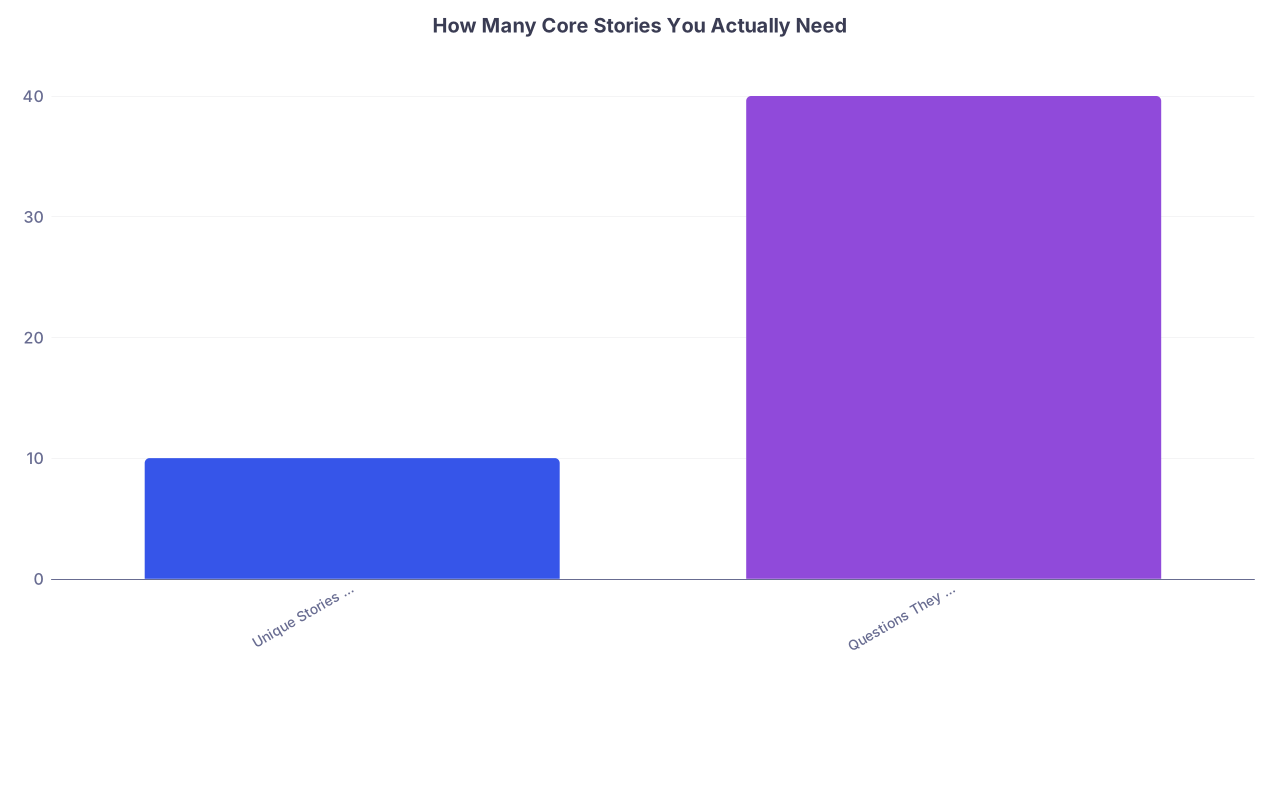
| Category | Value |
|---|---|
| Unique Stories Needed | 10 |
| Questions They Can Cover | 40 |
See the point? You don’t need perfect recall of 40 things. You need decent recall of about 10.
The Anxiety Voice vs. Reality
Your anxiety says:
- “If I don’t give them specific details, they’ll think I’m making it up.”
- “Everyone else has these polished stories, mine are too boring.”
- “I don’t remember enough to sound competent.”
Reality:
- Most people tell pretty generic stories. A surprising number forget to even say what they did. If you can clearly describe your actions and reflections, you’re already above average.
- Programs don’t want actors, they want residents who will function at 3 a.m. Your ability to be honest, self-aware, and thoughtful matters more than cinema-level storytelling.
- If your attendings wrote you decent comments and people generally liked working with you, you already have the raw material. You’re not fabricating; you’re organizing.

A Simple Plan You Can Use Today
Here’s what to actually do, so this stops feeling like a doom cloud hanging over you.
Today—literally today—do this:
- Pick two rotations (say, IM and Surgery).
- For each, write down three memorable moments—good, bad, awkward, whatever.
- Pick one of those six and force it into STAR on paper. Doesn’t matter if it’s clunky.
- Say it out loud once, into your phone. Listen back one time. That’s it.
That’s enough to start loosening the “I don’t remember anything” story you’re telling yourself.
You’re not trying to become a flawless storyteller overnight. You’re trying to give your overloaded, anxious brain some pre-built handles to grab in the interview.
And once you have even a few of those, behaviorals stop being this horror-movie jump scare and turn into something way more manageable:
“Okay, they asked about conflict. That’s probably my surgery resident story or my student-run clinic story. Pick one. Go.”
Not perfect. But absolutely good enough to Match.
FAQ (Exactly 6 Questions)
1. Is it okay to use pre-med or non-clinical examples for behavioral questions?
Yes, as long as the story is relevant and shows skills that matter for residency: communication, teamwork, conflict management, resilience, leadership. If you truly don’t have a clinical example for a particular question, say, “This example is from before medical school, but it really shaped how I approach [skill] now,” and then tie it back to how you act on the wards.
2. What if my stories make me look weak or incompetent? Won’t that hurt me?
A story where you messed up but clearly learned and changed is better than a story where you were perfect from the start. Interviewers are allergic to “I did everything right, and everyone loved me” narratives. You’re going into residency, not applying to be a superhero. They want people who can recognize mistakes, accept feedback, and adjust. Just make sure the “I changed” part is clear and believable.
3. How long should each behavioral answer be? I’m scared I’ll ramble.
Aim for about 1.5–2 minutes. Under a minute usually means you skipped important details about your actions and thought process. Over 3 minutes and you’re probably drowning them in backstory. Record yourself answering a few questions and literally time them. Most anxious people feel like they’re rambling when they’re actually too short and vague.
4. Can I reuse the same story multiple times in one interview day?
Yes, but don’t use the exact same story three questions in a row with the same interviewer. Across different interviews? Totally normal. Even within one, you can revisit an experience if you emphasize different aspects. Just don’t sound like you only have one experience from all of med school. That’s why 8–12 core stories is a nice buffer.
5. What if the interviewer challenges details or asks very specific follow-ups I don’t remember?
Stay calm and don’t fake precision. You can say, “I don’t remember the exact wording, but the gist was…” or “I don’t remember the exact lab value, but it was significantly elevated and concerning for…” This actually makes you sound more honest and grounded than pretending you recall every tiny detail from years ago.
6. How do I stop obsessing over whether my stories are ‘good enough’?
You probably won’t fully stop obsessing—that’s kind of how our brains are wired. But you can give yourself a sanity check: ask one blunt friend or mentor to listen to 3–4 of your stories and tell you if any sound confusing, fake, or weak. Fix those. After that, your job is practice, not infinite revision. Open your notes doc today and draft just one messy STAR story—then say it out loud once. That tiny, concrete step will do more for your anxiety than another hour of spiraling.