
How PDs Really Judge Your ‘Conflict With a Colleague’ Interview Story
It’s 2:17 p.m. on your big interview day. You’ve survived the “tell me about yourself,” stumbled a bit on the “why this program,” but overall you feel okay. Then the program director leans back, looks straight at you, and drops it:
“Tell me about a time you had a conflict with a colleague. How did you handle it, and what was the outcome?”
You feel your heart rate bump up. Because you know you have stories. The nurse who snapped at you on OB. The gunner classmate who hijacked the group presentation. The co-intern last month who disappeared at 2 a.m. while you were drowning. You start sifting frantically for something “safe,” not too negative, not too fake.
On the other side of the table, here’s what’s actually happening.
They’re not just listening to your story. They’re running a silent checklist in their heads:
- Are you going to be a problem?
- Are you going to make me deal with your drama?
- Will my chiefs regret it if we rank you high?
This question is one of their favorite landmines. Because it exposes things your MSPE, your LORs, and your glossy ERAS personal statement never will.
Let me walk you through how they really judge this answer.
What PDs Are Actually Testing With the “Conflict” Question
This is not a “tell me about a challenging experience” question. It’s narrower, more dangerous, and more revealing.
Here’s the ugly truth: almost every residency class has one or two people who consume 80–90% of the leadership’s emotional energy. Not because they are dumb. Not because they are clinically unsafe. Because they cannot get along with other humans under stress.
Program leadership is obsessed with not accidentally matching those people.
So when you answer the conflict question, they’re scanning you for a few core traits. I’ve sat in those rooms; I’ve heard the debriefs. These are the things that decide if your story helps you or quietly tanks you.
1. Blame vs. ownership
If your story sounds like a complaint session, they’re done with you.
They’re listening for how often the subject is “they” versus “I.”
“They kept ignoring…” “She was always…” “The nurses wouldn’t…”
Red flag. You’re the hero and victim in your own narrative. That’s exactly the person who ends up in the PD’s office every month.“Initially I reacted by…” “I realized I had contributed by…”
This is what calms them down. Ownership. Even partial. Even if the other person was worse.
They know conflict is almost never truly one-sided. If in your version of events, it is? They assume you’re blind to your own role.
2. Emotional regulation under stress
PDs don’t care if you were annoyed. Everyone is. They care how you behaved when you were annoyed.
They’re listening for language that reveals your actual emotional state:
“I was really frustrated, so I went outside and took a few minutes before responding.”
Good. Awareness + self-regulation.“I was so mad I just couldn’t work with him after that.”
That’s exactly the sentence that gets dissected in the ranking meeting with: “Yeah… no. Hard pass.”
What they’re really asking is: when things get tense at 3 a.m. and everybody is tired, are you the gasoline or the fire extinguisher?
3. Reality testing: does your story sound like real residency?
Here’s something applicants underestimate: faculty can smell a scripted, over-sanitized story from a mile away.
If your “conflict” is that a classmate didn’t contribute enough to a low-stakes group project in M2 year, and that’s the only thing you bring? You’re telling them one of two things:
- You’ve never actually been in the trenches
- Or you’re unwilling to be candid
Neither is great.
They’re expecting something with at least some teeth. Not a nuclear war, but real stakes: patient care, workload, differing clinical opinions, communication breakdown on the wards.
When someone gives a story like, “In my pre-clinical years we had a disagreement about presentation format,” I’ve literally heard PDs say afterward, “That’s the hardest conflict you’ve had? They’re not ready.”
4. Do you understand the power dynamics?
This is the subtle part. They’re listening carefully for whether you grasp hierarchy, roles, and institutional culture.
If your story is, “I confronted the attending because they weren’t listening,” and you tell it like you’re proud of “standing up,” you may think you sound courageous.
You don’t. You sound naïve. Or worse, insubordinate.
Conflict with:
- A peer
- A nurse
- A consultant
- An attending
- An administrator
Each of those has different rules. PDs want to see that you understand when to be direct, when to escalate, when to document, and when to shut up and live to fight another day.
If your story ignores hierarchy completely, they assume you will ignore it as a resident too. That scares them.
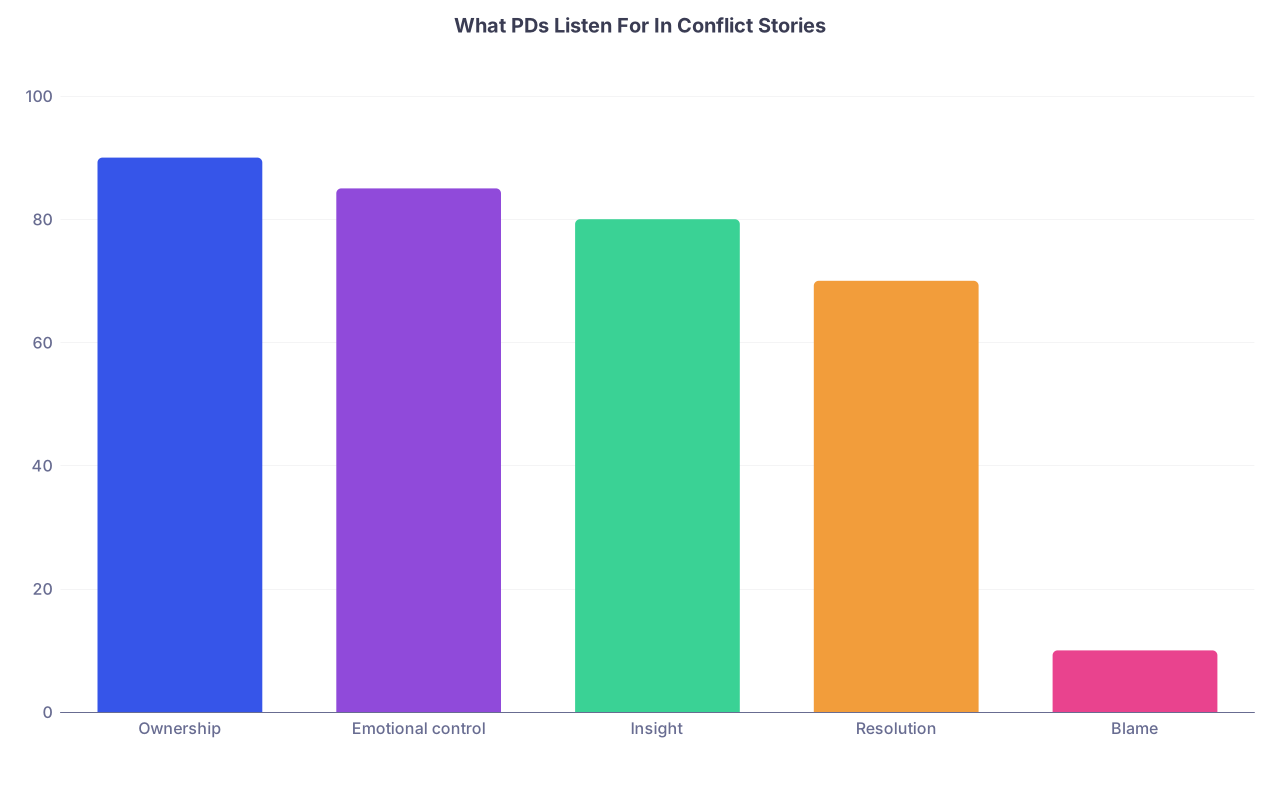
| Category | Value |
|---|---|
| Ownership | 90 |
| Emotional control | 85 |
| Insight | 80 |
| Resolution | 70 |
| Blame | 10 |
The Stories That Quietly Kill Your Rank Position
Let me be more concrete. I’ve watched great applications sink over a single answer to this question.
Here are the common failure patterns.
The “I was right, they were wrong” narrative
The applicant walks in convinced they’re showcasing clinical judgment or advocacy. What the committee hears is rigidity.
Example I’ve heard almost verbatim:
“On my medicine rotation, I strongly believed a patient needed a CT, but the senior resident disagreed and didn’t order it. I kept bringing it up, but he wouldn’t listen. I was very frustrated because I knew I was right. The next day the patient deteriorated and ended up needing the CT. I was upset that my concerns had been ignored.”
On the surface, this sounds like “advocating for the patient.” But listen to how it lands in a PD’s head:
- No self-reflection on communication style
- No recognition of the senior’s broader picture
- No acknowledgment of how they might have been perceived
- No specific constructive behavior described
Then the applicant will often tack on a weak ending like, “I learned to always speak up for my patients.” That’s not a learning point. That’s a slogan.
You want to watch PDs internally recoil? Paint yourself as the lone voice of truth surrounded by idiots. They’ve lived this movie with previous problem residents.
Trashing nurses, staff, or “the system”
You never, ever, ever win by talking badly about nurses in an interview. Or by talking with contempt about “the system.”
I’ve seen this one too:
“The nurses on that floor were just lazy. They kept calling us for stupid things, and when we needed something, they dragged their feet. One time I confronted one of them…”
Candidate thinks they sound strong and honest. What we write down afterward is one word: “Toxic.”
Same with “administration.” You can describe broken processes; you cannot sound superior to everyone who works in them.
The better version of this kind of conflict is: “There was a pattern that affected patient care, here’s how I tried to address it constructively, here’s what I learned about systems and communication.”
The “I avoid conflict” humblebrag
This is the polished, fake answer that bombs softly.
You know the one:
“I don’t really have conflicts with people. I’m pretty easy-going. If there’s ever tension, I just focus on the work and let it go.”
PDs do not hear “mature.” They hear:
- Won’t address issues directly
- Will stew silently and then explode or disengage
- Has low insight or is unwilling to be honest
Residency is conflict. If you claim you’ve basically never had any, the room doesn’t think, “Wow, what a saint.” They think, “We’re not getting the real version of this person.”
The overshare / professionalism red flag
Other end of the spectrum: the applicant who tells a story that’s way too raw or unresolved.
Real example: someone described a conflict with another student and ended with, “To be honest, I still think she’s a terrible person and I’d never work with her again.”
PD’s reaction afterward: “Absolutely not.”
You can feel that you’re right. You can’t say it like that. Not in an interview.

What A Good Conflict Story Actually Looks Like To PDs
Let’s flip it. What makes faculty relax and nod when you answer?
Not perfection. Not some textbook, leadership-seminar answer. They want something that feels real, shows your spine, and proves you’re not going to be chaos in scrubs.
Here’s what they’re grading in their heads.
1. Specific, concrete, and time-bounded
Vague stories feel fake. “One time, during third year, there was this person who…” is too blurry. Pick one event, with names removed but roles clear:
- “During my Sub-I on general surgery last August…”
- “On nights in my IM rotation, I had repeated tension with another student about task distribution…”
You’re telling them: this happened, this is how I handled it then, this is what I’d do now.
2. Balanced description of both sides
The strongest answers give enough context that a fair-minded outsider could see why the other person behaved that way.
Something like:
“The senior was under a lot of pressure; we were holding eight patients in the ED and he was getting paged nonstop. I understood why he didn’t want to add another study, but I was still concerned about this one patient…”
That tells PDs two things at once: you had a concern, and you’re not blind to the other person’s reality.
3. Calm but not passive behavior
They want to see you do something. But not blow up.
Sample structure that lands well:
- You noticed the conflict early
- You tried a reasonable, direct conversation at an appropriate time
- You framed things in terms of patients / workflow, not personal attacks
- You adjusted your own behavior too, not just demanded changes from others
I’ve watched PDs literally underline phrases like, “I asked if we could find a time to talk privately after rounds,” or, “I started by asking how they were seeing the situation.”
Why? It shows impulse control and basic emotional intelligence.
4. Real learning and behavior change
This is where most answers collapse. People tack on a shallow lesson because they know they’re supposed to.
“I learned the importance of communication” is meaningless. Everyone says it. It signals nothing.
A lesson that actually moves the needle sounds like:
- “I realized I often waited until I was already frustrated before speaking up. Since then, I’ve tried to address things earlier and more calmly.”
- “I learned that asking how others see the situation first lowers defenses and gets to resolution faster.”
Notice the difference? The learning is specific and behavioral. It tells PDs you won’t repeat the same mistake endlessly.
| Dimension | Green Flag Example | Red Flag Example |
|---|---|---|
| Ownership | "I contributed by..." | "They always..." |
| Emotional control | "I took a moment, then approached calmly." | "I was furious and couldn’t work with them." |
| Insight | "I understood their workload and pressure." | "They were just difficult people." |
| Resolution | "We agreed on a plan going forward." | "We just avoided each other after that." |
| Learning | "Now I start by asking their perspective." | "I learned to always stand my ground." |
The Hidden PD Calculus: “Are You Going To Be A Problem?”
You need to understand how brutally simple the mental math gets in ranking meetings.
After a full day of interviews, nobody is re-reading every line of your ERAS. They’re scanning a handful of things:
- Any major red flags
- Any strong champions (“I would love to work with this person”)
- And how you handled pressure in the room
Behavioral questions like “conflict with a colleague” are pure pressure tests.
Behind closed doors, the conversation is not philosophical. It sounds like this:
“Seemed smart, but a little brittle. Blamed the nurse in that conflict story. I’m not convinced they won’t be high-maintenance.”
“Really thoughtful about that disagreement with their senior. Took some ownership. I’d trust them with a tough team dynamic.”
Programs have limited bandwidth for drama. One poisonous interpersonal hire can destabilize a whole class. PDs remember the year they matched that person. They talk about it like a war story.
So if your numbers and CV are solid, this question is where you either cement your status as “safe to work with” or quietly slide down the rank list into the “only if we need to fill spots” tier.

| Step | Description |
|---|---|
| Step 1 | Hear conflict question answer |
| Step 2 | Risky hire Rank lower |
| Step 3 | Neutral Middle of list |
| Step 4 | Green flag Comfortable ranking high |
| Step 5 | Blaming others? |
| Step 6 | Shows ownership? |
| Step 7 | Emotional control? |
| Step 8 | Insight & learning? |
How To Choose The Right Story (And Avoid Landmines)
You probably have several possible conflicts you could talk about. Some are better than others.
You want something:
- Real, with moderate stakes
- Resolved (or at least functionally improved)
- Where you do not look like a victim or a saint
Bad categories to use:
- Major professionalism investigations (leave those for when you’re directly asked)
- Open wounds where you’re still pissed off
- Conflicts where the other person did something egregiously unethical or dangerous and you’re clearly traumatized by it
Strong categories to use:
- Task distribution disagreements with peers
- Communication breakdowns with seniors that you eventually worked through
- Recurrent friction with a nurse or staff member that you learned to manage better
Let me give you a skeleton of a story that tends to land well, then I’ll show you how PDs dissect it.
Example of a conflict story that helps you (if delivered naturally)
“On my medicine Sub-I, I worked closely with another student on a very busy team. We were both trying to be helpful, but we had very different approaches. I liked to pre-chart and see patients early; he preferred to discuss with the resident first and then see patients together.
At first, I felt like he was slowing us down and I was getting frustrated. I vented once to another student, which did not help. After a couple of days of both of us stepping on each other’s toes and occasionally duplicating work, I realized this wasn’t sustainable.
I asked him if we could chat briefly after rounds. I started by saying I appreciated how engaged he was, and that I thought we both wanted the same thing—good care and not making extra work for the resident. Then I shared that I was feeling like our styles were clashing and asked how he was seeing it.
He admitted he felt like I was ‘going rogue’ and making him look uninvolved. That was not my intent, but I could see how it appeared. We agreed that I’d still pre-chart and see my patients early, but I’d leave a couple of key questions to discuss on rounds so he could contribute, and for patients he admitted, we’d go in together.
Things went much smoother after that. For me, the takeaway was that my preferred way of working isn’t automatically the best way for the team, and that addressing tension early and directly—rather than complaining sideways—leads to much better outcomes.”
Why PDs like this:
- You show annoyance and imperfection (venting), then correct it
- You explicitly use “I realized,” “I could see how,” “We agreed” — magic words to them
- You made a specific change in your behavior
You don’t sound like a doormat. You don’t sound like a martyr. You sound like someone they can toss onto a team at 5 p.m. and not worry you’ll blow it up.

How To Fix A Story You Already Have
Maybe you’re reading this thinking, “Well, my best story is a big disagreement with a nurse or an attending. Am I screwed?” Not necessarily. But you have to reframe it.
Here’s what PDs listen for if your story involves someone higher in the hierarchy:
- Did you respect the chain of command?
- Did you seek advice from appropriate people (resident, chief, etc.)?
- Did you focus on patient safety and system solutions rather than personal attacks?
If your original internal monologue is, “That attending was negligent,” the version they need to hear is more like, “I was concerned, here’s how I tried to ensure safe care within the system and my role.”
You can still be honest about discomfort:
“I was uncomfortable with how things unfolded and I brought it to my chief afterward to understand what I might have missed and how to approach similar situations in the future.”
That line tells them: you escalate appropriately, you don’t go rogue, and you seek mentorship instead of just stewing.
Same idea if the other person truly behaved badly. You don’t have to protect them, but you cannot marinate in moral outrage in the middle of an interview answer. You bring it back to your actions, your learning, and how you’d handle it more effectively now.
The Bottom Line: What PDs Remember After You Leave The Room
By the time you stand up, shake hands, and walk out, the PD is already reducing you to a mental headline. For this question, it’s usually some variation of:
- “Calm, team-oriented, realistic. Not fragile.”
- Or: “Blame-y. High drama risk.”
Your goal is simple:
Show them one believable story where you experienced real conflict, stayed basically professional, took some ownership, and came out with better insight and behavior.
If you do that, the exact details don’t matter nearly as much as you think.
Let me leave you with three things to remember when they inevitably ask:
- Pick a real, moderate-stakes story where you’re not the hero or the villain.
- Show ownership, emotional control, and a specific behavioral change you made.
- Never use this answer to prove you’re “always right” or that everyone else was wrong. That’s how you slide from “top tier” to “do not rank” in one question.
You’re not being tested on whether you’ve had conflict. You’re being tested on whether you’ve outgrown at least one.