
It’s 4:45 p.m. on a Friday. You’ve just walked out of a residency interview day, replaying your answers in your head. That conflict with a nurse story. The time-you-failed example. The “tell me about a time you received critical feedback.”
You’re in your car wondering: Did I sound humble or weak? Did they believe me? Did I over-share?
Meanwhile, on the fourth floor of that same hospital, in a windowless conference room, your name is on a spreadsheet. Three attendings, two residents, maybe a coordinator, are going around the table saying things like:
“Good insight, but that conflict story felt rehearsed.”
“Strong clinical judgment, but dodged accountability.”
“Red flag – blamed the attending for everything.”
You’re not in that room. But I have been. Many times. Let me walk you into that debrief and show you what actually happens to your behavioral answers after you leave.
What Actually Happens After You Log Off (or Leave the Building)
There are two main flavors of post-interview debriefs, and most programs use some hybrid of the two.
- The quick huddle right after your interview block
- The formal “big committee” meeting weeks later
Your behavioral answers get processed in both.
Right after your interview, most interviewers jot a few notes before they forget you. They’re not writing novels. It’s usually a few phrases that will haunt or save you later:
- “Great team example, took ownership”
- “Blamed EMR for med error – no accountability”
- “Couldn’t give concrete example of conflict”
- “Strong self-reflection, appropriate vulnerability”
Then, in the debrief huddle, the program director or chief will say something like, “Okay, let’s go through the 9:00 a.m. applicant – [Your Name].”
This is where your behavioral answers either:
- Solidify a strong impression.
- Quietly inject doubt.
- Or, in bad cases, brand you with a subtle red flag no one tells you about.
Later, in the big ranking meeting, people don’t remember word-for-word what you said. They remember the impression your stories left. The phrases like “took responsibility,” “made excuses,” “thin examples,” “great insight,” or “rigid, defensive.” Those shorthand labels are what get repeated.
The Rubric They Pretend Not to Have (But Definitely Use)
Let me be blunt: most programs claim to be “holistic.” They are. But they also have rubrics. Especially for behavioral questions.
They’ll never show you this, but let’s approximate what it looks like behind the scenes.
| Dimension | What Interviewers Look For |
|---|---|
| Self-awareness | Insight into own behavior & limits |
| Accountability | Owning mistakes without excuse |
| Teamwork/Collaboration | Works well with others, no drama |
| Communication | Clear, structured, concise |
| Professionalism | Judgment, boundaries, maturity |
| Growth mindset | Learns from feedback/failure |
Each interviewer might rate you 1–5 on some or all of these. Then a composite score gets generated. And yes, that’s actual math deciding your career.
Here’s the dirty secret: they’re not really scoring your words. They’re scoring the pattern behind your stories.
They’re asking themselves:
- Does this person cause problems on the ward?
- Do they fix things or create drama?
- Will they make our days easier or harder?
Your behavioral answers are just a proxy test for that.
How Behavioral Answers Are Really Evaluated, Dimension by Dimension
Let’s break down what they’re actually listening for. Not the “STAR” nonsense you memorized. The underlying signals.
1. Self-Awareness: Do You Know Yourself, Or Are You a Walking Blind Spot?
Programs are terrified of residents who lack insight. They don’t have time to drag someone through basic self-awareness.
When you answer “Tell me about a weakness” or “Tell me about a time you received critical feedback,” here’s what’s going through the interviewer’s head:
- Did this person actually understand what they did wrong?
- Can they see their contribution to the problem?
- Do they grasp how others might see them?
High-scoring behavioral answers show:
- Specificity: “My feedback was that I jumped into solutions too fast without hearing the full story from the nurse.”
- Emotional honesty: Not melodrama. Just real. “It stung to hear that because I thought I was being efficient.”
- Insight: “I realized I was prioritizing task completion over shared understanding.”
- Concrete change: “After that, I started asking, ‘Can you walk me through what you’re seeing?’ before giving my plan.”
Low-scoring answers look like:
- Vague nonsense: “I care too much” or “I’m a perfectionist.” Interviewers roll their eyes at this.
- Deflection: “We were all stressed and there was a misunderstanding.” Translation: “Not my fault.”
- No growth: Story ends with “and then it was fine” without what you changed.
When the debrief happens, you get labeled fast:
- “Good insight, took feedback seriously.” → High self-awareness score.
- “Could not name a real weakness.” → Low self-awareness, potential problem resident.
And that label will matter more than your perfect Step 2 score.
2. Accountability: Do You Own the Mess or Dodge It?
This is the one that sinks a lot of otherwise strong applicants.
When they ask, “Tell me about a time you made a mistake,” they’re not trying to trap you into admitting malpractice. They’re testing whether you’re going to be the resident who:
- Quietly fixes something and tells the attending.
- Or buries it, points fingers, and creates disaster.
High-scoring answers do three things clearly:
Name the mistake without minimizing it.
“I discharged a patient without reconciling all the home meds correctly.”Explicitly accept responsibility.
“This was my oversight. I’d checked the list but rushed and did not confirm the updated med list with the patient and pharmacy.”Describe corrective systems, not just “I’ll be more careful.”
“I built a checklist in my discharge workflow and now always review meds with the patient and, when there’s any complexity, call the pharmacy before finalizing.”
Low-scoring answers?
- Blame: “The nurse didn’t tell me” or “The attending rushed me.”
- Passive voice: “A mistake was made.” (By who? The ghost of medicine?)
- Zero system-level learning: “So now I double-check.” That’s bare minimum.
In the debrief, I’ve heard lines like:
- “He never actually said ‘I made a mistake.’ Everything was ‘we’ and ‘the system’.”
- “She owned it completely and had a clear process change. That’s someone I trust at 2 a.m.”
Same question. Two completely different scores.
3. Teamwork: Are You a Quiet Asset or a Future Problem Child?
Every program has been burned by The Brilliant Disaster. High scores, beautiful letters, then shows up and fights with every nurse, consult, and co-resident.
Behavioral questions about conflict, difficult team members, or dealing with disagreement are designed to smoke this out.
Strong answers show:
- Respect for others, even when they were wrong.
- Shared goals (“We both wanted what was best for the patient”).
- You tried to understand the other person’s perspective before escalating.
- You avoided humiliation, public shaming, or power plays.
- You involved higher-ups appropriately, not as a first move.
Here’s what they do not want to hear:
- “The nurse just didn’t get it.”
- “I had to go over the attending’s head.” (Almost always a red flag unless described with surgical nuance.)
- “I stood my ground and refused to compromise.” That sounds heroic in your head. It sounds rigid in theirs.
The phrases that show up in the debrief:
- “Good boundaries, but collaborative.”
- “Sided against the nurse in every part of the story.”
- “Everything was ‘I’ – no sense of team.”
- “Handled conflict maturely, no ego.”
You’re either coded as “plays well with others” or “might create drama.” No one will say that to your face, but that’s the real scoring.
4. Communication: Can You Actually Get a Point Across Under Pressure?
Behavioral answers are a stress test of your communication style.
Interviewers are listening for:
- Can you tell a coherent story without spiraling into every irrelevant detail?
- Do you answer the question asked, or wander?
- Are you concrete or abstract?
- Do you ramble, or can you land the plane?
A very common silent penalty: disorganized storytelling. You might think you “did fine,” but your interviewer wrote: “Long, unfocused answers. Hard to follow.”
They’re thinking about sign-outs, consult calls, family meetings. If you cannot structure a three-minute story in an interview, are you going to give a clear cross-cover handoff at 3 a.m.?
The candidates who score well:
- Pick one clear story, not a fusion of three.
- Give just enough context, then move quickly to their actions and reflection.
- Answer follow-ups directly, without getting defensive.
The ones who get dinged:
- Start three times: “So there was this one time—actually wait, a better example is…”
- Get lost in the weeds: Every lab value, every note, none of it matters to the behavioral point.
- Never actually answer the “what did you do?” part.
No one cares about your STAR mnemonic. They care if they could stand listening to you on rounds every day.
5. Professionalism & Judgment: Do You Get What’s Appropriate?
Behavioral questions about ethical dilemmas, professionalism, or boundaries are brutal because interviewers are hypersensitive to certain things:
- Patient privacy, gossip, social media.
- Throwing colleagues under the bus.
- Complaining about prior institutions.
Tell a story that casually violates confidentiality? Or where your punchline is “and I told the patient the attending was wrong”? You just flunked the unspoken professionalism rubric.
Post-interview, I’ve heard:
- “Good story, but way too much detail about specific colleagues – boundary issues.”
- “Talked about how incompetent their prior program’s attendings were. That will be us next year.”
- “Very balanced; held both patient and team perspectives appropriately.”
Remember: word travels. The same attendings who interview you are the ones who’ve been burned by residents with poor judgment. Your behavioral stories either reassure them or set off alarms.
6. Growth Mindset: Are You Coachable or Already ‘Perfect’?
Programs assume you’re not a finished product. The question is: can you grow, or will you fight every piece of feedback?
Every “tell me about a failure,” “tell me about a challenge,” or “time you got tough feedback” question is secretly: Are you coachable?
High scorers:
- Admit something that was actually hard for them.
- Don’t sanitize the emotional part – “I was defensive at first.”
- Then show a clear before/after in their behavior.
- Sound grateful (yes, grateful) for hard feedback in hindsight.
Low scorers:
- Pick trivial “failures” – not getting honors on a rotation, missing a question on rounds. No one cares.
- Blame “style differences” instead of owning their role.
- Never arrive at, “I was wrong about X, and now I do Y differently.”
In the debrief, you’ll hear:
- “Very coachable, already has a good growth mindset.”
- “Could not point to a single real mistake. That’s not how residency works.”
That “coachable” label is gold. It can pull you up the rank list even if you’re not the flashiest on paper.
How Scores Actually Come Together
Let’s talk mechanics.
Some programs use formal, weighted scoring systems. Others are more “vibes and comments.” But there’s usually some structure, especially at bigger academic centers.
A fairly typical setup:
- Each interviewer scores you 1–5 across several domains (behavioral, clinical potential, fit, communication, etc.).
- Those get averaged or turned into a composite numerical score.
- Then in a ranking meeting, those numbers get discussed and sometimes overridden based on strong impressions.
Here’s the piece applicants misunderstand: your behavioral performance is often the tiebreaker.
If Program X has 40 applicants they like for 15 spots, many of them will look similar on paper. Step scores, clerkship grades, research – all fine. What separates you from the pack?
Your perceived behavior on teams. Your risk of being “a problem.” Your ability to own mistakes and adapt.
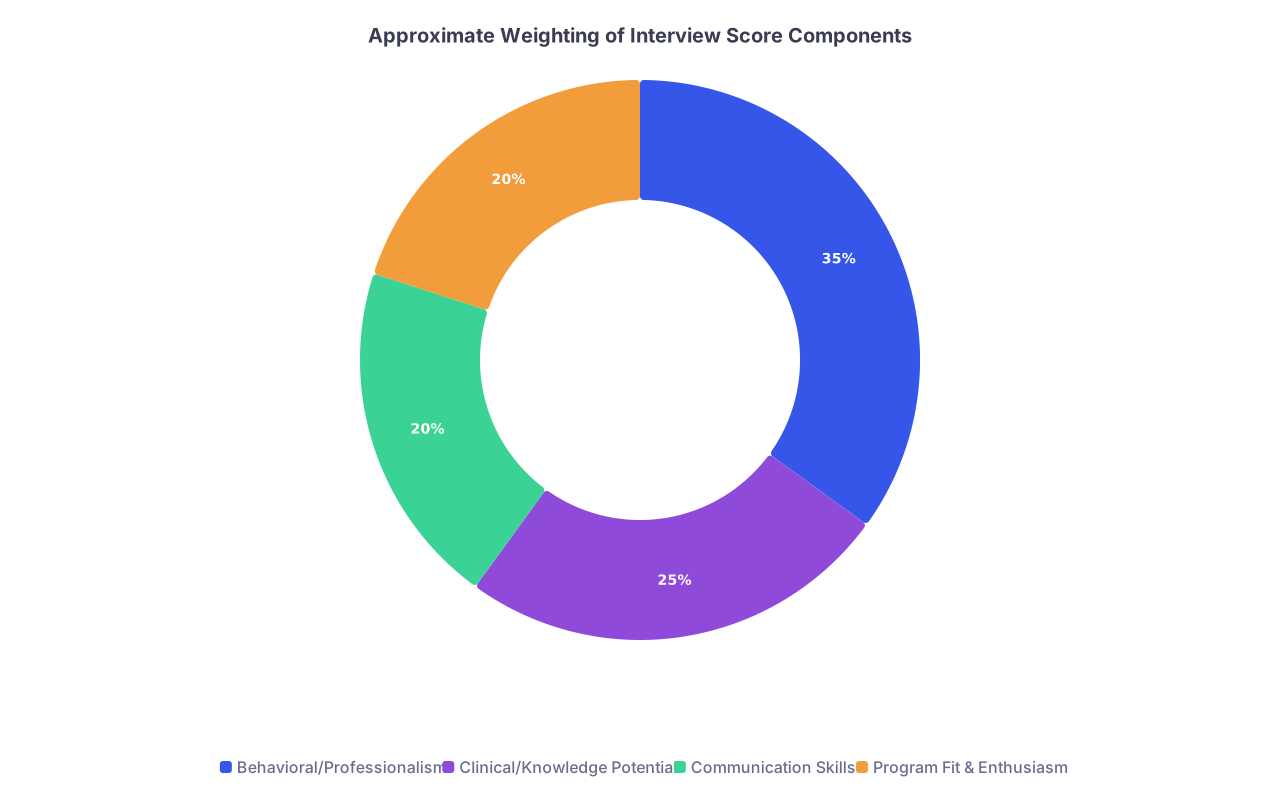
To make this more concrete, here’s how programs might internally weight things (not official, but close to what I’ve seen):
| Category | Value |
|---|---|
| Behavioral/Professionalism | 35 |
| Clinical/Knowledge Potential | 25 |
| Communication Skills | 20 |
| Program Fit & Enthusiasm | 20 |
That 35% behavioral/professionalism piece? That’s where all those “Tell me about a time…” questions land.
And when they do the big debrief weeks later, those comments from behavioral questions are what people remember. Not the generic “seems smart” stuff.
The Subtle Penalties That Applicants Never Hear About
There are a few patterns that quietly tank an otherwise solid interview. You will never get this feedback, but it gets written in your file.
1. The “Hero” Story That Backfires
You think you’re telling a story where you saved the day. What they hear is:
- You violated chain of command.
- You undermined your attending.
- You made yourself the star instead of the patient or team.
Example: “The attending wanted to discharge, but I knew the patient wasn’t ready, so I refused and told the family I disagreed.”
Debrief translation: “This person will go rogue and blame us to patients.”
2. The Chronic Externalizer
Every story: someone else’s fault.
- “The nurse didn’t document correctly.”
- “The senior didn’t support me.”
- “The system is broken.”
We all know the system is broken. The question is whether you take any ownership within that.
Programs will literally label you “external locus” or “low accountability” for this. I’ve seen it.
3. The Over-Disclosure Trap
Being honest is good. Trauma dumping is not.
Telling stories with intense personal content (mental health crises, huge medical errors, interpersonal drama) without tight framing and mature reflection makes people nervous. Not because they don’t care, but because they’re assessing stability and boundaries.
You want vulnerability with control. Not raw oversharing.
4. The “Perfect” Applicant With No Real Failures
If you cannot describe a single meaningful failure, mistake, or conflict, everyone in that room knows you’re either:
- Dishonest.
- Or dangerously unaware.
You won’t get a pity score for this. You’ll quietly be moved down.
What High-Scoring Behavioral Answers Actually Look Like
Let me give you a pattern that consistently earns high marks. Not as a script, but as a structure.
When asked behavioral questions, the applicants who score well tend to:
- Pick a specific, real story. Not generic.
- Show their initial, imperfect reaction honestly.
- Clearly state what they did and why.
- Reflect with insight on what they’d do better now.
- Connect it to residency: “This matters because as a resident I’ll need to…”
They sound like someone already halfway acting like a resident. Not like a med student reciting a prepped answer.
Interviewers write comments like:
- “Felt authentic. Good reflection.”
- “Clear sense of responsibility and growth.”
- “Already thinks like an intern.”
Those are the phrases that move your score column into the “we’d be lucky to have them” zone.
One More Layer: Program Culture and What They Prioritize
Different programs quietly care about different behavioral dimensions.
- High-volume, safety-conscious academic centers are obsessed with: accountability, systems thinking, and professionalism.
- Smaller community programs might focus more on: teamwork, humility, flexibility.
- Malignant or old-school cultures (yes, still exists) might perversely reward: toughness, tolerance of abuse, never showing weakness. You’ll feel it on interview day.
You can often sense what matters by:
- How the residents talk about “difficult interns” or past problem residents.
- What behavioral questions they emphasize.
- Whether they probe deeply on conflict vs. failure vs. ethics.
Smart applicants mirror back what that culture values, without faking who they are. If every question circles back to conflict with nurses and communication, you’d better have crisp examples there.
How to Practice in a Way That Actually Matches How You’re Scored
You don’t need perfect, polished stories. In fact, those often backfire as “too rehearsed.” You need real stories that hit the scoring dimensions: self-awareness, accountability, teamwork, communication, professionalism, growth.
The best way to rehearse?
- Record yourself answering common behavioral questions.
- Then watch it as if you are a PD asking: “Would I trust this person with my service at 2 a.m.?”
- Ask a resident or attending you trust (not your med school dean) to listen for: blame, vagueness, rambling, hero complex.
They should be ruthless. You’d rather bleed a little in practice than silently lose 20 rank positions because you came across as evasive or oblivious.
To visualize the process your answers go through from interview to rank list:

| Step | Description |
|---|---|
| Step 1 | You Answer Behavioral Questions |
| Step 2 | Interviewer Notes & Scores |
| Step 3 | Post-Interview Huddle |
| Step 4 | Composite Applicant Score Created |
| Step 5 | Ranking Committee Discussion |
| Step 6 | Final Spot on Rank List |
That’s the pipeline. Your stories get squeezed through each step.
FAQ: Inside the Debrief – 5 Questions You’re Probably Asking
1. Do interviewers really remember the details of my stories weeks later?
Not word-for-word. What they remember are the labels they wrote down: “strong insight,” “blamed others,” “great conflict management,” “low accountability.” Those shorthand impressions, created in the 1–2 minutes after your interview, are what survive into the ranking meeting. That’s why the pattern of your answers matters more than any single clever line.
2. Can one bad behavioral answer ruin an otherwise good interview?
If it hits a program’s core fear—like clear lack of accountability around patient safety, disrespect toward nurses, or obvious boundary violations—yes, it can tank you. More often, one weak answer just nudges your score down a bit. But if you consistently dodge responsibility or refuse to name real failures, you don’t just get “dinged.” You get branded as high-risk.
3. Do programs care if my examples are from earlier in medical school or even before med school?
They prefer clinical and recent, but they care more about how you think than the exact timestamp. A well-told M2 or pre-med story with sharp insight and clear growth will score better than a messy M4 story that’s vague or defensive. If you use older examples, you must bridge it: “Since then, as a sub-I, I’ve applied this by…”
4. Are scripted, perfectly polished answers a problem?
Yes, when they sound scripted. Interviewers are very good at spotting rehearsed language. If you speak in bullet points and clichés, you’ll be coded as “inauthentic” or “over-rehearsed.” The highest scorers know their key stories and lessons but tell them like a human, not like a YouTube interview coach. Imperfect but real beats slick and hollow every time.
5. If I think I messed up a behavioral question, should I email the program to clarify?
Almost always no. Sending a follow-up “clarification” reads as anxious and sometimes draws more attention to a moment that might have been forgotten. The exception: if you said something factually wrong about patient safety or your record, and you truly need to correct it. Otherwise, accept that everyone has one or two imperfect answers. Commit to doing better on the next interview, not trying to retro-edit the last one.
You’re going to walk out of some interviews feeling like you wrecked it, and still end up high on their list. You’ll leave others thinking you crushed it, and you’ll be buried.
The difference is rarely about sounding perfect. It’s about whether, when your name comes up in that quiet debrief room, people say:
“Solid. Accountable. Coachable. I’d work with them.”
If you can consistently tell real stories that show those traits—owning mistakes, learning out loud, working with people instead of against them—you stack the deck in your favor where it really counts: in the room you never see.
With that foundation, you’re not just performing for interview day. You’re already building the reputation you’ll carry into intern year. The next step is using this insight to refine your actual stories and practice sessions—so when the next interviewer says, “Tell me about a time…,” you know exactly what they’ll be writing down afterward. But that’s a conversation we’ll have in detail another day.