
It is 8:17 a.m. on interview day. You are in a conference room at a mid-tier IM program you actually like. The associate PD leans back, scans your ERAS, and asks:
“Tell me about a time you had a conflict with a team member. How did you handle it?”
You answer. You talk about a disorganized senior, a nursing miscommunication, and how the attending never listened. You think you sound honest.
You do not.
You sound like someone who blames other people.
I have watched applicants sink themselves in under two minutes, not with arrogance or low scores, but with subtle blame. They walk out thinking, “That went pretty well.” The faculty walk out thinking, “High maintenance. Needs everything to be perfect. Not our problem.”
You are not trying to throw anyone under the bus. But you are doing it. Accidentally. Let us fix that.
Below are seven very specific ways you shift blame in behavioral interview answers without realizing it—and how to stop before you wreck your chances.
1. Hiding Behind “We” So You Never Own Anything
You think you are being a team player. The committee hears something else: “I never take personal responsibility. I was just there.”
Here is how this sounds in interviews:
- “We decided to discharge the patient…”
- “We didn’t get the lab results back in time…”
- “We worked together to resolve it…”
Nothing technically wrong. But if the question was:
- “Tell me about a mistake you made”
- “Tell me about a time you had a conflict”
- “Tell me about a time something did not go as planned”
…and you answer almost entirely in “we” language?
Programs need to know:
- What you did
- What you learned
- How you changed your behavior next time
When you hide in “we,” it sounds like you are trying to dissolve responsibility into the group. That is a blame move. It says, “If something went wrong, it is spread across the team, so you cannot pin it on me.”
Do not make that mistake.
Fix it like this:
- Use “I” for your contributions, “we” for the team context
- Explicitly state your personal role, even if it was small
- Own error or limitation without dilution
Weak answer (blame-dodging by committee):
“We discharged the patient and then they came back septic. We didn’t realize they were deteriorating so quickly, but once we saw the labs we worked together to manage them in the ICU.”
Better answer (personal responsibility inside a team):
“Our team discharged the patient, and I was the one who presented them on rounds. I did not emphasize their borderline vitals and worsening pain as clearly as I should have. When they returned septic, I reviewed the chart and realized where my assessment had been incomplete. After that, I started explicitly flagging any concerning trends in my presentations and double-checking discharge criteria with my senior before proposing discharge.”
See the difference? Same event. One answer spreads blame into a fog. The other actually raises your stock.
2. Throwing “Difficult” People Under the Bus
Program directors are not impressed by how many “difficult” attendings, nurses, or classmates you survived.
Every time you label someone as:
- “Difficult”
- “Toxic”
- “Unreasonable”
- “Very emotional”
- “Not a team player”
…you are telling the interviewer how you talk about colleagues behind their backs. How you will talk about them when you leave the room.
The sneaky version is softer but just as bad:
- “The nurse was upset for some reason…”
- “The attending just did not listen…”
- “My classmate was not willing to help…”
You think you are describing context. It sounds like blame.

What to do instead:
Describe behavior, not character.
- Bad: “The nurse was difficult to work with.”
- Better: “The nurse strongly disagreed with the plan to discharge and felt her concerns were not being heard.”
Acknowledge their perspective as at least partially valid.
- “From her perspective, the patient did not look stable to go home, and she had seen similar situations deteriorate before.”
Center your response, not their flaws.
- What did you do with the disagreement?
- How did you adjust your communication?
- What did you learn about interprofessional dynamics?
Damaging answer:
“I had a conflict with a nurse who was very difficult and constantly questioned orders. It made it hard to work with her, but I stayed professional and followed the attending’s plan.”
Better answer:
“I had a situation where a nurse strongly disagreed with our discharge plan. She felt the patient was not as stable as our note suggested. I initially felt defensive, but I realized she was seeing the patient at the bedside for much longer stretches than I was. I asked her to walk me through her concerns, presented them clearly to my senior, and we agreed to observe the patient a bit longer. That experience pushed me to proactively ask nurses for their impressions before rounds, instead of only reacting when there is a disagreement.”
In the second answer, nobody is under the bus. You still look like you can advocate, collaborate, and adjust.
3. Hiding Behind Systems to Avoid Personal Growth
The laziest form of blame is vague “system” talk:
- “The system failed the patient.”
- “There were communication breakdowns.”
- “The process is not very efficient.”
- “Our EMR makes it hard to…”
Might be true. Still unhelpful in an interview.
When a program director hears you blame “the system,” they think:
- Is this person going to complain about our workflows constantly?
- Are they capable of reflecting on their own next step?
- Or is every problem someone else’s policy?
You are not interviewing for a QI fellowship; you are interviewing to be someone they trust at 2 a.m. with limited support. They want to know what you do in an imperfect system. Everyone has a bad EMR.
The trap answer:
“The situation happened because our sign-out system is not great and there is no standard template. Things get lost all the time, so that is how this handoff error happened.”
All I hear: “Not my fault. It is the system. Shrug.”
Better structure: system + self:
- Briefly acknowledge the system factor (1 sentence).
- Spend most of the answer on:
- What you personally missed or could have done better.
- What you concretely changed after.
Stronger answer:
“We did not have a standardized sign-out template, and a key follow-up lab for my patient was buried in the text. I realized I had not highlighted it clearly for the night team. After the near-miss, I started using a consistent structure in my sign-out with a separate ‘critical tasks’ section, and I suggested a simple template our team adopted for the rest of the rotation.”
That is what they want: “Imperfect system, but here is how I got better anyway.”
4. Overusing Passive Voice to Erase Yourself
Listen to your own practice answers. If they sound like this:
- “The patient was not followed up appropriately.”
- “The orders were not entered correctly.”
- “The discharge was delayed.”
- “Communication was not optimal.”
You are dodging.
Passive voice is a classic defense move. It removes the actor:
- Not “I missed the lab.”
- Instead: “The lab was not seen.”
Residency interviewers are not grammar police, but they are pattern detectors. If your answers consistently erase your role when something goes wrong, you look slippery.
Concrete examples of blame-through-passive:
- “The wrong medication was given” instead of “I wrote the wrong dose.”
- “The patient’s concern was not addressed” instead of “I did not ask enough follow-up questions.”
- “Expectations were not clearly communicated” instead of “I never clarified expectations with my senior.”
You think you are being “professional.” You are just avoiding ownership.
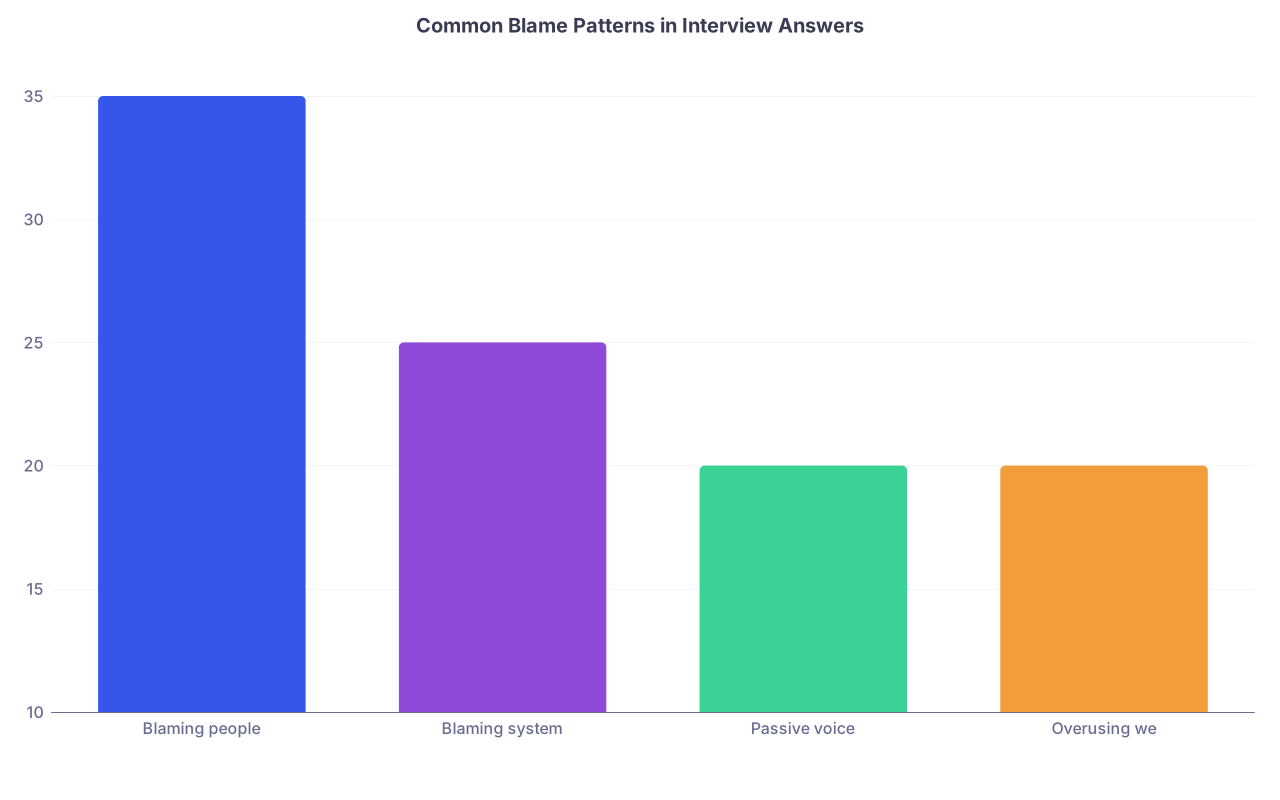
| Category | Value |
|---|---|
| Blaming people | 35 |
| Blaming system | 25 |
| Passive voice | 20 |
| Overusing we | 20 |
Better pattern:
- Use clear “I” statements when describing your contribution.
- Use “I could have…” or “I did not…” when you describe the error.
- Then show what you did differently afterward.
Example fix:
Weak:
“The lab was not checked before the patient went to the OR, and unfortunately the abnormal value was only found post-op.”
Strong:
“I did not recheck the pre-op lab before the patient went to the OR. It was my oversight. After that case, I created a simple pre-op checklist for myself and started verifying critical labs at the same time I confirmed consent and site marking.”
Faculty respect that. You are honest, specific, and clearly trainable.
5. Turning “Conflict” Questions Into Character Assassinations
“Tell me about a conflict with a colleague” is one of the most dangerous questions in residency interviews.
Here is how many applicants mis-handle it:
- They waste 80% of the answer describing how unreasonable the other person was.
- They give a long backstory about how the other person “always” did this.
- They emphasize how right they were and how wrong the other person was.
By the end, the interviewer has learned almost nothing about:
- Your communication style
- Your ability to de-escalate
- Your capacity to compromise or set boundaries professionally
All they know is that when asked about conflict, your default is to attack the person who is not in the room.
Example of an answer that quietly blames:
“On surgery I worked with a senior resident who constantly belittled students and made us stay late without teaching. I confronted him about it, but he refused to change. It was very frustrating because I care about education and he clearly did not.”
You might feel morally correct here. You still sound like someone who will be a headache when the environment is less than ideal (which is always).
Turn it into growth, not judgment:
- Brief set-up of the conflict (brief, not a rant).
- Focus on your behavior:
- How you prepared for the conversation.
- What you actually said.
- How you adjusted after.
- Show respect for complexity, even if the other person behaved poorly.
Better answer:
“On surgery I had a senior who gave very little feedback and often dismissed questions. I initially complained to classmates, which did not change anything and just made the team feel more negative. I scheduled a brief check-in with him and said, ‘I really want to improve. Could we set one specific thing for me to focus on each day?’ He agreed, and although his style did not completely change, I got more concrete feedback and the rotation became more productive for me. It also pushed me to address issues directly instead of only venting sideways.”
Here, you are not pretending the senior was perfect. But you are not using the question as a platform to vent. You are demonstrating maturity.
6. Using “Miscommunication” as a Shield Instead of a Mirror
“Miscommunication” is one of the most overused words in residency interviews. It sounds neutral. Non-judgmental. Safe.
It is not.
When you say:
- “There was a miscommunication with the nurse.”
- “We had a miscommunication about follow-up.”
- “Due to miscommunication, the patient stayed longer.”
You are usually doing one of two things:
- Blaming the other person while pretending not to:
- Translation: “They misunderstood me.”
- Hiding your own unclear communication:
- Translation: “I was not precise, but I do not want to say that.”
The committee needs the specific truth:
- Did you use vague language?
- Did you fail to close the loop?
- Did you assume understanding without confirming?
- Did you document poorly?
That is what they care about. Those are things that will matter at 3 a.m. on night float.
Weak, blame-y answer:
“There was a miscommunication with the pharmacy and the antibiotic was not started until later.”
Better, ownership answer:
“I placed the antibiotic order but did not mark it as STAT or call the pharmacy despite the patient’s condition. I assumed the regular processing time would be fast enough. It was not. After that, for any unstable patient I started explicitly clarifying urgency in my orders and closing the loop with a direct call.”
Specific. Concrete. No smokescreen.
Replace “miscommunication” with details like:
- “I did not confirm that the nurse had seen the order.”
- “I used vague language instead of giving a clear time frame.”
- “I assumed the consultant understood our question without summarizing it.”
- “I did not know the standard protocol and failed to ask.”
Yes, it feels more exposing. That is exactly why interviewers trust it.
7. Making Yourself the Hero and Everyone Else the Obstacle
This is subtle but deadly.
Some applicants frame every story like this:
- They are the insightful one.
- Everyone around them is shortsighted, rigid, or oblivious.
- They “pushed” the team to do the right thing repeatedly.
On paper, that sounds like leadership. In an interview, it often sounds like ego wrapped in faux advocacy.
Common patterns:
- “No one else noticed the patient was deteriorating, but I…”
- “The team wanted to discharge, but I convinced them…”
- “Everyone was ready to give up on the patient, but I…”
A little of this is fine. If every story has this arc, you are the common denominator.
Program faculty are not foolish. They know students do not run the service. If you describe yourself as constantly correcting attendings, convincing seniors, and saving patients from nurses’ oversights, it sounds inflated at best, dishonest at worst.
| Element | Hero Narrative Version | Collaborative Version |
|---|---|---|
| Role of others | Obstacles, wrong, unaware | Partners with different perspectives |
| Your tone | “I fixed it” | “I contributed meaningfully” |
| Faculty reaction | “Inflated ego, poor insight” | “Growth mindset, realistic self-view” |
| Match risk | High if repeated across multiple answers | Much lower |
Hero-style answer (sounds like blame + ego):
“The team was going to send a patient home, but I noticed the creatinine was creeping up and pushed hard to keep them. Nobody else seemed concerned, but I insisted, and it turned out I was right.”
Better, collaborative version:
“Our team was considering discharge for a patient, and I noticed their creatinine had risen from baseline and their urine output was borderline. I brought my concern to my senior, framing it as, ‘I might be over-cautious, but I am worried about X and Y. Would you mind re-evaluating with me?’ We re-examined the patient, discussed with the attending, and decided to observe another day. That reinforced for me that speaking up is important, but how you bring concerns forward—with humility and specific data—affects how they are received.”
Same event. In the second answer:
- You are not the lone genius.
- The team is not incompetent.
- You still look good.
How to Scrub Blame from Your Answers Before Interview Day
You can rehearse 50 answers and still sound blame-heavy if you never audit your language.
Here is a quick, brutally effective process:
Record yourself answering 5 common behavioral questions:
- Conflict with team member
- Mistake you made
- Time you received critical feedback
- A difficult patient / family interaction
- Time something did not go as planned
Play them back and literally tally:
- How often you say “they,” “the nurse,” “the attending,” “the system,” “we”
- How often you say “I” when describing what went wrong
Mark every place where you use:
- “Miscommunication”
- Passive voice (e.g., “was not done,” “was missed”)
- Global judgments (“difficult,” “toxic,” “unreasonable”)
Rewrite those sentences to:
- Describe your own specific actions or missed actions.
- Describe others’ perspectives instead of their personalities.
- Show 1–2 concrete behavior changes you made after.
If you do this once, properly, your answers will immediately sound more mature and more trustworthy than half the applicant pool. Because very few people are willing to explicitly own their role in problems.
Those are the ones faculty remember—in a good way.
The Bottom Line: Three Things to Remember
Residency interviews are not about proving you are always right. They are about proving you can own your part when things go wrong, without collapsing into self-defense or blame.
Blame leaks through in your language. Watch for: hiding behind “we,” passive voice, vague “miscommunication,” and constant stories where you are the hero and everyone else is the problem.
Specific ownership beats generic system talk every time. Name what you did, how you changed, and what you now do differently. That is what makes people want you on their team at 3 a.m., when it actually matters.