
The way you answer “Tell me about a mistake you made” will kill more interviews than a mediocre Step score ever will.
I’ve watched it happen, over and over, from the other side of the table. Applicant has great numbers, strong letters, polished handshake. Then this question comes. They freeze. Or deflect. Or give some shallow “I care too much” nonsense. You can feel the room go cold.
Let me tell you what’s really going through a program director’s mind when you mishandle this question – and how to stop silently tanking your rank list spot.
Why PDs Love This Question (And Why You Should Fear It)
This isn’t a creativity test. It’s a safety test.
Program directors use this question to answer one core concern:
“If I give you a pager and my patients, what happens when you screw up?”
Because you will. Everyone does. What matters is how you behave when you inevitably make a mistake. That’s the whole ballgame.
Here’s what they’re actually probing:
- Are you honest when it’s uncomfortable?
- Do you recognize real clinical risk, or are you naive?
- Do you blame others or own your decisions?
- Can you analyze your own behavior without crumbling?
- Did you actually change anything afterward?
They don’t care whether your story is “big enough” or “dramatic enough.” They care whether, in the story, you act like someone they trust at 2 a.m. when nobody’s watching.
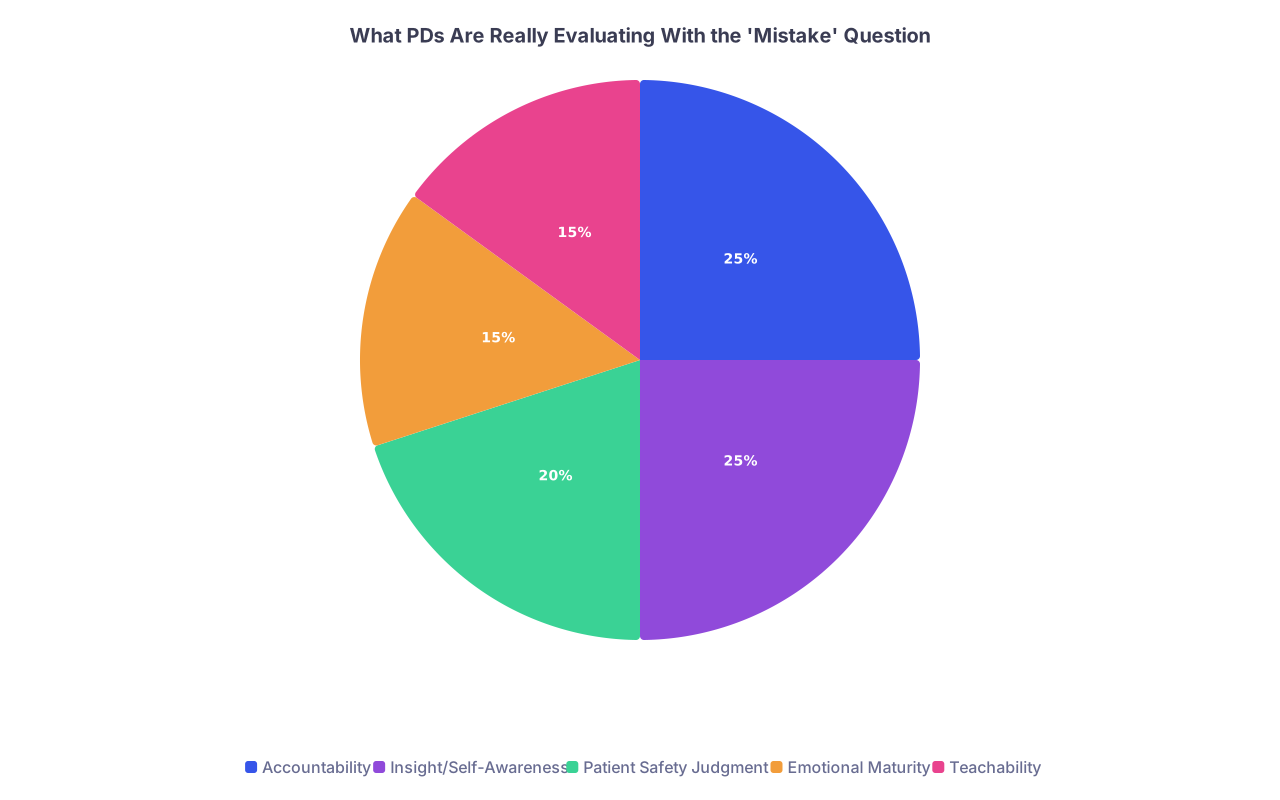
| Category | Value |
|---|---|
| Accountability | 25 |
| Insight/Self-Awareness | 25 |
| Patient Safety Judgment | 20 |
| Emotional Maturity | 15 |
| Teachability | 15 |
Most students completely misunderstand that.
They think the goal is: “Show I’m competent and don’t screw up.” Wrong goal. That answer makes you look dangerous, not impressive.
The Non-Answers That Quietly Sink You
Let’s walk through the classic disasters. I’ve seen every one of these in real interviews, including at “prestige” programs where you’d think applicants would know better.
1. The “I Don’t Really Have a Big Mistake” Answer
You say:
“I can’t think of a major mistake, but I’m very careful and double-check my work…”
Here’s exactly what the PD hears:
- You lack insight into your own performance.
- You’re either dishonest or dangerously unaware.
- You will hide errors or fail to recognize them.
- You will be a patient safety problem.
You just told a room full of physicians, who have all made painful errors, that somehow you have floated through training without a meaningful mistake. That’s not impressive. It’s delusional.
The unspoken conclusion: “High risk. Not worth it.”
2. The Paper-Thin “I Care Too Much” Mistake
This one is epidemic.
“My biggest mistake is that I care too much and sometimes I take on too much work because I’m so dedicated…”
Transparent. Contrived. Insulting to their intelligence.
Program directors talk to each other. We hear the same “weakness” and “mistake” clichés like a broken record. When you give a fake, self-flattering “mistake,” they infer two things:
- You think this is a game and you’re trying to manipulate them.
- You either cannot or will not examine yourself honestly.
That’s far worse than admitting a real, bounded mistake.
3. The Blame-Shifting Story
Common version:
“There was this one time the resident didn’t tell me the plan clearly, and the nurse also misunderstood, so the patient didn’t get their meds on time…”
You think you’re being “nuanced.” They think you’re a problem.
When you spend half the answer describing what other people did wrong, you’ve just revealed your default setting under stress: protect your ego, not your patient.
I’ve seen PDs write one-word notes after these answers: “BLAME.” I’ve seen otherwise solid applicants sink an application with one over-defensive mistake story.
4. The Trauma Dump
On the other end of the spectrum, some of you go too big:
- Talking about an unreported near-miss you hid.
- Admitting you lied in documentation and didn’t correct it.
- Describing a massive professionalism violation as “a mistake.”
You’re not being authentic. You’re waving a red flag that says, “I don’t understand risk stratification.” They don’t want saints. They want people who know the difference between an honest, contained error – and a pattern of seriously poor judgment.
5. The Emotionless Robot
You give a technically clean story:
- The mistake is clear.
- The timeline is clear.
- The outcome is neutral.
But your affect is flat. No discomfort. No gravity.
That bothers faculty more than you realize. Because we know how real mistakes feel. If you talk about a patient-related error like you’re reciting a shopping list, we start asking:
- Does this person feel appropriate responsibility?
- Are they too detached?
- Will they connect emotionally with consequences?
You don’t need to cry. But if there’s zero visible emotional engagement, it reads as either rehearsed or callous. Both are bad.
What PDs Quietly Infer About You From Your Answer
You’ve got to understand the mental math they’re doing while you talk. They’re not grading your content like a school essay. They’re projecting you forward into residency.
Program directors sit through dozens of these answers in a season. Patterns jump out. After a while, you start categorizing applicants subconsciously.
Here’s the internal translation:
| What You Say / Do | What They Infer About You |
|---|---|
| “I can’t really think of a mistake…” | Poor insight, unsafe, ego problem |
| Blame resident / nurse / system repeatedly | Defensive, hard to coach, will cause conflict |
| Tiny, trivial “mistake” (e.g., typo on note) | Avoidant, superficial reflection |
| Real mistake + clear ownership + change in behavior | Mature, safe, teachable |
| Over-dramatic, boundary-violating story | Unstable judgment, risk to program |
| Very polished, over-rehearsed language | Scripted, unknown authentic self |
Behind the scenes, the conversation after you leave the room sounds like this:
“Good numbers, but did you hear that mistake answer? She danced around it and never took responsibility.”
Or:
“His mistake story was actually pretty serious, but the way he broke it down and what he changed after – I’d trust him on nights.”
The story matters. The processing of the story matters more.
What a “Good” Mistake Story Actually Looks Like
Let me reconstruct what strong applicants do differently. They hit five beats, usually without even realizing it.
1. They Pick a Real, Moderate-Impact Mistake
Not catastrophic. Not trivial.
The sweet spot is: something that mattered for patient care or team functioning, but did not cause irreversible harm. Think:
- Missed a pending lab result on pre-rounds that delayed a consult.
- Miscommunicated follow-up instructions leading to a near-miss.
- Failed to speak up when unsure about a med dose until later.
I’ve heard good ones from neurology, EM, IM, surgery, you name it. The content varies. The structure is the same: a real, consequential-but-containable error.
Red flag I’ve heard from PDs: If every example you give in interviews involves “the nurse did X” or “the resident didn’t tell me Y,” they assume you have a chronic externalization problem.
2. They State the Mistake Clearly and Plainly
Weak phrasing:
“There was a situation where things could have gone better…”
Strong phrasing:
“I made a mistake in not verifying the patient’s medication list, which led to…”
You name it. You own it.
Faculty listen for the word “I.” Not “we,” not “the team.” “I missed… I failed to… I didn’t…”. If you dodge that pronoun, their trust in you drops.
3. They Acknowledge the Clinical or Human Impact
You don’t have to turn it into a drama, but you must show you understand the stakes.
Bad:
“It didn’t really affect anything in the end.”
Better:
“Fortunately, the resident caught it before it harmed the patient, but the delay increased the patient’s time in the ED and understandably affected their trust.”
That line – “fortunately” – is a subtle way of signaling: “I understand this could have been worse.” PDs like that. It shows you have a safety lens.
4. They Show the Internal Process, Not Just the External Fix
Most weak answers jump straight from “I made a mistake” to “I fixed it by doing X.” You’re skipping the part PDs care about: your cognitive and emotional work.
They want to hear:
- What you realized about yourself.
- How uncomfortable it was.
- What made that moment stick in your memory.
You don’t need to monologue, but a line or two like:
“I was embarrassed, honestly, because I’d prided myself on being thorough. It forced me to confront that thoroughness is a habit, not a trait – and my ‘habit’ had gotten sloppy on a busy day.”
That shows actual reflection. That’s what separates safe residents from dangerous ones.
5. They Describe a Concrete, Sustainable Change
Absolutely critical.
Saying, “Since then I’ve been more careful” is useless. Everyone says that. It’s noise.
You need a behavior. A procedure. A checklist. Something with edges.
For example:
“Now, before presenting in the morning, I run through a specific three-step checklist: new meds, overnight events, and pending labs. I physically check them off in my sign-out sheet. I haven’t missed a critical lab since.”
That’s what PDs are hunting for: Are you the kind of person who builds systems around your weaknesses?

Two Real-World Style Examples: Bad vs Strong
To make this concrete, here’s what they actually hear.
The Weak Answer
“Um, a mistake I made… I guess one time on my medicine rotation there was some confusion about a patient’s dose of Lovenox. The resident had told me one thing, but the nurse thought it was something else, and the order ended up not being put in until later. In the end, it was fine and the patient wasn’t harmed. I learned the importance of communication and being very careful to make sure everyone’s on the same page.”
What the committee writes down:
- Vague timeline.
- No clear ownership.
- Blaming resident + nurse.
- No specific change in behavior.
- “Communication” platitude.
Now compare it to a stronger version of almost the same event.
The Strong Answer
“On my medicine sub-I, I made a mistake with anticoagulation timing that could have delayed a patient’s care.
A patient with new-onset atrial fibrillation was admitted overnight. On pre-rounds, I reviewed the H&P and understood we were planning to start therapeutic Lovenox. I assumed the resident would put in the order, and I didn’t verify it in the chart before rounds. By mid-morning, the nurse asked about the dose, and we realized no order had been placed yet. The patient ended up receiving the first dose several hours later than intended.
The resident and attending were very clear that the patient was ultimately fine and that the delay was not catastrophic, but I was uncomfortable with the role I played. I’d told myself I was ‘just the student,’ but I knew better – I knew the plan and I didn’t speak up or confirm orders.
Since then, any time I know an important management step is planned – anticoagulation, antibiotics, imaging that changes dispo – I check the chart myself before rounds to confirm it’s either ordered or we’re actively deciding against it. I keep a running list in my notebook of “must-happen-today” items and I cross-check it with orders before noon. That habit has already helped me catch a few near-misses, and I plan to keep that system in residency.”
What they infer:
- Takes ownership.
- Grasps clinical significance.
- Feels appropriate responsibility.
- Built a concrete system around the failure.
- “Resident-level thinking,” not passive student.
Same basic event. Completely different signal.
The Subtle Things PDs Watch While You Answer
Content aside, they’re studying you during this question more closely than most others. A few tells they pick up:
Your Initial Reaction
Do your eyes dart? Do you freeze? Do you visibly brace?
If you look like you’re panicking because someone asked you to reveal imperfection, they predict you’ll behave the same way on the wards. And they hate residents who hide mistakes.
The best applicants have a micro-moment of “okay, here we go,” then step into the story. Calm. Not defensive.
How Long You Take
You’re allowed a 2–3 second pause. That’s normal.
But if you sit there for 10 seconds sifting through excuses in your head, they notice. Either you didn’t prepare (which tells them you didn’t respect the interview), or you don’t want to share truth.
On the flip side, answering instantly with a perfectly polished speech you’ve clearly rehearsed verbatim can also rub the room wrong. They start wondering how much is genuine.
Your Body Language When You Say “I”
Watch yourself on video sometime answering this. Most people lean back and glance away right when they say “I made a mistake.” Their body tries to escape.
PDs don’t analyze microexpressions like FBI profilers, but they do notice whether you shrink or stay present while admitting fault. Confidence plus humility is rare. When it shows up, they highlight your name.

| Step | Description |
|---|---|
| Step 1 | Hear Mistake Question Answer |
| Step 2 | Assume Defensive / Low Insight |
| Step 3 | Assume Naive to Risk |
| Step 4 | Assume Limited Growth |
| Step 5 | Safe, Teachable, Rank Higher |
| Step 6 | Clear Ownership? |
| Step 7 | Understands Impact? |
| Step 8 | Concrete Change Described? |
How To Build Your Own Strong Answer (Without Sounding Scripted)
You do not need to invent some perfect story. You need to pick one real event and structure it.
Use this rough framework in your prep – not as word-for-word lines, but as scaffolding.
One sentence: Set the context.
“On my [rotation] we were managing a patient with [issue].”Two to three sentences: State the mistake plainly.
“I did X / failed to do Y. As a result, Z happened (or almost happened).”Two to three sentences: Show your emotional and cognitive reaction.
“I realized… I felt… It forced me to see that…”Two to four sentences: Describe the concrete change.
“So I started doing… Now, in similar situations, I… It’s changed how I…”
Then stop. Don’t over-explain. Don’t keep apologizing. Own it, show growth, move on.
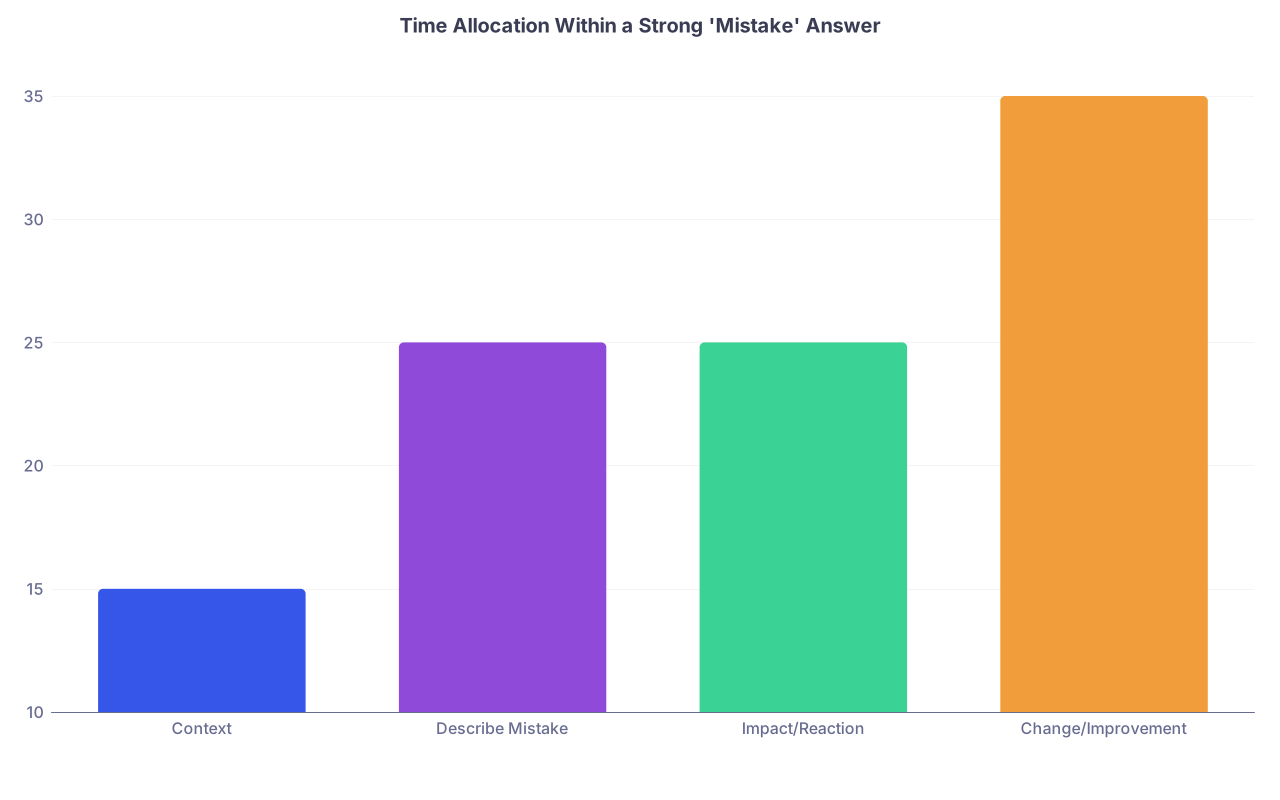
| Category | Value |
|---|---|
| Context | 15 |
| Describe Mistake | 25 |
| Impact/Reaction | 25 |
| Change/Improvement | 35 |
Practice enough that you can hit those beats in under two minutes with natural language. If it sounds like a monologue you’ve memorized, loosen it up. Program directors care more about your thinking than your wording.
The Biggest Hidden Risk: Picking the Wrong Category of Mistake
There’s one more insider detail most people never tell you: the type of mistake you choose sends its own message.
There are roughly four “buckets” your story might fall into:
- Clinical judgment / patient safety
- Communication / teamwork
- Professionalism / reliability
- Knowledge gap
PDs don’t rank these perfectly the same, but here’s the general hierarchy of what’s “safer” to admit, assuming the mistake is bounded and you grew from it:
- Communication / teamwork issues → Very common, very fixable, usually safe.
- Knowledge gap → Expected at student level, safe if you show how you learned.
- Mild clinical judgment lapses (with catch / near-miss) → Acceptable if you show serious reflection and new safeguards.
- Professionalism / reliability issues → High risk. Tread very carefully.
You do not want your big story to be:
- “I chronically showed up late for weeks.”
- “I yelled at a nurse in front of a patient.”
- “I plagiarized part of a note.”
Could you technically rehabilitate those with enough contrition and behavior change? Maybe. But why choose that hill to die on when you’ve got other genuine, less radioactive mistakes to work with?
You’re not in a confessional. You’re in a job interview. Be honest, but also be smart.

FAQs
1. Does the mistake have to be from a clinical setting, or can it be pre-med / personal?
For residency interviews, use a clinical or at least medical-school context if at all possible. PDs are hiring you as a physician, not as a college student. A work or leadership-related mistake can work if it clearly translates to how you function on a team, but a well-chosen clerkship or sub-I story is usually stronger because it shows how you behave with actual patients and teams.
2. How “big” should the mistake be?
Moderate. That’s the sweet spot. Something that mattered – it affected workflow, trust, or had real potential for patient impact – but didn’t result in catastrophic harm or require formal remediation. If it’s so minor that it’s basically a non-event, you look evasive. If it’s huge and ethically ugly, you look like a ticking time bomb. Aim for “real but rectifiable.”
3. Can I reuse the same mistake story for multiple programs?
Yes, and most people do. The key is to own it well enough that you can adapt it to the room. If a program has a strong patient safety or QI culture, you can lean into the systems-learning side. If they’re big on teamwork, emphasize communication. The core event can stay the same; the emphasis can shift slightly depending on what they care about.
4. What if my mistake involved a resident or attending doing something questionable too?
Then mention their role briefly only if it’s necessary for context, and immediately pivot back to your responsibility. Something like: “The resident and I had different assumptions about who’d enter the order, but I should have clarified instead of assuming.” The moment you sound like you’re building a case against them, you’re done. PDs are allergic to blame narratives.
5. Is it okay to show emotion or say the mistake still bothers me?
Yes, in measured form. Saying, “I still think about that patient sometimes; they really stuck with me,” reads as human and appropriate. Breaking down or turning the answer into a therapy session does not. The line you’re walking is: emotionally engaged but functionally stable. They want to see that mistakes weigh on you enough to change your behavior – but not so much that you’ll fall apart under normal residency stress.
Remember: PDs are not looking for the applicant who never errs. They’re looking for the one who can say, “I screwed this up, here’s how it affected care, and here’s exactly what I do differently now.” You show that, and you stop being a risk – you become a resident they can trust when things inevitably go wrong.