
You are not losing interviews because your stories are bad. You are losing them because you do not know when to shut up.
I have watched brilliant applicants talk themselves from “rankable” to “hard pass” in under three minutes. Not because they were arrogant. Not because they were weird. Because they rambled. Behavioral interviews are brutal that way: the more you talk, the more rope you give the committee to hang your application with.
If you are applying to residency, you cannot afford this mistake.
This is not about being “more confident” or “more yourself.” This is about not triggering the three silent thoughts that kill you in an interviewer’s mind:
- “This person will overwhelm patients.”
- “This resident will not be concise on rounds.”
- “I do not want to sit next to them on a 24-hour call.”
Let me walk you through the specific behavioral answer patterns that quietly sink candidates every cycle—and how to stop doing them before you walk into your next Zoom or in‑person interview.
The Number One Red Flag: The 5-Minute Story To A 30-Second Question
Interviewers will rarely cut you off. They will instead silently down-rank you for “communication” and “professionalism.”
The classic pattern looks like this:
Question: “Tell me about a time you had a conflict with a team member.”
You start well: “During my surgery rotation, the senior resident and I disagreed about…”
Then you keep going. And going. And going.
You add the attending’s entire backstory. You explain the hospital context. You start apologizing for how you felt. You re-describe the same point three different ways. By minute three, the interviewer has stopped listening and is waiting for you to exhaust yourself.
The quiet evaluation in their head: “Lacks focus. Will ramble on rounds. Will not give succinct sign-out.”
How to avoid this
You need a structure that forces you to stop. STAR (Situation–Task–Action–Result) works, but most applicants misuse it by bloating the “Situation” and “Task.”
Think:
– Situation = 1–2 sentences
– Task = 1 short sentence
– Action = 2–4 sentences
– Result/Reflection = 2–3 sentences
If your “Situation” is longer than your “Action,” you are already in trouble.

| Step | Description |
|---|---|
| Step 1 | Hear question |
| Step 2 | Ask for a moment, pick simpler story |
| Step 3 | State situation in 1-2 sentences |
| Step 4 | State your role/task in 1 sentence |
| Step 5 | Describe 2-4 key actions |
| Step 6 | Give result + reflection in 2-3 sentences |
| Step 7 | Stop talking |
| Step 8 | Do you know the story? |
Practice ending. Literally. Say your final line, then stop. If you feel an urge to add “and also…”—that is the reflex that’s been hurting you.
Pattern #1: The Autobiography Answer
Symptoms:
- You start at “First year of medical school…” when the question was about “a time you made a mistake.”
- You feel compelled to explain all your context: your background, your previous training, your family situation.
- You hear yourself saying, “To give you some background…” more than once per answer.
Interviewers do not need your life story. They need one clear, recent example that answers the question. Everything else is noise.
This pattern is dangerous because it sounds impressive to you. You are “showing growth” and “sharing your journey.” To an interviewer on their eighth Zoom slot of the day, it sounds like: “This person does not know what is relevant.”
Fix: Ruthless time boxing
Set a hard rule: you get 15–20 seconds maximum for background.
That usually means:
- Where (rotation / setting)
- Who (your role)
- What (the conflict / challenge / mistake)
Then move on. If the story requires you to explain three months of context, it is the wrong story.
Try this before your interview: record yourself answering, “Tell me about a time you failed.” Look at the timestamp when you finish “background” and first describe what you actually did. If that point is past 25–30 seconds, you are in the autobiography trap.
Pattern #2: The Emotional Spiral
You get a behavioral question about conflict, feedback, or burnout. Instead of describing the situation and your actions, you slip into a feelings monologue:
- “I felt really overwhelmed…”
- “I just felt like I was letting everyone down…”
- “It was really, really stressful…”
- “I kept thinking, what if I am not cut out for this…”
Your answer becomes a therapy session instead of a professional reflection.
Interviewers do want authenticity. They do not want emotional dumping. They are thinking: “How will this person handle stress when my pager is exploding and three admissions are waiting?”
The danger: you confuse honesty with over-disclosure. That scares programs. They start wondering about your resilience, your boundaries, and whether they are about to hire a future HR problem.
Fix: Emotion as seasoning, not the main dish
A strong answer acknowledges emotion in 1–2 precise sentences, then pivots to behavior and learning.
Bad pattern:
“I was so anxious… I could not sleep… I kept replaying it over and over…”
Better pattern:
“I was embarrassed and worried I had lost my attending’s trust. So I asked to meet with her the next day to review what happened and what I needed to do differently.”
Use feelings to show you are human. Then transition immediately to what you did and what changed as a result.
A good test: If a transcript of your answer uses the word “felt” more than three times, you are probably spiraling.
Pattern #3: The Laundry List (“I did a, and b, and c, and also…”)
This one fools high-achieving applicants every year.
You get: “Tell me about a time you led a team.”
You think: “I must show everything I did as a leader.”
So you create a grocery list of actions:
“I organized the schedule, and I also created a spreadsheet, and I set up a group chat, and I made sure everyone was included, and I also checked in with people individually…”
By the end, none of it sticks. No single action feels meaningful because you drowned the interviewer in twelve small ones.
Programs do not need to hear every subtask. They need to understand your thinking and your impact.
Fix: Pick 2–3 actions and go deeper
Answer like this:
- Name the central problem in 1 sentence.
- Name your approach (“I focused on…”).
- Choose 2–3 representative actions that support that approach.
- Then show a concrete result.
You are aiming for coherence, not completeness.
If your answer feels like you are reading your CV out loud with “and then” between bullet points, you are listing, not leading.
Pattern #4: The Tangent Cascade
You start on track. Then one detail reminds you of another. You follow it. Then another.
By minute four you are talking about a side story you never needed to mention.
Interviewers see this as a thinking problem. Not a personality quirk. On call, tangents mean missed information and unsafe handoffs. On rounds, they mean delayed decisions and annoyed attendings.
Red flags you are doing this:
- You literally say “Oh, and I forgot to mention…”
- You backtrack: “I should probably explain that part better…”
- You add new characters halfway through who do not change the outcome.
Fix: Decide the endpoint before you start
Before you open your mouth, identify your final line in your head.
Example:
“I’ll end on: ‘That experience changed how I approach conflict by…’”
Now everything in your answer must serve getting to that final point. If a detail does not clearly support that, you leave it out.
Also, never add new information after your “result” sentence. The story ends where the reflection ends. Anything after that sounds like an afterthought or a cover-up.
Pattern #5: The Hero Epic (You Star In Every Scene)
You think you are “showing initiative.” The interviewer thinks you are self-centered and possibly hard to work with.
Typical signs:
- Every sentence starts with “I.”
- The team magically disappears once you show up.
- Other people exist only as obstacles or extras in your narrative.
In residency, medicine is a team sport. Programs are extremely wary of people who sound like solo operators or saviors.
The danger: Overcompensating. You are terrified of sounding passive, so you push too hard on how crucial you were. The result is an answer that sounds inflated or ego-driven.
Fix: Balance “I” and “we” on purpose
You must show both:
- “We” for collaboration and respect.
- “I” for ownership and accountability.
A simple rule: every time you describe a success, explicitly mention at least one contribution from someone else, and then your specific role.
Example:
“Our intern caught the medication error, and the pharmacist quickly verified the interaction. I took responsibility for updating the order set and creating a short reminder for our night team, so the same mistake would not repeat.”
You are not less impressive for acknowledging the team. You are more trustworthy.
Pattern #6: The Vague Morality Tale
This one is subtle. The story is short enough. You are not overly emotional. But your answer sounds like a Hallmark card instead of a specific event.
Clues:
- “I learned the importance of communication.”
- “At the end of the day, it is all about patient-centered care.”
- “I realized you need to work as a team.”
Those sentences are meaningless without evidence. Every applicant claims those values. Programs care whether you can show them through behavior.
The vague answer leaves the interviewer with nothing to write in the notes except “generic reflection.”
Fix: Put numbers, concrete changes, and “before vs after”
Strong behavioral answers have at least one of:
- A specific metric or concrete outcome
(“Our average response time dropped from 8 minutes to 4.”) - A clear behavior change
(“Since then, I always pause before sign-out to ask, ‘What are you most worried about overnight?’”) - A short “before vs after” statement
(“Before that, I avoided conflict; now I address it directly within 24 hours.”)
If your “lesson” could be copy-pasted into any other applicant’s answer, it is too vague.
How Long Is Too Long? The Timing Reality Check
Programs rarely say this out loud, but I have heard many versions of it in debrief rooms:
“If they cannot answer a behavioral question in under two minutes, they are going to be rough on rounds.”
Here is a reasonable target range for most behavioral answers:
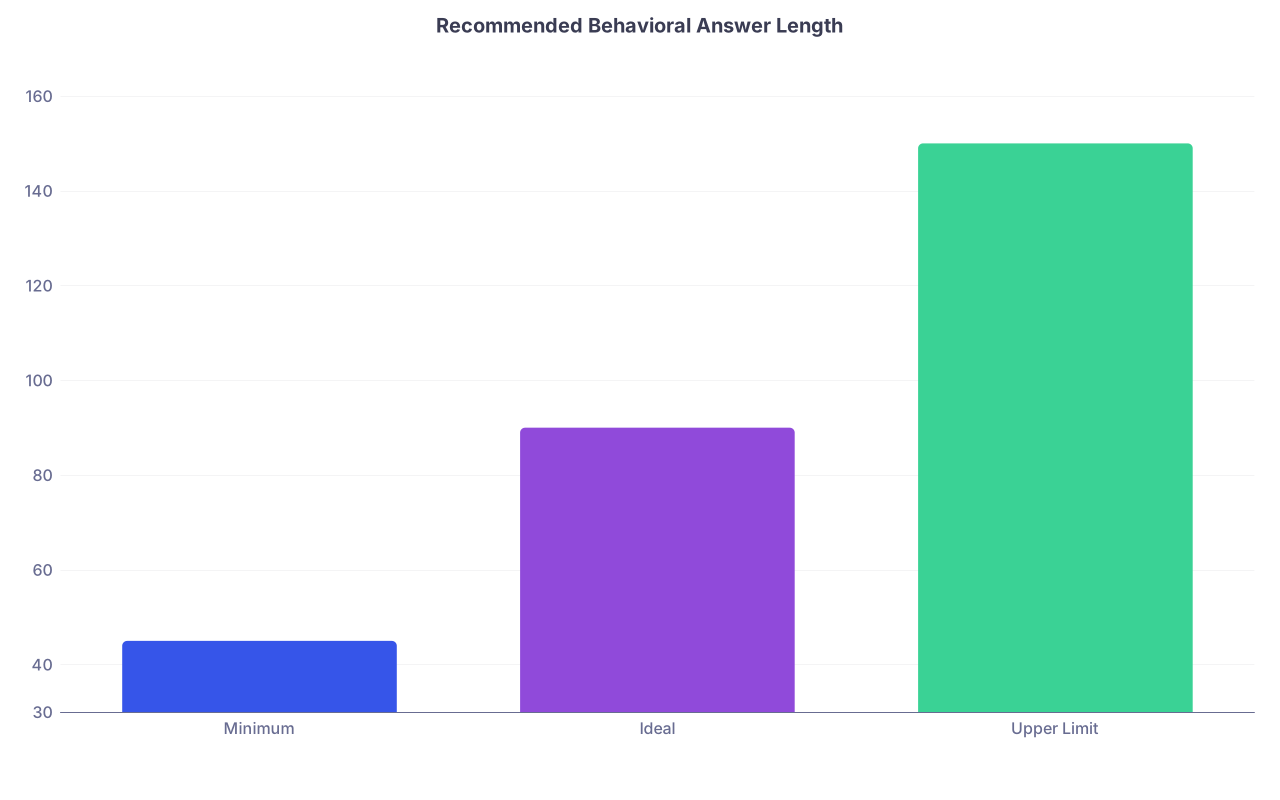
| Category | Value |
|---|---|
| Minimum | 45 |
| Ideal | 90 |
| Upper Limit | 150 |
- Under 45 seconds: often too shallow, unless it is a simple follow‑up.
- 60–90 seconds: ideal for many questions.
- 120–150 seconds (2–2.5 minutes): acceptable for more complex scenarios if very structured and focused.
- Past 3 minutes: you are almost certainly rambling.
You need to actually time yourself. Your internal clock is lying to you, especially under stress.
Record 5–7 common behavioral questions:
- Tell me about a time you failed.
- Tell me about a conflict with a colleague.
- Tell me about a time you had to advocate for a patient.
- Tell me about a time you were overwhelmed.
- Tell me about a time you received critical feedback.
Listen back. If any answer crosses 2.5 minutes without a clear need, you are bleeding points.
The Nonverbal Side of Rambling That Programs Notice
Rambling is not only words. Your body advertises it before your mouth finishes the sentence.
Watch for these tells:
- You keep glancing up or to the side, grasping for the next part of the story.
- You start talking faster and higher-pitched as you realize you are still going.
- You use fillers when you are thinking mid-sentence: “like,” “you know,” “sort of,” “basically.”
- Your hands begin “drawing” your story in the air endlessly.
On Zoom, it is worse. Interviewers stare at your face the entire time. Every sign of you losing your own thread is painfully visible.

Two nonverbal fixes that help you stop
Use a deliberate pause.
Answer your question. Then force a one‑second pause with your mouth closed and your hands still. If the interviewer wants more, they will ask. That pause saves you from the reflexive “and also…”Plant your final sentence physically.
Decide: “When I say my last line, I will nod once and then stop moving.”
Sounds small. It trains your body to signal completion instead of continuing to leak words after your actual ending.
The Hidden Cost: How Rambling Infects Your Evaluations
Programs do not have an “excessive talking” checkbox. They have things like:
- “Communication skills”
- “Professionalism”
- “Maturity”
- “Team fit”
- “Clinical reasoning”
Your rambling answer about a conflict gets filed as:
- Poor insight
- Unable to prioritize information
- Might give disorganized handoffs
- May struggle under time pressure
I have seen cases where attendings said, “They seem bright, but I am exhausted after one question.” That is fatal in a crowded rank list.
| Rambling Behavior Pattern | What Interviewers Infer |
|---|---|
| 5-minute answers | Poor time management, unfocused communicator |
| Emotional spiraling | Questionable resilience and boundaries |
| Tangent cascade | Disorganized thinking, unsafe for sign-out |
| Hero epic answers | Ego, potential difficulty in team dynamics |
| Vague morality tales | Shallow reflection, weak insight |
You may have the Step scores, publications, and glowing letters. None of that cancels out the impression that you will talk in circles while someone’s potassium is 6.8.
A Simple Practice Framework To De-Ramble Yourself
You do not fix this by reading more advice. You fix it by short, focused reps.
Here is a sane, 7‑day process that I have seen work for actual applicants with real schedules:
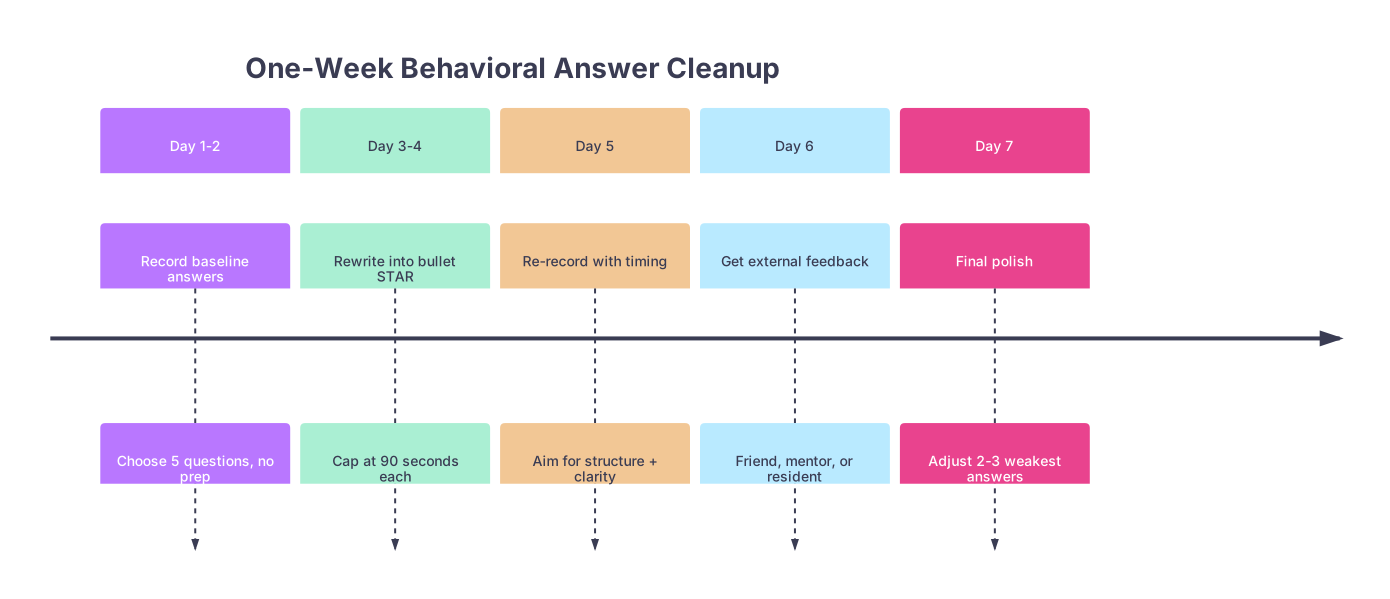
| Period | Event |
|---|---|
| Day 1-2 - Record baseline answers | Choose 5 questions, no prep |
| Day 3-4 - Rewrite into bullet STAR | Cap at 90 seconds each |
| Day 5 - Re-record with timing | Aim for structure + clarity |
| Day 6 - Get external feedback | Friend, mentor, or resident |
| Day 7 - Final polish | Adjust 2-3 weakest answers |
Day 1–2: Record yourself answering 5 standard behavioral questions cold. No notes. Just see where you are.
Day 3–4: For each recorded answer, write a bullet-point outline:
- Situation – 2 bullets
- Task – 1 bullet
- Action – 3 bullets
- Result/Reflection – 3 bullets
Then cut that in half. Yes, half. Force concision.
Day 5: Re-record using your skeleton outline. Keep every answer under 2 minutes. Avoid reading; just glance at the structure.
Day 6: Send 2–3 recordings to a friend, resident, or advisor. Ask them specific questions:
- “Where did I lose you?”
- “Which parts felt repetitive?”
- “Where did you wish I had stopped?”
Day 7: Edit only your worst 2–3 answers. Do not try to perfect everything. Surgical improvement beats vague overhauling.
If You Are Already A Rambler, Do Not Do This
One last trap: over-correcting by memorizing scripts.
You panic about rambling. You write full paragraphs for every possible question. You memorize them. You show up sounding robotic and terrified to deviate. Programs see that and wonder how you will cope the first time a patient says something you did not rehearse.
Do not replace uncontrolled rambling with rigid monologue.
Use flexible skeletons, not scripts.
For each common question type, you should know:
- Which story you will use.
- The 3–5 key points you must hit.
- Your final takeaway sentence.
That is it. The wording can be different each time. The spine stays the same.

FAQs
1. What if my story is genuinely complex and needs more time to explain?
Then you picked the wrong story. Choose one where the conflict, your role, and the outcome can be understood by a stranger in under 20–25 seconds of background. You are not being graded on how dramatic your case was. You are being evaluated on judgment, communication, and reflection. A simpler case with a clear decision is almost always safer than a convoluted epic that eats three minutes and confuses your interviewer.
2. How do I know if I am under-explaining instead of over-explaining?
Listen to your recordings and ask one question: “Could a non-medical friend tell me what I actually did and what changed because of it?” If they cannot answer that in 1–2 sentences, you are probably being too vague. Under-explaining usually shows up as missing actions and results, not short answers in general. A 60-second answer with clear action and outcome is strong. A 2.5-minute answer that never clarifies what you did is not.
3. What should I do during the interview if I realize mid-answer that I am rambling?
Stop trying to salvage every detail. Do this instead: briefly summarize and close. Say something like, “So in summary, I…” and give a tight 1–2 sentence wrap-up that hits your main action and what you learned. Then stop. Interviewers will appreciate that you self-corrected more than they will punish you for starting to ramble. The worst move is to panic and keep talking in circles to “fix” it.
Open your phone, set a 2-minute timer, and answer out loud: “Tell me about a time you failed.” Stop when the timer buzzes. Then listen to your recording and cross out every sentence that did not change the interviewer’s understanding of the story. That is where your rambling lives.