
What does your answer sound like when a program director silently writes a note, looks up, and their face hardens just a bit?
Behavioral interviews are trap-rich environments. Not because program directors are cruel, but because they’re listening for things you don’t realize you’re saying.
You think you’re telling a story about “overcoming conflict.”
They hear: “This resident will be a problem on my service.”
You think you’re being honest about “work–life balance.”
They hear: “This person may not survive night float.”
I’ve sat in rooms where a single behavioral answer killed an otherwise strong applicant’s chances. Step 1: excellent. Letters: glowing. Interview vibes: good…until one story exposed a massive red flag.
You don’t need perfect answers. You do need to avoid the 10 answers that reliably make program directors nervous.
Let’s walk through them.
Red Flag #1: Blaming Everyone Else In Conflict Questions
The question usually sounds like:
“Tell me about a time you had a conflict with a colleague or supervisor and how you handled it.”
The dangerous answer sounds like this:
“On my surgery rotation, the chief resident was really unfair and always picked on me. I tried to explain myself, but they were unreasonable. I just put my head down and powered through the month.”
Or:
“The nurse was overreacting. I knew my orders were correct, but she kept making a big deal out of it. It was very frustrating.”
Here’s what a program director hears:
- You see yourself as the victim in every story.
- You don’t reflect on your own role. At all.
- You talk about colleagues (especially nurses) with disrespect.
- Under stress, you’ll likely be defensive and hard to coach.
This is a major mistake: turning a behavioral question into an airing of grievances.
The safer move:
- Acknowledge what you could have done better
- Show empathy for the other person’s perspective
- End with what you learned and how you changed your behavior
Program directors don’t care if your attending was a jerk. They care if you can function with difficult personalities without turning into a lawsuit or a complaint magnet.
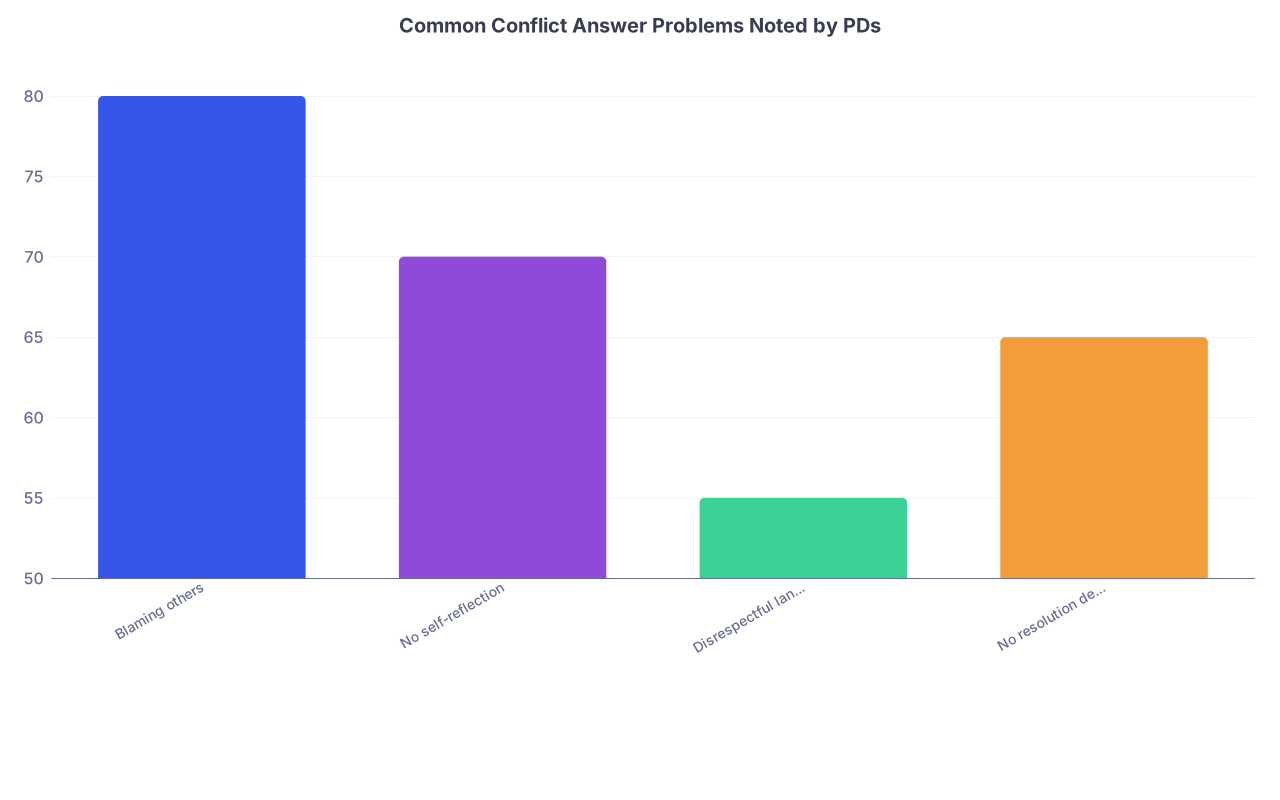
| Category | Value |
|---|---|
| Blaming others | 80 |
| No self-reflection | 70 |
| Disrespectful language | 55 |
| No resolution described | 65 |
Red Flag #2: “My Weakness Is That I Work Too Hard”
The classic “weakness” question:
“Tell me about a weakness or an area for improvement.”
If you answer:
“I’m just such a hard worker. I care too much. Sometimes I forget to go home because I’m so dedicated.”
Program directors roll their eyes. They’ve heard that line 400 times. It doesn’t make you sound strong. It makes you sound rehearsed and shallow.
Even worse versions:
“I’m a perfectionist. Everything I do is perfect so it’s hard to stop.”
“Honestly, I don’t really have a big weakness. I just sometimes care too much about patients.”
Red flags here:
- You’re not self-aware.
- You’re trying to game the question instead of answer it.
- You might be hiding something bigger.
- You may not take feedback well.
You want a real, bounded, non-catastrophic weakness:
- Time management on busy services
- Difficulty asking for help early
- Over-documenting and slowing yourself down
Then you must show:
- Specific steps you’ve taken to improve
- Concrete progress
- That your weakness is under control, not out of control
Fake weaknesses impress nobody. They just tell the PD you think you’re smarter than the question.
Red Flag #3: Throwing Nurses, Staff, or Peers Under the Bus
Any answer that casually disparages:
- Nurses
- Techs
- Consultants
- Co-residents
- Medical students
…is radioactive.
Examples I’ve actually heard:
“The nurses on that unit just don’t like med students. They always exaggerate things.”
“Honestly, the intern wasn’t very smart, so I had to double-check everything.”
“The psych team was useless. They never help.”
Here’s what program directors hear:
- You don’t respect the team
- You’re going to cause friction with nursing leadership
- You’ll probably get written up
- You might create a toxic work environment
You’ll be living inside a hierarchy. If you can’t talk about colleagues respectfully — even when they were actually wrong — that’s a big problem.
A better framework when others made mistakes:
- Acknowledge the issue without character assassination
- Focus on the problem, not the person (“communication broke down,” not “the nurse was hysterical”)
- Emphasize collaboration: “We sat down together,” “We clarified expectations,” “We agreed on a plan”
Program directors are constantly putting out fires between residents and nurses. They won’t willingly add gasoline.

Red Flag #4: Talking About Burnout in a Way That Sounds Unstable or Untreated
The question:
“Tell me about a time you were overwhelmed and how you managed it.”
Here’s where people panic and either overshare or lie.
Red-flag version:
“During third year I got really depressed and stopped going to some rotations. I was really burned out. I don’t really like to talk to therapists, so I just pushed through. I’m still kind of struggling with it.”
Or:
“Honestly, I think burnout is exaggerated. I don’t really get tired — I can handle anything.”
Problem in both directions.
The first one:
- Unstable, untreated, or not clearly managed
- No mention of support systems, coping strategies, or recovery
- Signals risk of leave, professionalism issues, or patient safety concerns
The second:
- Naïve about residency demands
- Possibly dismissive of wellness and boundaries
- Likely to hit a wall because you think you’re superhuman
You don’t need to pretend you’re a robot, but you can’t sound like you’re barely hanging on.
Safest approach:
- Briefly acknowledge a challenging period (e.g., step prep + rotations)
- Be concrete about healthy coping strategies: scheduling, exercise, mentor support, therapy, time management
- Emphasize that you recognized limits early and acted, rather than waiting for disaster
Program directors are not looking for “never struggled.”
They’re looking for “struggled, used appropriate help, and is stable now.”
Red Flag #5: “I Don’t Make Mistakes” / Dangerous Patient-Care Answers
Behavioral question:
“Tell me about a time you made a mistake in patient care and what you did.”
Terrible answer:
“Honestly, I haven’t made any real mistakes yet. Nothing that affected a patient.”
Or:
“I did order the wrong medication once, but the nurse caught it before anything happened, so it wasn’t a big deal.”
Disaster.
First version:
- Zero insight
- Zero humility
- Zero understanding that medicine is full of near-misses
Second version:
- Dismissing a near-miss
- No clear reflection on system safety
- No concrete change in your practice
The answer that reassures PDs:
- Own a real but not catastrophic error or near-miss (e.g., almost missed a critical lab, delayed a consult, mis-ordered a dose that was caught)
- Describe exactly how you recognized/corrected it
- No excuses, no blaming
- Identify what you changed permanently: checklist, double-check habit, asking for help sooner
They’re not hunting for perfect. They’re hunting for safe and coachable.

Red Flag #6: Arrogant, Entitled, or “I’m Doing You a Favor” Vibes
Some answers aren’t wrong in content. They’re wrong in tone.
Examples that immediately cool the room:
“I expect to be in an academic leadership role pretty quickly. I’ve always risen to the top.”
“I’m not worried about the clinical workload. My medical school was much harder than what I’ve seen from your residents.”
“I’m applying broadly but I know I’m a top candidate. I’ll be picky.”
You may think you’re signaling confidence. You’re not. You’re signaling that you’re going to be difficult to supervise and hard to please.
Program directors remember the residents who:
- Refuse feedback
- Talk down to seniors
- Constantly compare their program unfavorably to others
- Threaten to leave or complain to GME
Do not sound like one of those.
A healthier flavor of confidence:
- “I’ve been fortunate to have strong training and I’m excited to contribute here.”
- “I like high expectations; they tend to bring out my best work.”
- “I know I’ll have a lot to learn, and I’m looking for a program that pushes me in a supportive way.”
Ambitious is good. Entitled is not.
Red Flag #7: “Work–Life Balance” Answers That Sound Like You Don’t Understand Residency
The question:
“How do you maintain balance or wellness with a demanding schedule?”
The mistake is swinging too far in either direction.
Red flag version 1 (too rigid):
“I always protect my sleep and social life. I don’t think it’s healthy to stay late or pick up extra work. I need my evenings for myself.”
In residency, there will be codes at 6:55 pm. Sick admits at 6:59. Work doesn’t stop when your shift theoretically ends. “I always leave on time” is not the hill you want to die on.
Red flag version 2 (no boundaries at all):
“I don’t really need balance. I’m fine working all the time. I can always sleep later.”
That sounds heroic until you’re the one falling asleep writing orders and missing a sepsis case.
Program directors want:
- Someone who understands residency is intense and sometimes brutal
- Someone who has functional coping strategies: exercise, friends, therapy, hobbies scaled realistically
- Someone who will ask for help before things crash
If your answer makes them think:
- “This person will refuse to stay late for a crashing patient,” or
- “This person will hide their struggles until they melt down,”
…you’ve lost them.
Red Flag #8: Future Plans That Suggest You’ll Leave or Cope Poorly
Behavioral + goals question:
“Where do you see yourself in 5–10 years?”
Or: “What are your long-term career goals?”
The risky answers sound like:
“I’m not sure I really want to practice clinically long-term. I’m mostly interested in consulting or leaving medicine eventually.”
“I’d like to switch specialties after intern year if I can.”
“Honestly, I see residency as a temporary sacrifice before my real life starts.”
No program director wants to spend three years training you so you can bolt. Or worse, mentally check out halfway through PGY-2.
You don’t have to swear eternal loyalty to the specialty, but you do need to sound invested.
Another red flag: talking about future plans with zero realism.
“I’ll probably get a top academic job at a major center and run multiple labs.”
With no track record, no nuance, no humility — that just sounds delusional.
Better path:
- Express genuine interest in the specialty’s range of careers
- Be honest that you’re still exploring, but inside the field
- Show some flexibility: “I’m drawn to academic settings now, but I’m open to where my interests and strengths lead as I learn more.”
They don’t need you to have a 10-year blueprint. They need to believe you won’t quit halfway.

| Step | Description |
|---|---|
| Step 1 | Behavioral Answer |
| Step 2 | Low risk |
| Step 3 | High flight risk |
| Step 4 | Moderate risk, depends on tone |
| Step 5 | Mentions staying in specialty? |
| Step 6 | Mentions leaving medicine or switching? |
Red Flag #9: “Teamwork” Stories Where You’re the Hero and Everyone Else Is Useless
The classic behavioral trap:
“Tell me about a time you worked as part of a team to accomplish something difficult.”
Red-flag answer:
“The team was falling apart, so I stepped up and took over. I basically coordinated everything because no one else was organized enough.”
Or:
“The attending and senior didn’t really know what to do, but I had read about a case like this and suggested the whole plan.”
Let me translate:
- You overinflate your own role
- You diminish your seniors and attendings
- You confuse appropriate initiative with ego
Directors have seen this movie. The intern who “knows better” than everyone else on day 3. They usually end up in serious trouble.
A safe structure:
- Describe the team’s shared goal
- Clarify your role accurately (student, sub-I, junior member)
- Highlight what others contributed
- Emphasize communication, reliability, follow-through, not heroics
If you’re always the savior in your stories, you’re a liability. Real teams don’t need heroes. They need adults.
| Aspect | Red Flag Example | Green Flag Example |
|---|---|---|
| Role description | "I took over the team" | "As the sub-I, I helped organize sign-out" |
| Others' competence | "No one else knew what to do" | "Each person brought a different strength" |
| Outcome credit | "I basically saved the patient" | "As a team we turned things around" |
| Reflection focus | "They should have listened to me sooner" | "I learned when to speak up and when to listen" |
Red Flag #10: Dishonesty That Doesn’t Match Your File
The sneakiest one.
Behavioral questions expose inconsistencies between what you say and what’s in your application, MSPE, or letters.
Examples:
- You say you “love research” and plan a heavily academic career, but you have zero research and your letters don’t mention it.
- You claim to “thrive in high-volume environments,” but your dean’s letter describes you as struggling with time management and needing reminders.
- You talk about being “very detail-oriented” and then can’t remember core details of the story you’re telling.
Program directors notice when things don’t line up. They compare:
- What you say about conflict vs. what your MSPE hints at
- What you say about professionalism vs. any “concern” comments
- What you say about work ethic vs. lukewarm letters
Once they sense you’re bending the truth, everything else you say gets downgraded.
Big mistake: inventing polished “STAR” stories that never actually happened just because you think that’s how you “should” answer behavioral questions.
You don’t need perfect stories. You need true ones, framed intelligently.
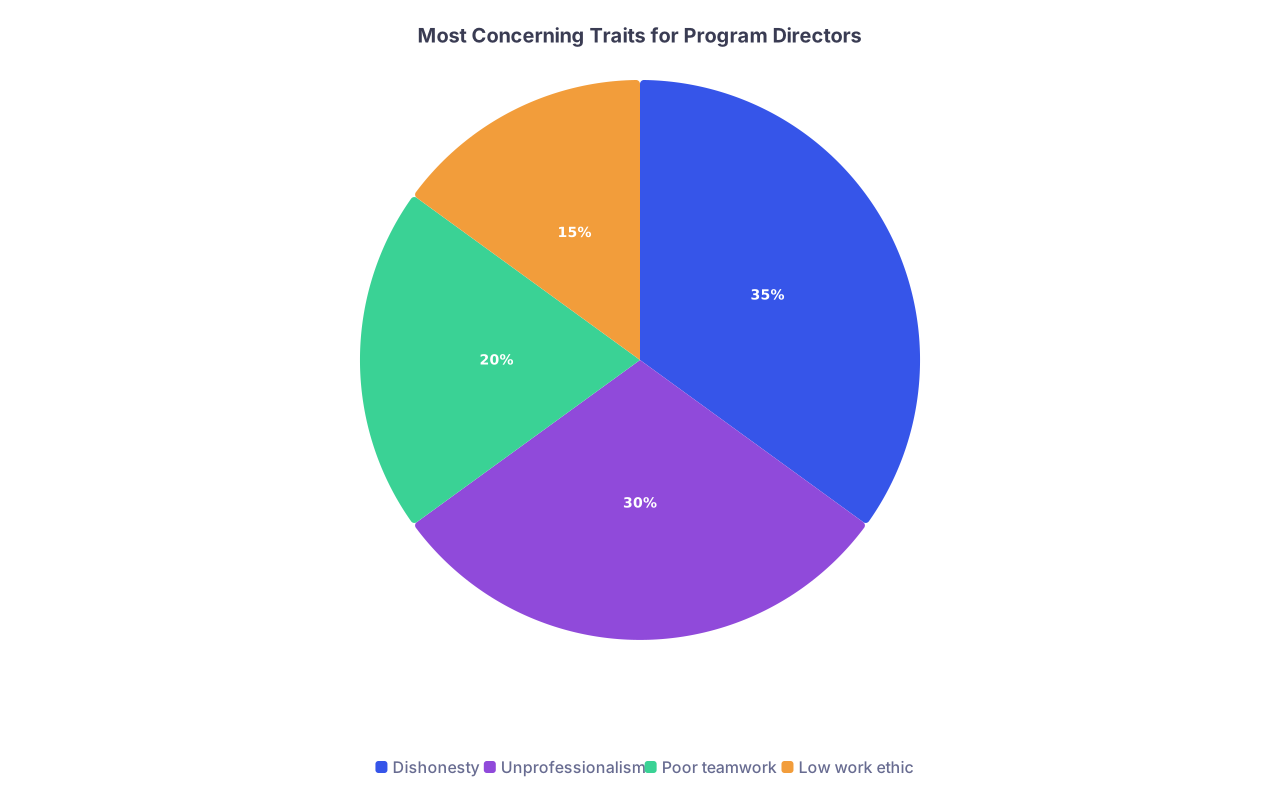
| Category | Value |
|---|---|
| Dishonesty | 35 |
| Unprofessionalism | 30 |
| Poor teamwork | 20 |
| Low work ethic | 15 |
How to Accidentally Trigger Red Flags Even With Good Stories
Here’s the painful part: you can have the right story and still tank it in the delivery.
Common ways people sabotage themselves:
Too much detail on irrelevant drama
You spend 3 minutes describing the politics of a rotation and 10 seconds on what you learned.Using inflammatory language
“That nurse freaked out,” “that psych patient was crazy,” “the resident was incompetent.” One word is enough to end you.No arc of growth
You tell a story of struggle, pause, and then stop. If there’s no improvement, you just confessed a problem that’s still unresolved.Chronically negative tone
Every story turns into how others were lazy, unfair, or incompetent. You sound bitter, even if you think you’re just being honest.Vague non-answers
“I always try to communicate,” “I value teamwork,” “I prioritize patient care.” With no specifics, this sounds like fluff and avoidance.
If a program director has to work to figure out whether you learned anything, they’ll assume you didn’t.

How to Protect Yourself Without Sounding Robotic
You do not need to memorize scripts. You do need guardrails.
Before the interview, for each common behavioral theme (conflict, mistake, leadership, stress, teamwork, weakness), do this:
Pick 1–2 real stories that:
- Involve some challenge
- End with a professional resolution
- Don’t implicate you in gross negligence, bigotry, or major professionalism violations
For each story, sanity-check:
- Do I speak respectfully about everyone involved?
- Do I clearly show what I did, not just what “we” did?
- Do I avoid blaming and focus on solutions?
- Is the “lesson learned” obvious and believable?
Practice out loud with someone ruthless enough to say:
- “You sound arrogant.”
- “That story makes you look worse, not better.”
- “You didn’t actually answer the question.”
Don’t ignore the flinch moments. If your gut says, “This makes me look bad,” it probably does. Either reframe it or pick a different story.
Final Summary: What You Must Not Do
Keep these tight in your head on interview day:
- Don’t blame, belittle, or throw anyone under the bus — especially nurses, staff, or supervisors.
- Don’t fake weaknesses, deny mistakes, or tell hero stories where you’re the only competent person in the room.
- Don’t contradict your file with grandiose claims or unstable-sounding burnout/conflict narratives that show no growth or control.
Avoid these, and you’ll already be ahead of the applicants who walk in and self-destruct in 90 seconds.