
It’s 8:32 a.m. on your first interview day. You’re in a small conference room with two faculty and a chief resident. You get the classic behavioral question: “Tell me about a time you dealt with conflict on the team.”
You launch into your story… and within 45 seconds you’ve mentioned:
- “When I was scrubbing with Dr. Smith, the chair…”
- “My dean, Dr. Patel, said my evaluation was the best she’d seen…”
- “Honestly, my co-intern was kind of incompetent…”
You walk out thinking you sounded “impressive” and “honest.”
You didn’t.
You sounded like someone who name-drops for validation and overshares sensitive details. That’s exactly the kind of person programs worry will create drama, breach trust, or write that infamous 2 a.m. email to GME.
Let me be direct: name-dropping and oversharing are two of the fastest ways to poison otherwise decent behavioral responses. They make you look immature, politically unaware, and risky. And residency selection committees are allergic to risk.
Let’s walk through the traps so you don’t tank your own interview.
The Two Silent Killers in Behavioral Interviews
](https://cdn.residencyadvisor.com/images/articles_svg/chart-common-red-flags-in-residency-interviews-faculty-p-5018.svg "Common Red Flags in Residency Interviews (Faculty Perception)")
| Category | Value |
|---|---|
| Name-dropping | 70 |
| Oversharing drama | 80 |
| Vague answers | 60 |
| [Blaming others](https://residencyadvisor.com/resources/behavioral-interview-questions/7-ways-you-accidentally-blame-others-in-behavioral-interview-answers) | 85 |
I’ve watched candidates with excellent scores and solid experiences sink their interviews with these two habits.
Name-dropping: using people’s names, titles, or institutional power to make yourself sound impressive or “connected,” when it adds nothing substantive to your story.
Oversharing: giving way too much detail about interpersonal conflicts, patient care issues, personal trauma, or internal politics—details that don’t improve the answer but do make people question your judgment and boundaries.
Most applicants are not cartoon villains. They’re anxious and trying to prove they belong. That anxiety is exactly what pushes them into these mistakes.
You’ll see it in phrases like:
- “I was on a rotation with the PD from X program…”
- “Our neurosurgery chair personally told me…”
- “My attending was basically abusing the intern…”
- “The nurse was incompetent and lazy…”
These land terribly. Not subtly bad. Memorably bad.
Mistake #1: Name-Dropping – Why It Backfires
You think you’re saying:
“I’ve worked with big names. I’m serious. I’m connected.”
They hear:
“I need prestige props to feel valuable. I might be high-maintenance. And I probably don’t understand when status talk is inappropriate.”
How Name-Dropping Creeps In
It usually shows up in three flavors:
Prestige signaling
“On my sub-I with Dr. X, the vice chair at [famous institution]…”
The story that follows would be exactly the same if you just said “an attending on my sub-I.”Borrowed credibility
“My dean, Dr. Y, told me I’m one of the strongest applicants she’s seen.”
No one cares. They’ve heard a version of that before. It sounds like you’re trying to smuggle in a letter of recommendation mid-answer.Program stalking
“I’ve heard from Dr. Z that your PD is very supportive…” when Dr. Z is on their faculty.
This gets weird fast. Now you’re playing internal politics with people you don’t know.
Why Faculty Hate It
I’ve seen the facial shift in real time: candidate casually drops the name of a big research chair; interviewer glances sideways at the other faculty. Not impressed. Mildly annoyed.
Name-dropping triggers a few concerns:
- Insecurity: If you were confident in your own achievements, you wouldn’t need other people’s titles to validate you.
- Political clumsiness: Residency is full of complex hierarchies. Someone who tosses around names in an interview may gossip or play politics in the program.
- Boundary issues: If you’re that casual about other people’s roles and statements in an interview, what are you like on the wards?
The Safe Rule: Title Only When It Adds Meaning
If a person’s role changes the nature of the story, fine. For example:
- “I was the only medical student on the cardiology team, working closely with the fellow and attending.”
- “I brought my concern first to the senior resident, then to the attending, when I felt patient safety was at risk.”
Notice what you do not need:
- Full names
- “World-renowned”
- “Program director of X”
- “Chair of Y at [brand-name school]”
If the title doesn’t change the ethical landscape or your responsibility level, it doesn’t belong in your answer.
How to Fix Name-Dropping in Your Stories
Take a common behavioral story. Then strip every unnecessary name or fancy title.
Original (bad):
“I was on trauma surgery with Dr. Johnson, the division chief at Big Academic Center, and he personally pulled me aside…”
Fixed:
“I was on my trauma surgery rotation and the attending pulled me aside…”
Original (bad):
“My dean, Dr. Patel, told me I had the strongest professionalism evaluation she’d seen in years.”
Fixed:
“I received feedback that my professionalism was a particular strength, which pushed me to…”
If you can remove the name/title and nothing essential changes? Cut it.
Mistake #2: Oversharing – When “Honest” Becomes Dangerous

Behavioral questions push people into story mode. And once you start telling a story, it’s very easy to forget you’re not with your classmates venting over post-call breakfast.
The worst oversharing always sounds like someone letting their guard down just a little too far.
Common Oversharing Landmines
Excessive interpersonal drama
“The nurse was screaming, the attending was being totally inappropriate, the intern was crying in the bathroom…”
Do they need this level of drama to understand how you communicated or resolved conflict? No.Attacking colleagues’ competence or character
“The resident was lazy.”
“The intern didn’t care about patients.”
You’ve just painted yourself as judgmental and unprofessional.Confidential or sensitive program details
“Our PD was under investigation…”
“The residents all hated the chief…”
Massive red flag. They immediately think: you will talk like this about us someday.Unfiltered personal trauma
Sharing grief, burnout, or hardship can be powerful—but not when it’s raw, unmanaged, or irrelevant to the question.
Example of too much: “I failed Step 1, my relationship ended, I was depressed and drinking heavily…” in response to “Tell me about a challenge.” That may be true, but it’s not interview-safe if you haven’t framed recovery and current stability very, very clearly.
What Oversharing Signals to Interviewers
They start asking themselves:
- Will this person respect patient confidentiality?
- Will they take sensitive issues up the chain, or just gossip sideways?
- Will we read about our program on Reddit with suspiciously familiar stories?
- Is this someone residents will trust with their own struggles?
If there’s even a hint that the answer might be “no,” they’ll move on to someone safer.
Where These Mistakes Show Up Most: Specific Question Types
| Question Type | Risk Level | Typical Mistake |
|---|---|---|
| Conflict with team member | Very High | Trashing others, giving names |
| Handling unprofessional behavior | Very High | Oversharing internal issues |
| Biggest challenge/failure | High | Trauma dumping without structure |
| Leadership example | Medium | Prestige name-dropping |
| Ethical dilemma | High | Giving too many case details |
1. “Tell me about a conflict with a colleague or team member.”
This is the number-one oversharing trap.
Bad version:
You give the person’s role, sometimes their name, go into every insult, every mistake they made, and how the whole team hated them.
Better approach:
- De-identify: “a team member,” “another student,” “a member of the nursing staff.”
- Focus on your actions and communication, not their flaws.
- Skip unnecessary color commentary.
Example:
Bad:
“I worked with this nurse, Mary, who everyone said was lazy and didn’t care…”
Safer:
“I worked with a nurse whose communication style often felt abrupt and dismissive to me…”
See the difference? You’re describing behavior and perception, not assassinating character.
2. “Describe a time you saw unprofessional or unsafe behavior.”
High risk for both name-dropping and oversharing.
Bad path:
You basically hand them a malpractice narrative with enough detail that they could guess the institution.
Safe path:
- Remove every identifying detail: no names, no specific unit nicknames, no exact dates.
- Focus on the process you followed: who you told, how you framed it, how you handled your own emotions.
- Dial down drama; dial up judgment and systems-thinking.
Example skeleton:
“I noticed something that raised a patient safety concern. I first clarified the situation by… Then I escalated to my senior resident/attending by saying… The outcome was…”
No one needs the attending’s name, your hospital, or whether this made the group chat blow up.
What Good Behavioral Responses Actually Sound Like

| Step | Description |
|---|---|
| Step 1 | Question asked |
| Step 2 | Pick relevant story |
| Step 3 | De-identify people & places |
| Step 4 | Describe situation briefly |
| Step 5 | Focus on your actions & reasoning |
| Step 6 | Share outcome & learning |
Let me show you contrast pairs. Watch the name-dropping and oversharing get stripped out.
Example 1: Conflict with a Resident
Risky answer:
“I was on surgery with Dr. Thompson, the vice chair, and the senior resident was honestly kind of toxic. He’d yell at students, belittle the nurses, and even the chief said he was a nightmare. One day he…”
Safer, stronger answer:
“On my surgery rotation, I worked with a senior resident whose communication style often felt harsh and dismissive, especially toward students and nursing staff. I felt it was affecting team morale and patient care. When he criticized me in front of the team, I…”
See what’s missing?
- No names
- No titles
- No gossip about what “everyone” thought
You’re describing behavior and impact, not painting a villain.
Example 2: Handling a Near-Miss
Risky answer:
“I was on nights at [Big Hospital] and the attending, Dr. X, almost signed an order for the wrong dose because the intern was clueless…”
Safer answer:
“During a night shift on internal medicine, I noticed a medication order that seemed inconsistent with the patient’s renal function. The order had been entered by a junior team member and was about to be co-signed. I double-checked the dosing, then approached the resident by saying…”
Again: no one needs to know that it was the attending, the specific hospital, or your opinion of the intern’s knowledge.
How to Practice Without Falling Into These Traps

You will not fix name-dropping and oversharing the night before interviews. These are habits you’ve probably built over years of telling stories to classmates.
You need to deliberately retrain.
Step 1: Write Out Your Go-To Stories
For each common behavioral theme, jot down one or two stories:
- Conflict on a team
- Working with someone difficult
- Making a mistake or near-miss
- Receiving critical feedback
- Leading a project or QI effort
- Managing stress or failure
Then go through each and ruthlessly:
- Remove all full names
- Replace titles + names with generic roles (“attending,” “resident,” “nurse,” “classmate”)
- Cut gossip, judgmental adjectives, and unnecessary drama
Step 2: Use the “Newspaper Test”
Ask yourself: if this answer were transcribed and showed up on a public forum tomorrow:
- Would anyone at my institution recognize the exact situation or people?
- Would I be comfortable if the person I’m describing read this?
- Would my PD think I showed judgment and discretion?
If any answer is “no,” it needs another pass.
Step 3: Get a Brutally Honest Listener
Not your nicest friend. Someone who’s a little blunt.
Have them listen to a few recorded practice answers and specifically mark:
- Any time you mention a name or exact title
- Any phrase that sounds like gossip or venting
- Any detail that makes them go “whoa, I wouldn’t have said that out loud”
Those are your danger spots.
Red Flags You Don’t Notice But Interviewers Do
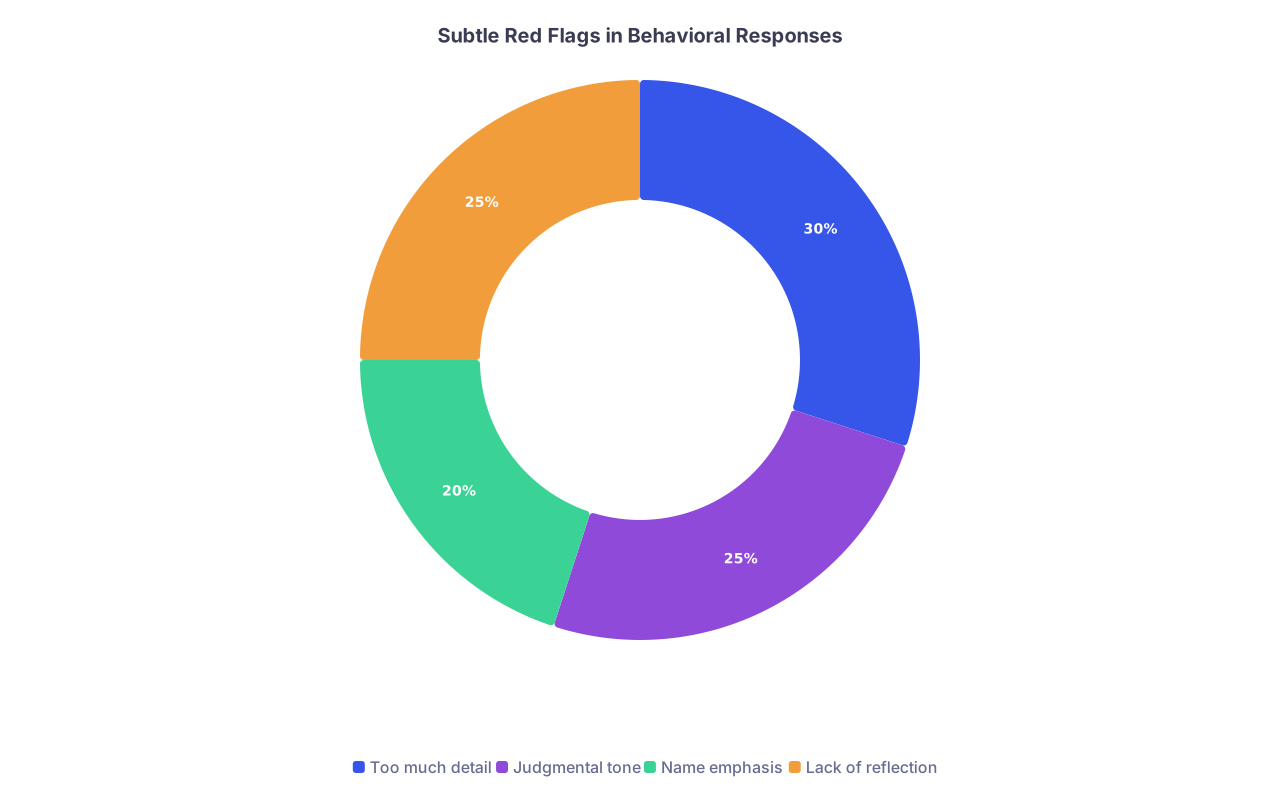
| Category | Value |
|---|---|
| Too much detail | 30 |
| Judgmental tone | 25 |
| Name emphasis | 20 |
| Lack of reflection | 25 |
These are the small things that quietly kill otherwise good content.
Repeating titles
“The chief resident… the chief… the chief…”
They can hear you leaning on rank to make the story sound bigger.Global judgments
“He was just lazy.”
“She didn’t care about patients.”
Even if you’re right, you sound arrogant and unprofessional.Revealing internal dirt
“Everyone hated this attending.”
“The program was toxic.”
You’re telling them you will talk about their dirty laundry like this too.No self-critique, only blame
In a conflict story, if the other person is 100% wrong and you’re 100% righteous, your answer is not believable and not safe.Emotion without containment
Getting visibly angry, bitter, or tearful while describing old conflicts. They’re wondering: is this still raw? Is this going to show up on night float?
Quick Guardrails You Can Use On Interview Day

You’re tired. You’re on your fourth interview in six days. You’re more likely to slip.
Use these on-the-fly checks before you answer:
No names. No institutions.
Unless they explicitly ask, or it’s clearly safe and neutral (e.g., “my medical school,” “my home institution”).Describe behavior, not character.
“He interrupted frequently” is fine. “He was a narcissist” is not.Three-sentence situation limit.
If it takes you more than 3–4 sentences to set up the story, you’re heading into oversharing territory. Move to your actions and thinking.Ask yourself: Who looks worse in this story?
If the answer is the other person, not you, be very careful. Good answers often show your own growth, not someone else’s failure.If it makes a great gossip story, it’s probably terrible interview content.
The better it plays as drama over dinner, the less you should say in front of a PD.
FAQs
1. Is it ever okay to mention a big-name institution or attending?
Yes, but rarely, and only when it’s directly relevant and not used for prestige flexing. For example, “I did a sub-I away from my home institution, which helped me adjust quickly to new systems” is fine. You don’t need to say “at Mass General with Dr. Famous.” If you’re not sure whether dropping the name changes the substance of the story, leave it out.
2. How do I talk about a truly toxic environment without oversharing?
Keep it high-level and focused on your response, not on specific villains. Something like: “I worked in a setting where communication norms were often harsh and feedback was not always constructive. I learned to seek out mentors who modeled healthier approaches, and I focused on…” Avoid naming the program, describing scandals, or quoting inflammatory comments.
3. What if my best “challenge” story involves mental health issues?
You can use it, but you must show control, growth, and current stability, and you must trim details. Focus on: what you noticed, how you sought help, concrete changes you made, and how you function now. Don’t go deep into graphic details, active self-harm, or still-unresolved crises. If in doubt, pick a different challenge that still shows resilience and insight.
4. How do I know if I’m giving too much detail about a patient case?
Ask: could someone familiar with my hospital probably identify the patient from what I said? If yes, you’ve overshared. Strip out ages beyond general ranges, dates, unique conditions, and any rare events. You only need enough clinical detail so the ethical or communication issue makes sense. Everything else is vanity or voyeurism.
5. My mentor told me to mention that I worked with the PD at another program. Should I?
Careful. That can easily sound like you’re trying to pressure or impress them with connections. If it’s directly relevant (e.g., a project that clearly demonstrates your skills), you can say: “During an away rotation, I worked on a QI project with the program leadership there.” You don’t need to say, “with Dr. X, the PD at Y,” unless they push for specifics. When in doubt, under-name-drop. Programs punish arrogance much more than they reward connections.
Two things to carry into every behavioral interview:
- You’re being evaluated for judgment and discretion just as much as for skills and stories.
- If a detail makes the story spicier but not clearer, cut it. It’s not helping you.
Protect yourself from looking risky. You worked too hard to let one sloppy, name-heavy, overshared answer undo the rest of your application.