
The most polished behavioral story in the room is usually the least believable.
If your residency interview answers sound like they survived 20 edits in a Google Doc and three coaching sessions, you’re in trouble. Programs don’t rank the best script. They rank the person they trust will actually function at 3 a.m. on call.
Let me be blunt: over-rehearsing your behavioral stories is one of the fastest ways to sound inauthentic, robotic, and forgettable. And in a competitive Match cycle, that’s lethal.
You’re aiming for prepared, not performed. Most applicants blow straight past that line.
The Core Mistake: Confusing “Prepared” With “Performed”
There’s a huge difference between knowing your experiences and performing them like a TED Talk.
Prepared sounds like:
- Clear structure
- Real details
- Natural speech
- Moments of reflection
Performed sounds like:
- Memorized transitions
- Same rhythm for every answer
- Over-polished “lessons”
- Zero human hesitation
I’ve heard this exact pattern dozens of times:
“I had a conflict with a team member during my third-year internal medicine rotation. First, I identified the problem. Second, I communicated respectfully. Third, I reflected and grew. Overall, this experience taught me the importance of communication, empathy, and professionalism.”
Technically fine. Humanly dead.
No interviewer believes that’s how you actually tell stories about your life. It screams: “I practiced this 20 times and stripped out anything risky, specific, or real.”
The mistake isn’t practicing. The mistake is practicing the words instead of the story.
You should know:
- The event
- The key details
- What you learned
You should not know:
- Exact phrases
- Memorized transitions
- The same closing line you use in every answer
Once your answer becomes a script, you stop listening to the question and start waiting to recite your monologue. Interviewers can see that shift instantly.
The Red Flags: How Over-Rehearsed Stories Give You Away
Let’s walk through the common tells that you’ve rehearsed yourself into inauthenticity.
1. The Same Structure for Every Single Answer
If every response is a perfect “STAR” template with the same rhythm, you become predictable and artificial.
Example pattern I hear over and over:
- “The situation was…”
- “The task was…”
- “The action I took was…”
- “The result was…”
Once? Fine. Twice? Okay. Five times in a row? Now it feels scripted.
You’re not being graded on using the STAR acronym out loud. You’re being evaluated on whether you can walk them through a real event in a coherent, human way.
Use structure in your head. Not as a recitation.
2. Over-Generic Language and Zero Concrete Details
Over-rehearsed answers get “cleaned up” until there’s nothing real left.
Bad: “I worked with a multidisciplinary team to care for a complex patient. There were challenges with communication, but through leadership and collaboration we provided excellent care.”
Good: “On my medicine rotation, we had a cirrhotic patient with recurrent GI bleeds. The resident wanted early discharge, but nursing kept escalating concerns about his confusion and safety at home. I realized no one had actually sat down with his daughter, who was supposed to manage his meds.”
See the difference? The second answer has edges. Specifics. Real medicine. Specificity is the enemy of fakeness.
When every story sounds like it could happen on any rotation, with any patient, at any hospital, it signals that your priority was polish, not honesty.
3. Perfect “Moral of the Story” Endings
Another giveaway: the overly tidy reflection.
“I learned the importance of communication, teamwork, and empathy.”
“I realized that adaptability and resilience are critical in medicine.”
“This taught me to always put patients first.”
These are fine ideas. But as endings to every story, they sound like you copied them from a Step 1 ethics review.
Real reflection actually connects the experience to you:
- How did it change your behavior afterward?
- What do you do differently now?
- Where did you fall short?
Over-rehearsed answers often avoid any admission of imperfection because the applicant is trying to be “bulletproof.” That’s how you end up sounding like a brochure instead of a colleague.
4. The “Locked In” Facial Expression and Tone
Interviewers do not just hear your words. They watch your face and body.
Over-rehearsed stories often come with:
- Slightly frozen expression
- Fixed eye contact or staring at a single point
- Very uniform speaking pace
- No natural variation in tone
Why? Because you’re running the script in your head, terrified of derailing.
Contrast that with someone who knows their story but is telling it fresh. They pause, they search for a word, they sometimes smile at an odd detail. It feels live, not replayed.
5. Total Collapse When the Question Changes Slightly
Big tell: your beautiful scripted answer only works for one exact version of the question.
Question: “Tell me about a time you had a conflict with a team member.”
You’re ready.
But then they say: “Tell me about a time you strongly disagreed with your senior or attending. What did you do?”
Now your canned “conflict with a classmate on a group project” story doesn’t quite fit. You start force-fitting it anyway. The disconnect shows.
If you were actually comfortable with your experiences instead of just rehearsed answers, you’d be fine adjusting on the fly.
Why Programs Hate Over-Rehearsed Stories (And They Do)
Residency programs are not trying to hire actors. They’re trying to select future coworkers.
Over-rehearsed behavioral answers create several serious concerns for them.
Concern #1: They Don’t Know the “Real You”
Programs are thinking:
“If this is all performance, who are we actually ranking?
The person, or the script coach?”
If your answers feel manufactured, they can’t confidently answer:
- How will this person handle feedback?
- Will they tell us when something is wrong?
- Do they actually understand their limitations?
Authenticity matters more than perfection. A slightly messy, honest story beats a flawless, generic one every time.
Concern #2: Risk of Poor Insight and Self-Awareness
Forced, polished reflection is shallow by definition.
Programs need residents who can:
- Recognize their own blind spots
- Admit when they made a bad call
- Learn from near-misses without defensiveness
When your answers sound like they were optimized not to show any vulnerability, it signals low self-awareness or high image-management. Neither is reassuring.
Concern #3: Questionable Reliability Under Real Pressure
If you can only perform when heavily rehearsed, what happens:
- On night float?
- During an unexpected code?
- When a family is furious and wants answers?
Interviewers know: medicine is unscripted. If you can’t handle a mildly unpredictable question without glitching, they’ll doubt your ability to function when things actually go sideways.
The Subtle Ways Over-Rehearsal Creeps In
You might be doing this without realizing it. Let’s talk about how it happens.
1. Over-Coaching and Too Many Opinions
You ask:
- A professional coach
- Two residents
- Your dean’s office
- A friend in consulting
They all give feedback. You incorporate everything. Suddenly your story sounds like five people wrote it.
That’s when you get:
- Business-school phrasing in a med story
- Unnatural corporate-speak: “leverage,” “stakeholders,” “alignment”
- Weirdly formal transitions no human uses in conversation
Use feedback to refine, not to turn your life into a committee-approved narrative.
2. Writing Full Scripts and Memorizing Them
The second you open a Word doc and write:
“During my third year, I had the opportunity to…”
You’re halfway to disaster.
Writing is more formal than speech. If you memorize written text, your spoken answer will sound stiff. Interviewers can tell when they’re listening to written language delivered orally. It’s off by just enough to feel fake.
For behavioral questions, you should not:
- Write out full paragraphs to memorize
- Practice reading answers aloud verbatim
- Try to hit every exact phrase you liked on paper
Instead, write bullet points. Short ones. Then talk it out in your own words. Different every time, same core story.
3. Practicing Only in “Performance Mode”
Some people only practice on Zoom mock interviews or in ultra-formal settings. They never practice just…talking about their experiences like a human.
So on interview day, they flip into Interview Persona:
- Too formal
- Too stiff
- Too careful
You want your “interview mode” to be just a slightly more polished version of how you talk to an attending you respect on rounds. Not a different personality.
What “Authentically Prepared” Actually Looks Like
Let me show you the target you should be aiming for instead of memorized stories.
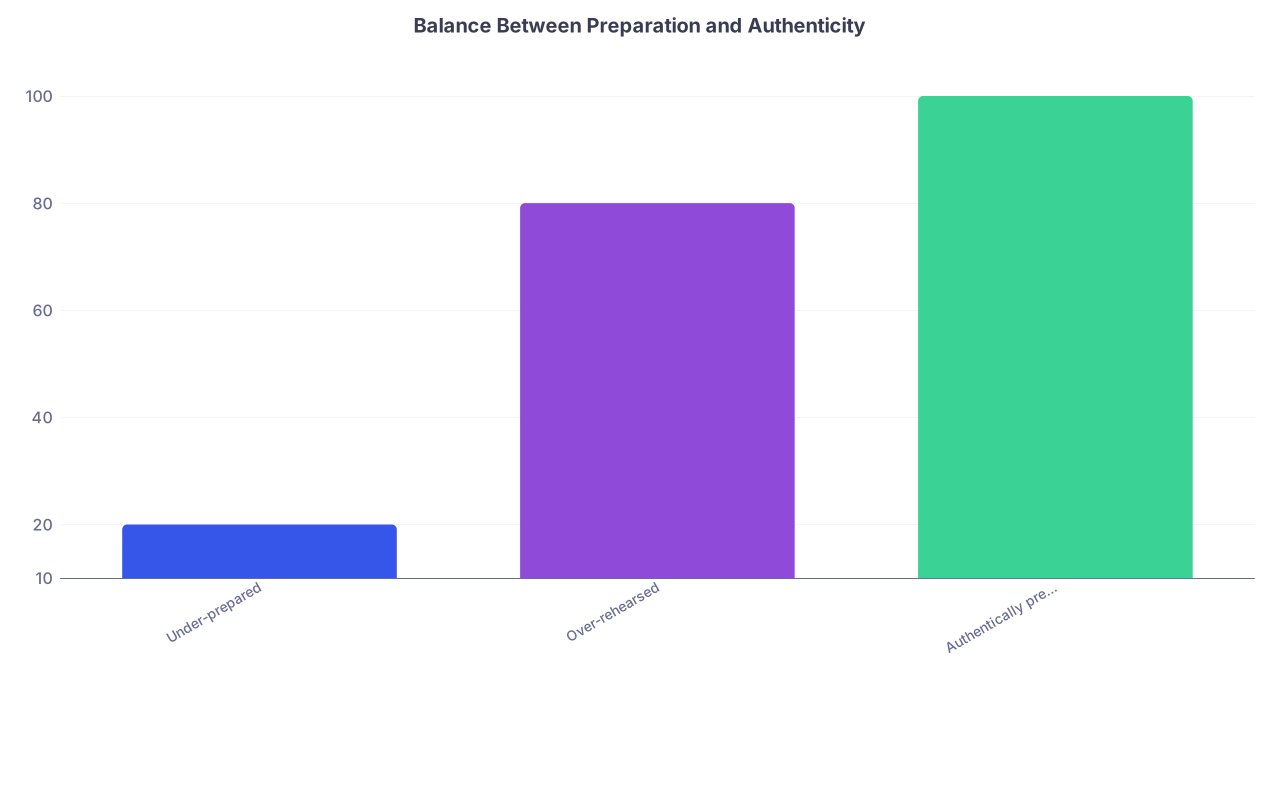
| Category | Value |
|---|---|
| Under-prepared | 20 |
| Over-rehearsed | 80 |
| Authentically prepared | 100 |
Know Your Stories, Not Your Sentences
You should clearly know:
- 5–7 core experiences you can flex for different questions:
- A conflict or disagreement
- A failure or mistake
- A time you received hard feedback
- A leadership experience
- A stressful / high-pressure situation
- A time you advocated for a patient or peer
- A time you changed your mind or approach
For each one, you need:
- The basic timeline
- 2–3 vivid details
- What you actually thought/felt
- What you changed afterward
That’s it. No movie script.
Practice in a Way That Forces Spontaneity
Do this:
- Record yourself answering a question without notes.
- Then answer the same question again later, but you’re not allowed to use any of the exact phrases you used before.
- Have a friend interrupt and ask follow-ups halfway through:
- “Why did you choose that approach?”
- “What would you do differently now?”
- “What surprised you the most?”
If you can answer consistently, with the same core story but different wording every time, you’re prepared. Not performed.
Fixing Over-Rehearsed Stories You Already Created
You might be reading this thinking, “Too late, I already have a scripted answer for everything.” It’s not too late. But you do need to strip them down.
Here’s how.

| Step | Description |
|---|---|
| Step 1 | Start with Scripted Answer |
| Step 2 | Delete Exact Sentences |
| Step 3 | Reduce to Bullet Points |
| Step 4 | Add 2-3 Real Specific Details |
| Step 5 | Record Yourself Telling It Casually |
| Step 6 | Practice Variable Versions |
| Step 7 | Test with Follow-Up Questions |
Step 1: Destroy the Script
Take your written answer and:
- Delete all full sentences
- Keep only:
- Key event
- Who was involved
- 2–3 key moments
- Your main takeaway
No transitions. No “this taught me that…” phrasing.
Step 2: Rebuild With Real Details
Most over-rehearsed stories lost anything specific because details feel risky.
Add back:
- The actual setting (ICU, clinic, ED)
- The role you really played (student, not secret attending)
- What people actually said (short quotes)
Not: “I implemented a new system of communication.”
Instead: “I started writing a quick team update on the whiteboard after rounds, so nights knew which labs and consults we were still waiting on.”
Step 3: Force Yourself to Vary the Telling
Practice that same story:
- Once to a friend in med school
- Once to someone outside medicine
- Once alone, recorded, answering slightly different versions of the question
If every version comes out word-for-word the same, you’re still clinging to a script.
How This Plays Out in Real Residency Interviews
Let me paint two versions of the same question.
Question: “Tell me about a time you failed or made a mistake.”
Over-rehearsed applicant: “I experienced failure during my surgery rotation when I did not perform as well as I had hoped on my mid-rotation evaluation. At first, I felt disappointed, but I used this as an opportunity to seek feedback, grow, and improve. Ultimately, I learned the importance of being proactive, communicating, and embracing a growth mindset.”
This could be anyone, anywhere, anytime.
Authentically prepared applicant: “On my third-year surgery rotation, my mid-rotation eval said I was ‘too hesitant’ in the OR. I honestly thought I was being respectful and not in the way. The resident pulled me aside and said, ‘If you don’t speak up about wanting to try things, you won’t get to do them.’
That stung, because I thought I was trying hard. That night I wrote down three specific things I wanted to get better at and asked the intern the next day, ‘Can you page me anytime you’re doing central line preps or Foley placements? I need reps.’
By the end, my eval still didn’t say I was the “strongest” student on the team, but it said I’d become ‘noticeably more proactive.’ Now I always ask residents on day one, ‘What do strong students on this service do differently?’ I don’t assume I know.”
Same theme: failure and growth. One sounds alive. The other sounds like a template from a blog.
Quick Comparison: Healthy vs. Harmful Practice
| Practice Approach | Helps Authenticity | Hurts Authenticity |
|---|---|---|
| Bullet-pointing key stories | ✅ | |
| Memorizing written paragraphs | ✅ | |
| Practicing with follow-ups | ✅ | |
| Repeating exact phrasing | ✅ | |
| Adding real, messy details | ✅ | |
| Polishing out all vulnerability | ✅ |
How to Sound Prepared and Real on Interview Day
A few tactical rules to keep you out of the “robot” territory.
Don’t chase the perfect answer. Chase a true one that’s structured enough to follow.
Allow small imperfections:
- Brief pauses
- Occasional “let me think about that for a second”
- Natural shifts in wording
Answer the question that was actually asked, not the one you prepared for. If they say “Tell me about a time you received difficult feedback,” don’t force your generic “conflict with a classmate” story if you have a better one.
Stop talking before it sounds like a conclusion you rehearsed. If your ending feels like the last slide of a PowerPoint, you’ve gone too far.
Treat the interviewer like a future colleague, not a panel of judges. Because that’s what they are.
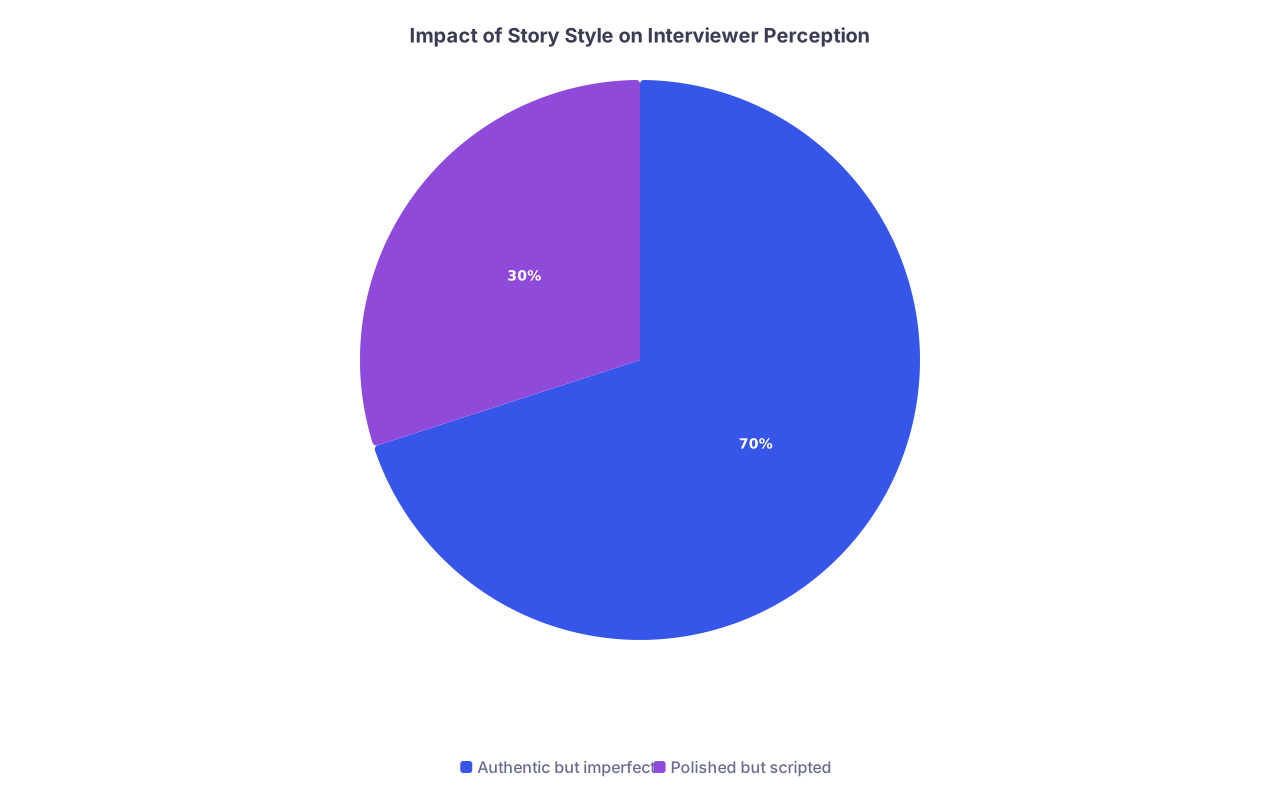
| Category | Value |
|---|---|
| Authentic but imperfect | 70 |
| Polished but scripted | 30 |
Most faculty will take “authentic but slightly rough” over “flawless and fake” every single time. They trust what feels real.
FAQs
1. How many behavioral stories should I prepare for residency interviews?
Prepare 5–7 core stories, not 25 separate ones. Each story should be flexible enough to answer multiple question types. For example, one good “conflict with a senior resident” story can also work for questions about feedback, professionalism, or adapting to challenging team dynamics—if you adjust the focus on the fly.
2. Is it okay to practice answers with friends or a coach?
Yes, but set boundaries. Don’t let anyone write sentences for you. Use them for:
- Spotting missing details
- Pointing out when something sounds fake or corporate
- Throwing you unexpected follow-ups
If you leave a session with a fully scripted paragraph, you went too far.
3. What if I blank in the middle of a behavioral story?
Do not panic and default to a memorized line. Do this instead: Pause, say, “Let me back up for a second—the key piece here is…” and re-anchor yourself in the main point. Interviewers don’t penalize brief, honest resets. They do notice when you glitch because your script fell apart.
4. Can I reuse the same story with different interviewers or programs?
Absolutely. They don’t compare tapes. Just don’t deliver it word-for-word each time. If you tell the same story three times in one day and it sounds different in natural ways—slightly different details, different emphasis—that’s normal and human. That’s what you want.
5. How do I know if my story sounds over-rehearsed?
Two tests:
- Record yourself and listen: if you wouldn’t tell that same story in that exact way to a trusted resident you like, it’s probably over-produced.
- Ask someone to stop you mid-answer and change the question slightly. If you completely derail or can’t adjust the story focus, you’re relying on a script instead of real understanding.
Here’s what you need to remember:
- Scripts make you sound safe, not strong. Programs want real colleagues, not polished performances.
- Know your stories deeply, then tell them loosely. Prepared in substance, unscripted in wording.
- If your answer could belong to any applicant, at any school, for any specialty—it’s not helping you. Strip it down, make it specific, and make it yours.