
The way most applicants answer “weakness” questions in residency interviews is dangerously wrong.
Not just suboptimal. Actively harmful. I’ve watched outstanding applicants sink their rank position because they tried to be clever, cute, or overly polished with this one question.
You’re applying to a profession where your limitations can hurt real patients. Program directors are not asking this to play games. They’re checking: will you hide problems or own them?
Let me walk you through the biggest mistakes people make with “weakness” questions – and exactly how to avoid torching your interview.
1. Treating the Weakness Question Like a Trick Instead of a Safety Check

The first mistake is assuming the interviewer is trying to trap you.
They’re not. They’re trying to answer a few very specific questions in their head:
- Does this person recognize they’re not perfect?
- When they mess up at 3 a.m., will they tell someone or cover it up?
- Are they coachable, or will they argue with feedback?
- Will their blind spots put patients or co-residents at risk?
When you treat the question as a puzzle to “beat,” you end up giving plastic, dishonest answers. And faculty can smell that a mile away.
Here’s what they’re not asking:
- “Are you flawless?”
- “Convince us you have no weaknesses.”
- “Perform some clever verbal gymnastics.”
They already know you have weaknesses. You’re human. The interview is about how you think about them, not whether they exist.
If the voice in your head is, “How do I spin this so I don’t look bad?” you’re already walking in the wrong direction. The better question is: “What real limitation have I been actively working on, and what does that say about me as a learner and colleague?”
2. The Fake Weakness: “I Care Too Much” and Other Cringe Responses
Let me be blunt. These are terrible answers:
- “I’m a perfectionist.”
- “I work too hard.”
- “I care too much about my patients.”
- “Sometimes I just push myself too much to get everything right.”
Interviewers roll their eyes internally when they hear this. They’ve heard the exact same phrases 30 times that season. Usually delivered in the same rehearsed tone.
The problem with “fake weaknesses” is twofold:
- They insult the interviewer’s intelligence. You’re signaling, “I don’t trust you enough to be honest with you.”
- They tell us nothing about how you actually operate under stress, how you learn, or how you respond to failure.
I’ve seen rank meetings where someone reads an interview note:
“Asked about weakness – gave cliché ‘I work too hard’ answer.” Then the PD says, “So we don’t know how they handle real problems. That’s a yellow flag.”
You do not want to be the “yellow flag” person when there are 600 applicants for 10 spots.
Avoid this whole category:
| Type | Example Phrase |
|---|---|
| Overwork humblebrag | "I work too hard." |
| Perfectionism spin | "I just care too much about details." |
| Self-sacrifice brag | "I put patients above myself too much." |
| Vague fluff | "I’m always striving to improve." |
If your weakness, on its surface, sounds like a compliment, you’re probably doing it wrong.
3. Confessing a Fatal Flaw That Makes You Untrainable
On the other extreme, some applicants over-share in a way that terrifies programs.
Residency is stressful. Program directors are constantly calculating risk. Certain “weaknesses” raise huge red flags because they imply danger, unreliability, or lack of basic professionalism.
Answering with something like:
- “I have trouble being on time.”
- “I procrastinate a lot and always cram at the last minute.”
- “I get bored with routine tasks and lose focus.”
- “I don’t do well with authority or being micromanaged.”
- “I’m bad at communicating with nurses.”
- “I freeze under pressure.”
These are not “growth edges.” They’re landmines. The follow-up thought in the interviewer’s head is: “…and my patients are supposed to be safe with you at 2 a.m. on cross-cover?”
You also don’t want to disclose unstable, unmanaged personal issues as your primary interview weakness:
- “I have uncontrolled anxiety and sometimes shut down.”
- “I get very angry when criticized.”
- “I sometimes yell when stressed.”
If it sounds like something that would clearly derail performance under stress or jeopardize patient safety, it’s the wrong choice for this context.
Do those issues matter? Absolutely. Should you be addressing them in real life? Yes. But the residency interview is not your therapy session. It’s a professional evaluation.
The safe zone is:
A real, contained, behavior-level weakness that:
- Doesn’t make you unsafe
- Doesn’t make you unreliable
- Has a clear history of improvement
- Has a concrete plan attached
4. Giving a Weakness With No Evidence of Growth
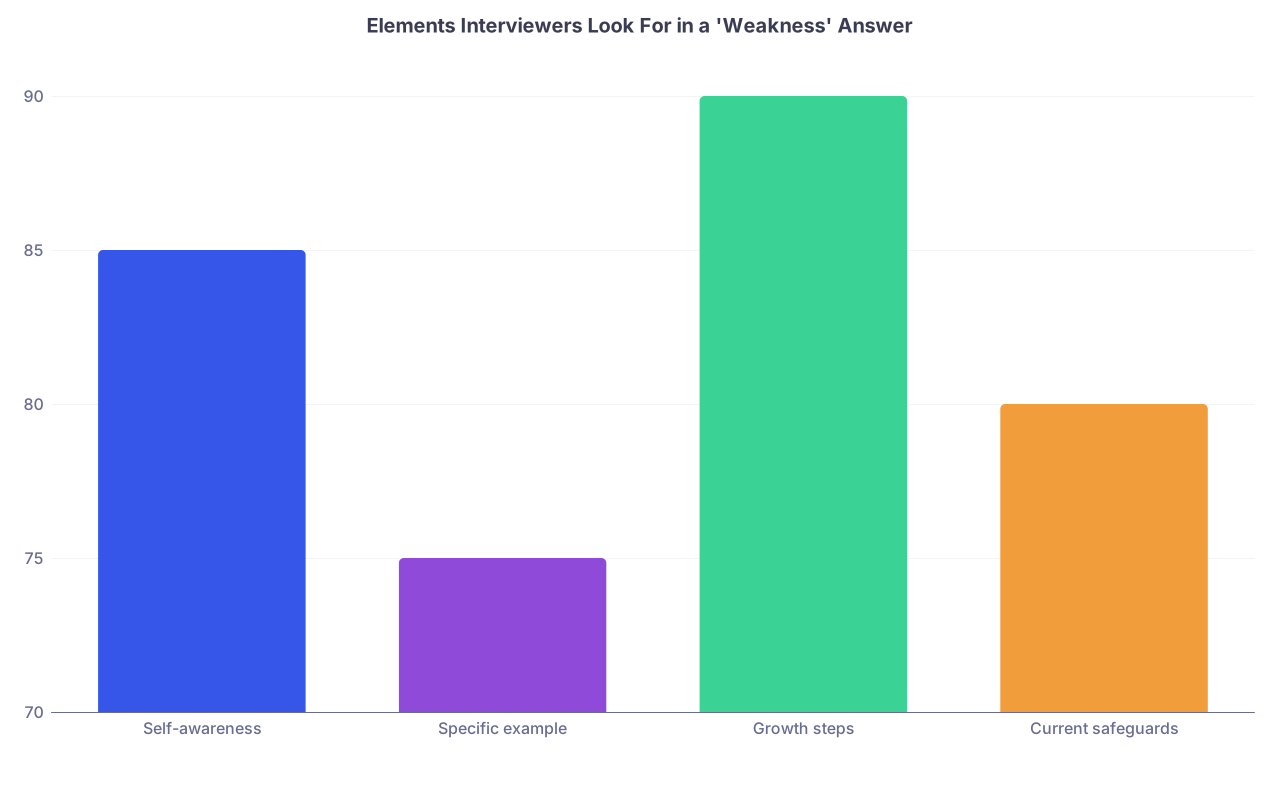
| Category | Value |
|---|---|
| Self-awareness | 85 |
| Specific example | 75 |
| Growth steps | 90 |
| Current safeguards | 80 |
Another huge mistake: answering like this is a static personality test.
If your answer sounds like, “This is just the way I am,” you’ve missed the point. Programs are not just judging your personality. They’re judging your trajectory.
A bad answer stops here:
“My weakness is time management. I tend to underestimate how long things will take.”
Okay… and then what? Do you still? What changed? What’s different now?
A better structure is:
- Name a specific, behavior-based weakness
- Give a brief, concrete example from the past (non-patient-harming)
- Explain what you learned and what you changed
- Describe your current strategies and remaining growth edge
For example:
“Earlier in medical school, I had trouble prioritizing tasks on busy inpatient days. I’d get stuck perfecting notes and fall behind on pages. On my internal medicine clerkship, my senior pointed out that patient care tasks were getting delayed because I was trying to make my documentation flawless in real time.
Since then, I’ve started using a simple triage system: urgent patient care tasks first, quick sign-out notes, and then I batch longer documentation after critical work is done. I also ask my senior to sanity-check my plan at the start of the day. I’m much more functional now, but I still consciously remind myself that ‘perfect notes’ can’t come at the cost of delayed patient care.”
Notice what this does:
- Admits a real issue
- Shows insight and teachability
- Demonstrates concrete process changes
- Frames weakness as managed, not ignored
Your weakness answer without growth is just a confession. With growth, it becomes proof you’re coachable.
5. Picking a Weakness That Directly Contradicts the Specialty’s Core Demands
This one’s sneaky and very common.
You say:
- “I’m not very detail-oriented” → applying to pathology or radiology
- “I don’t like talking to families” → pediatrics or oncology
- “I hate long-term follow-up” → primary care, psychiatry
- “I get bored in the OR” → surgery
- “I’m not a team person; I prefer working alone” → literally any residency
That’s like telling a flight school: “My weakness is I don’t like following checklists.” It doesn’t matter how honest it is. You’re telling them you’re a bad fit for the core job.
You want a weakness that is:
- Real, but not central to the specialty’s identity
- Something residents commonly struggle with but can realistically improve
- A growth edge, not a value mismatch
Examples that are safer when framed correctly:
- Struggling to speak up early in hierarchy (for any field)
- Being overly self-critical after mistakes
- Difficulty saying no and overcommitting
- Initially afraid to ask for help because you want to be independent
- Taking longer to feel comfortable with new EMRs or systems
All of those can be framed as “I recognized this, mentors helped me, here’s what I do differently now.” None of them scream “wrong specialty.”
6. Using Vague, Fluffy Language That Sounds Rehearsed
If your answer could have been generated by a random corporate interview book, it’s probably hurting you.
Examples of vague nonsense:
- “My weakness is I’m always striving to do better.”
- “I think my main weakness is I care deeply about patient outcomes.”
- “Sometimes I set high standards for myself.”
These phrases are content-free. Interviewers want a story, not a slogan.
Compare these two:
- “I guess my weakness is that I want to do everything perfectly, and I can be too detail-focused.”
- “On my third-year rotations, my feedback was that my notes were thorough but sometimes too long and delayed my throughput. My senior on surgery taught me to front-load key information, and I started timing myself for each note to keep the essentials while trimming extras. Now my notes are more focused and I’m finishing them earlier in the day. I still sometimes overthink wording, but I’m much faster at prioritizing what actually matters.”
Same core trait (perfectionism). Completely different impact. One is fluff; the other is usable information.
If you can’t attach your weakness to 1–2 specific behaviors and at least one real example, it’s too vague.
7. Over-Explaining, Over-Justifying, or Getting Defensive
Another trap: turning the weakness question into a courtroom defense.
You’ll hear applicants say:
“Some people say I’m not great at time management, but that’s only because I had 3 shelf exams back-to-back that month, and I was also dealing with family issues, and it actually wasn’t my fault because…”
They argue with their own answer. They preemptively justify every piece of criticism. They’re visibly uncomfortable with imperfection.
The unspoken message: “If I’m this defensive in an interview, imagine me when you give me real feedback on the wards.”
You want to show you can sit with imperfection without melting down or building a 10-slide PowerPoint about why it wasn’t your fault.
Healthier pattern:
- Own it succinctly
- Give enough context to understand, not to excuse
- Spend more time on what you changed than on why it happened
If 70% of your answer is explaining why it wasn’t really your fault, you’ve missed the assignment.
8. Ignoring the Follow-Up: “What Are You Doing About It Now?”

| Step | Description |
|---|---|
| Step 1 | State specific weakness |
| Step 2 | Brief concrete example |
| Step 3 | What you learned |
| Step 4 | Specific changes you made |
| Step 5 | How you monitor it now |
Strong interviewers will almost always follow up:
- “How has that shown up on rotations?”
- “What have you done to address it?”
- “What feedback have you received recently about this?”
If you’re not ready here, you’ll stumble into either:
- Minimizing it (“Oh, it’s not really an issue anymore.”)
- Exaggerating your progress (“I completely fixed that in two weeks.”)
- Vagueness (“I just try to be more aware now.”)
You need concrete, boring, real strategies:
- “I use checklists for complex discharges.”
- “I schedule intentional debriefs with seniors when something goes wrong.”
- “I keep a short written feedback log and review it monthly.”
- “I build in 10 minutes before sign-out to organize and double-check my to-do list.”
Boring is good here. It sounds real. It sounds sustainable. It sounds like something you actually do at 4 p.m. when your pager won’t stop going off.
9. Failing to Connect Your Weakness to Residency Reality
A subtle but important mistake: keeping your answer stuck in “med school land” and never translating it to, “What does this mean for me as an intern?”
For example, you talk about:
“I had challenges delegating in a student-run clinic.”
Okay. But what about when you’re cross-covering 40 patients at night?
Interviewers want to know: what will this weakness look like under actual resident pressure? And are you already thinking about that?
So you might add:
“Going into residency, I’m aware that difficulty delegating could show up when I’m trying to handle too much myself instead of using the team. I’ve been watching good seniors on my sub-I and noticed they constantly communicate with nurses and RTs rather than trying to do everything solo. So I’ve started explicitly asking, ‘What on this list can only I do, and what can someone else on the team help with?’ I plan to keep using that mental filter as an intern.”
That tells a PD: you’re already mentally in the role, not just reciting a premed self-help script.
10. Not Practicing Aloud – So You Sound Either Robotic or Chaotic

There’s a difference between rehearsed and prepared.
Two obvious disasters:
- Robotic recitation – You’ve memorized a paragraph from some blog and now you’re reading it in your head. Same cadence, same buzzwords. No emotion. No real reflection.
- Chaotic rambling – You didn’t prepare at all. You pick a weakness on the spot, meander for three minutes, contradict yourself twice, and end with, “So yeah, I guess that’s it.”
Both signal poor judgment. And lack of preparation.
You want “clear but natural.” The way you get there is not by scripting word for word. It’s by outlining your answer and saying it out loud multiple times to a real human.
Your outline should be:
- One sentence: the weakness
- 2–3 sentences: specific example
- 3–5 sentences: what you learned and what you changed
- 1–2 sentences: how it will matter in residency
Then you practice it until you can say it conversationally, with minor variations, without sounding like ChatGPT circa 2022.
If you’ve never actually spoken the words before interview day, you’re gambling with one of the most predictable questions you’ll get. That’s lazy.
11. Strong Example Structures (So You Don’t Have to Wing It)

Use these as templates, not scripts. Change them to fit your actual experience.
Example 1 – Difficulty asking for help:
“One weakness I’ve been working on is hesitating to ask for help early when I’m unsure. Early in third year, I worried that asking too many questions would make me look unprepared, so I sometimes spent too long trying to figure things out alone. On my medicine rotation, my resident pointed out that this delayed decisions for a patient with worsening shortness of breath because I didn’t immediately get them involved when I saw the change.
Since then, I’ve started using a simple rule: if I’m unsure and it could affect patient safety, I ask early and briefly, even if it feels uncomfortable. I also try to frame questions clearly – ‘Here’s the situation, here’s what I’m thinking, here’s where I’m stuck’ – so I’m not just dumping problems on my seniors. I’m much better now at differentiating between things I can look up later and things that need real-time input. Going into residency, I plan to keep erring on the side of early communication, especially at night or with unstable patients.”
Example 2 – Being overly self-critical:
“I tend to be pretty hard on myself after I make a mistake. On my surgery rotation, I missed a lab result that delayed calling a consult by about an hour. The patient did fine, but I replayed it in my head for days, which honestly made me more distracted on subsequent shifts. My attending noticed I was quieter than usual and reminded me that learning from an error is important, but ruminating on it doesn’t help the patient in front of you.
Since then I’ve started using a more structured approach: I jot down what happened, one to two concrete takeaways, and what I’ll do differently next time, then I intentionally put it away and refocus. I’ve also gotten better at seeking brief debriefs from residents instead of trying to process it alone. I still feel that sting when I fall short, but it’s less paralyzing, and I’m more able to convert it into action instead of just guilt.”
Notice: real, non-catastrophic, improved, with a clear plan.
FAQ (Exactly 4 Questions)
1. Should I ever say, “I don’t know” when asked about my weakness?
You should never say, “I don’t really have a weakness,” or dodge the question. That screams lack of self-awareness. If you truly freeze, you can buy a second: “That’s a good question – one thing I’ve been actively working on is…” and then go into a prepared, honest example. Not having anything ready is a preparation failure, not a personality trait.
2. Can I use the same weakness answer for every specialty?
You can use the same core theme (e.g., trouble asking for help early, being overly self-critical), but you must tailor it slightly to the specialty and program. A weakness that fits psychiatry may land differently in EM. The spine of the answer can stay, but the example and residency-relevance should be specific to where you’re interviewing.
3. Is it okay if my weakness shows up in my MSPE or evals?
Actually, that can be a strength if you handle it well. If there’s consistent feedback (e.g., time management, speaking up), owning that pattern and showing how you’ve addressed it can reassure programs you’re not blind to it. What you absolutely should not do is pretend it doesn’t exist when they can plainly read it in your file.
4. How long should my weakness answer be?
Aim for about 60–90 seconds. Long enough for a concrete example and growth story, short enough that you’re not hijacking the interview. If you’re going past two minutes, you’re probably over-explaining or justifying. Focus on clarity: specific weakness → specific example → specific change → brief link to residency.
Key points, so you don’t blow this:
- Stop trying to “game” the weakness question with fake humblebrags. Interviewers see right through it.
- Choose a real, non-fatal, behavior-based weakness and show concrete growth. Boring, specific strategies win.
- Practice out loud until you can answer clearly and naturally, without sounding either robotic or defensive.