
It is interview day at your top residency program. You have your suit, your CV, your Step scores. The PD leans back and asks:
“Tell me about a time you had a conflict with a teammate.”
You answer. You talk for maybe 45 seconds. Something about a group project, a miscommunication, you cleared it up. The interviewer nods politely, writes something down, and moves on.
And you can feel it.
That answer did not land.
This is the problem: your answers are technically fine. You are not blanking. You are not saying anything disastrous. But they are flat. Forgettable. They do not show judgment, growth, or how you actually function on a team at 2 a.m. on a bad call night.
Let us fix that.
You do not need to become a different person. You need a system to:
- Diagnose why your answers are weak
- Upgrade them step by step
- Practice in a way that actually sticks
Here is the playbook.
Step 1: Diagnose Why Your Answers Are Flat
Before you fix anything, you need to know what is broken. Weak behavioral answers usually fail in predictable ways. I see the same patterns in med students and residents every single season.
Run your recent answers through this checklist.
Common failure modes
-
- “We had a disagreement, but we worked it out.”
- No names, no stakes, no concrete actions.
- The interviewer learns nothing about how you actually behave.
Too safe / sanitized
- You never admit struggle, pushback, or mistakes.
- Everything is “we communicated better and it was fine.”
- It sounds like a pre-chewed canned line, not a real story.
No clear role
- You say “we” the entire time.
- It is impossible to tell what you personally did.
- This kills you in ranking meetings. Committees want to know what you do when things get hard.
No impact or outcome
- The story just… stops.
- “So that was that” or “and then we moved on.”
- No measurable change, no lesson, no evidence that you left the situation better.
Narrative sprawl
- You spend 80% of the time on background.
- The actual action is one or two sentences.
- You are three minutes in and still describing the ED layout.
Wrong level of severity
- For “big” questions (serious conflict, major error) you pick trivial examples.
- For minor questions, you pick something so huge it becomes awkward or unsafe to discuss fully.
No reflection
- You tell “what happened” but not “what you learned” or “what changed.”
- You sound like a reporter, not a developing professional.
If more than two of these hit home, your answers are objectively weak. That is not a character judgment. It is a performance problem—and performance problems are fixable.
Step 2: Learn the Simple Upgrade Framework (STAR+I)
You have heard of STAR. Situation, Task, Action, Result. That is fine for generic corporate interviews.
Residency interviews need a better version.
Use STAR+I:
- S – Situation: Brief, precise context
- T – Task: What you were responsible for
- A – Action: What you did, step by step
- R – Result: Concrete outcome (numbers or clear change)
- I – Insight: What you learned and how you use it now
The “I” is where most applicants fail. Programs are not just hiring what you did at 23. They are hiring your trajectory. They want to see evidence you actually adapt.
Here is how to apply STAR+I without sounding robotic.
Start with stakes, not a novel
Bad:
“So I was a third-year on my internal medicine rotation. It was a large academic center, really busy, and we had a lot of complex patients and a brand-new EMR rollout…”Better:
“On my IM rotation, we had a breakdown in communication about DNR status that almost led to an unnecessary transfer to the ICU.”One sentence. High stakes. Now they are actually listening.
Define your task clearly
- “As the student, my role was to…”
- Be explicit: responsible for clarifying, coordinating, following up, de-escalating.
Actions = verbs, not buzzwords
- “I called,” “I clarified,” “I proposed,” “I documented,” “I closed the loop.”
- Avoid fluff: “leveraged,” “optimized,” “synergized.” That is LinkedIn nonsense, not medicine.
Result: numbers or tangible changes
- “We prevented an ICU transfer and updated the code status in the chart before sign-out.”
- “Our response times improved by one full day.”
- “The attending adopted that checklist for the rest of the rotation.”
Insight: 1–2 lines that connect to residency
- “Since then, I always confirm code status myself during pre-rounds, especially on handoff patients.”
- “Now, when I sense misalignment early, I address it that same day instead of hoping it will resolve.”
If you remember nothing else: every story must end in “Now I…” or “Since then I…”
That is the upgrade line.
Step 3: Build Better Raw Material (Your Story Bank)
You cannot fix flat answers if your examples are weak or repetitive. Most applicants overuse:
- “Group project in pre-clinical years”
- “Generic team disagreement”
- “Patient who did not want to take their meds”
Those are fine, but if they are the only stories you have, you are in trouble.
You need a story bank: 12–15 solid, reusable stories that you can adapt to multiple questions.
Core categories to cover
Make a quick table for yourself. Use these categories:
| Category | Minimum Stories |
|---|---|
| Conflict | 2 |
| Mistake / Failure | 2 |
| Difficult Feedback | 2 |
| Leadership | 2 |
| Initiative | 2 |
| Stress / Burnout | 2 |
| Ethics / Safety | 2 |
You will reuse the same story frame across questions. For example, one “conflict with a nurse” scenario can be used for:
- Conflict
- Communication
- Dealing with hierarchy
- Advocacy for patient safety
How to mine your past quickly
Set a 30-minute timer. No distractions. Open a blank document. Then:
List every rotation and role in reverse order:
- Sub-I, AI
- Core rotations
- Research, leadership roles, volunteer work
Under each, free-write short bullets:
- “Attending yelled in front of patient; debriefed with resident after.”
- “Code blue where no one was coordinating chest compressions.”
- “QI project where faculty PI disappeared mid-way.”
- “Miscalculated fluids on a surgery patient; caught by resident before order placed.”
Do not evaluate yet. Just capture.
Aim for at least 20–30 raw moments. You can refine later.
Step 4: Turn One Weak Answer Into a Strong One (Live Example)
Let us take a very common scenario and upgrade it step by step.
Question: “Tell me about a time you had a conflict with a nurse or another team member.”
Version 1: Flat answer (what I actually hear in interviews)
“I had a situation on my surgery rotation where a nurse and I disagreed about when a patient could start eating after a procedure. We had different understandings of the order, and there was some tension. I explained my perspective, and the nurse explained hers, and eventually we clarified it with the resident and moved on. It was a good learning experience about communication and teamwork.”
Problems:
- No stakes. Was the patient at risk for aspiration or just mildly annoyed?
- No clear role. What did you actually do beyond “explained my perspective”?
- No outcome. “Moved on” tells me nothing.
- Zero insight that affects future behavior.
Version 2: STAR+I upgrade
“On my surgery rotation, we had a miscommunication about post-op diet on a patient with significant aspiration risk.
I had prerounded on a patient the morning after a laparoscopic cholecystectomy. The resident’s note suggested advancing diet as tolerated later that day. At noon, the bedside nurse called me, frustrated, because the patient’s family was upset he was still NPO and they wanted to order food.
As the student, my role was to clarify the plan and make sure we were not putting the patient at risk.
First, I went to the chart and confirmed the latest orders and the operative note. I realized the formal order set had not actually been updated from NPO, and the patient had a history of dysphagia from a prior stroke.
Instead of debating at the desk, I went to the bedside, acknowledged the family’s frustration, and explained that I wanted to double-check the safest timing based on his swallowing history. Then I stepped out, called the resident directly, and laid out the discrepancy: the note about advancing diet, the unchanged NPO order, and the aspiration risk.
We agreed it was safer to get a quick speech and swallow evaluation before changing anything. I updated the nurse with that plan, placed the consult, and then went back to the family to explain the rationale and timeline.
The speech eval that afternoon showed he did have an impaired swallow, so we started with a modified diet rather than regular food. The family was still disappointed, but they understood we were trying to prevent another aspiration event.
Since then, when I sense tension building around a plan, especially with nursing, I try to do two things early: 1) go back to the primary source—the chart, the orders, the attending’s stated plan—and 2) move the conversation to a shared goal, like patient safety, rather than who is ‘right.’ That approach has helped me de-escalate similar situations on later rotations.”
Why this works:
- Clear stakes (aspiration risk, upset family).
- Concrete actions (checked chart, bedside conversation, called resident, placed consult).
- Clear result (prevented potential aspiration; specific change in diet plan).
- Insight clearly tied to future behavior (“Since then, I…”).
This is the exact kind of answer that moves you from “generic good student” to “someone I trust on my night float team.”
Step 5: Use the “Three Angles” Technique to Deepen Any Story
Once you have a decent STAR+I answer, you can make it stronger by adding one or two “angles”:
Systems angle
- Did this reveal a workflow or system issue?
- Did anything change beyond this one patient?
Self-awareness angle
- What did you learn about your own default reaction?
- Did you realize you avoid conflict, over-apologize, speak too fast, etc.?
Team dynamics angle
- How did you account for hierarchy, differing communication styles, or burnout?
You do not need all three in every answer. That would be overkill. But one extra angle can turn a B+ answer into A-level.
For the surgery-nurse conflict story, a brief systems angle could be:
“I also mentioned to the resident that our note templates were generating ambiguity around post-op diet, and he updated his template to explicitly state ‘await SLP eval before diet advancement’ on patients with prior dysphagia. That small tweak probably prevented the same argument on the next few similar cases.”
That is an extra 1–2 sentences. But it shows you think beyond yourself.
Step 6: Match Story Type to Question Type (Without Overthinking)
Many strong candidates fumble because they pair the wrong example with the wrong question. Some quick mappings:
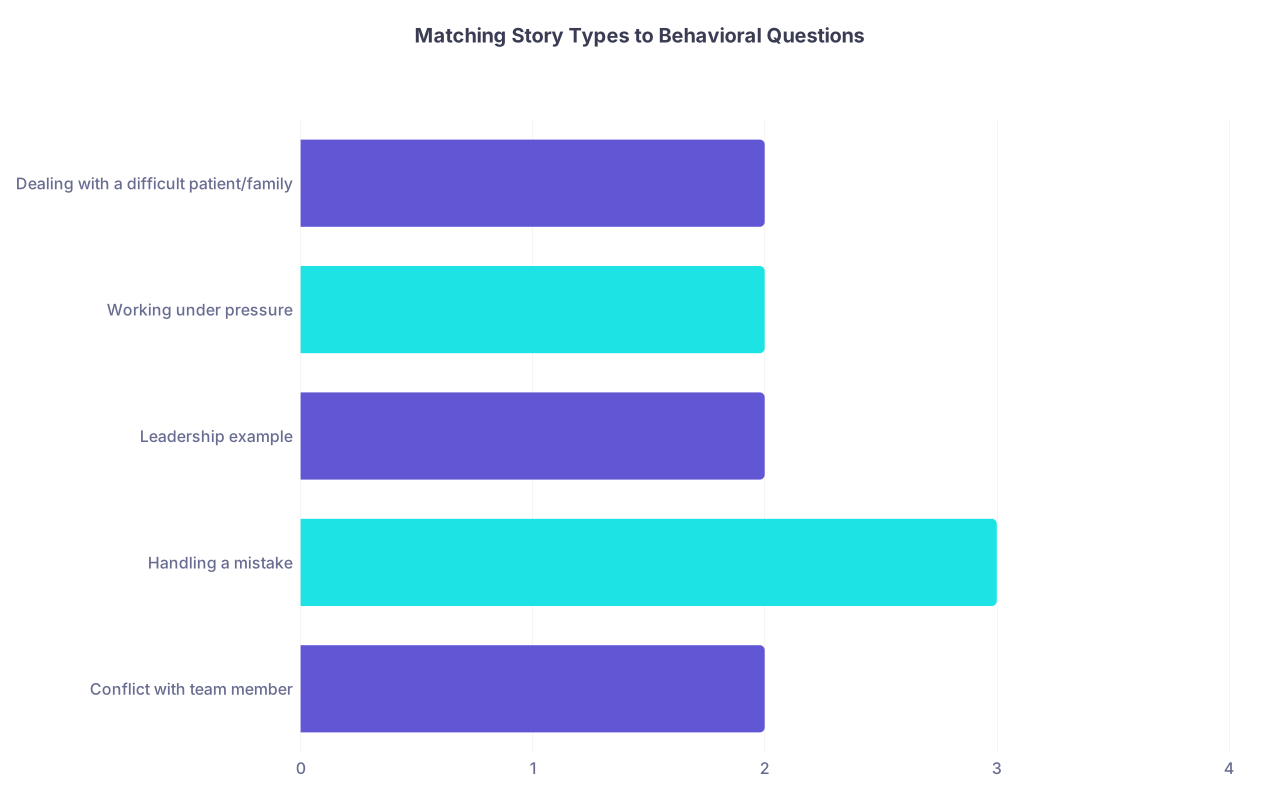
| Category | Value |
|---|---|
| Conflict with team member | 2 |
| Handling a mistake | 3 |
| Leadership example | 2 |
| Working under pressure | 2 |
| Dealing with a difficult patient/family | 2 |
(Values here represent the minimum number of solid stories you should have rehearsed for each theme.)
Use these pairings as your baseline
“Tell me about a time you made a mistake.”
Use: Actual error or near-miss where you had some agency. Not a trivial typo; not a catastrophic malpractice story.
Avoid: “I studied wrong for an exam” as your only example. Use clinical or team-based examples when possible.“Tell me about a time you received critical feedback.”
Use: A moment where feedback stung but you changed something concrete.
Show: How you processed it emotionally and how you operationalized it.“Tell me about a time you went above and beyond.”
Use: A scenario where your extra effort changed an outcome, not just staying late.
Show: Initiative tied to patient care, team function, or system improvement.“Tell me about a time you had to work with someone difficult.”
Use: A story where you maintained professionalism and adjusted your style.
Avoid: Trashing attendings, residents, or specific nurses. Red flag.“Tell me about a time you were under significant stress.”
Use: Call nights, overlapping responsibilities, personal crisis overlapping with clinical duties.
Show: Concrete coping strategies and boundary-setting, not martyrdom.
Have 1–2 stories per theme. Many will overlap. That is the point. You are not writing 30 unique monologues; you are creating a tight set of adaptable scenarios.
Step 7: Fix Delivery: Pacing, Length, and Voice
Even a good story dies if your delivery is off.
Length: 60–120 seconds
- Under 45 seconds: usually too shallow and vague.
- Over 2 minutes: usually too rambling and background-heavy.
Target: About 90 seconds. You can go shorter for simpler questions and slightly longer for complex ethical or error questions.
Pacing: front-load the stakes
Bad tendency: 45 seconds of context, 30 seconds of actual action.
Fix it:
- One or two sentences for situation and task.
- Most of your time on actions and result.
- One or two sentences on insight.
Voice: direct, not defensive
- Own your part. “I missed X,” “I did not clarify Y,” “I did not speak up early enough.”
- Avoid blame-dumping: “The attending never explained,” “The nurse overreacted.”
- You can describe others realistically without attacking them.
Practice saying phrases like:
- “Looking back, I would do X earlier.”
- “At the time, I thought Y, but I realized…”
- “Since then, I changed how I…”
Those are the sentences attendings lean forward on.
Step 8: Practice the Right Way (Not Just Re-Reading)
Reading your answers silently is not practice. That is fantasy.
Real practice involves:
-
- Use your phone. 20 minutes.
- Answer 3–4 core behavioral questions out loud.
- Watch it once with a pen in hand.
Score yourself ruthlessly on 5 dimensions:
| Dimension | 1 (Weak) | 3 (Average) | 5 (Strong) |
|---|---|---|---|
| Clarity | Rambling, hard to follow | Mostly clear, some tangents | Crisp, logical, easy to follow |
| Specificity | Vague, no details | Some concrete actions | Clear actions, vivid details |
| Ownership | Blaming, evasive | Mixed “we” and “I” | Clear personal responsibility |
| Impact | No clear outcome | Outcome implied, not explicit | Concrete, measurable outcome |
| Insight | No reflection | Generic lesson | Specific change in future behavior |
Pick your worst two dimensions and fix those first.
- Run “tightening drills”
- Take one answer. Deliver it in:
- 2 minutes
- 1 minute
- 30 seconds
This forces you to prioritize what actually matters and kills unnecessary background.
- Pressure test with a real human
- Grab a co-applicant, senior resident, advisor.
- Give them 3 questions to hit you with, randomly.
- Ask them two things only:
- “What is the one part that stuck with you?”
- “Where did you get confused or bored?”
If the part that stuck is the wrong part (some irrelevant detail), or if they got confused early, rewrite.
Step 9: Pre-Build “High-Risk” Answers
There are a few behavioral questions where a flat or evasive answer is a major red flag. You cannot wing these.
You need pre-built, rehearsed answers for:
Red flags / concerns in your application
- Step failure, course remediation, LOA, professionalism issue.
- You must show:
- Ownership
- Specific changes
- Evidence the problem is resolved and not recurring
Failures or mistakes in patient care
- They are not looking for perfection. They want honesty and a learning curve.
- Avoid graphic details. Focus on decisions, communication, and systems.
Conflicts with faculty or residents
- The trap is sounding bitter or victimized.
- The upgrade is showing how you used channels appropriately and remained professional.
For each of these, script a STAR+I answer. Practice it until you can say it calmly, without sounding rehearsed or defensive.
Step 10: Create a One-Page “Behavioral Answer Cheat Sheet”
Before interview day, you should have a single page you can glance at in the morning. Not a script. A map.
It should include:
- 10–12 story titles (e.g., “ICU handoff fall risk miss,” “Surgery NPO conflict,” “Shelf failure + study overhaul”).
- 1–2 keywords per story for:
- Conflict
- Mistake
- Leadership
- Stress
- Initiative
Example layout:

So when they ask, “Tell me about a time you were under pressure,” your brain does not freeze. You glance mentally at your map: “ICU handoff miss – pressure + systems + insight.” Then you run the STAR+I pattern.
This is how you sound sharp without sounding scripted.
Final Check: Are Your Answers Still Flat?
Ask yourself, honestly, about each of your go-to stories:
- Does the story have real stakes?
- Is my role crystal clear?
- Do I state a concrete outcome?
- Do I end with a specific “Since then, I…” insight?
- Can I deliver it in about 90 seconds without rushing?
If you can say yes to all five, that story is interview-ready.
Your Next Step Today
Do this now. Not “later,” not “this weekend.”
Open a blank document.
Pick one behavioral question you consistently dread. For most people, it is one of these:
- “Tell me about a time you made a mistake.”
- “Tell me about a time you had a conflict with a team member.”
- “Tell me about a time you received critical feedback.”
Draft a STAR+I answer for that one question. Aim for 10–12 sentences total.
Record yourself delivering it once on your phone. Watch it. Identify one change to make.
Redo it once with that change.
Do not try to fix all your answers in one sitting. Fix one. Properly. Feel what a strong answer sounds like in your own voice.
Once you have that template, you can upgrade the rest. One story at a time.