
It is 8:45 p.m. the night before your first residency interview.
You are on your third cup of coffee, staring at a Word doc full of bullet points:
- “Tell me about a time you failed…”
- “Tell me about a conflict with a team member…”
- “Tell me about a time you went above and beyond…”
You have “answers” written for all of them. You have practiced them. You also now sound like a robot.
You try one out loud:
“During my third-year internal medicine rotation, I encountered a situation where—”
You stop halfway. You hate it. It sounds fake, over-polished, and nothing like how you actually talk to people.
Here is the problem:
Programs want structured, thoughtful answers.
You want to sound like a real human.
Traditional advice pushes you straight into “scripted robot” territory.
You need a different approach: practice in a way that builds structure, content, and flexibility… without memorizing paragraphs.
Let me walk you through how to do that.
Step 1: Stop Writing Paragraphs. Build “Answer Skeletons” Instead.
The main reason people sound scripted is simple: they write essays, then try to recite them. That always leaks through.
Instead of scripts, you want skeletons.
A skeleton is a lightweight outline of your answer that you can flesh out differently each time.
Use STAR, but strip it down
Yes, STAR (Situation, Task, Action, Result) is still your friend. But most people misuse it by writing full sentences under each section.
Do this instead:
- Pick a story.
- Write 4–7 words per line only.
- No full sentences allowed.
Example – “Tell me about a time you resolved a conflict on the team.”
Bad (script version):
- During my surgery rotation, I worked with a resident who frequently criticized my performance in front of the team…
Good (skeleton version):
- S: Surg rotation – chief, public criticism
- T: Maintain pt care, team morale, get feedback
- A1: Asked to debrief post-rounds, private
- A2: Owned gaps, asked for specifics
- A3: Suggested weekly 5-min feedback
- R: Better relationship, better evals, calmer rounds
You have:
- The setting
- The key beats
- The outcome
But you do not have a script to recite. That is the point.
Do this for all your major stories:
- Max 7 bullet points per story
- Max 7 words per bullet
- No full sentences
If you catch yourself writing a sentence, you are writing a script. Stop and trim.
Step 2: Build a Story Bank, Not 50 Disconnected Answers
Another way people sound fake is by treating each question like it needs a totally unique story. It does not.
You need a story bank, not a script binder.
Create 8–12 “core stories” that you can recycle
Most behavioral questions for residency can be answered by remixing 8–12 strong stories. Aim to cover:
- Failure / mistake
- Conflict / difficult teammate
- Difficult patient or family
- Ethical or professionalism challenge
- Leadership experience
- Teaching or mentorship
- Going above and beyond for a patient
- Working under pressure / high workload
- Adapting to change / uncertainty
- Feedback and growth
You likely already have these. You just have not organized them.
Make a simple table to see coverage:
| Story # | Scenario Type | Rotation/Setting |
|---|---|---|
| 1 | Conflict with team member | Surgery – chief resident |
| 2 | Failure / mistake | IM – missed lab follow-up |
| 3 | Difficult patient/family | ED – frequent flyer |
| 4 | Leadership | Free clinic coordinator |
| 5 | Teaching | M3 teaching M2 skills |
| 6 | Ethical/professionalism | Witnessed shortcut on notes |
| 7 | High pressure / workload | Night float cross-cover |
| 8 | Adapting to change | COVID schedule disruption |
For each story in your bank, build a STAR skeleton like we just did. You now have reusable core material.
Map one story to many questions
Here is how one “conflict” story can stretch:
“Tell me about a time you had a conflict with a teammate.”
→ Emphasize the disagreement and resolution.“Tell me about a time you received critical feedback.”
→ Same story, but now focus on how you sought feedback and used it.“Tell me about a time you demonstrated professionalism.”
→ Same story, shift angle: you remained calm, avoided public confrontation, protected team function.
You bend the framing, not the truth. That is how you sound natural and flexible.
Step 3: Practice Out Loud – With Strict Constraints
Silent practice is useless for behavioral interviews. The problem shows up when you speak: monotone, rehearsed phrases, unnatural transitions.
You fix that by forcing yourself to improvise around your skeletons.
Drill 1: 3-take variability drill
Pick one story skeleton. Answer the same question 3 times in a row. You are not allowed to use the same opening or the exact same phrasing twice.
Example question: “Tell me about a time you failed.”
Take 1 – Start with the setting:
“On my third-year medicine rotation, I had a patient whose potassium I completely forgot to recheck…”
Take 2 – Start with the failure itself:
“I missed a critical lab follow-up that delayed treatment for a patient, and it forced me to rebuild my entire system for managing tasks…”
Take 3 – Start with the lesson:
“I learned the hard way that relying on my memory alone for follow-up tasks will fail every time…”
Same story. Different entry points. You are training flexibility.
Record yourself. Listen once. Ask:
- Do I sound like I am reading in my head?
- Do any phrases show up exactly the same each time? (Those are probably scripted.)
- Are my openings and closings too long?
If yes, loosen it up. Change one phrase each time until it comes out more naturally.
Step 4: Use “Anchor Phrases,” Not Memorized Monologues
You do want some phrases nailed down. Just not entire answers.
Think of anchor phrases as short, reliable bits that:
- Help you structure your answer
- Buy you 1–2 seconds to think
- Keep you from rambling
Examples of useful anchor phrases:
Openers:
- “One example that really stands out is…”
- “Recently on my [rotation], I had a situation where…”
- “I can think of a specific time when…”
Transitions:
- “The main challenge there was…”
- “What I decided to do was…”
- “The most important step I took was…”
Reflection / closing:
- “Looking back, I would now…”
- “The key lesson for me was…”
- “That experience changed how I now approach…”
You can practice these without scripting the whole answer.
Protocol: anchor-only rehearsal
- Take one story from your bank.
- Decide on:
- 1 opening anchor
- 1 transition anchor
- 1 reflection anchor
- Speak the answer out loud using those anchors, but ad-lib everything in between.
You are building muscle memory for structure, not content.
Step 5: Simulate the Real Thing – With Imperfect Conditions
Most people only practice under ideal conditions:
- Sitting at a desk
- Looking at notes
- Enough time before answering
Interviews are the opposite.
You will be:
- Slightly anxious
- Looking at a human face, not your outline
- Asked a question once, with 1–2 seconds to start
So your practice has to mimic that.
Use a strict timing and randomization protocol
Find a friend, resident, or attending. If you cannot, use a question list app or website.
Have them (or the tool):
- Randomly pick a behavioral question.
- Read it out loud.
- You must start answering within 3 seconds.
- You get 2 minutes max to answer.
Repeat for 8–10 questions in a row.
You are not testing “perfect content” here. You are testing:
- Can I quickly find a story from my bank?
- Can I structure it on the fly?
- Do I sound like myself when I am not overthinking?
Add a real-world twist:
- Do 1–2 practice questions while standing/walking around your room.
- Do 1 after a tiring day.
- Do 1 with a slightly distracted background (within reason).
You are training your floor performance, not your ceiling.
Step 6: Fix the Three Most Common “Robot” Triggers
There are specific tells that make you sound scripted. You can remove them quickly if you know what to look for.
Trigger 1: Overly formal, essay-style openings
If you start every answer with:
“During my third-year internal medicine rotation, I was involved in a situation where…”
you sound like you are reading your personal statement out loud.
Fix:
- Cut filler words: “I was involved in a situation where…”
- Start closer to the action.
Better:
“On my medicine rotation, I missed a key lab follow-up on a patient…”
You shave off the fluff and sound like a person.
Trigger 2: Listing emotions like a psych note
Scripted answers often say:
“I felt frustrated, anxious, and overwhelmed, but I persevered…”
Nobody talks like that in real life.
Replace the list-of-feelings style with one emotion + concrete behavior.
Instead of:
“I felt anxious and overwhelmed…”
Say:
“I was pretty overwhelmed — I caught myself triple-checking orders and still worrying I had missed something…”
That sounds lived, not memorized.
Trigger 3: Ending with generic “and I learned a lot”
Weak, scripted closing:
“Overall, it was a great learning experience and I learned the importance of communication and teamwork.”
That could be from anyone about anything.
You want a specific change in your behavior.
Stronger:
“Since then, I created a simple checklist system in my phone for pending labs and critical follow-ups. I have not missed one since, and I plan to keep refining that system in residency.”
Behavior change = authenticity.
Step 7: Use Video Feedback Like a Surgical Attending
You cannot fix what you do not see. Or hear.
You need to watch yourself the way a tough attending watches a PGY1 suture.
Simple self-review checklist
Record 3–5 answers on your phone. Then watch them back once, ruthlessly. You are looking for:
Pacing
- Do you sprint for 90 seconds with no pause?
- Do you meander and lose the thread?
Filler
- Excessive “um, like, sort of”?
- Or the med-student version: “I think that… I feel that… in terms of…”
Eye contact / facial tone
- Are you staring at the floor?
- Weird half-smile no matter the topic?
Content balance
- Are you spending 80% on the Situation and 20% on Action/Result?
- Are you actually answering the question asked?
Pick one thing to fix per round. Not five. Overhauling everything at once makes you stiff.
Example improvement rounds:
- Round 1: Focus only on cutting the first two unnecessary sentences in each answer.
- Round 2: Add a 1-second pause before speaking to avoid starting with filler.
- Round 3: Compress the Situation to 20–25 seconds max.
You will sound more natural simply by trimming fat and correcting pacing.
Step 8: Build a One-Page “Cheat Sheet” (That You Never Read in the Interview)
You are going to want something to hold onto. That is fine. Just do not let it become a script.
Create a single page with:
- Your 8–12 story names (short labels)
- 3–5 keywords for each (reminders, not sentences)
- A few anchor phrases you like
Example layout:

It might look like:
- Conflict – Surg chief
- public criticism / asked for debrief / weekly feedback / better relationship
- Failure – IM lab follow-up
- missed K recheck / called attending / new checklist / no repeats
- Difficult pt – ED frequent flyer
- frustration / sat down / addressed social issues / changed ED use
- Leadership – free clinic
- schedule chaos / reworked system / coverage grid / fewer no-shows
You review this before interviews, not during. It is for pattern recognition, not reading.
Seeing all your stories on one page does two things:
- Lowers anxiety — you know you have material.
- Makes you faster at mapping stories to questions during live practice.
Step 9: Practice With Different Interviewer Styles
You can have great stories and still sound bad if you are thrown by the interviewer’s style. Programs are not standardized. Some interviewers are warm and nod along. Some stare at you stone-faced.
You want practice with both.
Get at least two “types” of mock interviewers
If possible:
One person who is supportive / expressive
(They smile, nod, and give you verbal affirmations.)One person who is stoic / poker-faced
(They give you nothing. No nods. No “uh huh.” Just… stare.)
Your task is to keep your tone consistent regardless of the feedback you get.
This is where video helps again. People often start performing when they feel encouraged, and shrink when they feel judged. Programs notice that.
If you do not have two humans:
- Ask the same person to do two rounds:
- Round 1: engaged, friendly
- Round 2: absolutely blank, minimal response
You will be surprised how much this changes your delivery the first time.
Step 10: Convert Clinical Cases Into Interview-Ready Stories
Many students tell weak stories because they pick weak cases: vague, indirect, or obviously embellished.
Stronger move: take real cases you have already presented on rounds and convert them into behavioral answers.
You already know the patient:
- Age, condition
- What went wrong or what was hard
- What you did
Now you just frame it differently.
Example conversion: cross-cover chaos → “working under pressure”
Clinical memory:
- Night float
- Called for two hypotensive patients at once
- One septic, one GI bleed
- You prioritized, called for help, stabilized both
Behavioral answer skeleton:
- S: Night float, 2 hypotensive pts same time
- T: Triage, avoid delay, use limited resources
- A1: Quick vitals check via nurse, EMR review
- A2: Went to more unstable pt first (GI bleed)
- A3: Called senior, delegated labs/fluids for septic pt
- R: Both stabilized, debriefed prioritization with senior
- Lesson: Structured triage under pressure, using team
You did not invent anything. You just translated clinical to behavioral.
Do this for 4–5 cases you remember clearly. Now you have rock-solid, authentic stories.
Step 11: Know When To Stop Practicing
There is a point where “more practice” just means “more stiffness.” You need a cutoff.
Your practice is good enough when:
- You can answer the 10–15 most common behavioral questions
- You can do it:
- Without notes
- With slightly different wording each time
- In under 2 minutes per answer
- You do not feel the urge to “rewind and say it perfectly” after each practice
At that point, your time is better spent reading about programs, reviewing your own application, and sleeping.
Over-practicing behavioral answers the night before an interview is like doing a new workout the day before a marathon. It just makes you sore and weird.
Give yourself a hard rule:
- No behavioral practice after 7 p.m. the night before an interview.
- Night before is only:
- Quick glance at your story bank
- Review program specifics
- Skim your personal statement and ERAS
Your brain consolidates better if you are not flooding it with last-minute rewrites.
Sample Weekly Practice Plan (2 Weeks Before Interviews)
Here is a practical schedule that works without taking over your life:
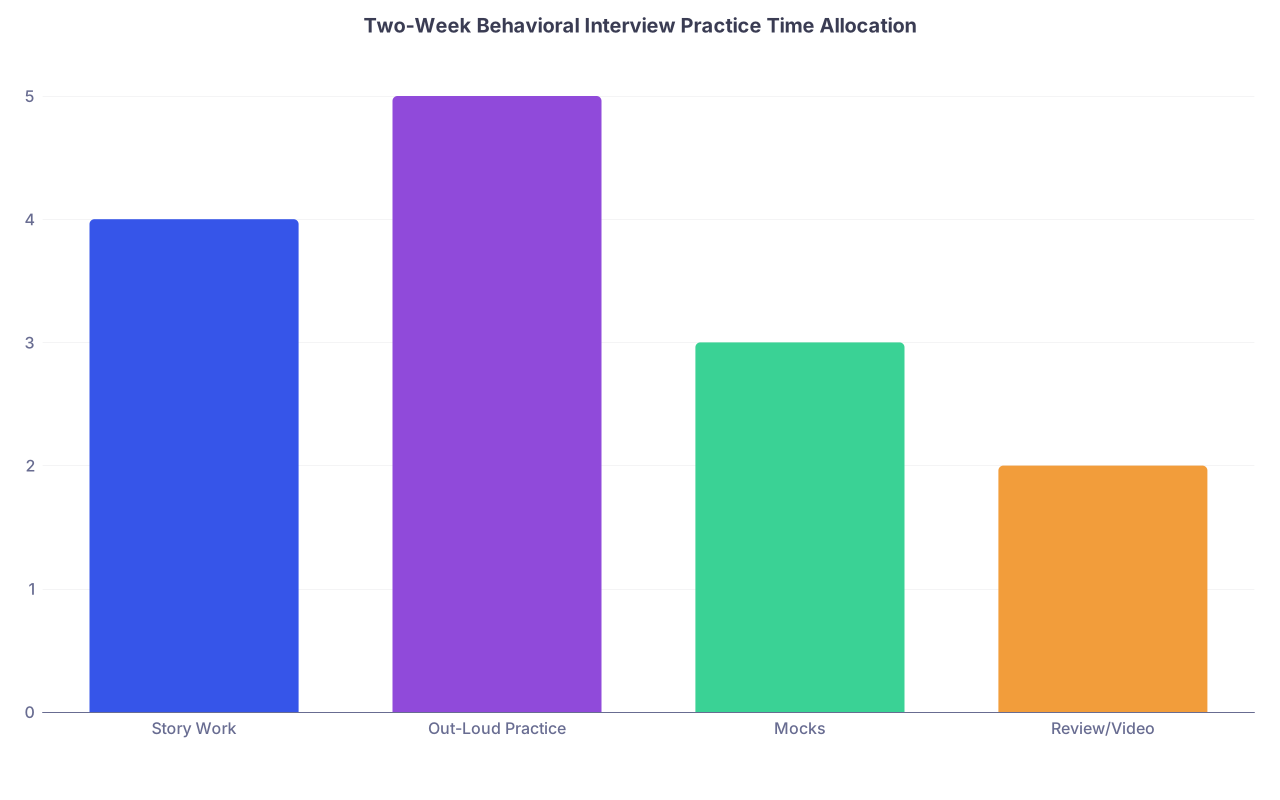
| Category | Value |
|---|---|
| Story Work | 4 |
| Out-Loud Practice | 5 |
| Mocks | 3 |
| Review/Video | 2 |
Day 1–2: Build Foundations
- Create your 8–12 story bank with skeletons.
- Do 3–4 out-loud answers alone just to test the material.
Day 3–4: Variability + Anchor Drills
- 20–30 minutes per day:
- 3-take variability drill on 2–3 stories.
- Add 2–3 anchor phrases you like and test them.
Day 5–6: First Full Mock
- 1 mock interview (friend, resident, or faculty).
- 8–10 behavioral questions.
- Ask for direct feedback on:
- Rambling
- Clarity
- Authenticity (do I sound like myself?)
Day 7: Video Check
- Record 3 answers.
- Fix one issue (pacing, long openings, or weak closings).
Week 2: Short, Targeted Reps
- Every other day:
- 15–20 minutes of random questions with 2-minute limit.
- One more mock interview with a different “style” of interviewer.
- One final video review (3–4 answers).
Past that point, you are maintaining, not building.
Two Quick Visuals You Can Use
A simple flow of how you should handle any behavioral question:

| Step | Description |
|---|---|
| Step 1 | Hear Question |
| Step 2 | Identify Theme (failure, conflict, etc.) |
| Step 3 | Map to Story Bank |
| Step 4 | S - 20s context |
| Step 5 | T - goal/challenge |
| Step 6 | A - focused actions |
| Step 7 | R - results + lesson |
And how your story bank connects to different themes:

Final Thoughts – What Actually Matters
If you strip everything else away, practicing behavioral interviews without sounding scripted comes down to three things:
Stories, not scripts.
Build a small bank of real, specific stories with STAR skeletons, then practice telling them different ways. Never memorize paragraphs.Structure + flexibility.
Use anchor phrases and a simple flow (Situation → Task → Action → Result/Lesson) to keep answers organized, but force yourself to vary your wording and openings.Deliberate, realistic practice.
Time your answers, randomize questions, record video, and rehearse under slightly imperfect conditions so you sound like your normal clinical self, not a personal statement on legs.
Do that, and you will walk into interviews with something most applicants never have: real confidence in how you sound when you talk about who you actually are.