
The way most applicants handle behavioral questions is broken. They wing it, ramble, and recycle the same two stories until they fall apart under follow-up questions.
You need a story bank. Built before interview season. Organized. Battle-tested.
Here is how you build it step by step.
Why You Need a Personal Story Bank (Not Just “Preparing Answers”)
Program directors are not asking behavioral questions to hear your opinion about “teamwork” or “professionalism.” They want receipts. Specific evidence that:
- You have done hard things.
- You made decisions under pressure.
- You learned from your own screwups.
- You can handle sick patients and difficult people without falling apart.
That evidence lives in your stories. Not in your adjectives.
If you go into residency interviews with “I’ll just be honest and speak from the heart,” you will:
- Forget your best experiences on the spot.
- Over-focus on one job / research project and underuse others.
- Give disorganized, 7‑minute sagas that never answer the actual question.
- Contradict yourself between interviews because you are improvising.
A story bank fixes this by giving you:
- 15–25 pre‑mapped stories.
- Tagged by competency (teamwork, conflict, leadership, failure, ethics, etc.).
- Structured in a standard format so you can plug-and-play for many questions.
Let’s build that.
Step 1: Brain Dump Every Experience That Might Be Usable
You cannot build a story bank from memory “on the fly.” You will forget half of what matters.
Open a blank document. Or spreadsheet. Or a big piece of paper. Then do a ruthless brain dump in categories:
Clinical
- Rotations (core and electives)
- Sub‑I / Acting Internship
- Night float, cross-cover, code blue situations
- Difficult patient/family conversations
- Times you advocated for patient safety
Academic / Professional
- Research projects
- QI initiatives
- Presentations (M&M, grand rounds, journal clubs)
- Committee work, curriculum projects
Leadership / Extracurricular
- Student government
- Free clinics
- Community outreach
- Tutoring, peer mentoring
- Organizing events / conferences
Personal / Life
- Working through illness (yours or family’s) while in training
- Immigration stories, first‑generation struggles
- Sports, music, military, or other non‑medical leadership
- Service jobs (waiter, EMT, tech) with “difficult people” stories
For each bullet, write just enough detail to trigger the memory later. One line per experience is enough at this point:
- “MS3 IM – advocated for DNR clarification for non‑English speaking patient”
- “Free clinic – conflict with med student about triage priorities”
- “Research team – PI went MIA before abstract deadline, I reorganized tasks”
- “Soccer captain – handled teammate badmouthing coach, restored team trust”
You want quantity first, not quality. Aim for at least 40–60 raw experiences, even if some feel trivial now. The “small” ones (like a minor med error you caught) often make your best behavioral examples.
Step 2: Map Every Story to Core Residency Competencies
A story is only useful if it helps you answer actual questions.
Residency behavioral questions target a fairly predictable set of competencies. Use those. Do not invent your own vague categories like “good communication.” Use the language programs actually care about.
| Competency | What Programs Look For |
|---|---|
| Teamwork | Works with nurses, peers, staff |
| Communication | Clear, honest, patient-centered |
| Leadership | Takes initiative, guides others |
| Conflict Management | Resolves disagreements constructively |
| Professionalism | Reliability, integrity, boundaries |
| Adaptability | Handles change, ambiguity, setbacks |
| Clinical Judgment | Prioritization, safety, escalation |
| Improvement Mindset | Learns from feedback, QI thinking |
Now, take your brain dump list and assign 2–3 competencies to each experience.
Example:
“MS3 IM – advocated for DNR clarification for non‑English speaking patient”
- Tags: Communication, Professionalism, Clinical Judgment, Ethics
“Free clinic – conflict with med student about triage priorities”
- Tags: Conflict Management, Teamwork, Leadership
“Research team – PI went MIA before abstract deadline”
- Tags: Leadership, Adaptability, Improvement Mindset
This is where you start seeing patterns:
- You might have 15 teamwork stories but only 1 real failure story.
- You might have leadership in sports and clinics, but nothing in research.
Good. Now you know your gaps.
Your target: At least 2–3 strong stories for each competency, with some stories tagged across multiple buckets.
Step 3: Ruthlessly Select Your “Anchor Stories”
Not all stories deserve to live in your bank.
Pick the best 15–25 experiences as anchor stories. These should be:
- Specific – A particular patient, event, or project. Not “During my IM rotation I always…”
- High stakes – Something meaningful was on the line (patient outcome, team function, safety, integrity).
- Role‑clear – Your individual actions are obvious. “We” is fine, but your piece must be clear.
- Outcome‑rich – There was a result. Good, bad, or mixed. You learned something concrete.
Watch out for overrated stories:
- “I shadowed and saw something powerful” — you did nothing.
- “I once read an article that changed how I think” — again, no action.
- “I always go above and beyond” with no measurable outcome.
Kill those. Or demote them to “backup examples.”
Solid anchor story candidates:
- The time you recognized early sepsis and escalated care.
- The family meeting where you broke bad news with attending support.
- The scheduling disaster for a student‑run clinic day that you fixed.
- The M&M case where you made a mistake, disclosed it, and changed your practice.
- The team conflict where someone was undermining others and you addressed it constructively.
Step 4: Put Every Story into a Tight, Reusable Structure
Now you give each anchor story a skeleton. If your structure is sloppy, you will ramble. And rambling is death in residency interviews.
Use a modified STAR format. But sharpen it for medicine.
SAO‑LR: Situation – Action – Outcome – Learning/Reflection
- Situation – 2–3 sentences. Set the stage, no backstory novel.
- Action – What you did. Think verbs: identified, clarified, escalated, mediated, reorganized, taught.
- Outcome – What happened, concretely. Patient survived, project finished early, team dynamic improved, metric changed.
- Learning/Reflection – How it changed your behavior. What you would do again or differently.
Example – Conflict with a co‑student:
Situation:
“During my MS3 surgery rotation, I was assigned to pre‑round on two post‑ops with another student. On a busy post‑call morning, I realized we had both seen the same patient and missed another entirely. The resident got incomplete information during check‑out and was understandably frustrated.”Action:
“I apologized to the resident for the confusion and took responsibility for clarifying which patients each of us would cover going forward. I pulled the other student aside away from the team, acknowledged my role in the mix‑up, and proposed a simple system: every evening we would text each other our assigned patients and confirm before leaving. I then personally went back to examine the missed patient, updated labs and vitals, and presented a complete mini‑update to the resident later that morning.”Outcome:
“Over the next week, we had no further coverage gaps. The resident started trusting us more and gradually gave us more active roles on rounds. At the end of the rotation, she mentioned in my feedback that I ‘identified a workflow issue and quietly fixed it.’”Learning/Reflection:
“I learned that small process errors can snowball into patient safety issues in a surgical service. Now, any time I share responsibility for patients, I formalize who owns what and document it, rather than assuming we remember.”
That is interview‑ready. And reusable for:
- “Tell me about a conflict with a teammate.”
- “Describe a time you made a mistake or oversight.”
- “Tell me about a time you improved a process.”
Do this SAO‑LR mapping for each anchor story. 15–25 times. Yes, it takes real work. That is why most applicants do not do it. And why you will sound better than them.
Step 5: Build a Simple, Searchable Story Bank
If your stories live in random Word documents, you will not use them properly.
You need a quick, searchable system. Spreadsheet works best.
Basic columns:
- Story ID (S1, S2, etc.)
- Title (1 short line you can remember)
- Context (Clinical / Research / Leadership / Personal)
- Rotation or Setting (e.g., IM Sub‑I, ED, Free Clinic)
- Core Competencies (2–4 tags)
- One‑line Situation summary
- Bullet of your Action
- Outcome highlight
- Key Lessons / Reflection phrases
Example row (condensed):
- ID: C‑03
- Title: “DNR clarification for non‑English speaking patient”
- Context: Clinical
- Rotation: MS3 IM – County hospital
- Competencies: Communication, Professionalism, Clinical Judgment, Ethics
- Situation: Confusion about code status for non‑English speaking elderly patient with advanced cancer, family disagreements.
- Action: Noticed EMR inconsistency, asked attending if we could clarify, coordinated interpreter, facilitated family meeting, summarized patient’s values and aligned them with realistic options, documented new code status clearly.
- Outcome: Unified family understanding, clarified DNR/DNI, team aligned with goals of care, attending cited case in feedback.
- Learning: Do not assume code status is accurate; always verify with patient/family, especially when language barriers exist. Learned to initiate, not wait for, goals-of-care discussions.
Now you can filter by “Conflict,” “Leadership,” “Failure,” “Adaptability” and see what you have.
This is how you avoid using the same sepsis story for twelve different questions.
Step 6: Explicitly Cover the “Big Five” Behavioral Categories
Residency interviews have a pattern. You will get some version of these:
- Tell me about a time you had a conflict on a team.
- Tell me about a time you made a mistake or failed.
- Tell me about a time you showed leadership.
- Tell me about a time you dealt with a difficult patient or family.
- Tell me about a time you were under significant pressure or stress.
Check your story bank against these categories. Make sure you have 3–4 options for each:
- At least one clinical.
- One from outside medicine (leadership, job, sports) – useful for variety.
- One where you clearly look bad at the start (for failure questions).
If you are weak in one category, you have two options:
Option 1: Upgrade an existing minor example.
Maybe that “small” miscommunication with a nurse is actually a decent conflict story if you flesh out the stakes and your follow-up.Option 2: Reframe a success as a mini‑failure first.
Example: “I initially misjudged how much autonomy a junior student needed, micromanaged them, and had to correct my approach.” That becomes a genuine “I learned” story.
Do not show up with zero true failures. Program directors are not dumb. If you claim you have never made a real mistake, you are either lying or clueless.
Step 7: Layer in Follow‑Up Answers Before the Interviewer Asks
Good interviewers do not stop at one question. They press.
- “What would you do differently next time?”
- “How did your attending respond to that?”
- “How did this change your approach afterward?”
- “What feedback did you get?”
If you only rehearse your base story, you will stall when they push deeper.
So for each anchor story, write three add‑on notes:
What I would do differently now
- Specific behavior change, not “I would communicate more.”
How this shows up in my current practice
- “On my sub‑I, I started doing X on day one because of that case.”
What feedback I received
- Direct quote if you have one: “My attending told me, ‘You took initiative without overstepping…’”
You are not scripting full paragraphs; you are giving your brain hooks to grab mid‑interview.
That is how you sound reflective instead of defensive when they dig into your worst moments.
Step 8: Practice Out Loud With a Timer and Brutal Constraints
Silent preparation is a trap. You have to hear yourself.
Use this protocol:
Pick a story and a question category.
E.g., Story C‑03 + “Tell me about a difficult conversation with a patient or family.”Set a 2‑minute timer.
Aim for 60–90 seconds, but the hard cap is 2 minutes. If you go over, you are doing it wrong.Answer out loud once.
No stopping, no restarting. Interview day does not let you rewind.Immediately rate yourself on three things (1–5 scale):
- Clarity (did the listener understand what happened?)
- Ownership (was it obvious what you did?)
- Reflection (did you show growth, not just victory lap?)
Refine only what was weak.
If you rambled in the Situation, cut detail. If your Outcome was vague, add numbers (“saved 2 hours per clinic session,” “reduced pages overnight,” “no further near-misses that month”).
Repeat with 5–6 stories per session. Two or three sessions per week for a few weeks. That is it.
If you want to be serious:
Record yourself on video for at least one session. Awkward? Yes. Useful? Extremely. You will hear the “ums,” the self‑deprecation, the trailing sentences. Then you fix them.
Step 9: Stress‑Test Your Stories With a Human (Who Does Not Baby You)
At some point, you must have another person try to poke holes.
Pick someone who will actually be honest:
- Senior resident you know.
- Career advisor who has sat on selection committees.
- Not your mom. Probably not your best friend.
Ask them to:
- Pick random questions from an online “residency behavioral questions” list.
- Fire them at you quickly (30–45 seconds between questions).
- Ask at least 1–2 follow‑up questions per story.
- Tell you when they get bored or confused. Immediately. Not sugar‑coated.
Your job is to:
- Use different stories for similar questions when possible.
- Keep answers under 2 minutes.
- Notice which stories feel forced or fake and either fix or replace them.
After one or two sessions like this, your story bank will start feeling natural. You will instinctively reach for the right narrative for the right question.
Step 10: Create a One‑Page “Story Map” for Interview Days
On interview day you will be tired, over‑caffeinated, and possibly on your fourth Zoom call. Your recall will not be perfect.
Make a one‑page cheat sheet. Not a script. A map.
Sections like:
- Teamwork: S2, C5, L1
- Conflict: C3, L4, P2
- Failure / Mistake: C7, R2, P5
- Leadership / Initiative: L1, L3, C4
- Difficult Patient/Family: C1, C6, F2
- Stress/Resilience: P3, R1, F4
- Ethics/Professionalism: C3, C8, R5
Where the codes (C3, L1, etc.) refer back to your story bank entries.
You do not bring this into a face‑to‑face interview obviously. But you can glance at it:
- The morning of.
- Between interviews.
- Night before a big academic program.
It is a mental warm‑up. Like reviewing an algorithm before a code test.
Example: How One Story Covers Multiple Questions
To make this concrete, take one anchor story and see how it flexes.
Story: “MS4 Sub‑I – Near-miss medication error during night float”
- Situation: You caught a dosing error on heparin in a patient with CKD at 3 a.m., after a chaotic sign‑out.
- Action: Verified orders, checked lab trends, paged senior to confirm, contacted pharmacy, corrected order, and then proposed a sign‑out checklist the next day.
- Outcome: Patient avoided harm, team adopted a quick sign‑out checklist, fewer discrepancies over the next week.
- Learning: Never trust verbal hand‑off alone; always cross‑check critical meds. Realized systems errors are as dangerous as knowledge gaps.
You can reuse this for:
“Tell me about a time you made a mistake or almost made one.”
Focus on the near‑miss, your responsibility, and the system fix.“Tell me about a time you improved a process.”
Emphasize the checklist implementation and impact.“Tell me about a stressful situation on call and how you handled it.”
Emphasize triaging pages, maintaining composure, and methodical checking.“Tell me about a time you advocated for patient safety.”
Emphasize speaking up, not assuming attending saw everything, and follow‑through.
One well‑constructed story is a Swiss Army knife. That is what a story bank gives you: flexible, reliable tools under pressure.
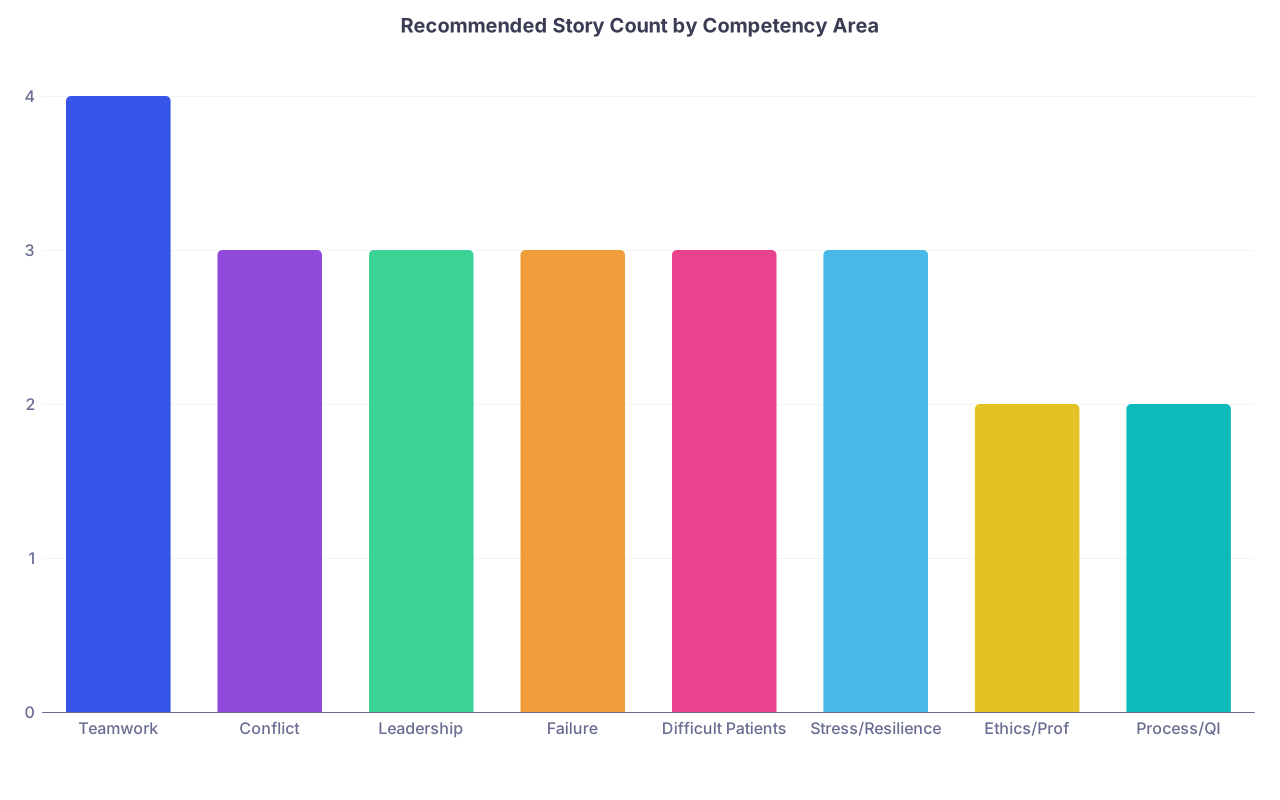
| Category | Value |
|---|---|
| Teamwork | 4 |
| Conflict | 3 |
| Leadership | 3 |
| Failure | 3 |
| Difficult Patients | 3 |
| Stress/Resilience | 3 |
| Ethics/Prof | 2 |
| Process/QI | 2 |

| Step | Description |
|---|---|
| Step 1 | Brain Dump Experiences |
| Step 2 | Tag by Competency |
| Step 3 | Select Anchor Stories |
| Step 4 | Write SAO-LR Structure |
| Step 5 | Build Story Bank Spreadsheet |
| Step 6 | Practice Out Loud |
| Step 7 | Stress-Test with Mentor |
| Step 8 | Create One-Page Story Map |
What Not To Do (Because I See It Every Year)
Let me be blunt about a few common mistakes:
- Do not memorize scripts. You will sound robotic and crack when interrupted. Memorize skeletons, not sentences.
- Do not only use “shiny” success stories. Programs care much more about how you handle failure and conflict.
- Do not over‑glorify yourself. “I saved the patient” stories without acknowledgment of team roles or system support sound arrogant and fake.
- Do not use anonymous “we” all the time. If I cannot tell what you did, the story is useless for evaluation.
- Do not recycle the same story five times in one interview. That screams unprepared and one‑dimensional.
Fixing all of those is exactly what a well‑built story bank does.
Final Tightening: Before Your First Interview
One week before interviews start, do a brief “maintenance check” on your story bank:
- Drop any story that still feels clunky after 3 practices.
- Promote 2–3 backup stories that have grown stronger as you reflected.
- Update learning points if you had new experiences on later rotations.
- Make sure every story respects confidentiality and avoids obvious identifiers.
Then stop tinkering. Over‑editing two days before interview #1 will just make you anxious. Trust the system you built and focus on sleep and logistics.
Key Takeaways
- A personal story bank is not optional if you want to perform consistently on behavioral questions; it is the infrastructure behind strong interviews.
- Build it deliberately: large brain dump → competency tags → select 15–25 anchor stories → structure each using SAO‑LR → organize in a searchable format.
- Practice out loud, under time pressure, with real feedback until your stories are flexible tools you can deploy for many different questions, not fragile scripts that fall apart under stress.