
The worst experiences from medical training make the best behavioral interview stories—if you know how to rebuild them from the ground up.
Most residency applicants do this wrong. They either:
- Avoid their negative experiences entirely, or
- Dump raw trauma on the interviewer with no structure, no insight, and no redemption arc.
Both approaches cost interviews. And sometimes, the match.
You can fix this. There is a systematic way to turn your failures, conflicts, and bad feedback into powerful, program-winning behavioral answers. I have seen average applicants completely change how PDs see them in a single well-structured answer about a “negative” event.
Here is the blueprint.
Step 1: Understand What Programs Actually Want From “Negative” Stories
Program directors are not asking about:
- A time you failed
- A time you had conflict
- A time you received criticism
Because they enjoy watching you squirm. They are probing for something very specific.
They use negative-experience questions to test:
- Emotional maturity – Can you talk about hard things without becoming defensive, blaming, or collapsing?
- Self-awareness – Do you recognize your role, your limits, your blind spots?
- Growth and adaptability – Did you change anything about your behavior, habits, or systems afterward?
- Risk management – How do you react when things go wrong? Do you escalate, seek help, or hide?
- Team-ability – Do you work with others to fix problems, or do you dig in and argue?
The content of the story matters less than the trajectory:
- From problem → reaction → reflection → change → improved outcome.
If your answer stops at “what happened,” you fail the test.
If your answer lands on “here is how I do it differently now,” you pass.
Step 2: Pick the Right Negative Experience (Not the Safest One)
You cannot tell a powerful behavioral story if you pick a weak, vague, or fake-negative example.
Bad choices:
- “One time I was late to rounds but I apologized and it never happened again.” (No depth, no real stakes.)
- “I study so hard that sometimes I over-prepare.” (Transparent fake weakness.)
- “Sometimes I care too much.” (Programs see through this in 2 seconds.)
You need something real. With stakes. But controlled.
Use this filter:
It involves actual tension or failure.
- You missed something.
- You handled a conversation poorly.
- You got negative feedback.
- A plan you pushed for did not work.
You were not grossly unethical or dangerous.
- No clear patient harm due to recklessness.
- No boundary violations.
- Nothing that makes a PD worry about future lawsuits.
You had some control.
If you were just a passive victim of a toxic attending, it is hard to show growth. You need at least one decision that you could have made differently.You can clearly show what changed afterward.
If you cannot point to concrete behavioral changes, the story will die at “I learned to communicate better.” Useless.
Here are “good negative” categories to mine:
- A tough feedback episode with a resident or attending
- A miscommunication with a nurse that delayed care but did not harm the patient
- Struggling with time management early in clerkships and nearly missing critical tasks
- Underestimating the complexity of a patient and needing help from your senior
- A poor initial approach to a difficult family conversation
Avoid:
- Anything that sounds like you are unsafe with patients
- Anything that suggests chronic unprofessionalism (no-shows, cheating, lying)
- Long, unresolved trauma stories with no clear resolution or growth
Step 3: Use a Better Framework Than STAR
You have heard about STAR (Situation, Task, Action, Result). It is fine. For basic answers.
But for negative experiences in residency interviews, you need something tighter:
FRAME Framework
- F – Facts: Brief, objective context
- R – Role: What you were responsible for
- A – Attempt: What you tried to do (what went wrong)
- M – Miss / Mistake: Where it failed, what the issue was
- E – Evolve: What you changed and how you now behave differently
Why this works: It forces you to own your part, define the miss clearly, and end on growth and future behavior—exactly what programs want.
Skeleton Example
“I was on my internal medicine clerkship (Facts) as the primary student following a complex CHF patient (Role). I tried to independently manage my pre-rounding workflow without checking in with the intern (Attempt). I ended up missing a key overnight event and presented an incomplete plan on rounds (Mistake). After feedback, I changed how I use the EMR sign-out and started building a pre-rounding checklist, which has since helped me catch overnight changes reliably (Evolve).”
That is the structure. Now we make it sharp.
Step 4: Decontaminate the Story – Remove Red Flags
Before you craft any answer, you need to scrub the story for red-flag language and framing.
Do not:
- Blame individuals by name or title (“The nurse was incompetent,” “The attending was unreasonable”).
- Sound bitter (“I was unfairly criticized,” “They did not understand my situation”).
- Over-explain your excuses (20 sentences on how tired, overworked, or misunderstood you were).
- Describe catastrophic outcomes if they make you sound dangerous.
Do:
- Emphasize systems and communication gaps rather than villainizing people.
- Take explicit ownership for your piece.
- Keep the clinical outcome safe and controlled.
Bad:
“The senior resident dumped way too many patients on me, and the night nurse kept calling about stupid things, so I forgot to follow up on a critical lab.”
Better:
“I did not yet have a functional system for tracking my tasks on a busy admitting night. With multiple new patients and frequent pages, I relied solely on memory and an improvised list, and I missed following up on one important lab.”
Same event. Completely different impression.
You are cleaning the story without sanitizing the lesson.
Step 5: Build a Strong “Negative” Answer Step by Step
Let us walk through a full construction using FRAME.
Example Prompt:
“Tell me about a time you received critical feedback.”
1. Facts (10–15 seconds)
- Set the scene. Concise. Objective.
“I was on my surgery rotation, about three weeks in, working with a chief resident I had not worked with before. We had a busy OR day with three back-to-back cases.”
Avoid clinical detail overload. The interviewer does not need the patient’s EF.
2. Role (5–10 seconds)
- Clarify your responsibility.
“My job was to follow the patients pre- and post-operatively and be ready to present them on rounds and update the team with any overnight issues.”
This helps the interviewer know what “good” would have looked like.
3. Attempt (15–25 seconds)
- What you were trying to do; what you thought was right at the time.
“I wanted to prove I could be efficient and independent, so I tried to manage my notes and pre-rounding without asking many questions. I was also trying to respond quickly to pages so I would not delay the workflow.”
You show intention. You were not careless; you were miscalibrated.
4. Miss / Mistake (20–30 seconds)
- Be specific. Do not duck it.
“In trying to keep up with everything, I prioritized speed over clarity. During one morning round, I presented a patient and did not mention a new fever overnight. The chief had seen it in the chart, stopped me, and after rounds, pulled me aside and told me very directly that missing that kind of update made it hard to trust my presentations.”
Own it plainly. No drama. No 5-minute justification.
5. Evolve (40–60 seconds)
This is where weak answers die and strong answers win.
You need two parts:
- Immediate response
- Long-term change
“I was embarrassed, but I realized he was right. I had checked the vitals quickly but did not pause to think about their significance. That afternoon, I asked him for specific advice on what he expected in a ‘reliable’ presentation.
Based on that, I made three concrete changes:
- I built a pre-round checklist in my notebook: vitals trend, new labs, new imaging, overnight events, and new consults. I would not present until I had mentally checked each box.
- I started pre-charting 15 minutes earlier so I was not triaging details under time pressure.
- I also began ending my presentations with, ‘Overnight issues were X and Y; no other changes’ to force myself to verify that I had looked.
By the end of the rotation, the same chief resident commented in my evaluation that my presentations had become ‘thorough and trustworthy,’ which I took as evidence that the changes were working. I have kept that structured approach on other rotations, and it has helped me feel more confident in high-acuity settings.”
Notice the pattern:
- Specific changes, not vague “I became more careful.”
- A clear external signal that the change worked.
- A link to how you practice now.
That final connection—how you behave today—is what turns the negative story into a positive asset.
Step 6: Convert Common Negative Categories into Strong Stories
Let me speed this up for you. Here are 4 frequent “negative” themes and how to rebuild them.
1. Handling Conflict with a Colleague
Bad version:
“I had a conflict with a nurse who was rude to me. I stayed professional, and it worked out.”
Better approach:
- Facts: “On my medicine rotation, a senior nurse confronted me at the nurses’ station about not putting in a lab order she had asked for.”
- Role: “I was the medical student following that patient and had said I would enter the order after rounds.”
- Attempt: “I thought I could hold the order in my head until I got to a computer, but I got distracted by another task and forgot.”
- Miss: “She called me out very publicly, and I reacted defensively in the moment, saying she had not reminded me. That escalated the tension instead of fixing the problem.”
- Evolve: “After stepping away and calming down, I went back, apologized without excuses, and asked how she preferred to communicate orders to students. I then started writing orders on a small pocket list the moment they were requested and repeating them back. The tension resolved, and by the end of the week we were collaborating smoothly. That experience pushed me to over-communicate and to treat nursing concerns as time-sensitive tasks, not casual requests. I still use that immediate-write-down rule, which has significantly reduced dropped tasks.”
The positive: You now look like someone who can repair working relationships and learns from interpersonal friction.
2. A Time You Failed or Made a Mistake
You must show:
- Clear description of the mistake
- No dodging responsibility
- A system-level change afterward
Example skeleton:
“I missed X because I relied on Y instead of Z. After that, I built [specific tool / checklist / routine]. Since then, in [later situation], that new habit prevented the same issue.”
Do not just say “I am more careful.” That signals no actual learning.
3. Receiving Harsh or Unfair Feedback
This one is delicate. Your job is to show:
- You can take imperfect feedback
- Extract the useful part
- Adjust your behavior anyway
Example:
“On pediatrics, an attending told me my notes were ‘not helpful’ and that they ‘added work’ for the team. Initially, I felt the comment was harsh because I had been staying late to finish them. After cooling down, I asked if we could review one note together. She showed me that I was rewriting the H&P daily instead of focusing on interval changes and decision-making. I restructured my notes to highlight assessments and plans, using fewer words but more direct problem lists. Within a week, she acknowledged the improvement and told me my notes were now driving better discussion on rounds. Since then, I have oriented my documentation around, ‘What does my team need to act on this?’ rather than ‘What can I write to prove I worked hard?’”
The negativity is transformed into evidence of growth and adaptability.
4. Time Management and Overwhelm
Programs know you will be stressed. They want to know: do you crumble or build systems?
Bad:
“I had trouble balancing studying and rotations but I eventually figured it out.”
Stronger:
“In my first core rotation, I consistently stayed 2–3 hours late finishing notes and reading, and I felt constantly behind. My attending pointed out that I was over-documenting and not prioritizing tasks.
I sat down one weekend and redesigned my day:
- I blocked specific times for notes (immediately post-rounds).
- I shifted most reading to commute and pre-bedtime instead of mid-day.
- I started using a single running task list with time estimates.
Within two weeks, I was leaving on time most days and my feedback shifted from ‘seems overwhelmed’ to ‘efficient and reliable.’ I now go into new rotations with a default daily template and adjust it in the first few days based on the team’s workflow.”
Again: specific changes, specific results.
Step 7: Add Metrics and Outcomes Where Possible
Hard truth: vague words are weak. Numbers are strong.
Whenever possible, quantify:
- “I missed 1 of 6 overnight events on my first week; by the end of the rotation, I was consistently capturing all events.”
- “I went from staying 2–3 hours late daily to finishing within 30 minutes of the team.”
- “I decreased unanswered pages during sign-out from 3–4 per shift to essentially zero after adopting a checklist.”
Even if your numbers are rough, they make the growth concrete.
Step 8: Practice Delivery – The Content Is Useless If You Sound Defensive
You can have the perfect structure and still torpedo yourself with tone.
When telling negative stories, watch for these red flags in your voice and body language:
- Tight, clipped answers that sound like you are rushing to get it over with
- Eye-rolling (even subtle) when referencing other team members
- Over-long justifications before you describe your mistake
- Smirking or laughing when mentioning errors (signals you do not take it seriously)
You want:
- Calm, steady pace
- Brief pauses after describing the mistake (shows you are not minimizing it)
- Slight forward lean and direct eye contact when discussing what you learned
- Neutral, non-blaming language about others
A simple practice drill:
- Record yourself answering: “Tell me about a time you failed.”
- Watch on mute first. Ask: Do I look defensive or embarrassed? Do I fidget most when saying “my mistake”?
- Then listen with audio only. Count how many seconds you spend on justification vs. growth. If justification is longer, cut it.
You are training your delivery to match your content: accountable, thoughtful, future-focused.
Step 9: Build a Small Library of 4–5 Reusable Stories
You do not need twenty stories. You need a tight, versatile core set you can adapt.
Aim for at least:
- Failure / mistake story
- Conflict with colleague / team member story
- Critical feedback story
- Stress / burnout / time management story
- Ethical tension / speaking up story (non-catastrophic, but shows backbone)
Most behavioral questions will map to one of these.
Here is how this plays out in real interviews:
- “Tell me about a time you made a mistake.” → Mistake story
- “Tell me about a conflict with a coworker.” → Conflict story
- “Tell me about a time you received feedback you disagreed with.” → Feedback story
- “Tell me about a stressful situation.” → Time management or conflict story
- “Tell me about a time you had to advocate for a patient.” → Ethical tension story
Same story, different framing emphasis.
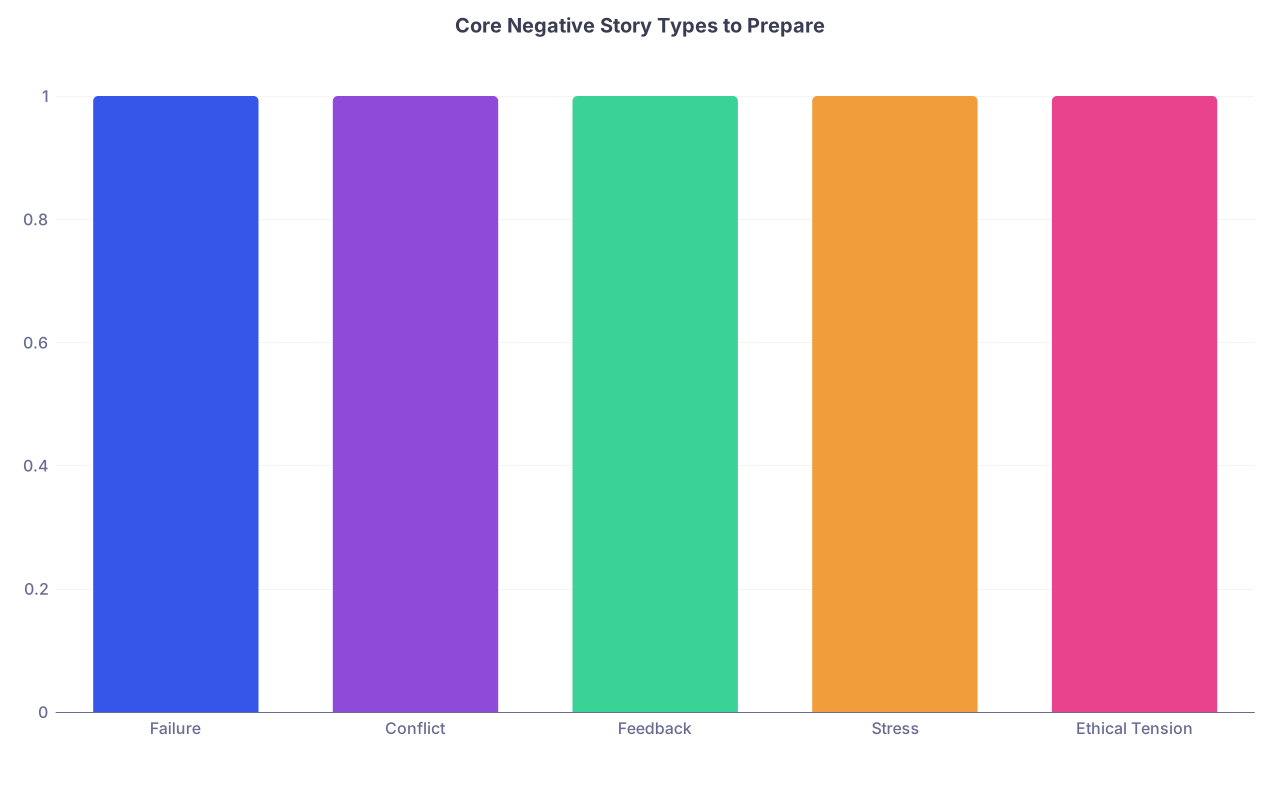
| Category | Value |
|---|---|
| Failure | 1 |
| Conflict | 1 |
| Feedback | 1 |
| Stress | 1 |
| Ethical Tension | 1 |
Step 10: Translate Stories Into “Residency-Ready” Competencies
You are not just telling stories. You are signaling competencies that match what programs screen for.
Here is how the mapping works:
| Story Type | Key Competencies Shown |
|---|---|
| Failure/Mistake | Accountability, systems thinking |
| Conflict | Teamwork, communication, humility |
| Feedback | Coachability, growth mindset |
| Stress/Overwhelm | Resilience, organization, judgment |
| Ethical Tension | Integrity, advocacy, professionalism |
Before each interview, pick which competencies a program likely values most (e.g., surgery cares a lot about resilience and teamwork; psychiatry cares heavily about communication and reflection) and choose versions of your stories that highlight those.
Step 11: A Concrete 7-Day Practice Plan
If you have interviews coming up, here is exactly what to do this week.
Day 1–2: Story Mining
- List 10–15 difficult experiences from med school / clinical rotations.
- For each, quickly mark:
- Stakes: Low / Medium / High
- Your responsibility: Low / Medium / High
- Growth potential: Weak / Strong
Keep the ones with medium–high stakes, medium responsibility, and strong growth potential.
Day 3: Draft with FRAME
Pick 5 stories and outline them in FRAME bullets:
- Facts: 1–2 bullets
- Role: 1 bullet
- Attempt: 2 bullets
- Miss: 2 bullets
- Evolve: 3–4 bullets (this is where you spend time)
Do not write scripts. Write bullets. Scripts make you sound robotic and brittle under pressure.
Day 4–5: Speak Them Out Loud
- Record 2–3 takes of each story, aiming for 1.5–2 minutes per answer.
- After each take, ask:
- Did I clearly state my mistake or challenge?
- Did I spend enough time on what changed?
- Did I blame anyone?
Cut blame. Cut excuses. Tighten evolution.
Day 6: Map to Questions
Take a list of common residency behavioral questions and write next to each one: which story will I use?
That way, when you get:
- “Tell me about a time you disagreed with a supervisor,” you know: “Feedback story, version B.”
- “Tell me about a time you had to adapt quickly,” you know: “Failure story, with emphasis on systems change.”
Day 7: Mock Interview
Ask a classmate, mentor, or resident to:
- Fire 10–12 behavioral questions at you, including 4–5 negative ones.
- Give you only 10–15 seconds between questions (simulating pressure).
Your job: stay calm, pick from your 5 stories, adapt on the fly, and end every answer on what you do differently now.
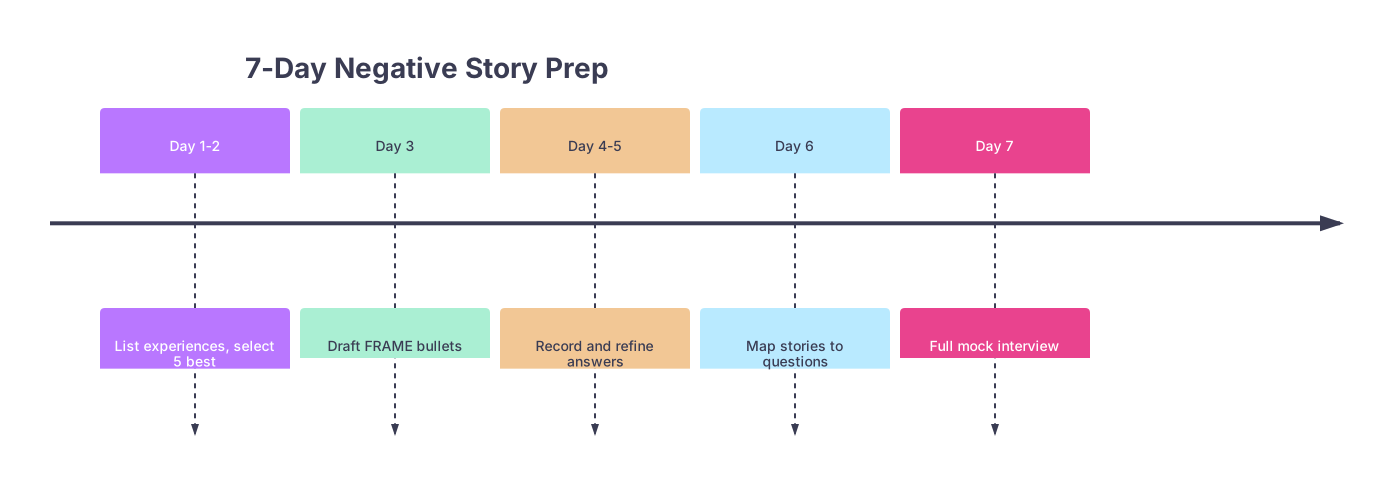
| Period | Event |
|---|---|
| Day 1-2 | List experiences, select 5 best |
| Day 3 | Draft FRAME bullets |
| Day 4-5 | Record and refine answers |
| Day 6 | Map stories to questions |
| Day 7 | Full mock interview |

Advanced Tweaks That Separate Strong From Outstanding
If you want to go beyond “good enough,” add these refinements.
1. Use Attending/Resident Language
Subtle word choices signal you understand team dynamics.
Instead of:
- “The doctor yelled at me...”
Say:
- “The attending gave me very direct feedback privately after rounds...”
You are not dramatizing. You are re-framing.
2. Show Pattern Recognition, Not One-Off Fixes
Programs want to see that your change spills into multiple contexts.
Rather than:
- “I started using a checklist for that patient.”
Say:
- “Since then, I have used a similar checklist on all my inpatient rotations, especially on call days, to make sure I track overnight events and outstanding tasks.”
That tells them: This is who I am now, not who I was once.
3. End With a One-Line Takeaway
Finish your answer with a short, punchy takeaway sentence.
Examples:
- “That experience permanently changed how I approach task tracking on busy services.”
- “Since then, I have treated feedback I dislike as a starting point for clarification, not a personal attack.”
- “It taught me that speaking up early, even when uncomfortable, is usually safer than waiting and hoping someone else will handle it.”
That last line is what interviewers often jot down.

One Thing To Do Today
Do not start with all your stories. Start with one.
Right now, pick one negative clinical experience that still makes you wince a little. Open a blank document and write five headings:
- Facts
- Role
- Attempt
- Miss
- Evolve
Fill each with 2–4 bullet points. Then say it out loud once.
If you do that today, you will have taken the single most important step toward turning your worst moments in training into your strongest behavioral interview answers.