
The worst-kept secret in residency interviews is this: strong candidates recycle the same few stories over and over. The difference between them and everyone else is simple. They know how to adapt one story to multiple behavioral questions without sounding fake, repetitive, or dishonest.
You can do the same. But you need a system.
This is not about “winging it” with your favorite ICU story and shoving it into every question. That is how you sound scripted, evasive, and insincere. I have watched programs quietly red-flag candidates for exactly that.
You need a method to:
- Build a small set of versatile, high-yield stories.
- Map each story to multiple behavioral question types.
- Adapt the angle, not the facts.
- Stay honest and specific under pressure.
Let’s fix this step by step.
Step 1: Build a Story Bank the Right Way
If you try to invent stories question-by-question, you will crash mid-season. Instead, you build a story bank: 6–10 strong, reusable stories that can flex to different questions.
Aim for coverage, not quantity. You want stories that collectively demonstrate:
- Clinical reasoning and ownership
- Teamwork and conflict management
- Dealing with mistakes / feedback
- Handling stress and uncertainty
- Leadership and initiative
- Communication with patients/families
- Integrity and professionalism
- Adaptability and learning
Start by drafting 8–10 raw stories (bullet points only, no novels). Use prompts like:
- A time you made a mistake or almost did
- A difficult patient or family interaction
- A conflict or miscommunication with a nurse, peer, or attending
- A time you stepped up beyond your role
- A time something went wrong on a team and you had to help fix it
- A situation with unclear guidance or limited resources
- A moment you got tough feedback that stung but helped
- A time you advocated for a patient or colleague
For each story, write only these basics:
- Setting (rotation, year, service)
- Stakeholders (who was involved)
- Problem (one sentence)
- What you did (3–5 bullets)
- Outcome (one or two sentences)
- What you learned (one sentence)
Example (rough, not polished):
- Setting: Third-year IM rotation, academic hospital, night float
- Stakeholders: Me, cross-cover resident, nurse, patient with CHF and CKD
- Problem: Nurse called with concern about low urine output and rising BP; cross-cover was tied up in a code
- What I did:
- Reviewed chart and vitals; saw trend of weight gain, low UOP
- Went to bedside, did focused exam (JVD, crackles, edema)
- Called cross-cover with concise summary and recs
- Clarified plan with nurse, set parameters for calling back
- Outcome: Patient got IV diuretics earlier, avoided transfer to ICU; staff appreciated communication
- Learned: How to triage concerns, communicate succinctly, and act within scope while escalating appropriately
That’s good enough to start.
Now prune. Keep 6–8 of the strongest, most flexible stories that:
- Involve real stakes (patient safety, team function, emotional weight)
- Show your actions clearly, not just “the team did X”
- Have clean lessons that map to competencies programs care about
You now have your raw building material.
Step 2: Deconstruct Each Story into Adaptable Angles
One story is not “about” just one thing. If you think, “this is my conflict story,” you are underusing it.
Take each story in your bank and identify 3–5 angles you can emphasize.
Use this simple drill:
Write the story name at the top (“CHF night float case”).
Under it, list potential angles as question types:
- Conflict / disagreement
- Handling pressure / stress
- Clinical judgment / prioritization
- Communication / handoff
- Professionalism / boundaries
- Learning from experience
For each angle, answer this:
“If I had to use this same story to answer a question about X, what would I highlight?”
Using the previous CHF case:
Conflict / disagreement angle
- Maybe nurse wanted immediate new orders; you needed to assess safely first.
- Focus: respectful communication, aligning on patient safety, validating concerns.
Handling pressure / stress angle
- You were cross-covering multiple patients, code running elsewhere, pager going off.
- Focus: triaging, staying calm, structured assessment under time pressure.
Clinical judgment / prioritization angle
- You recognized early decompensation, escalated appropriately.
- Focus: pattern recognition, limited data, knowing your limits and when to call for help.
Communication / handoff angle
- You gave a tight, organized case summary to the cross-cover.
- Focus: SBAR-style communication, being concise, clarity of plan.
Professionalism / learning angle
- You reflected later, maybe asked attending for feedback.
- Focus: growth mindset, using night float experiences to shape future practice.
Same event. Different lens.
Do this for every story in your bank. You will start seeing patterns: the same story can answer 4–6 different question types if you shift what you emphasize.
Step 3: Map Stories to Common Behavioral Question Categories
Programs do not have infinite creativity. Their behavioral questions fall into predictable buckets.
You do not need a unique story for each question. You need coverage of each category.
Here are the common categories you must be ready for:
| Category | Minimum Stories Ready |
|---|---|
| Conflict / Disagreement | 2 |
| Mistake / Failure | 2 |
| Stress / High Pressure | 2 |
| Leadership / Initiative | 2 |
| Difficult Interaction | 2 |
| Adaptability / Change | 1–2 |
Now, create a simple matrix. Rows = your stories. Columns = categories. Put an X where a story can genuinely fit.
Example:
- Story 1: CHF night float → Conflict, Stress, Clinical judgment, Communication
- Story 2: Angry family in ED → Difficult interaction, Communication, Professionalism, Stress
- Story 3: Missed lab follow-up → Mistake/failure, Accountability, Systems thinking
- Story 4: Starting a student-run clinic project → Leadership, Initiative, Collaboration
- Story 5: Adapting to COVID rotation disruption → Adaptability, Resilience, Systems change
- Story 6: Feedback about documentation issues → Feedback, Growth, Professionalism
Once you fill this out, check for gaps:
- No story that clearly shows owning a mistake? You need one.
- Nothing on conflict with a peer or supervisor? Add it.
- Only one leadership/initiative example? Strengthen that area.
You are not aiming for perfection. You are building redundancy: at least two stories that can cover each major category, so you do not hammer the same example all day.
Step 4: Use a Consistent Structure (But Don’t Sound Robotic)
Yes, everyone talks about STAR. The problem is most people do it badly: 90 seconds of “S” and “T,” then they run out of time and mumble the actual “A” and “R.”
You need a structure that:
- Keeps you concise.
- Centers your actions.
- Naturally highlights what the interviewer cares about.
Use this variant: STACR
- S – Situation (1–2 sentences, max)
- T – Task (your responsibility)
- A – Actions (what you actually did; 3–5 concrete moves)
- C – Complications (what made it hard)
- R – Result + Reflection (outcome and what you learned/changed)
Example using CHF night float case to answer:
“Tell me about a time you had to handle a stressful clinical situation.”
- S: “On my IM night float rotation in third year, I was cross-covering about 30 patients on a busy floor.”
- T: “A nurse called about a patient with CHF and CKD whose blood pressure was rising and urine output had dropped. The senior resident was running a code on another floor, so I was the first-line responder.”
- A:
- “I quickly reviewed his vitals and intake/output trend in the EMR.”
- “I went to the bedside to do a focused exam, looking for signs of volume overload and respiratory compromise.”
- “I documented my findings and called the cross-cover resident with a structured, concise summary and my concern for early decompensation.”
- “We agreed on giving IV diuretics and set specific parameters for when the nurse should call back.”
- C: “The stress came from juggling multiple pages, knowing my level of training, and not wanting to delay care while also not overstepping my role.”
- R: “The patient responded well to the diuretic, did not require an ICU transfer, and the nurse later thanked me for being present and clear about the plan. I learned to rely on a consistent mental checklist during stressful situations, which actually calms me down and keeps my thinking organized.”
That is tight, specific, and adaptable.
You can answer most behavioral questions in 90–150 seconds using STACR. Practice out loud with a timer. If you are talking for more than 2 minutes 30 seconds, you are rambling.
Step 5: Adapt the Same Story Safely to Different Questions
Here is where most people mess up. They treat “adaptation” as “one generic answer for everything.”
The trick:
Facts stay the same. Emphasis changes. Framing changes. Lesson changes.
I will show you how to reuse the CHF night float story for three different questions, without sounding copy-pasted.
1. Stress / Pressure Question
Question: “Tell me about a time you were under significant pressure in a clinical setting.”
Focus on:
- Volume of responsibility
- Competing demands
- How you stayed organized and calm
You emphasize:
- Number of patients
- Multiple pages coming in
- The code happening elsewhere
- Your internal process for not panicking
Lesson: How you now approach stressful nights systematically.
2. Communication / Teamwork Question
Question: “Describe a time when clear communication made a difference in patient care.”
Same story. New lens.
Focus on:
- How you spoke with the nurse (tone, validation, clarity)
- How you structured the call to the cross-cover
- How you confirmed the shared plan
You emphasize:
- “I used a structured format to present the case succinctly.”
- “I repeated back the plan to the nurse and checked that she felt comfortable with it.”
Lesson: Respectful, clear communication builds trust and improves safety.
3. Handling Ambiguity / Acting Within Scope
Question: “Tell me about a time you had to act without clear guidance.”
Again, same event.
Focus on:
- Senior unavailable in the moment
- No immediate supervision at bedside
- Having to initiate assessment and decide what is safe for a student
You emphasize:
- “I recognized I could safely gather more data and do an exam, but I did not start new medications without discussing with the resident.”
- “I framed my call as concern and preliminary assessment, not as final decisions.”
Lesson: Knowing your limits, using resources, escalating appropriately.
Same patient. Same night. Three different answers that feel natural, not forced.
That is how you safely adapt a story.
Step 6: Avoid the “Red Flags” of Overusing Stories
There are ways to do this that will quietly hurt you. I have seen it.
If you are going to reuse stories, you must avoid these behaviors:
Red Flag 1: Using the Same Story for Three Questions in the Same Interview
If an interviewer hears you say, “On my IM rotation, there was a patient with CHF…” multiple times in 20 minutes, they will notice. And they will think you have limited experience or poor insight.
Fix:
- Have a mental rotation rule: do not use the same story more than once per 30-minute interviewer, unless they explicitly ask you to revisit it from another angle.
- If you get cornered, at least choose a different patient or event from the same rotation.
Red Flag 2: Changing Key Facts to Fit a New Angle
Do not “massage” the story until it breaks.
If in one answer, the nurse was calm and you were the one anxious, and in another answer the nurse was furious and you were soothing them—someone will catch the inconsistency, at least subconsciously.
Fix:
- Facts are non-negotiable: who, where, what happened, what the outcome was.
- Only alter focus, not reality. You zoom in on different moments, not rewrite the event.
Red Flag 3: Lessons That Sound Copy-Pasted
If every story ends with, “and I learned the importance of communication and teamwork,” you sound like you memorized a script from Reddit.
Fix:
Give specific, behavioral lessons, such as:
- “Since then, I start every night by quickly scanning my list and noting who is highest risk.”
- “Now, when I get called with a concern, I always ask two follow-up questions: X and Y.”
- “I set a personal rule: if I feel defensive about feedback, I wait 24 hours, then revisit it with curiosity rather than emotion.”
Those hit harder than generic clichés.
Step 7: Prepare “Variants” of Your Core Stories
To safely reuse stories, create short, medium, and long versions of each.
- Short: 30–45 seconds. For follow-ups, group interviews, or multiple-question rapid rounds.
- Medium: 60–90 seconds. For standard behavioral questions.
- Long: 120–150 seconds. For complex multi-part questions.
And within each story, pre-identify:
- The clinical version (highlights medicine, reasoning, safety)
- The team dynamics version (highlights collaboration, conflict resolution)
- The personal growth version (highlights introspection, change, maturity)
You are not memorizing full speeches. You are memorizing outline skeletons you can flesh out differently in real time.
Example outline for CHF story:
- Clinical version: symptom trend → exam → early decomp suspicion → escalation → avoid ICU
- Team version: nurse concern → validation → structured communication to resident → set parameters → trust built
- Growth version: initial anxiety → using checklists → post-night debrief → new approach to stress
Pick the right version based on the question.
Step 8: Practice Under Realistic Conditions (Not in Your Head)
You will not become good at this by thinking about it on your commute. You need to say the words out loud and get feedback.
Here is a simple, effective practice protocol:
Write your 6–8 stories as bullets, not scripts.
Record yourself answering 5–7 common behavioral questions:
- Tell me about a time you had a conflict with a team member.
- Tell me about a time you made a mistake in patient care.
- Tell me about a stressful situation and how you handled it.
- Tell me about a time you went above and beyond for a patient.
- Tell me about a time you received critical feedback.
- Tell me about a time when you disagreed with a supervisor.
After recording, ask three things:
- Did I answer the question directly?
- Was my role unmistakably clear?
- Did I over-use one story or rotation?
Then deliberately reuse one story for two different questions. Listen carefully:
- Did I sound like I was repeating myself?
- Did the emphasis and lesson clearly match the second question?
Finally, get an outside opinion:
- A co-applicant, trusted resident, or advisor.
- Ask them:
- “Did any story feel fake or forced?”
- “Did any answer feel like I dodged the question?”
- “Do my lessons sound generic or specific?”
You will quickly see which stories are workhorses and which need to be retired.
Step 9: Use a Simple On-the-Spot Decision Tree in the Interview
You do not have time in the interview to philosophize about story choice. You need an internal shortcut.
Use a mental decision tree like this:

| Step | Description |
|---|---|
| Step 1 | Hear Question |
| Step 2 | Conflict |
| Step 3 | Mistake/Failure |
| Step 4 | Stress/Pressure |
| Step 5 | Leadership/Initiative |
| Step 6 | Communication/Relationship |
| Step 7 | Use Backup Story for Category |
| Step 8 | Use Primary Story, Adjust Angle |
| Step 9 | Apply STACR, Emphasize Matching Angle |
| Step 10 | What category is this? |
| Step 11 | Used Story X with this interviewer already? |
Before interview season, decide:
- For each category, what is your primary story?
- What is your backup story if you already used the primary one?
You are reducing decision fatigue. You hear “conflict,” your brain instantly pulls up your 1–2 conflict stories, then you adapt the angle.
Step 10: Track What You Use As You Go Through Interview Season
By the fifth interview, many applicants start recycling stories blindly. Programs see the same tired narrative, and you get bored of hearing yourself.
Fix this with a simple tracking system.
After each interview day, jot down:
- Which stories you used
- Which angles (conflict / stress / leadership, etc.)
- Any question type that felt weak or unconvincing
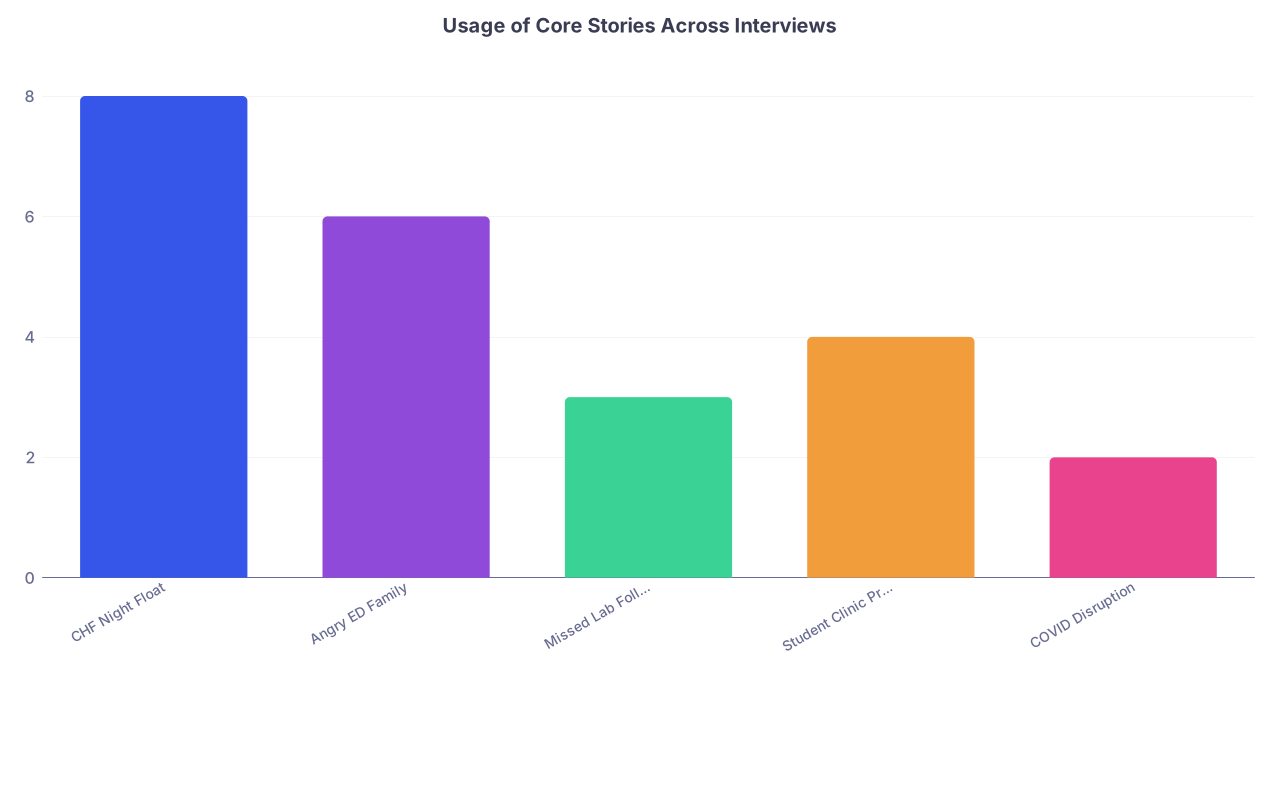
You will see patterns after a week:
| Category | Value |
|---|---|
| CHF Night Float | 8 |
| Angry ED Family | 6 |
| Missed Lab Follow-up | 3 |
| Student Clinic Project | 4 |
| COVID Disruption | 2 |
If one story is doing 80% of the work, you are overexposed. Time to:
- Strengthen alternative stories.
- Develop new angles for underused ones.
A Quick Example: One Story, Three Safe Adaptations
Let me walk you through another concrete example.
Story: Angry ED Family
- Med student in EM.
- Elderly patient with sepsis, long wait, family frustrated, raising their voice at staff.
- You stepped in to talk with them, clarify the plan, and de-escalate.
As a “Difficult Patient/Family” Example
Question: “Tell me about a challenging patient or family interaction.”
Angle:
- Emotional temperature of the situation.
- How you listened, validated, and set boundaries.
- How it resolved.
Lesson: You learned to see anger as fear, and how to communicate under stress.
As a “Professionalism” Example
Question: “Tell me about a time your professionalism was tested.”
Angle:
- Family member made a personal or unfair comment (“You people don’t care, you’re just ignoring us”).
- Temptation to be defensive.
- Choosing instead to respond calmly and focus on the patient.
Lesson: Professionalism is most visible when you are criticized unfairly or under pressure.
As a “Teamwork” Example
Question: “Describe a time you supported your team.”
Angle:
- Nurses were being verbally attacked.
- You stepped in, not to take over, but to support both family and nurse.
- You checked in with the nurse afterward, validated her experience, and informed the resident.
Lesson: Supporting the team includes emotional support and targeted communication, not just tasks.
Same story. No lies. Different focus, different takeaways.
Visual: How Many Stories Do You Really Need?
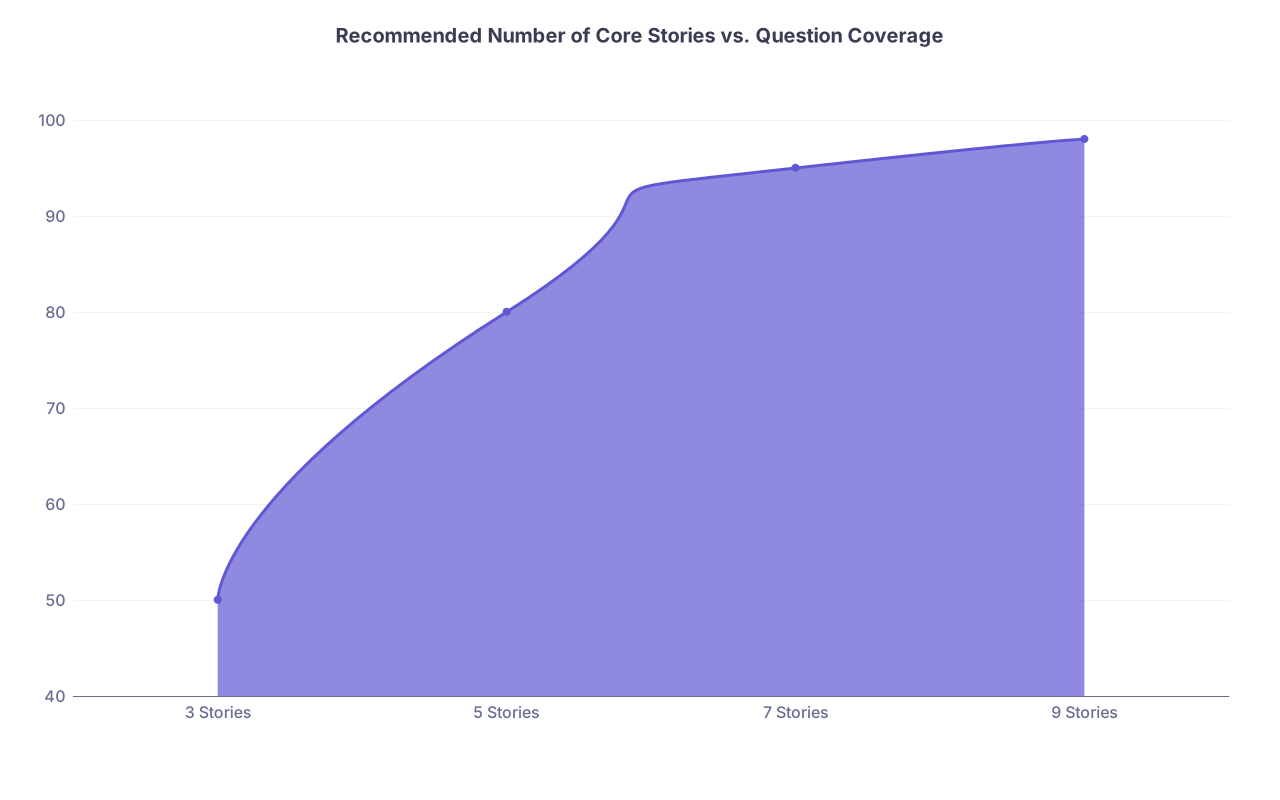
Most applicants overestimate the number of stories and underestimate the quality needed.
| Category | Value |
|---|---|
| 3 Stories | 50 |
| 5 Stories | 80 |
| 7 Stories | 95 |
| 9 Stories | 98 |
Once you hit around 7 strong stories, you can cover almost all behavioral questions through angles and adaptation. More than that and you start diluting your practice.
Final Check: Safety Rules for Reusing Stories
Before you walk into interview season with this strategy, run through this checklist:
- Do I have 6–8 clearly outlined stories with real stakes?
- For each story, can I name at least 3 different angles it can serve?
- For each major category (conflict, mistake, stress, leadership, difficult interaction), do I have 2 stories that fit?
- Can I tell each story clearly in 90 seconds using STACR?
- Can I reuse one story for two different questions without contradicting myself or sounding off-topic?
- Do I have a plan to avoid repeating the same story multiple times with one interviewer?
If you cannot honestly answer “yes” to those, fix that first. Then practice.
The Bottom Line
You do not need twenty stories. You need a sharp, adaptable core of a few good ones.
Remember:
- Build a small, versatile story bank and map each story to multiple behavioral categories.
- Keep the facts fixed but adapt the angle, emphasis, and lesson to match the question.
- Protect yourself from sounding repetitive by tracking which stories you use, rotating backups, and sticking to a tight, action-focused structure.
Do this properly and you will sound consistent, thoughtful, and experienced—without ever sounding rehearsed or fake.