
It is 8:10 p.m. You just finished a “mock interview” on Zoom. The feedback was polite but clear:
“Your answers are… fine. But they’re a little vague. I don’t really see you in them.”
That is code for: “If you talk like this on interview day, you will blend into the wallpaper.”
You do not have time for that. Behavioral questions are now a core part of residency interviews, and generic answers will quietly kill your chances. The good news: fixing vague answers is very mechanical. There is a protocol. You can run it on every answer you give.
I am going to show you exactly how to take a fuzzy, generic behavioral answer and turn it into something specific, vivid, and memorable—without sounding scripted or fake.
Step 1: Understand What Interviewers Actually Want
Let us clean this up first. Behavioral questions are not about seeing whether you “helped a patient” or “worked in a team.” They assume you did. You got through med school. Of course you did.
They are probing for 5 things almost every time:
- Specificity – Do you give real details or hide behind buzzwords?
- Self-awareness – Do you understand your own role, limits, and growth?
- Judgment – Did you choose reasonable actions with the information you had?
- Impact – Did what you did actually matter?
- Communication – Can you explain a complex situation cleanly under pressure?
Vague answers fail on all five.
Common vague answer tells:
- “There was this patient on my rotation who was very sick…”
- “We had a conflict on our team but we worked through it…”
- “I learned a lot about communication and teamwork…”
Interviewers hear this 30 times per day. It all sounds the same.
Your job is not to be poetic. Your job is to be concrete.
Step 2: Use a Rigid Skeleton (But Not the One You Think)
You have heard of STAR: Situation, Task, Action, Result. Good start. The problem: most applicants stop there and give thin “Actions” and boring “Results.”
Use this upgraded version instead: STARR-I
- Situation – Brief, clinical, concrete
- Task – What you were supposed to do or what problem had to be solved
- Actions – 2–4 specific things you actually did
- Result – What changed (numbers, behavior, decision, or feedback)
- Reflection – What you learned or changed in your practice
- Interest to program – How this matters for you as a resident here
This is how you go from “vague story” to “this is someone I can picture on my team.”
Quick Example – Before vs After
Question: “Tell me about a time you dealt with a difficult patient or family.”
Vague answer (what I hear constantly):
“There was a patient in the ICU who was really upset about the care plan. The family did not agree with the team and there was a lot of tension. I sat down with them, listened to their concerns, and tried to explain the plan in a way they could understand. Eventually they felt better and we moved forward. I learned the importance of communication and empathy.”
Nobody remembers that.
Rewritten with STARR-I (vivid):
Situation:
“On my MICU sub-I at County Hospital, we admitted a 58-year-old with severe COPD exacerbation who quickly required BiPAP. His daughter was convinced ‘machines’ had killed her father-in-law at another hospital and came in already distrustful and angry.”Task:
“As the sub-I who had done the admission, my job was to help de-escalate the situation and make sure the team’s plan was clearly understood so we could continue non-invasive ventilation safely.”Actions:
“First, I stepped out of the room with the daughter for five minutes and let her tell the story of what happened to her father-in-law without interrupting. I wrote down the specific things she feared—mainly that we would ‘give up’ on her dad too early.
Second, I asked my resident if we could adjust our language on rounds from ‘if he fails BiPAP…’ to ‘if his work of breathing worsens despite this support…’ and explicitly stated our thresholds for intubation in front of her.
Third, I offered to come back after rounds and review the settings and mask with her so she could see what each component was doing and why her dad could still communicate while on it.”Result:
“The next day, she was still appropriately anxious, but no longer yelling or threatening to leave AMA. She started asking more specific questions like, ‘What would make you think he was getting worse?’ My attending later told me that the daughter had mentioned feeling ‘finally listened to’ in her conversation with him.”Reflection:
“I realized that I had initially gone in trying to defend the plan, and that never works. Now when a family is angry, I start by asking, ‘What are you most afraid will happen?’ It saves time and gets to the real issue.”Interest to program:
“I know you have a large underserved population and high ICU volume here. These kinds of high-emotion conversations will be constant, and I feel more prepared to handle them under supervision as an intern.”
Notice:
- You can see the room.
- You understand exactly what she did.
- The result is modest but real.
- It connects to their program.
That is what you are aiming for.
Step 3: Identify Where Your Answers Are Vague
You probably already have some draft answers. Or you have stories you keep re-using.
Take one answer and run this 5-minute audit:
Highlight every general phrase
Things like:- “a patient on my rotation”
- “we had some issues”
- “it was very challenging”
- “I learned a lot”
Underline every concrete detail
- Rotation type and site (“surgery clerkship at XYZ VA”)
- Patient type (“neonate with hypoxic ischemic encephalopathy”)
- Numbers or dates (“over 3 months,” “twice a week”)
- Specific actions (“I called the charge nurse,” “I made a checklist”)
If your answer is mostly highlights and almost no underlines, it is vague.
Now fix it by forcing each section of STARR-I to include at least:
- 1 concrete location/time detail
- 1 specific action or phrase you actually used
- 1 measurable or observable result
Step 4: Turn Generic Into Concrete – Line-by-Line Fixes
Here is the rewrite protocol. Use this like a search-and-replace on your drafts.
1. Sharpen the Situation
Bad:
“There was a time on my clinical rotations when we were very busy.”
Better:
“On my internal medicine rotation at University Hospital during peak flu season, our census jumped from 12 to 20 patients in 48 hours.”
Template:
- [Service/rotation] at [site] during [time/condition], [specific pressure or complication].
2. Make the Task Personal
Bad:
“We needed to improve communication with the nurses.”
Better:
“As the only student on the team, I was asked to track all new overnight admissions and make sure nursing had updated plans by noon.”
Template:
- “My specific role was…”
- “I was responsible for…”
- “I took ownership of…”
If it could describe anyone on the team, it is too vague.
3. Replace Buzzwords With Behaviors
Common vague verbs:
- Helped
- Worked on
- Communicated
- Advocated
- Led
- Collaborated
Convert to visible behaviors:
- “Helped the team” → “Drafted the first version of the note for three new admissions.”
- “Improved communication” → “Started a 2-minute 7 a.m. huddle with the night nurse before rounds.”
- “Advocated for the patient” → “Asked the attending to delay discharge by one day to arrange home oxygen delivery and a follow-up appointment.”
Ask: If someone watched a video of me, what would they see?
4. Put Numbers or Comparisons in the Result
Bad:
“Things went more smoothly after that.”
Better:
“Before we changed the process, two of our three new admissions each morning had missing orders at noon. For the next five days, all new admissions had orders in by 10:30 a.m.”
Do not invent numbers. But you can:
- Use rough counts (“three nurses,” “two consults,” “half the patients”)
- Use time markers (“within 24 hours,” “over the next week”)
- Use behavior changes (“they stopped paging every hour,” “she stopped refusing meds”)
Step 5: Three High-Yield Behavioral Themes and How to Rewrite Them
You do not need 50 stories. You need about 6–8 flexible stories that you can angle at different questions.
Here are three core themes that almost always come up, with vague vs vivid versions.
Theme 1: Conflict or Disagreement
Common prompt: “Tell me about a time you had conflict on a team.”
Vague answer:
“On my surgery rotation there was a disagreement between a resident and a nurse about discharge planning. They both had different perspectives. I listened to both sides and tried to mediate, and eventually we were able to compromise. I learned the value of communication and understanding other people’s viewpoints.”
You can feel your soul leaving your body halfway through that.
Vivid rewrite using STARR-I:
Situation:
“On my third-year surgery clerkship at Saint Mary’s, a PGY-2 and the floor charge nurse were arguing at the nurses’ station about discharging a post-op colectomy patient. It was 6 p.m., the resident wanted the bed, and the nurse was worried the patient still had uncontrolled pain and had not yet seen PT.”Task:
“As the student following that patient, I knew the details well and felt responsible for making sure we did not rush a discharge that would just bounce back.”Actions:
“I asked both if I could quickly review the chart and confirm exactly what was left: oral pain control trial, PT clearance, and confirmation of home support.
I then called PT myself and asked if there was any possibility of seeing him within the next hour, explaining that discharge was contingent on their assessment.
While waiting, I went back to the patient and reassessed his pain on oral meds and clarified his home setup—who would be with him, whether someone could pick up prescriptions, and stairs at home.”Result:
“PT saw him within 45 minutes, confirmed he was safe to ambulate with a walker at home, and we were able to discharge him by 8 p.m. The nurse later told me she felt more comfortable because we had actually checked each box instead of just saying, ‘We’ll figure it out next time.’ The resident appreciated getting the bed without compromising safety.”Reflection:
“I realized that often the conflict is not about personalities, but about different risk thresholds and incomplete information. When I focus on clarifying the data and next steps, things de-escalate faster.”Interest to program:
“Your program’s emphasis on interdisciplinary rounds fits that mindset. I want to get better at surfacing these issues early in the day, not at 6 p.m. when everyone is tired.”
Theme 2: Failure or Weakness
Common prompt: “Tell me about a time you failed” or “What is a weakness you worked on?”
Here is where most people panic and give a fake weakness like “I care too much.”
Vague answer:
“I used to struggle with time management and would sometimes fall behind, but I worked hard to improve my organizational skills and now I am better at prioritizing tasks.”
Nobody believes this.
Vivid rewrite (real but professional):
Situation:
“During my first clinical rotation—family medicine—I underestimated how long it takes to write complete notes. For the first two weeks, I was consistently staying 1–2 hours late finishing documentation.”Task:
“My attending was clear that as a student I should be learning, not living in the EMR, so my task was to get faster without sacrificing quality.”Actions:
“I asked one of the senior residents if I could watch her write a couple of notes in real time and noticed she had a simple template for common visit types.
I created my own basic templates for three common scenarios—diabetes follow-up, hypertension follow-up, and new back pain.
Then I set a personal rule: I had to at least draft the HPI and assessment/plan in the room or immediately after each patient, not batch everything at the end of clinic.”Result:
“By the end of the rotation, I was consistently leaving within 15–20 minutes of the last patient, and my attending commented on my improvement in both efficiency and clarity of assessment/plan.”Reflection:
“My weakness is still that my first instinct is to over-document. Now I address it by using templates and time limits per note. I fully expect to need more coaching on efficient charting as an intern, and I am no longer defensive about that.”Interest to program:
“I know your program uses EPIC and has specific note templates. I look forward to learning from your senior residents how they balance thoroughness with time pressure.”
This sounds human, fixable, and safe.
Theme 3: Leadership / Initiative
Common prompt: “Tell me about a time you took initiative or led something.”
Vague answer:
“I was involved in a QI project on my medicine rotation where we tried to reduce readmissions. I helped collect data and presented our findings. It taught me about leadership and teamwork.”
That could be literally anyone on any campus.
Vivid rewrite:
Situation:
“On my inpatient medicine sub-I, I noticed two COPD patients readmitted within 7 days for the same issue: running out of inhalers. This kept coming up in sign-out as ‘non-compliance,’ which bothered me.”Task:
“I was not going to redesign the whole system as a student, but I could at least test one small change to see if we could reduce ‘forgotten’ prescriptions on discharge.”Actions:
“I asked our pharmacist if she would be willing to do a 3-minute inhaler check with each COPD discharge patient while I was there, to confirm they had refills and understood their schedule. She agreed if I did the legwork of flagging the patients.
I made a simple one-page checklist that I added to the front of each COPD discharge chart—refills, spacer, smoking cessation resources, follow-up appointment—and I walked through it with the patient and pharmacist together.
After two weeks, I pulled the list of our COPD discharges and tracked whether inhaler prescriptions and follow-up visits were documented.”Result:
“During that 2-week period, 100% of COPD discharges had documented inhaler teaching and refills, compared to 60% in the two weeks prior. None of those patients were readmitted within 7 days for medication-related issues. My attending suggested I present the checklist at the resident QI noon conference, and a modified version was later incorporated into the unit’s discharge packet.”Reflection:
“That experience taught me that small, student-driven changes can actually survive beyond the rotation if they are simple and solve a real pain point.”Interest to program:
“Your program’s QI track and emphasis on small PDSA cycles aligns with how I like to work—start with a tiny, testable change, prove it helps, then scale it.”
Step 6: Build a Reusable Story Bank
Do yourself a favor: stop reinventing answers. Build a story bank.
Create a table like this in a document:
| Story # | Core Theme | Setting/Rotation | Question Types It Fits |
|---|---|---|---|
| 1 | Conflict | Surgery – Saint Mary's | Conflict, teamwork, advocacy |
| 2 | Failure/Weakness | FM – University Clinic | Failure, growth, resilience |
| 3 | Leadership/QI | IM – County Hospital | Leadership, initiative, QI |
| 4 | Difficult Family | MICU – County Hospital | Communication, empathy, ethics |
| 5 | Time Pressure | ED – Community Hospital | Prioritization, stress management |
Now, for each story, write a STARR-I outline in bullet form. Not a script. Just the key anchors:
- 1–2 lines Situation
- 1 line Task
- 3 bullet Actions
- 1–2 lines Result
- 1–2 lines Reflection
- 1 line Interest to program
This way you can adapt the same story to:
- “Tell me about a time you worked under pressure”
- “Tell me about a time you made a mistake”
- “Tell me about a time you had to advocate for a patient”
…by slightly shifting which parts you emphasize.
Step 7: Practice Out Loud Without Sounding Like a Robot
Reading your beautiful STARR-I outline is not enough. You have to say this stuff. Under stress. To another human being.
Here is how to rehearse without becoming painfully scripted:
Voice record, do not write scripts
- Use your phone. Pick one question.
- Answer it once from your outline, not from a memorized paragraph.
- Listen back. Any spot where you sound hesitant or vague? Rework that section of the outline, not the whole answer.
Set strict time limits
- Aim for 60–90 seconds for most answers.
- Dangerous sign: you are at 3 minutes and still describing the Situation.
Practice pivoting
- Take one story and answer three different prompts with it.
- Force yourself to change the opening line and Reflection each time.
That trains flexibility, which is what prevents you from sounding canned.
Use a real person once
- Friend, partner, resident mentor.
- Ask them specifically:
- “Where did you lose interest?”
- “What do you still not understand about what I did?”
- “What one detail would make this more vivid?”
You are not aiming for TED Talk. You are aiming for “clear, specific, and human.”
Step 8: Know the Common Behavioral Question Types
Most programs recycle the same question templates with minor wording changes. If you pre-build for these, you are prepared for 80% of what will be thrown at you.
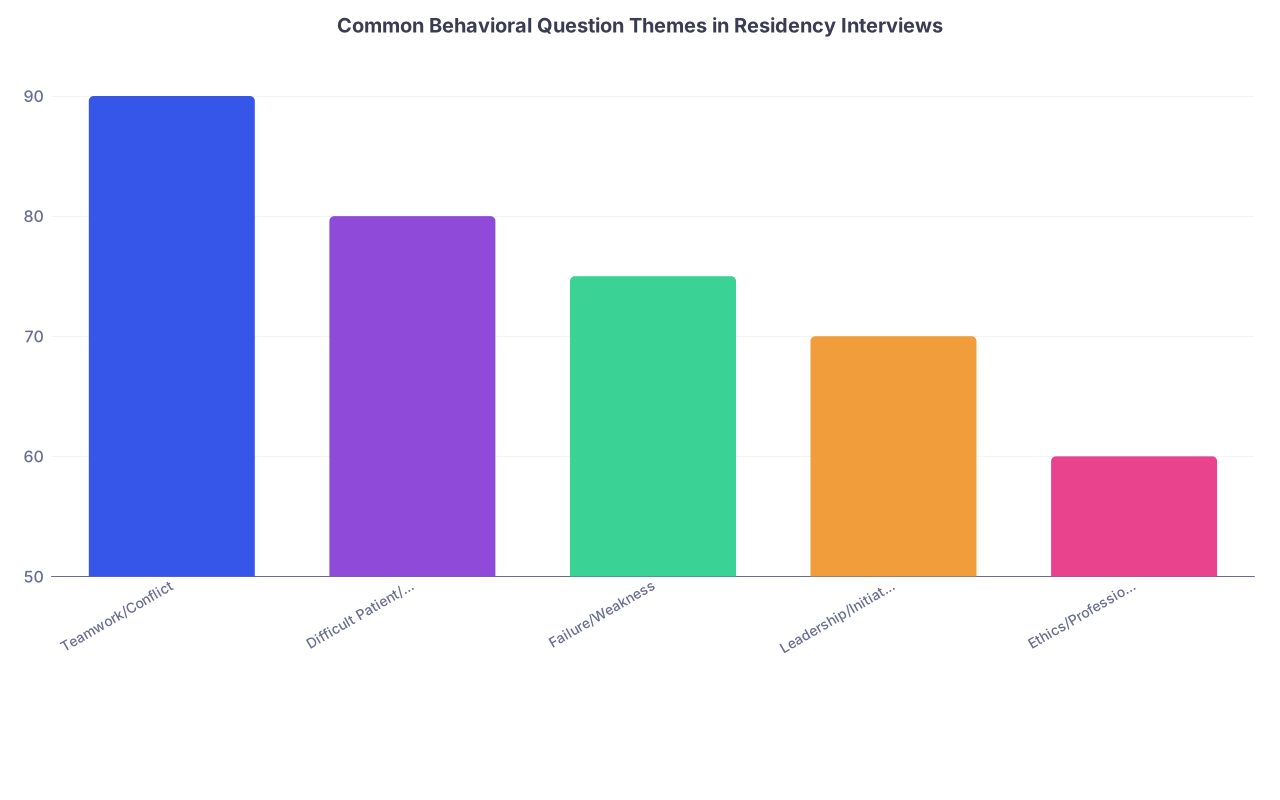
| Category | Value |
|---|---|
| Teamwork/Conflict | 90 |
| Difficult Patient/Family | 80 |
| Failure/Weakness | 75 |
| Leadership/Initiative | 70 |
| Ethics/Professionalism | 60 |
You should have at least one strong STARR-I story for each of these:
- Teamwork / Conflict
- Difficult patient or family
- Failure or mistake
- Leadership / initiative / QI
- Ethics / professionalism boundary
If you want to see them in flow form:

| Step | Description |
|---|---|
| Step 1 | List 6-8 stories |
| Step 2 | Assign themes |
| Step 3 | Outline with STARR-I |
| Step 4 | Audit for vagueness |
| Step 5 | Add concrete details |
| Step 6 | Practice out loud |
| Step 7 | Refine based on feedback |
Run your stories through that flow until each one is sharp.
Step 9: Avoid These Common Behavioral Answer Mistakes
I have seen these tank otherwise strong candidates.
HIPAA violations / oversharing
- Do not give patient names, exact dates of rare cases, or uniquely identifying details.
- Use age ranges and general descriptions.
Blaming and bitterness
- If your story makes your resident, attending, or nurse look incompetent while you look brilliant, it will backfire.
- Own your role. Give others some grace.
Over-dramatizing routine events
- Not every story needs to involve a code or a disaster.
- Interviewers like seeing how you handle typical stressors with maturity.
No actual reflection
- “I learned communication is important” is not a reflection. It is a platitude.
- Reflection must sound like a change in your behavior: “Now I do X differently…”
Rambling Situations
- If your Situation takes more than 20–25 seconds, you are overdoing it. Cut the preamble.
Step 10: Put It Together – A Mini Before/After Clinic
Let us run one more full example.
Question: “Tell me about a time you had to work with someone whose style was very different from yours.”
Vague version:
“On my pediatrics rotation, I worked with a resident who had a very different style than mine. He was more fast-paced and I like to be more thorough. At first it was hard, but we communicated and compromised. I learned how to adapt to different working styles and it made me a better team player.”
This says nothing.
Rewritten vivid version:
Situation:
“On my pediatrics rotation at City Children’s, I was paired with a senior resident who rounded extremely fast—he liked one-liner updates and decisions on the spot. I tend to be more detail-oriented and initially, I was giving long presentations that clearly frustrated him.”Task:
“My job was to still provide safe, thorough care but in a format that fit his style, without slowing the team down.”Actions:
“After the first rough day, I asked if we could spend five minutes after sign-out talking about how he preferred presentations. He told me directly, ‘Problem-focused, not organ-system recitation.’
That night, I re-wrote my patient lists into a simple structure: one-line summary, overnight events, and three active problems with one planned intervention each.
The next morning, I also made a point of asking, before each presentation, ‘Is this a patient where you want the full story or just key changes?’ to calibrate in real time.”Result:
“By mid-rotation, my presentations were under one minute per patient, and he started asking me to present first during table rounds. On my evaluation, he specifically mentioned that I ‘adapted quickly to feedback and improved efficiency on rounds.’”Reflection:
“I learned that ‘different style’ is not a personal attack; it is often just a different mental model. Now when I join a new team, I ask early, ‘How do you like information presented?’ instead of guessing.”Interest to program:
“Your program is large and I know I will be working with many different attendings and seniors. Being able to adapt quickly to each person’s workflow will be essential.”
That is “from vague to vivid” in practice.

FAQ: Behavioral Answers for Residency Interviews
1. How long should my behavioral answers be?
Aim for 60–90 seconds. Shorter than a minute usually means you are leaving out important context or reflection. Longer than 2 minutes and you are almost certainly over-explaining the Situation or rambling in the Actions. Practice with a timer until you can consistently hit that 60–90 second window using your STARR-I outline.
2. Can I use the same story for multiple questions?
Yes, and you should. A strong story can be angled toward conflict, leadership, or communication depending on which aspects you highlight. The key is to change:
- Your opening line (connect to the question theme),
- Which Actions you emphasize,
- The Reflection (tie it to the specific competency being tested).
If your answer to “failure” and “leadership” sounds word-for-word identical, you are over-scripting.
3. How many stories do I really need to prepare?
For most applicants, 6–8 well-constructed stories are enough:
- 1–2 conflict/teamwork
- 1 difficult patient/family
- 1 failure/mistake
- 1 leadership/initiative/QI
- 1 ethics/professionalism
- 1 time-pressure/stress or adaptation story
Build a STARR-I outline for each and practice pivoting them to different prompts.
4. What if I genuinely cannot think of a dramatic story?
Stop chasing “dramatic.” Interviewers prefer authentic, typical clinical scenarios where you showed judgment, growth, and reliability. A mundane example—catching a missed lab, clarifying a med list, organizing discharges—can be excellent if:
- You describe it concretely,
- Your actions are clear,
- There is a real, if modest, result,
- You show a believable reflection.
Do not wait for some perfect, Hollywood-level story. Use what you actually did and make it specific.
Open one of your existing behavioral answers right now.
Highlight every generic phrase. Then force yourself to add:
- One concrete detail to the Situation,
- One visible behavior to the Actions,
- One measurable or observable Result.
You just moved it one step from vague to vivid.