
Most residency applicants waste their best clinical stories. They ramble, they generalize, and they walk out of interviews thinking, “I swear that sounded better in my head.”
You can fix that. And you can do it with almost any clinical experience you have.
This is the playbook: how to turn any clinical encounter into a tight, high-yield behavioral interview example that actually makes a program want to rank you.
1. Stop Treating Clinical Stories Like Casual War Stories
Here is the first harsh truth:
Most applicants describe clinical experiences like they are chatting with classmates after rounds. Vague, episodic, and focused on the patient’s drama instead of their own behavior.
You know the pattern:
- Ten sentences of background.
- Three sentences of medical details irrelevant to the competency.
- One quick line of “and it all worked out.”
That is useless in a behavioral interview.
Behavioral questions have a purpose. They are trying to test specific, repeatable behaviors:
- How you think under pressure.
- How you deal with conflict.
- How you recover from mistakes.
- How you communicate with difficult patients, staff, or families.
- How you lead or follow in a team.
Clinical stories are gold for this. But only if they are structured.
Your mindset shift:
“This is not a ‘crazy ICU story.’ This is my evidence for teamwork / communication / resilience / leadership.”
Once you see every clinical experience as potential evidence, you start talking differently. More precise. More intentional. And program directors notice.
2. Use the Right Framework (and Fix What Everyone Gets Wrong About STAR)
You already know STAR: Situation, Task, Action, Result.
The problem is that most applicants do it like this:
- 60% Situation
- 10% Task
- 20% Action
- 10% Result
That ratio kills you. You bury the part that actually shows who you are.
For clinical behavioral answers, use this modified ratio:
- Situation – 10–15%
- Task – 10–15%
- Action – 55–65%
- Result & Reflection – 15–20%
Think of it as STAR-R:
- S – Situation: Short, specific context. Where were you? What was the setting level (ED, ICU, clinic, night float)?
- T – Task: What were you supposed to do? Not “what should a doctor do in general.” What was your role?
- A – Action: What you actually did, step by step, including thought process and communication.
- R – Result: What happened clinically or interpersonally.
- R – Reflection: What you learned or changed.
Here is a very simple but powerful clinical STAR-R skeleton you can reuse:
- “On my [rotation / service] at [type of hospital], we had [brief, relevant situation].”
- “As the [MS4 / sub-I / intern equivalent], my role was to [concrete responsibility].”
- “I [3–5 specific actions, including what you said, did, or decided].”
- “As a result, [clinical/interpersonal outcome + feedback if any].”
- “Since then, I [what you now do differently / how this changed your approach].”
Notice what is missing: no long differential diagnoses, no lab value monologues, no grand speeches about “the importance of empathy” without a concrete behavior.
3. Extract the Right Competencies From Any Clinical Encounter
Almost any clinical experience can be spun toward multiple behavioral competencies. That flexibility is how you reuse one story to answer five different questions.
Start here. Most residency behavioral questions cluster around 6–8 core domains:
| Competency | Common Question Theme |
|---|---|
| Teamwork/Collaboration | Working with others |
| Communication | Difficult conversations |
| Conflict Management | Disagreement with staff/peer |
| Resilience/Stress | Handling pressure or setbacks |
| Ethics/Professionalism | Doing the right thing |
| Leadership | Taking initiative |
Now look at a single clinical encounter and ask:
- Who else was involved? → Teamwork / conflict / leadership
- What was emotionally hard? → Resilience / empathy
- Any disagreement or pushback? → Conflict / communication
- Any gray-zone decisions? → Ethics / professionalism
- Did you step up beyond your role? → Leadership / initiative
Example:
You had a patient angry about waiting 6 hours in the ED.
- Teamwork version: How you coordinated with nursing and registration.
- Communication version: How you de-escalated and set expectations.
- Ethics/professionalism version: How you handled their demand to leave AMA.
- Resilience version: How you stayed composed on a chaotic overnight shift.
Same story. Different focus. This is how you build a compact but powerful story bank.
4. Turn a Messy Clinical Day Into a Clean Behavioral Answer: Step-by-Step
Let’s walk through the exact process you can use today.
Step 1: Pick a “Raw” Clinical Memory
It does not need to be dramatic. In fact, I prefer medium-intensity cases because you can talk freely without violating privacy or sounding like you are bragging about trauma.
Look for:
- A consult that went sideways then recovered.
- A time you had to update a family with mixed or bad news.
- A disagreement about management between team members.
- A patient who refused care, was non-adherent, or distrustful.
- A moment where you realized you missed something, then fixed it.
Write a messy, unstructured paragraph or two about it. Just get the memory down.
Step 2: Choose One Primary Competency
Do not try to make one story prove everything. Pick one main theme:
- “This is my teamwork story.”
- “This is my conflict with a senior / nurse story.”
- “This is my handling a mistake story.”
If an interviewer asks, “Tell me about a time you had a conflict with a colleague,” and you start talking about generic “it was important we all communicated well,” they check out. They want a clear, specific example.
So pick the lens before you shape the story.
Step 3: Strip the Clinical Noise
Cut the story down to skeleton form. Ask:
- Do they need to know the exact antibiotic regimen? No.
- Does the exact creatinine level matter for this behavioral theme? Usually not.
- Does it matter that it was “hospital day 3”? Almost never.
Keep only what is:
- Necessary to understand stakes (ICU vs clinic matter; the exact systolic blood pressure often does not).
- Necessary to understand your role.
- Necessary to understand why your actions mattered.
If you are unsure, imagine explaining it to a smart non-medical friend in 60 seconds. Anything you would skip there? Cut it.
Step 4: Rewrite Using STAR-R With a Heavy “A” Section
Now, rebuild the story intentionally.
Here is an example transformation.
Raw clinical story (what most people do):
I was on my medicine sub-I and we had this patient with decompensated cirrhosis and a bunch of complications, hepatorenal, hepatic encephalopathy, the whole thing. The family was very upset because they felt like previous teams had not told them how sick she really was. They were angry and kept saying things like “nobody told us she could die from this.”
We rounded late that day and the attending wanted to move on quickly since we were behind. The daughter kept asking questions and the attending’s answers were pretty short. I felt bad because I could see that she was still confused. After rounds, I tried to go back and answer some of the questions and just listen. The daughter ended up crying and saying thank you, and after that, she seemed a lot calmer with the team. That experience taught me the importance of communication and empathy.
It is not terrible. But it is fuzzy and the interviewer still does not know what you actually did.
STAR-R version (behavioral answer about communication):
On my medicine sub-internship at a large county hospital, we cared for a woman with advanced cirrhosis who had been admitted multiple times in the prior year. Her daughter was at the bedside and felt blindsided by the severity of her mother’s condition.
As the sub-intern, my task was to help present the patient on rounds and follow up on questions the family had after the team discussion.
During rounds, our attending gave a very concise update and focused on the day’s plan. The daughter kept asking, “So is she getting better?” and “How serious is this?” but we were behind, and the team moved on. I could see she was still confused and frustrated.
After rounds, I went back to the room alone and said, “You asked a few really important questions on rounds. I want to make sure we address them.” I sat down at eye level, closed the computer, and asked her what she had understood so far about her mom’s liver disease. She said, “They keep saying it’s serious, but no one has told us what that means long term.”
I acknowledged that we had given a lot of information quickly and said, “I am sorry this has felt unclear. Your mom’s liver is very sick, and while we are treating the complications right now, this is something she may not recover fully from.” I used simple language, pausing often to check understanding. When I reached the edge of my knowledge, I said, “I want to be honest that part of this conversation is best had with our attending. Would it be helpful if I asked him to come back this afternoon so we can all talk together?”
I then flagged my senior and attending, explained the daughter’s concerns, and we scheduled a dedicated family meeting later that day. During that meeting, because I had already heard the daughter’s questions, I prompted the attending to address prognosis directly and clarify what “serious” actually meant.
As a result, the daughter said, “This is the first time I feel like I understand what is going on.” She became less confrontational with the team and more focused on specific decisions, like whether to pursue certain procedures. My attending later commented that initiating that follow-up conversation “really helped reset the relationship.”
Since then, when I sense that a family is confused or dissatisfied after rounds, I routinely circle back, ask them to explain their understanding in their own words, and, when needed, proactively organize a more formal family meeting rather than assuming “someone else will handle it.”
Notice:
- Clear role (sub-intern, not savior of the hospital).
- Very specific actions (sat down, closed computer, used simple language, flagged attending).
- Result is concrete (family’s behavior changed, attending feedback).
- Reflection is behavioral (what you do differently every time now), not just emotional (“I learned empathy”).
That is what programs want.
5. Build a Reusable Story Bank From Your Rotations
If you are serious about interviews, stop winging it. You need a small but sharp library of clinical stories ready to deploy.
Aim for 6–8 core stories that cover:
- A time you had a conflict or disagreement with a teammate / nurse / senior.
- A time you made or almost made a mistake and what you did.
- A time you dealt with a difficult patient or family.
- A time you showed leadership or initiative.
- A time you were under serious pressure or time constraints.
- A time you advocated for a patient or for safety.
- A time you had to adapt to unexpected change.
- A failure, setback, or critical feedback and how you responded.
Each of these should be rooted in a specific clinical moment.
Here is a simple structure you can use to organize them.
| Story ID | Rotation/Setting | Core Competency | Backup Competency |
|---|---|---|---|
| S1 | IM wards – county | Communication | Ethics/Advocacy |
| S2 | ED night shift | Resilience/Stress | Teamwork |
| S3 | ICU sub-I | Leadership | Conflict Management |
| S4 | Outpatient clinic | Difficult patient | Professionalism |
For each story in your bank, keep a 5–6 bullet “cheat sheet”:
- One line situation.
- One line task/role.
- 3–4 bullets of specific actions.
- 1 bullet for outcome.
- 1 bullet for reflection / lesson.
You do not memorize scripts. You memorize anchors so you can reconstruct clearly under pressure.
6. Align Your Examples With the Specialty You Are Targeting
Same story. Different spin. That is how you make your answer feel tailored to internal medicine vs EM vs pediatrics vs surgery.
Here is what I mean.
Example: Same Case, Different Specialty Lens
Case: Overnight rapid response on a hypotensive patient you were cross-covering.
Internal Medicine:
Focus on clinical reasoning, longitudinal responsibility, communicating uncertainty, and coordinating care on the floor.Emergency Medicine:
Focus on rapid stabilization, prioritization under time pressure, clear commands, and handoff to ICU.Surgery:
Focus on pre-op/post-op complication recognition, escalation to senior, clear and concise clinical communication, follow-through after the event.Pediatrics:
Focus on communication with anxious parents, using non-technical language, and maintaining calm presence.
You do not change the facts. You highlight different behaviors.
7. Practice Out Loud – With Brutal Self-Editing
You cannot fix this on paper alone. Your brain will always think you are clearer than you really are until you hear yourself.
Here is a simple 3-rep practice protocol:
- Record yourself answering one behavioral question (e.g., “Tell me about a time you had a conflict on the team”) using a clinical story. No notes. 2–3 minutes max.
- Listen back once and ruthlessly mark:
- Any jargon a layperson would not follow.
- Any sentence where you talk about “we” but never “I.”
- Any section where you repeat yourself or drift into philosophy.
- Rewrite just the Action part as 4–6 short, punchy sentences. Practice again, focusing on:
- Clear “I did X, then Y, then Z.”
- Short setup.
- One sharp lesson.
Do this for 3–4 of your key stories. The first time will feel rough. By the third, you sound like a different applicant.
8. Common Mistakes That Make Strong Clinical Stories Fall Flat
You can have incredible experiences and still give average answers if you do these:
Hiding behind “we”
“We decided,” “we felt,” “we communicated.”
Programs are not interviewing your team. They need to know your personal behavior. Use “we” only when truly joint; always clarify your distinct piece.Over-dramatizing
Making every story life-or-death. Or telling a high-trauma story with very little actual action on your part. That reads as performative or insensitive.Underselling your role
The opposite problem. You describe yourself as a passive observer: “I watched the attending do X.” You are not being graded on being the hero. You are being graded on initiative within your lane. Show thought process and micro-actions: asking clarifying questions, pulling up imaging, advocating for a family meeting, etc.Skipping the “Result” or “Reflection”
You stop at “and then it was fine.” That is not enough.- What changed? How did the patient, team, or outcome look different because of what you did?
- What do you now do differently on every rotation because of this?
Telling stories that make you look like a victim
“The nurse yelled at me, the resident was unfair, the attending embarrassed me” with no ownership. You can absolutely talk about tough dynamics, but you must show:- What you did to move things forward.
- What you learned about communication upward or across disciplines.
9. Mini Library: Example Clinical Stories by Question Type
You asked for practical. So here is a concise “menu” of clinical experiences you probably already have, and how to aim them.
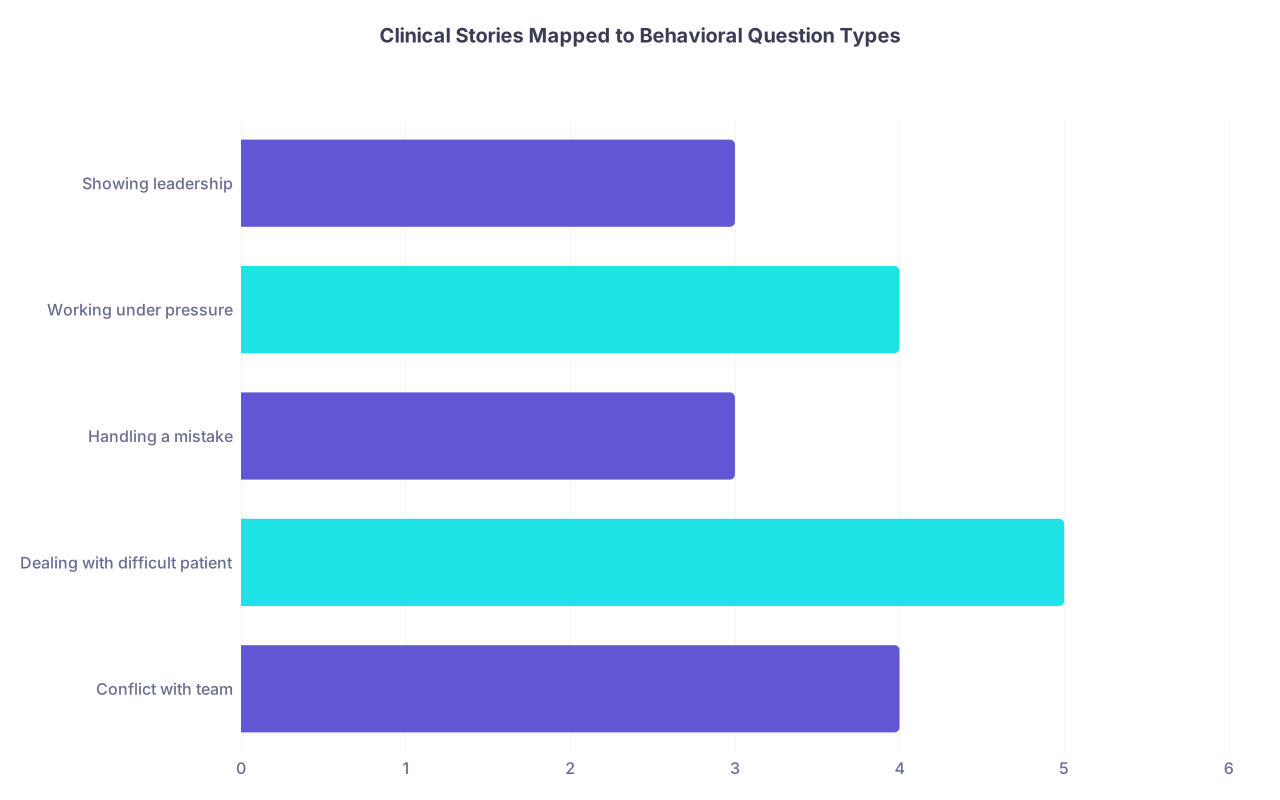
| Category | Value |
|---|---|
| Conflict with team | 4 |
| Dealing with difficult patient | 5 |
| Handling a mistake | 3 |
| Working under pressure | 4 |
| Showing leadership | 3 |
(Values here simply indicate relative number of clinical scenarios most students can find for each type.)
Conflict with a teammate or other staff
- Example scenario:
Nurse pages you frustrated that orders were not placed; your senior had delayed decisions. - Angle:
Owning communication gaps, clarifying expectations, following up, maintaining respect.
Difficult patient or family
- Example scenario:
Patient repeatedly leaving AMA for substance use; you build rapport over several visits. - Angle:
Nonjudgmental approach, motivational interviewing elements, consistency.
Handling a mistake or near-miss
- Example scenario:
You almost ordered a contraindicated medication but caught it, or realized a missed lab follow-up. - Angle:
Owning error, immediate corrective action, disclosure to team, system-level change.
Working under pressure
- Example scenario:
Several sick patients overnight; you triage pages, call for help appropriately, keep yourself organized. - Angle:
Prioritization, calm communication, knowing limits.
Showing leadership or initiative
- Example scenario:
You noticed discharge delays due to confusing instructions and created a simple template or checklist. - Angle:
Identifying a pattern, proposing a solution, implementing with team buy-in.
Each of these can be fleshed out into STAR-R in 2–3 minutes. That is your interview sweet spot.
10. A Simple Workflow You Can Use Right Now
Tie this together into a repeatable process.

| Step | Description |
|---|---|
| Step 1 | Recall clinical encounter |
| Step 2 | Choose primary competency |
| Step 3 | Strip unnecessary clinical details |
| Step 4 | Outline STAR-R structure |
| Step 5 | Emphasize Actions & Reflection |
| Step 6 | Add to story bank |
| Step 7 | Practice out loud & refine |
You can literally run one clinical memory through these steps in 20–30 minutes. Do that once a day for a week, you will have a better story bank than most applicants bring to interview day.