
Structured Prep: Weekly Plan to Master Behavioral Interview Questions
Most applicants “prepare” for behavioral interviews by skimming a question list and winging it. That is why they sound generic, rambling, and forgettable. You are going to do the opposite.
You will treat behavioral interviews like a clinical skill: break it down, drill it, get feedback, refine. In one week, with a structured plan, you can move from messy, story-dumping answers to sharp, residency-ready responses that program directors actually remember.
This is the system I wish more applicants used.
Step 0: Know the Game You Are Playing
Before the weekly plan, you need to understand what behavioral questions are really testing. Because if you misunderstand the goal, you will practice the wrong thing.
Behavioral questions sound like:
- “Tell me about a time you had a conflict with a team member.”
- “Describe a situation where you made a mistake.”
- “Give me an example of a time you had to advocate for a patient.”
They are not asking:
- For your entire life story.
- For the most dramatic story you have.
- For a perfect outcome.
They are testing:
- Self-awareness – Do you recognize your own role in events? Or do you blame everyone else?
- Clinical maturity – Do you think like a future resident or like a student who just wants to be praised?
- Communication – Can you tell a focused, organized story in 60–90 seconds?
- Pattern of behavior – Across multiple stories, are you consistently reliable, teachable, ethical, and team-oriented?
So your job this week is not to memorize scripts. Your job is to build:
- A story bank of strong, versatile experiences.
- A structure (STAR or close variant) that keeps you concise.
- A practice system so answers sound natural, not robotic.
You can accomplish the core of this in 7 days if you are disciplined.
The Framework: STAR, But Smarter
Yes, you have heard of STAR. Most people use it badly. They spend 80% of the time on context and 10% on insight. Backwards.
Here is the version that works for residency interviews:
S – Situation (1–2 sentences)
T – Task (your responsibility, 1 sentence)
A – Actions (what you did, 3–5 crisp steps)
R – Result + Reflection (outcome + what you learned, 2–3 sentences)
The most important piece is the Reflection. This is where you sound like a resident instead of a pre-med.
Example “mistake” question done badly:
“On one of my internal medicine rotations, I was covering a busy service and had to write multiple notes. I was tired and accidentally copied over an old medication list without reconciling it. Fortunately the attending caught it and corrected it…”
You can feel it drifting. Unfocused. Generic.
Fixed version (STAR, tight):
- S: “During my medicine sub-I, I was covering a 12-patient list and doing admission H&Ps in the afternoon.”
- T: “I was responsible for updating all medication reconciliations before sign-out.”
- A: “Toward the end of the day, I rushed through one chart and copied an old med list without confirming with the patient. My senior caught the discrepancy during sign-out. I immediately went back to the bedside, re-verified the meds with the patient and pharmacy, corrected the chart, and flagged it for the attending. That night I created a simple checklist I started using before signing any med rec.”
- R + Reflection: “The patient was not harmed because the error was caught early, but I was embarrassed. I realized my system was the problem, not just my attention. Since then, I have used that checklist on every rotation, and I double-check high-risk meds with pharmacy when in doubt. I am much more deliberate about slowing down for safety tasks, even on busy days.”
That answer shows ownership, specific behavior change, and a resident mindset. This is the bar you are aiming for.
Day-by-Day Plan: One Week to Competence
You want structure. Here it is. If you are starting from scratch, expect to spend 60–90 minutes per day. If you already have some prep, you can compress it.
| Day | Focus | Time (min) |
|---|---|---|
| 1 | Story inventory + core themes | 60–90 |
| 2 | Build answers for core questions | 60–90 |
| 3 | Conflict, feedback, and failures | 60–90 |
| 4 | Teamwork, leadership, and ethics | 60–90 |
| 5 | Timing, polish, and variation | 60–90 |
| 6 | Mock interview (full session) | 60–90 |
| 7 | Refinement, gap-fill, and backup stories | 60–90 |
You can move days around if needed, but do not skip any category. Programs will absolutely ask about conflict, mistakes, and ethical tension.
Day 1: Build Your Story Bank
Today is about raw material. No polishing, no worrying about wording.
1. List High-Yield Experiences
Open a blank document. Set a 20-minute timer. Write bullet points for:
- 5–7 challenging patient encounters
- 3–5 times you had a conflict or disagreement (with a peer, resident, attending, nurse, or patient/family)
- 3–5 mistakes or near-misses (clinical or professional)
- 3–5 leadership or initiative examples (starting something, fixing a problem, improving a process)
- 3–5 times you received critical feedback and changed
- 2–3 ethical or professionalism gray zones (confidentiality, boundaries, unsafe practice, bias, etc.)
Do not write full stories. Just bullet reminders:
- “M3 IM: disagreement with senior about escalation for hypotensive sepsis patient”
- “Surgery clerkship: scrub tech snapped at me; followed up after”
- “Free clinic: undocumented patient afraid to seek follow-up care”
You should end with 20–30 rough bullets. If you cannot find that many, you are filtering too hard. “Small” stories are fine; it is your reflection that matters.
2. Tag Each Story by Theme
Next to each bullet, tag what it could answer:
- conflict
- mistake
- leadership
- teamwork
- feedback
- time pressure
- ethical issue
- communication challenge
- resilience / stress
- handling ambiguity
Many stories will have multiple tags. That is good. Versatile stories are gold.
Day 2: Core Questions – Build Your First 5 Answers
Today you will pick your best stories and turn them into real answers.
1. Choose 5 Core Questions
Start with these. They show up in almost every residency interview in some form.
- Tell me about a time you had a conflict with a team member.
- Tell me about a time you made a mistake in clinical care or judgment.
- Tell me about a time you went above and beyond for a patient.
- Tell me about a time you received critical feedback.
- Tell me about a time you had to work with a difficult patient or family.
Match your best tagged stories to these five questions. One story per question for now.
2. Draft Using Tight STAR
For each story, write:
- 1–2 sentences for Situation
- 1 sentence for Task
- 3–5 bullet points under Actions (concrete things you did)
- 2–3 sentences for Result + Reflection
Keep the draft under ~200–250 words. If it is longer, you will ramble when you speak.
Example skeleton:
- S: “During my M3 pediatrics rotation at a county hospital, I was caring for a 6-year-old with poorly controlled asthma who was frequently admitted.”
- T: “As the student on the team, I was responsible for daily family updates and discharge teaching.”
- A:
- “Realized the mother looked confused during the discharge teaching.”
- “Paused and asked her to explain in her own words how she would use the inhalers at home.”
- “Discovered she was mixing up the rescue and controller inhalers.”
- “Asked the nurse educator to join me; we used an inhaler demo kit and color-coded labels.”
- “Documented the teaching and flagged concerns for our attending and social work.”
- R + Reflection: “She was able to correctly demonstrate the regimen before discharge and voiced more confidence. That experience taught me not to assume understanding just because someone is nodding. I now routinely use teach-back and ask patients to show me how they will use meds or devices, especially when there are multiple steps or language barriers.”
3. Read Answers Out Loud Once
Do not try to memorize. Just read them out loud once to feel the flow. Notice which parts feel clunky or too long. Mark those for trimming later.
Today’s output: 5 structured, written answers that are under 2 minutes when read out loud.
Day 3: Conflict, Feedback, and Failure – The Landmines
This is where many applicants blow it. They either:
- Pick a story where nothing actually went wrong.
- Or they confess something serious without showing growth or insight.
You are going to handle these like an adult.
1. Conflict Questions
Expect variations of:
- “Tell me about a time you had a conflict with an attending / resident / nurse.”
- “Tell me about a time you disagreed with a supervisor’s plan.”
Rules:
- Do not trash talk. Ever.
- No “I was right, they were wrong, end of story.”
- Show how you approached the disagreement and how you preserved the relationship.
Structure your conflict story like this:
- Brief context.
- What the disagreement was actually about (clinical vs communication vs process).
- How you expressed concern (specific, respectful behavior).
- How you sought help or compromise.
- What happened and what you learned about interprofessional dynamics.
If your story makes the other person sound like a cartoon villain, you chose the wrong story or you are telling it badly.
2. Failure and Mistake Questions
You already drafted one mistake answer on Day 2. Today, add one more:
- A non-patient-harm failure (exam, project, deadline, leadership task).
- A clinical or near-clinical failure (missed follow-up, documentation, miscommunication, etc.).
Key points:
- Own your part. No vague “communication errors were made.”
- Show what system you changed afterward.
- Show how that change has stuck over time.
Do not pick:
- A catastrophic event with no clear resolution or learning.
- Something that raises red flags about your integrity or patient safety without clear remediation.
3. Feedback Questions
You need at least one sharp story answering:
- “Tell me about a time you received difficult feedback.”
Use the same STAR, but emphasize:
- Exact wording of the feedback (paraphrased is fine).
- Your immediate reaction (honest, not melodramatic).
- The concrete steps you took afterward.
- How your evaluations or outcomes changed afterward.
Keep all three of these answers under 90 seconds. Conflict, mistakes, and feedback answers drag if you are not strict.
Day 4: Teamwork, Leadership, Ethics
Today you cover what programs care about for 3 a.m. on call.
1. Teamwork and Leadership
Questions to prepare for:
- “Tell me about a time you led a team.”
- “Tell me about a time you had to work in a team under pressure.”
- “Tell me about a time you stepped up and took initiative.”
You do not need some grand title. A good example:
- Stepping up when a code blue was called and no one was clearly directing roles.
- Coordinating a QI project on handoff errors in your clerkship.
- Organizing coverage when a co-student was sick and your service was short-staffed.
Show:
- How you assessed the situation.
- How you communicated.
- How you divided tasks or supported others.
- The tangible outcome.
2. Ethics / Professionalism
Programs watch your ethics stories very carefully. Expect:
- “Tell me about an ethical dilemma you encountered in clinical care.”
- “Tell me about a time you saw unprofessional behavior and what you did.”
You want an example where:
- There was genuine tension (autonomy vs beneficence, safety vs privacy, etc.).
- You did not have total power, so you had to use judgment inside a hierarchy.
- You sought supervision or used institutional resources appropriately.
Be explicit about:
- Who you spoke with (resident, attending, ethics consult, program leadership).
- How you balanced respect for authority with patient safety and integrity.
- How this shaped your approach since.
If all your ethical stories end with “so I did nothing and just felt bad about it,” that is a problem. You want at least one story where you took some kind of concrete, appropriate step.
Day 5: Timing, Variation, and “Any Other Example?”
By Day 5, you will have 8–10 structured stories. Now you are going to test them under time and stress.
1. Time Your Answers
Use your phone timer and record yourself (voice or video). Run through 6–8 questions:
- Conflict
- Mistake
- Difficult patient/family
- Leadership
- Feedback
- Ethical dilemma
- “Above and beyond”
- “Proudest clinical moment”
Target times:
- Most answers: 60–90 seconds
- Max for complex ethical stories: 2 minutes
If you are routinely at 3+ minutes, cut:
- Extra background.
- Irrelevant details.
- Repetition of the same point.
Focus your trimming on Situation and Task. Protect Actions and Reflection.
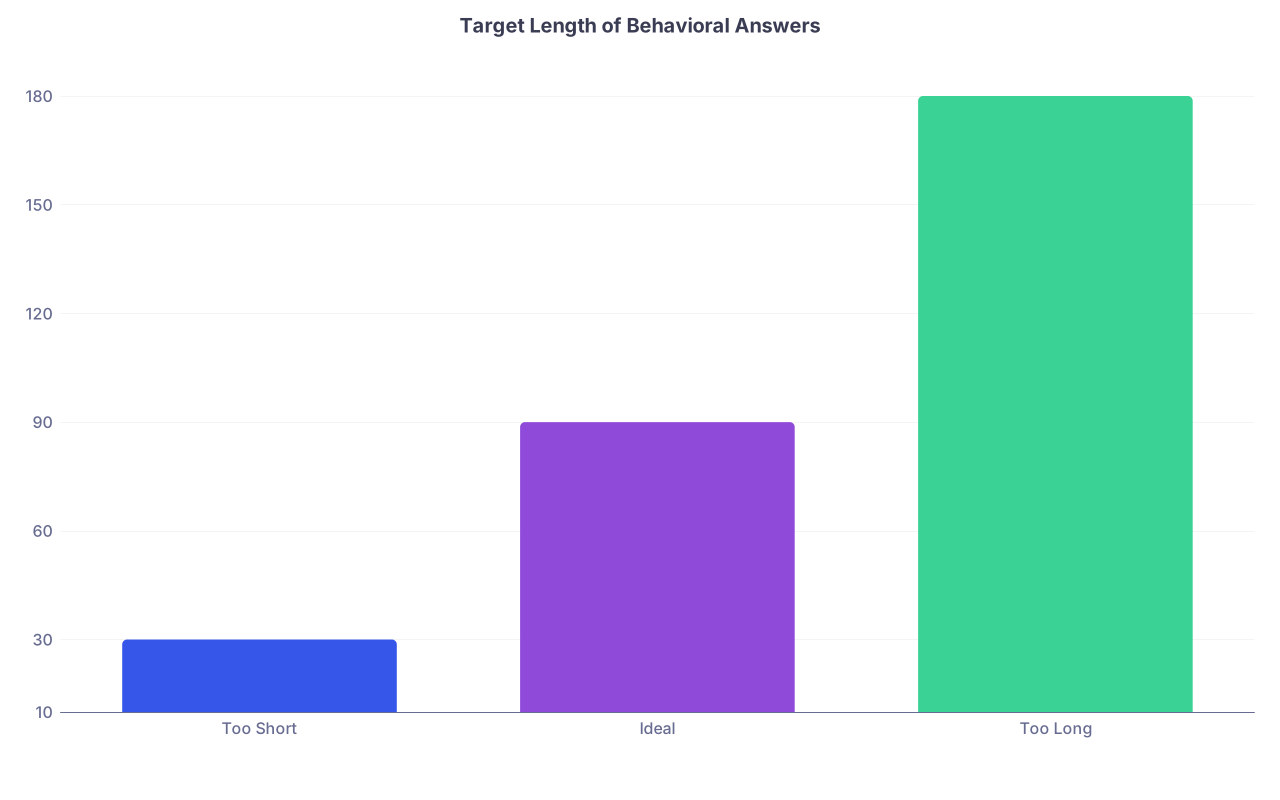
| Category | Value |
|---|---|
| Too Short | 30 |
| Ideal | 90 |
| Too Long | 180 |
(Interpretation: sub-30 seconds often feels shallow; ~90 seconds is ideal; 180+ seconds is painful.)
2. Build Variations on Common Themes
Interviewers love to say:
- “Can you give me another example?”
- “What is a different time you handled conflict?”
If you only have one conflict story, you are exposed.
Take your top 3 themes (conflict, mistake, leadership) and identify at least one secondary story for each. You do not need a full script. Just outline:
- Context (1 line).
- Key action.
- Key learning.
That way, when asked for a second example, you are not recycling the same story.
3. Check for Redundancy
If 6 of your stories all come from the same rotation or the same role, spread them out. Ideally your examples will touch:
- At least 2–3 different rotations or settings.
- Both inpatient and outpatient if possible.
- At least one non-clinical context (research, volunteering, leadership) to show dimension.
Day 6: Full Mock Interview – No Notes
Today you simulate the real thing.
1. Set It Up Properly
Minimum viable setup:
- Friend, partner, or co-student acts as interviewer.
- 45–60 minutes on Zoom or in person.
- Business-casual attire. Upright posture. Camera at eye level.
Give them a list of 10–12 behavioral questions. Tell them to:
- Ask in random order.
- Follow up once on any answer they found vague.
- Give you blunt feedback at the end.
If you truly have no one, record yourself with a list of questions, but do not look at your notes between questions. It is obviously not as good, but better than nothing.
2. Use a Simple Feedback Rubric
Have your mock interviewer score each answer:
- 1–5 for clarity (did the story make sense?)
- 1–5 for concision (did you ramble or hit time?)
- 1–5 for impact (did it show maturity, ownership, growth?)
Have them explicitly tell you:
- “This story was confusing / too long / too vague.”
- “Here is where you lost me.”
Write down their comments immediately after. Do not trust your memory.
3. Identify Your Top 3 Issues
From the mock:
- Are you talking too fast?
- Are your transitions (“So… um… yeah”) distracting?
- Are you stacking too many details and losing the main thread?
- Are you underplaying your own role and sounding passive?
Pick the top three and make a quick fix plan:
- If too long → commit to 1 sentence max for Situation for every answer.
- If vague → add more specific behaviors and fewer abstract adjectives.
- If passive → explicitly describe what you decided, initiated, or changed.
Day 7: Patch the Holes and Lock It In
Today is about tightening, not overhauling.
1. Add 2–3 Backup Stories
Look at your story bank:
- Do you have at least 2 conflict examples?
- 2 mistake/failure examples?
- 2 leadership/initiative examples?
- 1–2 ethical/professionalism examples?
If not, quickly outline backup stories. Again: no full scripts needed, just STAR bullets.
2. Write “Anchor Phrases” Not Scripts
To avoid sounding robotic, ditch full memorization. Instead, for each story, write 3–4 “anchor phrases” you want to hit. Example:
Conflict with resident:
- “IM sub-I, disagreement about early escalation for septic patient.”
- “Privately expressed concern; used specific vitals and trend.”
- “Suggested we call attending together.”
- “Outcome: earlier transfer to step-down; reflection on advocacy vs hierarchy.”
You remember these anchors; the sentences around them stay natural.
3. One More Short Rehearsal
Take 20–30 minutes:
- Randomly choose 5–6 behavioral questions.
- Answer them out loud, standing or sitting at a desk, no notes visible.
- Stop if you start to overanalyze. Better to be slightly imperfect and authentic than stiff.
How to Keep Sharp Until Interview Day
You do not want to cram the night before interviews. You want a maintenance plan.
Weekly “Behavioral Drill” (15–20 Minutes)
Once or twice a week:
- Pick 3 behavioral questions at random.
- Answer them out loud.
- Record and listen once.
- Note one tweak per answer (shorter intro, clearer result, stronger reflection).
That is it. Light touch, consistent.
Before Each Interview Day (10 Minutes)
- Skim your anchor phrases.
- Remind yourself which stories you have not used much yet (so you do not repeat the same example four times in one day).
- Do 2 warm-up questions out loud to get your mouth and brain synced.
Common Mistakes You Are Going to Avoid
You have a plan now. Do not sabotage it with these classics:
Using “fake” conflicts
“We all got along great… the conflict was just that we were all such high achievers.” No. Pick something real.Over-sharing sensitive details
You do not need full identifiers, graphic details, or deeply personal trauma to make a point. Protect patients and yourself.Making yourself the hero with no flaws
If every story ends with you perfectly saving the day while everyone else flounders, you sound delusional.Blaming and shaming
Programs read unprofessionalism between the lines. “The nurse” or “the resident” as your villain in every story is a bad look.Rambling because you never practiced with a timer
The solution is simple: record, time, cut. If you skip this, you will pay for it in real time during interviews.
Quick Recap
Three things to keep in your head as you walk away:
- Structure beats talent. Using a tight STAR format with strong reflection will immediately put you ahead of 80 percent of applicants.
- You need a story bank, not a script. Build 10–15 versatile experiences you can flex into different questions, anchored by key phrases, not memorized paragraphs.
- One disciplined week is enough to transform your behavioral answers. If you follow the daily plan, use a timer, and do at least one real mock, you will sound like a prepared, self-aware future resident instead of a rambling student guessing in the moment.