
You can absolutely bomb a behavioral question and still match. The difference is whether you know how to rescue it in real time.
I have watched stellar applicants unravel because of one bad story. I have also seen people fumble, regroup, and walk out with strong evaluations because they knew how to repair the damage on the spot. Programs are not looking for perfection. They are looking for how you think under stress and how you self-correct.
This is your playbook for those awful moments when your brain freezes, your story derails, or you realize halfway through your answer that you sound arrogant, evasive, or just plain confusing.
Step 1: Diagnose the Type of “Mess-Up” – Fast
Before you can fix an answer, you need to know what went wrong. In residency interviews, most behavioral misfires fall into a few predictable buckets.

Common failure modes
The Ramble
- You started answering.
- You kept talking.
- You wandered through three different rotations and five tangents.
- You never clearly hit situation–task–action–result.
- Interviewers are politely nodding but clearly lost.
The Vague Non-Answer
- Question: “Tell me about a time you received critical feedback.”
- Your answer: “I always welcome feedback… I believe in lifelong learning…”
- You gave philosophy, not a story.
- Zero specifics. Nothing to evaluate.
The Bad Story Choice
- You pick something:
- Too minor (“One time the nurse was late with meds…”)
- Too incriminating (“I yelled at a nurse in front of the team…” and you do not show real growth)
- Too old (high school, college dorm drama)
- Not actually answering what they asked (conflict question answered with “I worked extra hard.”)
- You pick something:
The “I Look Like the Problem” Answer
- You sound:
- Defensive
- Blame-heavy (“The attending was just unreasonable”)
- Entitled (“I knew more than the resident”)
- Or you share poor judgment with no real insight or change.
- You sound:
The Emotional Hijack / Brain Freeze
- You blank.
- You start, then lose your train of thought.
- You get flustered, talk in circles, or contradict yourself.
- You panic and try to fill silence instead of thinking.
Your first task, in real time, is to silently tag what just happened:
- “I am rambling.”
- “This is too vague.”
- “I chose the wrong story.”
- “I sound defensive.”
- “I just lost the thread.”
That awareness is not optional. It is how you decide which rescue tool to use.
Step 2: Use the 10-Second Reset – Without Apologizing to Death
You feel it going sideways. Most applicants either double down (talk more) or crumble (“Sorry, I am so nervous”). Both are bad.
Instead, you use a controlled reset. Short. Clean. Purposeful.
The 10-second reset script
Pick one of these depending on the situation:
For rambling or losing the thread:
- “Let me pause and give you a clearer, more concise version.”
- “I realize I jumped around a bit. I will walk through that example more systematically.”
For vague / philosophical answers:
- “That was more my general approach. Let me give you a concrete example that shows this in action.”
For wrong story choice:
- “Actually, I have a better example that reflects this more directly. May I share that one instead?”
For sounding defensive / problematic:
- “I want to highlight something I did not emphasize clearly there, because it is important to how I approach situations like this now.”
Then stop. Breathe once. Mentally restart.
You are not groveling. You are modeling self-monitoring and adjustment. That reads as maturity, not weakness.
Step 3: Snap Back to Structure – STAR Rescue in 4 Moves
Most behavioral disasters are unstructured. You can salvage almost anything by quickly snapping back to a simple frame.
STAR (Situation – Task – Action – Result) still works in residency interviews, but you need a tighter, more disciplined version.

| Step | Description |
|---|---|
| Step 1 | Realize Answer is Failing |
| Step 2 | 10-Second Reset |
| Step 3 | Restate Question in Your Head |
| Step 4 | S: 1-2 Sentence Situation |
| Step 5 | T: Your Specific Role/Task |
| Step 6 | A: 2-3 Key Actions You Took |
| Step 7 | R: Concrete Result + What You Learned |
| Step 8 | Stop Talking |
The compressed STAR rescue method
When you reset, follow this spine:
Situation – 1–2 sentences max
- Where were you?
- Who was involved?
- What was the core issue?
Example:
- “On my medicine sub-I, we had a patient with decompensated heart failure whose family was very distrustful of the team.”
Task – your specific responsibility
- Do not say “We had to…” unless you then clarify your piece.
Example:
- “As the acting intern, I was responsible for daily updates and helping the resident with goals-of-care conversations.”
Action – 2–3 concrete things you did
- Think verbs:
- “I coordinated…”
- “I initiated…”
- “I clarified…”
- “I escalated…”
- Think verbs:
Result – outcome + insight
- Clinical outcome (if relevant).
- Relationship/team outcome.
- What changed in your practice.
Example:
- “The family agreed to a care plan that aligned with the patient’s wishes, and since then I’ve used that structured approach to family meetings on subsequent rotations.”
You do not need a perfect story. You need a clear story. Fixing a messy answer is mostly about reimposing structure before you dig the hole deeper.
Step 4: Specific Rescue Techniques for Each Type of Mess
Now the practical part. Here is exactly how to repair each common failure mode mid-interview.

1. You are rambling
Symptoms:
- Long wind-up.
- Too much background.
- Side stories.
- Interviewer loses eye contact, checks paper or computer.
Rescue protocol:
- Stop for half a second. Then say:
- “Let me summarize this more clearly.”
- Give a one-sentence Situation + Task:
- “On surgery, I was the MS3 responsible for pre-op teaching, and we had a patient who repeatedly refused to consent because of anxiety.”
- Then hit 3 bullet-style actions (spoken, not literally bullets):
- “So I did three things:
- First, I sat with her and asked what specifically worried her about surgery.
- Second, I brought in the anesthesiologist to explain the perioperative plan in plain language.
- Third, I clarified with the team that she needed more time before being taken to the OR.”
- “So I did three things:
- Finish with a tight Result + reflection:
- “She ultimately agreed to proceed, and it reinforced for me that patient refusal often reflects fear plus misunderstanding, not outright opposition.”
Then stop talking. If they want more, they will ask.
2. You gave a vague, generic answer
Symptoms:
- You talked about your values.
- You said “I always…” and “I believe…”
- No dates, no people, no actual events.
Rescue protocol:
- Acknowledge the gap:
- “That was more my general philosophy. Let me give a specific example.”
- Pick a recent, clinical, team-based example.
- Run compressed STAR:
- “On my ICU rotation last month…” etc.
- At the end, connect story back to philosophy in one line:
- “That case is a good example of how I try to handle conflict consistently: listen first, then align around the patient.”
You convert fluff into something evaluable. That is a win.
3. You chose a weak or inappropriate story
Symptoms:
- You realize mid-answer it is too trivial, too old, or makes you look bad in the wrong way.
- Some interviewers visibly disengage.
- Or you hear yourself and think, “This is not what I want them to remember.”
Rescue protocol:
You have two options: patch or replace.
Option A: Patch the story
Use this if the story is okay but a bit weak.
- Signal you are focusing it:
- “To give a more relevant clinical example…”
- Add a second, better mini-example right after:
- “Another, stronger example was during my medicine sub-I when…”
- Use very short STAR on the better example (30–40 seconds).
You are essentially saying: “Here is a more impressive data point,” without formally abandoning the first.
Option B: Replace the story outright
Use this if the story is clearly inappropriate, unprofessional, or off-target.
- Cut cleanly:
- “Actually, that example is less representative than one from my sub-internship that might be more helpful.”
- Start fresh: “On my sub-I on cardiology…”
- Deliver full STAR.
No need to apologize repeatedly. A single pivot shows judgment. Trying to force a bad story to work usually makes it worse.
4. You sound defensive, arrogant, or blame-heavy
This one is deadly if you do not catch it. Many applicants fail here on conflict and feedback questions.
Red flags in your own answer:
- You say “They were just…” about attendings, nurses, or peers.
- You emphasize how right you were.
- You minimize your own role: “I did nothing wrong.”
Rescue protocol:
- Insert ownership quickly:
- “Where I could have handled this better was…”
- “Looking back, my part in the problem was…”
- Name at least one concrete thing you would change:
- Communication timing
- Tone
- Involving the right people
- Clarifying expectations earlier
- Reframe others without attacking:
- Replace “The nurse was incompetent” with:
- “The nurse and I had different understandings of the priority of the task.”
- Replace “The nurse was incompetent” with:
- End with a specific practice change:
- “Since then, on wards I start the day by clarifying with the nurse what we each see as the top three priorities for that patient.”
Programs do not care that you had conflict. They care whether you learned to handle it like a physician, not a college student.
5. Your brain froze or you completely lost the thread
Yes, you can recover from this. I have seen applicants blank for 5–10 seconds, regroup, and still be ranked highly.
Rescue protocol:
- Buy a little time without looking evasive:
- “That is a good question. Let me think of a specific example rather than speaking in generalities.”
- Breathe. Literally inhale and exhale once.
- If you truly cannot find an example from med school, use:
- Early clinical experience (scribe, EMT, MA).
- Research team conflict.
- Once you pick an example, say the Situation out loud even if you are not fully ready:
- “On my OB/GYN clerkship, there was a day when…”
- Let STAR carry you. You do not need to pre-plan the whole story. Just answer the next part:
- What was I supposed to do? (Task)
- What did I actually do? (Action)
- What happened? (Result)
Silence plus composure beats frantic talking every time.
Step 5: Real-Time Course Correction During the Same Interview
Here is what strong candidates do after one bad behavioral answer: they use the rest of the interview to correct the narrative.
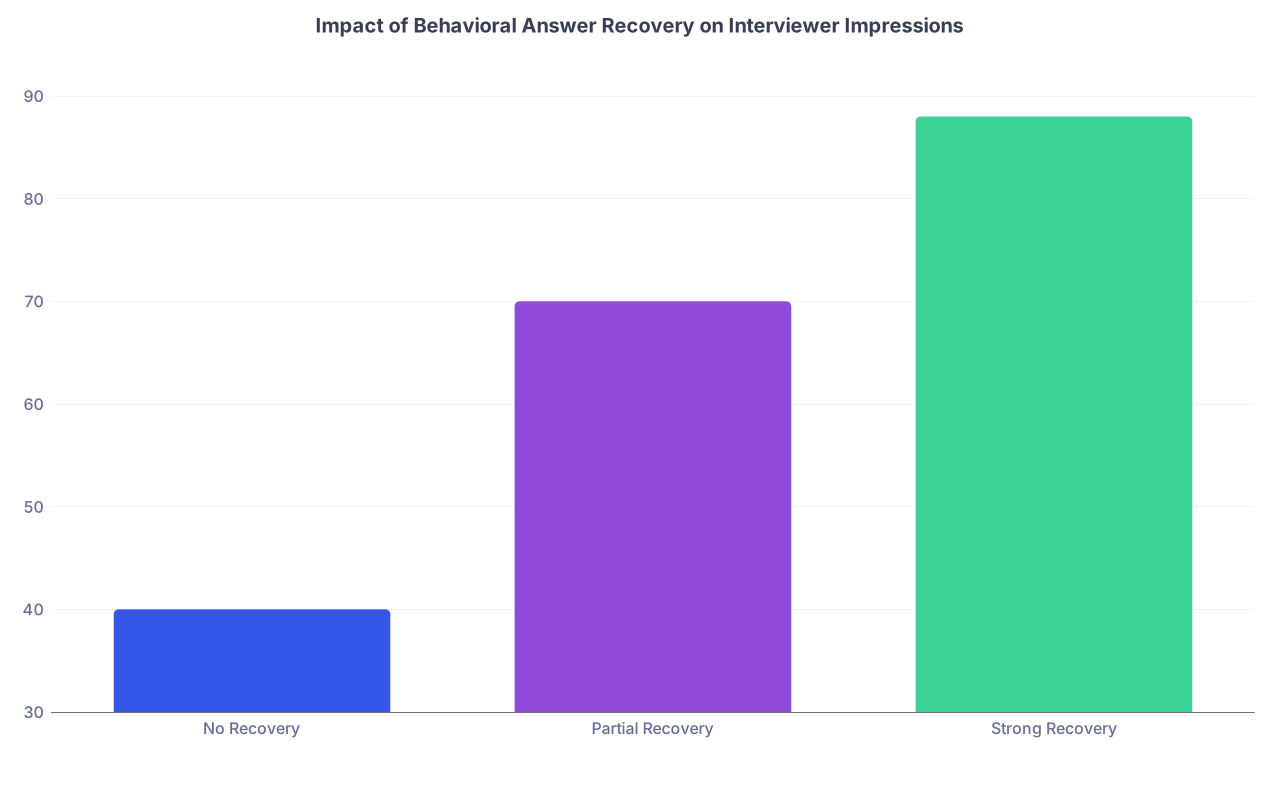
| Category | Value |
|---|---|
| No Recovery | 40 |
| Partial Recovery | 70 |
| Strong Recovery | 88 |
(Illustrative percentages: how often faculty describe a candidate as “resilient / self-aware” after each type of response, based on informal internal data and experience.)
1. Reuse the theme later in a stronger light
Let us say you fumbled a question about conflict with a nurse. Later, they ask:
- “Tell me about a strength that will help you intern year.”
You can subtly clean up your earlier impression:
- “One strength I have developed, especially through some early missteps in interprofessional communication, is the habit of explicitly aligning with nurses at the start of the day about priorities. I learned the hard way that assumptions on my side can create unnecessary friction.”
Now that earlier, mediocre answer becomes part of a growth trajectory.
2. Show pattern correction across examples
If your first answer made you seem:
- Disorganized → give a later answer that is extremely structured.
- Defensive → later emphasize how you sought feedback proactively.
- Passive → later describe where you took initiative.
Faculty rarely judge you on one single answer in isolation. They look for patterns. You can deliberately shape that.
Step 6: Post-Interview Damage Control (If Needed)
Sometimes the mess is not small. You shared something that sticks in your head all day. You walk out thinking: “I just tanked that.”
You may be overreacting. But there are a few legitimate follow-up moves.
1. Use the thank-you email strategically
If you clearly misrepresented something, or left out a critical piece, you can include a brief clarification.
Bad way:
- “I am so sorry I did terribly on the question about conflict. I was nervous…”
Better way:
- “During our conversation about conflict with team members, I realized after the interview that I did not fully convey how I incorporated that feedback into my later clinical practice. On subsequent rotations, I made a point to… [1–2 specific behaviors]. That experience significantly shaped how I communicate with nurses and residents now.”
Short. Specific. Focused on growth, not emotion.
2. Fix the pattern before the next interview
If you bomb one behavioral question once, that is nerves. If you bomb the same type in three interviews, that is a skills problem.
You need a 24–48 hour repair sprint:
- Identify the repeat offenders:
- Conflict with team
- Dealing with mistakes
- Handling feedback
- Time you failed / disappointed someone
- Write out one tight STAR story for each.
- Practice out loud, not in your head. Record yourself.
- Cut any story where you:
- Still sound defensive.
- Cannot name a specific behavior change.
- Need a 5-minute preamble.
Do this once, properly, and your need for “rescue” drops by 80 percent.
Step 7: A Quick Reference Rescue Card (Memorize This)
You are not taking a literal card into the interview, but you should have this sequence burned into your brain.
| Problem Type | Reset Phrase | Key Fix Move |
|---|---|---|
| Rambling | "Let me summarize this more clearly." | Compress to 1–2 sentence STAR intro |
| Too vague | "Let me give a specific example." | Add concrete, recent clinical story |
| Wrong story | "I have a more relevant example." | Replace or add stronger mini-example |
| Defensive tone | "Where I could have handled this better..." | Insert ownership + practice change |
| Brain freeze | "Let me think of a specific example." | Breathe, pick any solid case, use STAR |
If you can remember those five lines and the STAR skeleton, you can survive a lot of mess.
FAQs
1. If I mess up one behavioral question badly, is my interview basically over?
No. I have sat in ranking meetings where a candidate clearly stumbled on one behavioral question and still ended up near the top of the list. What mattered more:
- Did they recover with composure?
- Did their other answers show consistency, maturity, and insight?
- Did faculty feel they could trust this person at 2 a.m.?
One catastrophic answer that reveals major professionalism concerns can hurt you. But a clumsy or rambling story, if rescued reasonably, is rarely fatal.
2. Should I ever admit I was nervous or that I “messed up” the answer?
You do not need to label it as “messed up.” Acknowledge the adjustment, not your emotional state. Saying, “Let me give a clearer example,” is professional. Saying, “Sorry, I am so nervous, I am doing badly,” just makes the room awkward and shifts focus onto your anxiety instead of your actual capabilities.
If you truly freeze and need to normalize it a bit, something like, “Apologies, long day of interviews; let me take a second to think of the best example,” is acceptable. Then deliver.
3. Is it okay to use the same example for different behavioral questions?
Yes, if the case is rich and you emphasize different aspects. A complex ICU or ward scenario can illustrate:
- Conflict with a team member.
- Dealing with uncertainty.
- Handling a mistake.
- Communicating with family.
The key is to avoid sounding like you have only one story. Rotate at least 3–5 solid anchor cases. And when you reuse one, explicitly frame a different angle than before.
4. How honest should I be about my mistakes in behavioral questions?
Honest but curated. Programs want to see that you:
- Have actually made mistakes (because you are human).
- Can describe them without collapsing or over-defending.
- Extracted specific, actionable learning.
Avoid stories that:
- Involve major ethical violations, patient harm through gross negligence, or unprofessional behavior that is not clearly and credibly resolved.
- You still feel raw, angry, or ashamed about to the point that you cannot talk calmly.
Pick mistakes where you can convincingly show growth, not open wounds.
Open a blank document right now and write one concise STAR answer for: “Tell me about a conflict with a team member.” Then practice saying, out loud, “Let me give you a clearer example,” until it feels natural. That one line, plus one well-built story, will rescue you from most behavioral landmines this interview season.